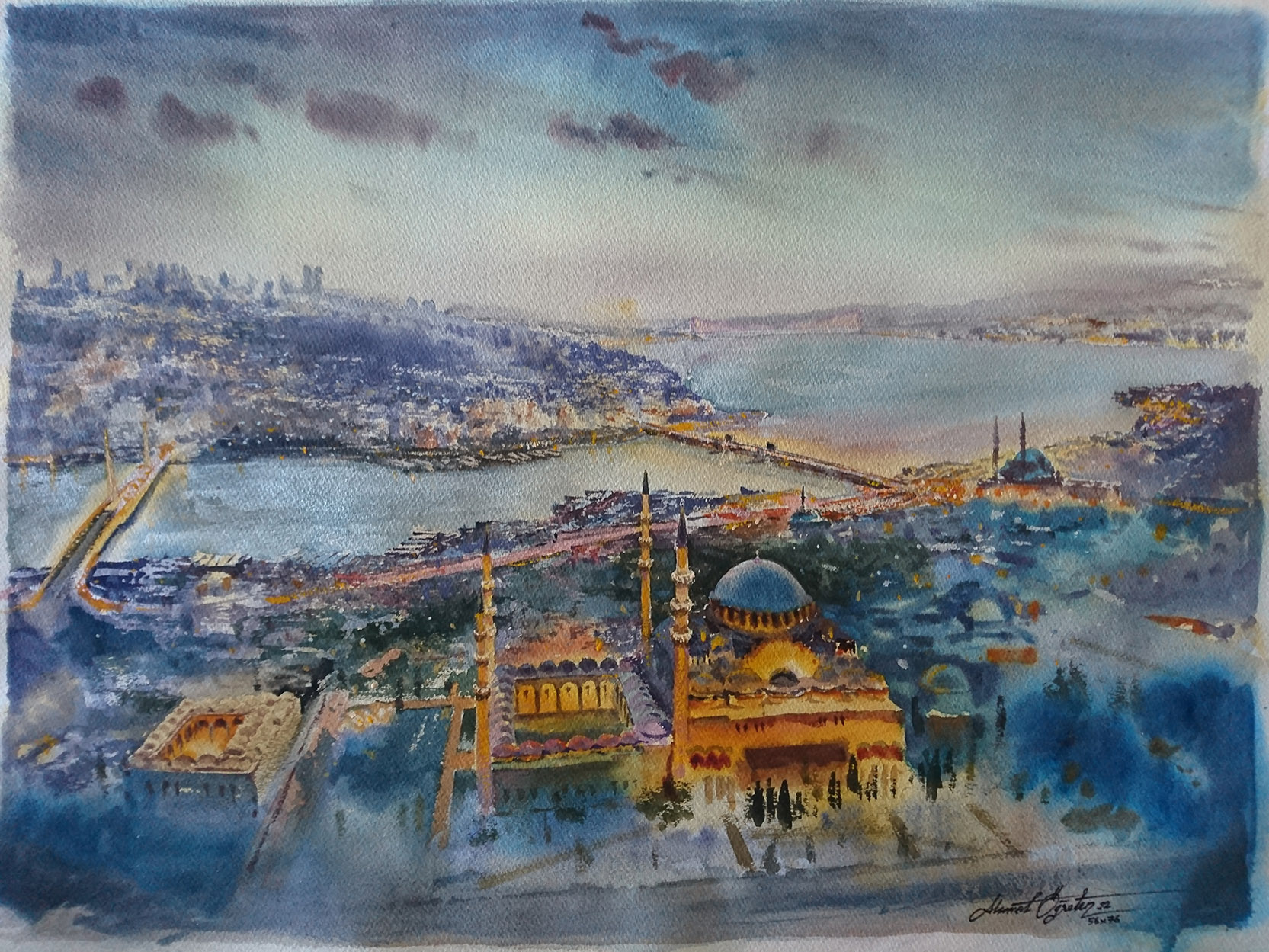
On a ferry crossing the Bosphorus, a history teacher quietly observes a disheveled stranger and begins to piece together his identity.
Not one of the eighty-something passengers on the 7:45 boat from Üsküdar to Beşiktaş can guess the profession of the gentleman in the black suit, white shirt, and black tie. Apart from me, that is. In Ottoman times, Orthodox monks and bishops wore robes and high hats — not always black but some serious color. They had beards and tied their long hair in a bun at the nape of the neck. Married priests didn’t wear robes outside church grounds back then, which was a good thing: when you don’t stand out, people don’t kiss your hand, but they also don’t spit on you. In 1934, the same year that women were given full civil rights in Turkey, religious dress was banned for all. Priests, imams, rabbis, monks, and dervishes trimmed their beards; those who wore their long hair in buns or plaits made a visit to the barber. The new dress code upset a few clerics, but most were secretly pleased to have gained the right to go about the City, renamed Istanbul, like normal men in suits. Black became the clerical standard, as if a priest must be constantly ready for bereavement, sorrow, or heat exhaustion. Even on the sultriest summer days, like today, they don’t take off their jackets.
The man in question is the only one on the boat wearing a suit jacket. He doesn’t have lips; old age has sucked them inside. Not only his mouth but also his eyebrows are sinking at the corners. He is not frowning. He has become a frown. His trousers are pulled up to his chest in grandfatherly fashion. He fidgets with something in his pocket. I’m sure he’s a priest despite the fact that, in one important aspect, he differs from his colleagues: the Orthodox priests of Istanbul are always clean. This is a strict professional requirement. Furthermore, all laypeople and clerics must shine their shoes before an audience with His All-Holiness (the Turkish bootblack who worked the Fener’s corner in the 1960s became so rich that he learned to wish “many years” to Patriarch Athenagoras in perfect Ecclesiastical Greek). Even today, no one dares enter the patriarchate without dressing to the nines, the men in suits and the women in tailleur or elegant dresses. One would think that His All-Holiness wanted his headquarters to be in constant readiness for a fashion competition with Buckingham Palace.
When you don’t stand out, people don’t kiss your hand, but they also don’t spit on you.
The man in the black suit on the upper deck of the 7:45 Üsküdar-Beşiktaş boat, however, is showing complete disdain for patriarchal protocol. His tie is loose and the top button of his shirt is undone. His shoes have been marked by the rain, and the soles are muddy. His lack of personal care should make me reconsider my hypothesis, but I have an intuition. For better or for worse, a little voice whispers to me when I see one of our own.
I take a tea from the steward’s tray and return the two sugar cubes provided on the saucer. The steward approaches the passenger in question, extending his tray indiscreetly in order to awaken appetites for his tea, orange juice, and toasted sandwiches. He carelessly trips on the feet of a “closed” woman — a headscarf-wearer, that is. His two remaining teas spill onto the man’s white shirt. The man stands up and vainly tries to shake off the tea. The steward apologizes. The woman makes disapproving tsouk sounds. She opens her handbag and gives the victim a packet of tissues. I offer him the wet wipes that I keep in my briefcase with the corrected essays of my students. I could say something to him in Greek, a simple oríste — there you go — but I prefer to remain incognito. The steward puts the empty tray on a bench, takes the wet wipes, and attempts to clean the man’s shirt and jacket. Not effectively. In any case, with so much mud on his shoes, I assume the man is not on his way to the patriarchate.
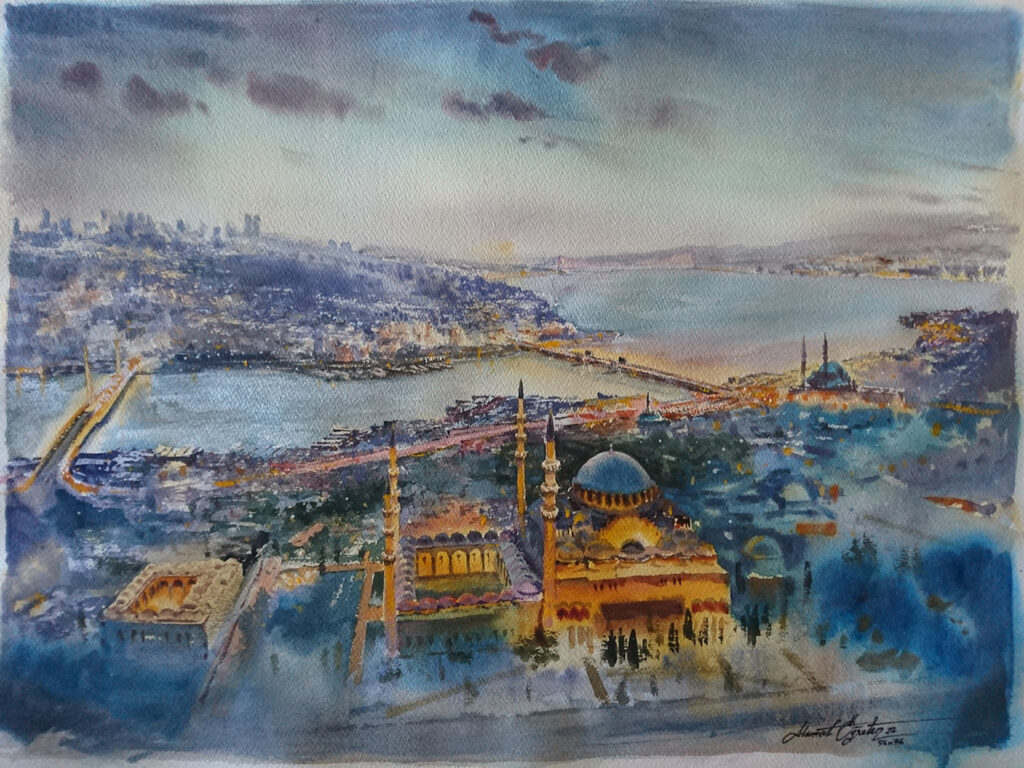
Summer sun floods the boat. The wind helps dry the man’s damp jacket. He sends the waiter away, sits down again, and opens his black briefcase. Its fine leather is dusty, as if it lay forgotten for years in a cupboard. It is packed so full that a pair of socks almost falls out. He grabs them just in time and stuffs them back inside. He takes out a pair of sunglasses, puts them on, and glances southward, toward the minarets of the Old City. Then he takes out a rumpled newspaper — yesterday’s Afternoon Tribune, Istanbul’s oldest Greek publication. He opens the paper and pretends to read, but he’s really just using it as a screen for silent, almost imperceptible weeping.
He folds up the newspaper, tosses it in the rubbish, wipes his tears, and looks in my direction. Has he recognized me? Perhaps he blessed me when I was a child. Until I was twelve, my mother used to drag me to Sunday liturgies against my will. Now, I turn my gaze to the red National Guard ship anchored between Beşiktaş and the first bridge. I’m fifty-three years old. Almost every day for the past nineteen years, I’ve been crossing from Üsküdar, where I live, to Beşiktaş, where I teach history. In other words, I keep company with the Bosphorus twice daily, yet I’ve never seen such a colossal ship anchored just off the quay of Çirağa Palace.
A professional beggarwoman approaches us. She is murmuring her lines: her brother has leukemia, no money, no work, she must care for him all day, she’d be pleased to show us his laminated hospital papers. I’ve heard it said that the characteristic melodies of Turkish peddlers may be the same as the melodies of Byzantine peddlers; I wonder if the same holds true for the songs of Istanbul’s beggars.
The man, lost in his own thoughts, stares at her. Then he comes to himself, raises the sleeve of his jacket, and removes — almost rips — a gold cufflink from his sleeve, as if it were burning him. He gives it to the woman. She takes it and tries to kiss his hand, not out of religious reverence, but as young people kiss the hands of the elderly in our country. The man casts his glance downward and puts his hand on his heart in polite refusal. I realize that he is not a priest but a bishop; only the latter wears gold cufflinks. I examine his face. I find his half-closed eyelids and sorrowful expression soothing.
He rises with ceremonial grace. He takes off his jacket, throws it over one shoulder, removes the other cufflink and puts it in his pocket, perhaps for the next beggar. He rolls up his sleeves, takes his briefcase, and limps toward the stairs. His left foot is either wounded or crippled. A bit of community gossip comes to mind: last week, a bishop named Adamantios fell on the steps of his mistress’s building in the trendy neighborhood of Cihangir. He twisted his ankle. The mistress, wearing only her bathrobe and howling that her man had wounded himself mortally, ran to the hospital across the street to beg for help. It goes without saying that the whole neighborhood heard her.
I try to remember the episcopal see of that bishop. In Istanbul, our bishops are more numerous than our parishioners, and our episcopal sees are symbolic jurisdictions of the vanished and ruined dioceses of Asia Minor. His was Cius. Ηis office is in the community of Saint Minas. My gossip-loving mother emphasized the last bit of information because she has a great affection for that second-class Cretan saint. No matter how many times I tell her that getting thick with a first-rate cavalier like George or Dimitrios would be more advantageous, she never listens.
The bishop, despite his difficulties, descends from the upper deck, supporting himself on both railings. I take his newspaper from the rubbish and open it. I don’t see a word regarding Adamantios of Cius. Everybody talks about such scandals; no one writes about them. On the second page, along with the ecclesiastical announcements for the Rum Orthodox parishes of Istanbul, I read the following: “HOLY CHURCH OF SAINT MINAS: it is brought to the attention of devout parishioners and liturgy-loving Christians that, on Sunday, August 21, at nine o’clock in the morning, the holy liturgy will be celebrated in our church.” If a bishop is to celebrate the liturgy, protocol stipulates that his presence must be mentioned in the announcement. I toss the newspaper back into the bin and descend to the lower deck.
Imagine: a hundred people want to kiss your hand, but you only want to kiss one and cannot — except in secret.
Bishop Adamantios is standing on the edge of the bow. He is gazing at the sea, which is littered with plastic bottles, bits of wood, and fast-food containers. The wind blows away his tears and scatters them onto the rubbish floating on the Bosphorus. I remember something else that my mother said: Bishop Adamantios is madly in love with his mistress. She’s been like a wife to him for over twenty years. Imagine: a hundred people want to kiss your hand, but you only want to kiss one and cannot — except in secret.
The boat rushes toward the quay. The tires serving as buoys squeak. Our captains don’t like to lose time with ropes. Instead, they open the throttle so the boat remains stuck to the quay. The dockworkers extend the gangway. The passengers begin debarking. Adamantios takes an old iron key from his pocket. As he passes from the boat onto land, he throws the key into the sea.
I follow him closely to Meclis-i Mebusan Avenue. He casts a last glance at the Bosphorus before he enters a taxi. Through the open window, I hear him tell the driver in Turkish to take him to the airport. Then he adds in Greek, speaking either to himself or to me: “I should have flown the coop long ago.”
Originally published in Greek in Κωνσταντινούπολη: Νόστος στον χώρο και τον χρόνο / Constantinople: Returning Home in Space and in Time (Ellinoekdotiki, 2024)