This collection from a contemporary Turkish poet was recently shortlisted for the Sarah Maguire Prize for Poetry in Translation.
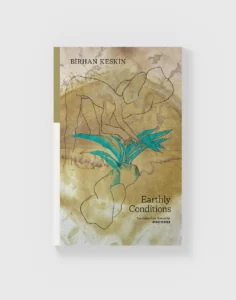
Earthly Conditions: Selected Poems, by Birhan Keskin, translated by Öykü Tekten
World Poetry Books October 2025
ISBN 9781954218369

Though Birhan Keskin (b. 1963) stands on her own, she is also part of a loosely affiliated group of poets that includes Lâle Müldür, Küçük İskender, Ahmet Güntan, Seyhan Erözçelik, Didem Madak, and Sami Baydar. Her work, as the poet-critic Murat Nemet-Nejat has suggested, crystallizes a kind of “Godless Sufism”: a secular spiritualism grounded in vulnerability, erotic candor, and a mystical acceptance of the self’s dissolution into the world. In contrast to İkinci Yeni’s oblique (often male) symbolics, this later generation cultivated a lyric shaped by intimacy and exposure, where questions of gender, queer desire, memory, and belonging emerge with directness yet retain an aura of metaphysical ache.
Keskin is perhaps the most transformative voice among them. Her poetry continually refashions identity—not only across gender but across species, matter, and element. Her speakers move beyond the merely human, inhabiting stones, oceans, birds, trees, and glacial expanses. This fluidity is not decorative; it registers a persistent attempt to escape, or at least blur, the confines of an identity formed through injury: an unwanted girl, a girl pretending to be a boy, a woman in menopause, a lover and the betrayed… Much of this perceptual ambiguity is enabled by Turkish itself: the third-person pronoun o, famously gender- and human-neutral, allows the self to slide across sexes and forms of life, echoing a thirteenth-century Anatolian mystical tradition in which love’s grammar refuses fixed subject positions.
As a young poet, I was particularly drawn to Birhan Keskin’s early collections, Delilirikler (Delirious Lyrics) and Cinayet Kışı + İki Mektup (Murder Winter + Two Letters). What struck me then was the unusual combination of emotional intensity and restraint: a dark lyricism marked by estrangement, vulnerability, and a refusal of easy confession. Unlike some of her later work, which occasionally gravitates toward a more overtly plaintive or sentimental register, these early poems possess a sharper emotional tension, oscillating between intimacy and distance, desire and self-withdrawal.
Keskin has also produced some of the most powerful poems in Turkish literature, past and present, written by a woman to another woman. Her poetry gives voice to female longing and intimacy with a tenderness and psychological insight that remain virtually unparalleled in Turkish letters. Without reducing them to questions of identity alone, these poems transform same-sex desire into a meditation on absence, recognition, and the unattainability of perfect union. Cinayet Kışı + İki Mektup is perhaps the most intricate expression of this vision: an epistolary sequence of dark, beautifully crafted letters structured around the conviction that love can never be fully realized in life and that only death grants lovers an eternal reunion. Running through the collection is an unmistakably Orphic current, a sympathy for thanatos, the inherent and often subconscious human drive toward self-destruction, decay, and dissolution, not as mere extinction but as the horizon where desire seeks permanence and where love, denied fulfillment in life, imagines its consummation beyond it. The result is a poetic voice at once youthful and remarkably mature, animated by a fresh, dark, and unforgettable emotional landscape.

The poems in Earthly Conditions enact this porousness with remarkable force. Consider the aching fragment:
for the sake of a fresh dream / i suffer from world-weariness […] here’s the world’s door, here’s the world’s grief / either stand in the shadow of its mountain / or dive into the joys of figs / ache, complete yourself (“Phoenix,” p. 17).
The oscillation between withdrawal and sensuous immersion, a mountain’s shadow as a place of concealment or the voluptuousness of figs opened to desire, figures the speaker’s continual self-remaking. She “refashions herself as a newborn,” as someone who has burned through prior embodiments and emerges with altered sexuality, altered desire, altered being. Yet this rebirth remains fraught: the fragile animal inside me was long since dead (“Seashell,” p. 19). Keskin writes as though seeking a dream beyond the ruins of interior life; the yearning is not simply for another person but for another consciousness with which to fuse, even if that consciousness is nonhuman, even if it is barely alive, perhaps barely awake.
This is one reason animals recur with such intensity. The poem “Penguin” offers one of her most crystalline self-figurations:
penguin
don’t turn your back on me
i know i’m like you
and the wind you hide inside
penguin
i too hide inside
icy shores, memories of screams
i too am a fugitive, wounded
as much as you
who will forgive me, penguin
i traced your white and fragile place
one side of me is a bright light
blinding, the other, a biting night
i too couldn’t get on the swing
in the park today
penguin, don’t turn your back on me
i didn’t forget the clumsy language we used
the world exhausted us. i too have things i couldn’t
say. things i might never say.
we traveled a long road together, as we do
i understand well enough we can’t
even walk on earth.
penguin, who will forgive me
i traced your white and fragile place
with the thin metal i’ve forgotten
“Penguin” can be read as a poem of estranged gender identity, in which the penguin becomes an imagined double, embodying a form of being the speaker desires yet cannot fully inhabit. The opening appeal—penguin / don’t turn your back on me / i know i’m like you / and the wind you hide inside—suggests an intimate recognition between the speaker and this elusive figure, while the confession i too hide inside / icy shores, memories of screams / i too am a fugitive, wounded / as much as you evokes a life lived in concealment, marked by the pain of inhabiting a body and social role that never entirely coincide with the self. The penguin thus emerges not merely as an animal image but as the projection of a masculine identification that remains inaccessible, a fragile and wounded counterpart from whom the speaker seeks recognition and forgiveness.

This reading gains additional force from the autobiographical afterword included in the volume, where Keskin recalls a childhood shaped by masculine roles and expectations, describing herself as a girl who dressed, behaved, and was often perceived as a boy. The poem’s language of hiding, fugitivity, and wounded resemblance suggests not only emotional estrangement but also a lifelong negotiation between the gendered self one inhabits and the one toward which one feels drawn.
Keskin does not anthropomorphize; rather, she animalizes herself, relinquishing the human as a stable category. The speaker becomes a creature of cold refuge and mute suffering, a fugitive from a world she cannot entirely abandon. And indeed, as the poems insist, there is no true departure: we are lost in you, where is our path? (“Desert,” p. 39). The “you” is the world, its earthliness at once sustaining and unbearable. This paradox culminates in one of her starkest declarations: the world, I saw it, completing itself with me (“Mountain,” p. 31). Here, the self is no longer a sovereign entity but a hinge within a larger, breathing totality, an aperture through which the earth briefly finds articulation in desire, even as the raw mood in you / are melting on a silver peak makes the very act of address nearly impossible.
Tekten’s translation handles these shifts from the mystical to the visceral, from the cosmic to the creaturely, with admirable sensitivity. Keskin’s Turkish is deceptively simple yet rhythmically intricate, animated by tonal registers that can turn abruptly from tenderness to grief, from minimalism to visionary amplitude of desire. Earthly Conditions renders these textures with disciplined, luminous restraint, allowing the poems’ tremors, abrasions, and devotional intensities to emerge without overstatement. It is a translation that listens, attuned to what remains unspoken as much as what is uttered. Keskin’s work, tracing the self’s dissolution and reconstitution across bodies, genders, elements, and species, finds in this volume a capacious and haunting English home: a space where the voice can indwell the other—human or nonhuman—whenever, as the poem “Snail” puts it, you wanted to put the memory in me to sleep.