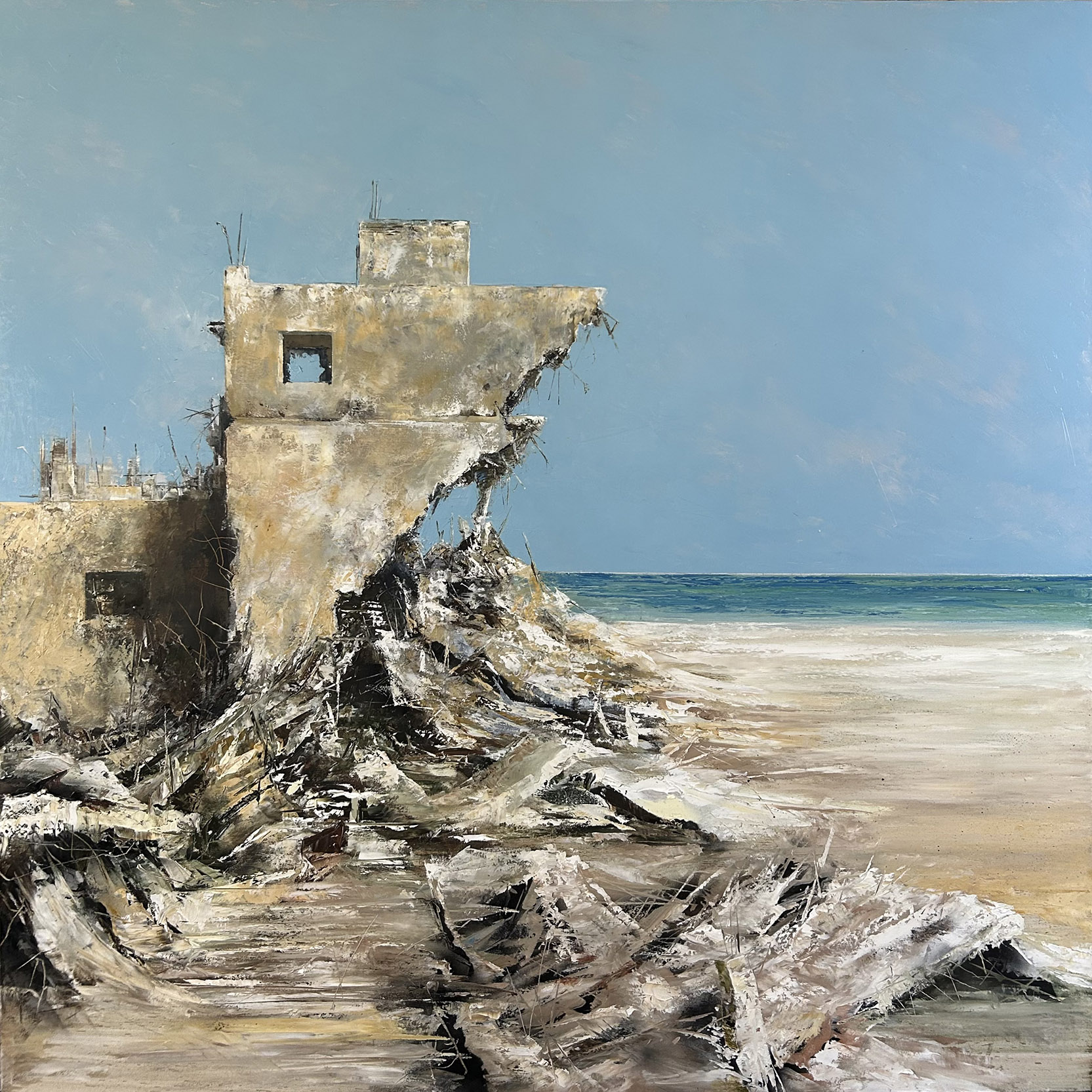
In this modern gothic story, a house on the island of Unguja becomes something far more terrifying than what it seems.
For the longest time, when I was feeling low, I’d remember as many details as I could about the house in Unguja. I concentrated until I could wander about in the rooms, as I indeed had when I was thirty and roaming freely across the world, wherever money or lack of it had me go. Sometimes, I traveled with people, but more often I was alone. Each time I found myself in a city where I didn’t know the language, customs, or passions of the inhabitants, I felt a great rush of freedom, a sensation that settling down stripped from me utterly.
Through a decade of living in London, I found I could tolerate my long and filthy underground journey to and from work by conjuring up every detail I could remember of the beautiful house, and perhaps a few that, in my yearning, I’d invented myself. I thought often about the two elegantly carved — though badly painted — dolphins high up on either side of the street door, and imagined restoring them to their original splendor.
I’d been shown around the property far too quickly on my first visit; no sooner had I gazed upon one thing — a vast window, the marble staircase, a Moorish architrave — than my friend Yaro hurried me onwards.
“I’m not supposed to be in the house when Uncle is away,” he told me as we entered the last room on the ground floor. We walked towards a set of beautiful French windows that opened onto a curved marble patio, from which shallow steps led to a long garden bordered all around by high walls of stone.
“I’ll take you down to the orange grove, Sarah, then we leave,” Yaro said.
The breeze was warm, brine-laden, and filled with perfume. I saw a carved wooden door with an arched top halfway along the stone walling. “Is that the beach door you were telling me about?”
“It is, but it can’t be opened now because sand has piled up behind it.”
“Surely the sand could be cleared?”
Yaro shrugged. “Of course, if anybody cared. We have to be quick now, that man can return suddenly. There’s another door similar to this one, in the orange grove. We’ll go there, then leave this place.”
This place… is heaven, I thought, and at that moment, a mule brayed loudly out on the street and punctured my dream-state, and so I followed Yaro swiftly into the orange grove past two old marble pillars.
When we came to the end door, I was struck by how unsettled my friend seemed. “Can we leave this way?” I asked, thinking it would lessen his anxiety.
“We must get out by the street door, so the old man in the bakery sees us and does not worry. This door should be removed and the hole filled in with big rocks, anyway.”
“That would be a real shame,” I murmured.
Back in the house, I took a last look at the great oval window at the top of the marble staircase through which the African light blazed like something alive. I did not want to leave. As Yaro raised his hand in greeting to the old man in the bakery, I examined the paint on the street door.
“How I’d love to strip that paint off and oil the wood properly,” I said.
“Perhaps you would, Sarah, but the house is not yours.”
“The house is not mine,” I repeated, hurrying after him.
That evening, we met at a quiet bar on the waterfront.
“Since you’re so enchanted by Uncle’s house, you might’ve noticed something particular about it,” Yaro stated, almost as soon as we were seated.
“Those two marble pillars in the garden were particular,” I offered.
“I must tell you,” Yaro leaned back and gazed at me. “Every building on the island is protected with hirizis except Uncle’s. Look upwards, Sarah.”
I did as he asked. Above us, a tatty-looking plug of paper tied with string hung from the ceiling of the bar. There were a great many of them.
“They have Quranic verses on them,” Yaro said. “The mashetani I told you about cannot tolerate that, unless they are very powerful.”
“Was it really the mashetani that made you edgy?” I asked. “I thought it was the idea of your uncle seeing us there.”
“It was him; he is a terrible man, he’s turned the house into a kufungua.” He looked at me uncertainly. “For those mashetani who still stalk Unguja.”
“A portal?”
He shook and nodded his head at the same time, then laughed. “Well, that’s what the old people say, anyway, those with no education.”
Yaro was one of those people I thought would be a passing cloud friend; but a long time after I’d settled in London, I still knew him, though only vaguely, so I was surprised when a letter came from Yaro saying his uncle had died and he’d inherited the house. He felt that he’d hurried me along on my first visit, and wrote that I could loiter in his uncle’s place for as long as I liked now. I felt my stomach tighten and thought about how much leave I had owing at work, and how soon I could get a flight. Yaro’s letter arrived on the first of the month, and I reached Unguja on the fourteenth.
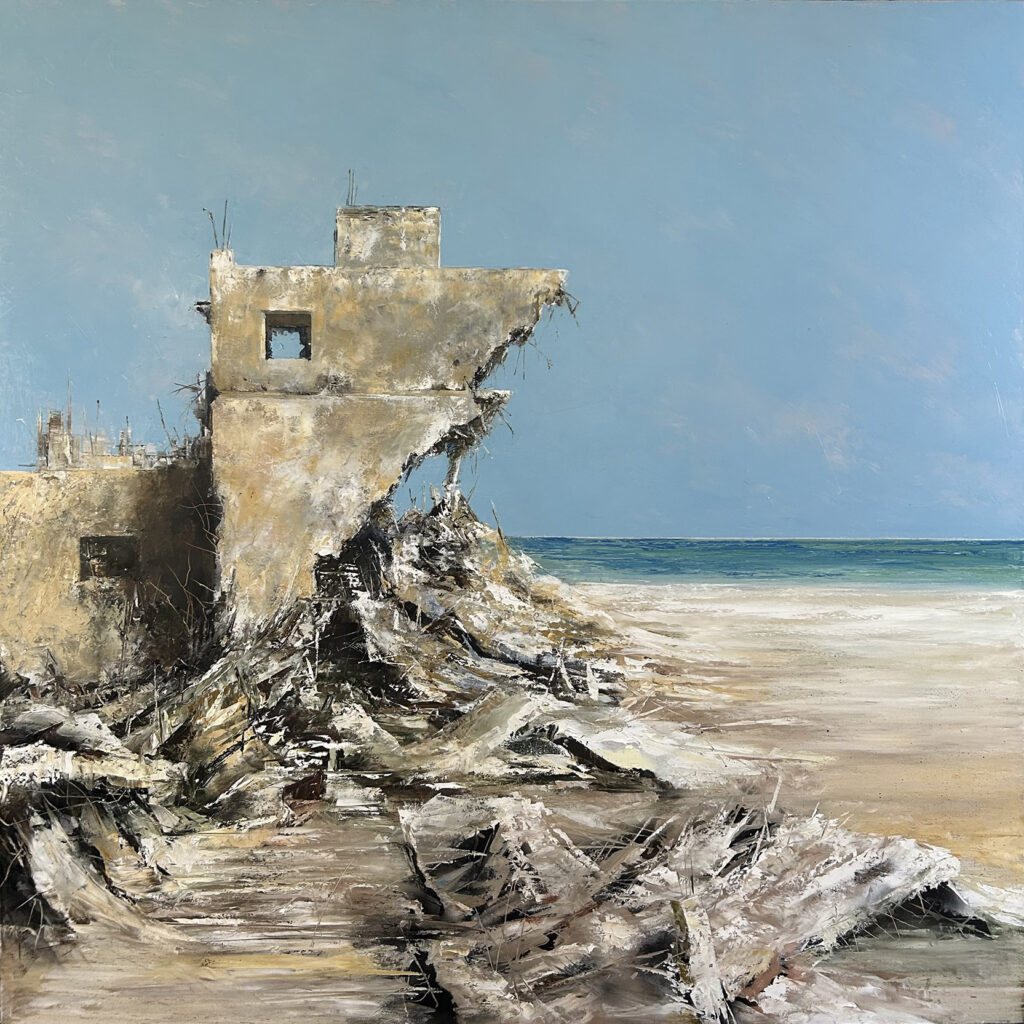
It had been close to a decade since I was last there, but everything about the house was as I recalled it. The street door was still blue and the dolphins faded pink. The hallway smelt like dust and incense, the cracks high up on the parchment-colored walls hadn’t changed. The beautiful light was still streaming down energetically through the oval window at the top of the stairs. I was in love with the place.
“You could get the floor tiles cleaned properly,” I said, scraping my shoe against the dingy black and white pattern that led towards the back of the house.
“I’m not going to live here, Sarah.”
“You could make decent money letting it out, help you pay for your university fees, eh?” Yaro had been accepted that year at Sumait University on the island, and his family members were very proud of him.
He stayed at the door, his hands crossed over his chest, his fists clenched. “You can eat at that café in the shortcut, it’s still there. I’ll return before dark in any case, so please do not fear.”
“Why would I fear?”
He hesitated. “The umeme is not working. You’ll be standing in the dark in this huge place. Won’t that make even you nervous, a little bit?”
I shrugged. “Perhaps so.”
“Sarah, don’t forget how suddenly dark settles in the tropics, how dense is the night’s blackness. There are things in the garden too.”
“Things?”
“Bats,” he said loudly, “Mostly bats in the garden.”
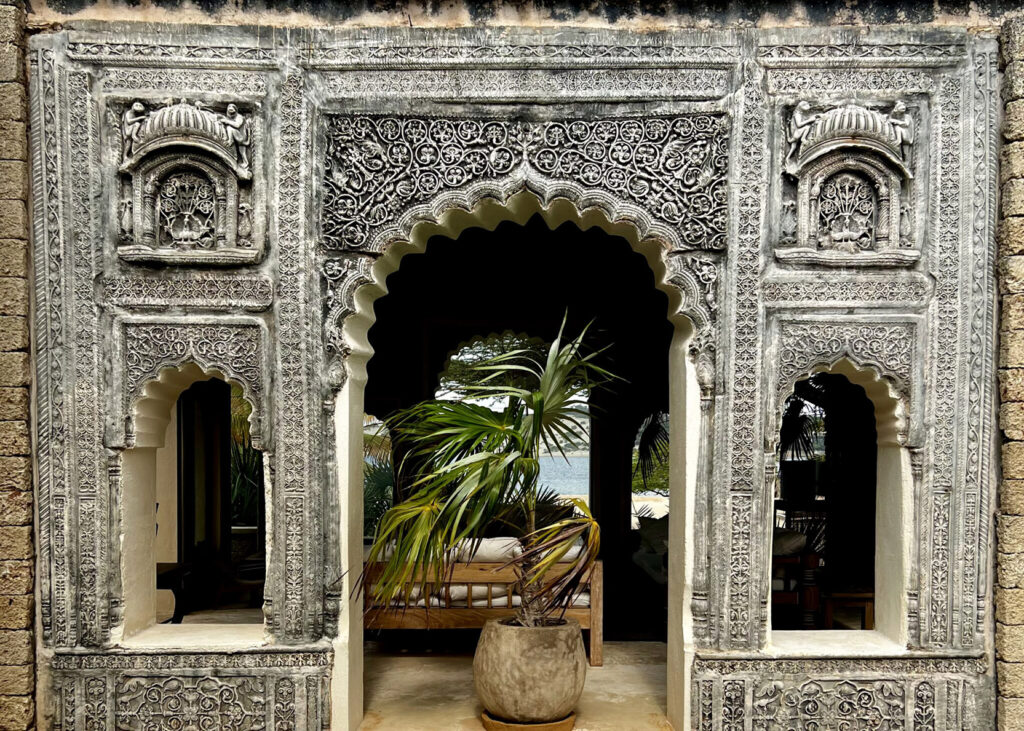
When Yaro had gone, a shiver of pure pleasure wriggled up my spine as I climbed the stairs. At the top was the door to the room overlooking the main street, and at the far end of that was a Moorish archway leading into a bedroom containing a canopy bed with old mosquito netting. Through the bedroom windows, I could see beyond the stone wall to the beach and some leaning palm trees, but not to the ocean itself.
I returned downstairs and into the room that opened onto the garden, from where I could hear the sound of the waves. Sinking down onto an old couch, I closed my eyes to hear the sounds better and when I opened them again, I knew I’d been sleeping. I heard the song from the mosque. Remembering what Yaro said about the sudden darkness, I got to my feet and let myself out through the French windows. The garden was laid out in terraces, the first of which was full of tall grassy plants. The second had a stand of rhododendron-like bushes with dark angled trunks and branches. Their shadows dappled the sunlight as I moved through them, the path littered with their leathery leaves, brown and spear-shaped.
“I don’t know how I can love the house so passionately, while you hate it so much,” I remarked.
“It’s because you see nothing,” he said.
On the third terrace I found a well beneath a huge slab of stone. All around it small ferny plants grew, suggesting the presence of an underground spring. Beyond it, two pillars looked as if they were part of an ornate gateway long since destroyed. One was standing, the other had fallen, and they made the spot enchanting and romantic. The path led into a small plantation of tree ferns and banana-like plants. A sweet fragrance hung in the air, and the silence seemed deeper. Finally, I walked into the orange grove. The trees were in fruit, the oranges small and in the hundreds. The door in the back wall was still there, but it was secured with heavy iron bars that stretched from the ground to the stonework above, and across the door from side to side. I recalled the moment of awkwardness as Yaro and I stood in that same spot ten years before, and he’d spoken of removing the door altogether. Later, he’d told me that people believed the mashetani used the orange grove door. “There are hundreds of them,” he’d said. “There is a very disgusting one called Popobawa, which terrorized people here in 1995. A man was even killed by it. People had to sleep outside with their neighbors because Popobawa has a very huge penis, and if a man was asleep on his back, it would turn him over and hold his face down while he did the deed.”
“Tell me,” I said, “do mashetani all look the same?”
“The only thing the same about them is that they are all misshapen and grotesque,” Yaro replied.
As I stood thinking back on this conversation, the first bats began to appear in the garden, and so I made my way to the house with a quickened step.
“I was happy, Yaro, so much so that I fell asleep for a while.”
“The whole place stinks. I’m surprised you could stay there. Nobody on the island feels any love for it. The air inside is completely corrupted.”
“I don’t know what to say, I’ve fallen in love with it.”
“You should fall in love with a man instead. That would be normal.”
“Perhaps so, but what would be the use of that?”
He shrugged and I laughed, and we said nothing more until we’d left the café and were walking along the beach road past the moored boats and dhows. “I don’t know how I can love the house so passionately, while you hate it so much,” I remarked.
“It’s because you see nothing,” he said.
“Meaning what?”
“You are not African, Sarah. That is all.”
“So, you do think mashetani are real?”
“I told you, no,” he answered quickly, “you do not listen.”
We stopped to sit on the harbor wall. I was staying at Kisiwa House, one street back. I had two more weeks before my return trip. In a rush of fevered thought, I had an idea.
“If I stayed in the house for a couple of nights, I could make note of everything that needs fixing before you rent it out.”
Yaro let out a strange little groan. “I want to sell it, except no one’ll buy it.”
“Why not?”
“Because of him and everything else.”
“Your uncle?”
“Of course. Let me take you now to Kisiwa House, Sarah, you look tired.”
“People didn’t like him?”
“Unguja people feared him. I’m afraid to tell you certain things in case you… scoff. But you may as well know. He was mganga, and claimed our family was descended. While you are here, you should see the palace at Dunga. The tourist bus goes from the square. Uncle made his living by necromancy, and he had the blasted weird thing, the one that stank, always around him. Have you heard the voice of a kingugwa? It sounds just like that.”
The tension in Yaro’s voice shocked me. We stood up and continued towards my hotel in silence. When we reached the entrance, he turned to me.
“Why don’t you buy it, Sarah? You love the place, and you don’t care what old people believe.”
“Let’s talk tomorrow,” I replied, trying to keep my voice steady.
But Yaro had planted a seed inside my mind, and that night I did not sleep. I thought of every reason why I shouldn’t buy the house: it was a stupid idea, I was blinded by love for the place and couldn’t see its faults; I’d always be an outsider in Unguja and fall into loneliness, even though I had little need for company; I’d struggle to learn Swahili properly; malaria was all around; the rainy season was long and hard; Unguja would be too hot and humid for me to tolerate. The knowledge that the house had a reputation was not on my list of negatives. Yet, each time I found reason not to buy it, I asked myself how, if I’d wanted it so achingly that it remained alive to me throughout all those years in London, I could reject it now when it could so easily be mine.
When Yaro and I met, we drank a couple of Tuskers before I dared ask him the price.
“I want dollars,” he said quietly, poking his finger into the tear in the plastic tablecloth. “One thousand, eight hundred and thirty… or whatever you have.”
“Wow, Yaro, that’s more than reasonable!” I answered, laughing. “Maybe you should get it valued first?”
“No, Sarah. If you can give me what I ask, we will sign papers. I will pay my university fees. I will be so happy.”
Three days later the house was mine. I felt as if I was walking in a delicious dream. Yaro wouldn’t come inside to celebrate with me, so we decided to take the tourist bus to see the remains of the Dunga palace his uncle claimed connection with.
“It goes back to the fifteenth century,” he explained, as we sat on a low wall by the massive stone entrance. “The family died out a few hundred years ago. They were all waganga, and the mortar in the walls is extra strong because it’s mixed with the blood of their slaves,” he whispered. “They had a royal house in town also, but they demolished it because the mashetani there were too strong and too many.”
“I hate what superstition does to people, even intelligent people,” I said. “I’m not convinced you don’t believe it yourself.”
Yaro stared at me and I could see he was both curious and insulted. “My father and grandfather believe, and because I respect them, I must appear to believe also, so as not to make them feel small. But if the mashetani were real, I’d leave Unguja immediately and go live in Nairobi.”
“What about uni?”
He shrugged. “Sarah, if mashetani are real, it means I’ve understood nothing about life. I would go to Nairobi and just be a mechanic or sell petrol in a garage.”
A few days later, I left Unguja. I was anxious to deal with my affairs. My existence in London was simple enough — typical, I think, of people who have no great need to collect possessions, pets, friends, or lovers, or life complications like beliefs, duties, obligations. I’d been a technical writer for some years, and my plan was to freelance and work from the island when I needed money.
I didn’t intend to renovate the house or modernize it much. I’d restore the street door and dolphins, sort out the kitchen, the beach door, the other door in the orange grove, and make the garden come alive; my heart beat hard at the thought of it.
When I returned to Unguja, I went straight to the hardware store where I bought a shovel and walked with it past the moored fishing boats until I could see the wall of my house along the edge of the beach. It took some time to remove the build-up of sand, but once I’d got the beach door open again, I was as pleased as anything.
Yaro was willing to use his scooter to transport my things only as far as the street door. “You know those pillars?” I asked. “The standing one is leaning dangerously now; it’d be better if it was pushed over. A couple of men could probably do it,” I said.
“You shouldn’t touch the pillars. No one here will help you anyway. Uncle’s house is on the site of the old royal house. Those pillars are all that remain of it now.”
“You didn’t think to tell me that earlier?” I asked.
Yaro shrugged. “How could I know you’d be interested?”
I spent the first week working on the house. At the end of each day, I swam in the glorious sea and felt myself to be the luckiest and freest woman who ever was. On the day I worked on the street door and the dolphins, a large band of kids and their dogs settled down to watch me, silent and nervous. Perhaps it would’ve been less disconcerting if they had been noisy or rude, as kids are supposed to be.
I’d bought tools and a ladder, but couldn’t take the iron bars off the orange grove door. On Malindi road, at the ferry terminal, I found some young men from the mainland who agreed to help me. When the iron came away as one piece, I realized it was welded together in the middle and was meant to be a cross. I had the guys prop it up close to the house.
The next afternoon rain came to the island, thundering down ferociously. The black night was very wet. The electricity had gone off, and I was sitting in the back room with a hurricane lamp. I became aware of an animal outside — a large dog. It made a commotion in the bushes on the second terrace and a peculiar yipping noise. I went to the French windows, checked that they were locked, and peered out. I could see it, and then not see it. Its eyes gleamed from time to time. I figured that if it got in, it could get out again. As far as I knew there were no reported cases of rabies on the island, but still, I didn’t want to go out there.
I went up to the bedroom and looked out into the garden. A pair of glowing eyes stared straight back up at me. It had come away from the bushes and was standing in the middle of the path. I did not like the stillness of it. The beast appeared huge. Turning away, I resolved to get curtains.
“People have been asking me if you speak to Iblis; they cannot believe you bought my uncle’s house in ignorance. It is pointless trying to explain that the things we see do not exist in the white man’s head or world.”
“Why don’t they speak to me, and get to know me, then?” I asked.
“If you are a necromancer, you could harm them.”
“That’s why they watch me like that?”
“Yes, Sarah, obviously.”
“Do you think I look like a … what do you call it in Swahili… mganga?”
Yaro laughed. “That’s another topic of conversation on Unguja. One old man said that if such a fair-looking creature as you could talk to the mashetani, or their father, he understood the world no longer and wished to die.” Yaro and I were together at Fahari’s material shop on Kenyatta Road. I hadn’t told him about the beast in the garden, and at that moment something significant occurred to me — its shining eyes had been at times close to the ground, and at others higher up, meaning that either there’d been more than one of them, or it’d climbed into a tree to get a better look at me.
“So, who is the father of the mashetani?” I whispered as I found the fabric I wanted.
“It is Iblis. I told you.”
When we reached Kilele Square, I stopped under one of the two big trees and put down my bag. “Come to the house and drink coffee with me,” I said. “I had mainland guys working for me who managed to leave the place unharmed. They took the iron off the orange grove door, so now I have another way in and out.”
Yaro turned pale in front of me. “You took off Ahmed’s cross?”
“I’m going to put a couple of strong bolts on that door, instead. Dogs got in last night. Did your uncle have a dog?”
Yaro frowned. “What made you think of that?”
“Forget it,” I answered, thinking it might raise the tension that’d come between us even further if I shared what I thought I’d seen.
Yaro stood some yards away from me, just within the shade of the tree. “I’ll try to get Ahmed to put the cross back,” he said quietly, his face drained and deadly still. “He put it there when Uncle died and said long and complicated prayers about it. But he was very afraid. Please, Sarah, don’t touch those pillars in case they are mlango wa kuzimu.”
We set off in the direction of my house. I felt angry. Door to the underworld, for Christ’s sake! It was as if he’d only lent me the house. “You showed me round that house once yourself, or had you forgotten?” I asked.
“Uncle was still alive then, so nothing could be rampant…”
Once I was home, I took sanctuary in my bedroom and did not come down again that night. I was miserable and edgy. I presumed Yaro’s attitude to the house was simply a reflection of the hatred he had for his uncle.
The morning light and the sound of birds the following day cheered me greatly. I needed to make friends on the island, I realized, so that I didn’t lean too much on Yaro for company.
After my swim, which washed away the final remnants of my unease, I fixed sturdy bolts onto the orange grove door and the beach door. As I worked, an image came to me, of a huge dark form appearing on top of the stone wall on the beach side. I tried to ignore it as simply a thought pitched up by panic. Later, I tried to recall that image, searching in my mind for the sight of its face. The face of a dog, surely? Yet I’d conjured up hands and not paws. I began to go out each morning looking for signs of it, and on one occasion I did find a couple of massive paw prints on the muddy path, but something greatly troubled me about them. There were only two of them, side by side, and about a yard apart. The creature could stand on its back legs.
With my curtains up, I felt more inclined to sit in the back room after dark had fallen. Even so, I felt the presence of the massive dog, which brought with it an appalling stench, loitering in the garden each night, as aware of me as I was of it.
I stopped going into town, afraid that my anxiety would show on my face. But my work on the house slowed, then stopped. I could think of nothing else but the dog, and how to rid myself of the damned thing. I imagined digging a branch-covered pit into which it would fall. I thought of poisoned meat, easy enough to get hold of on the island. I wondered if I could pay some men to catch the beast and take it away.
I fell into an obsessive routine of patrolling the garden first thing in the morning. I studied the muddy path for prints, the bushes for broken leaves or animal fur. I spent the afternoons upstairs on my bed. I had no desire to eat, swim, or work.
One evening, as darkness fell, I decided to put myself in full view of the creature, like a decoy, so I pulled back the curtains and moved the couch so that it was directly in front of the French windows. I settled myself down, waiting to smell the rotting stench that would signal the thing’s arrival.
As soon as I was aware of the odor, I saw it. The huge body emerged from the cover of the bushes and came unhesitatingly towards the patio. I recognized it as a human man, distorted in some manner I couldn’t define in my terror, and rising to around seven feet in height. He stopped at the patio steps and crouched down, perhaps to hide, so that his eyes were about four feet from the ground. Then, just as suddenly, he was gone.
My one consolation in discovering that a man was involved was that I now felt justified taking the matter to the police. My morning patrol the next day revealed a mass of paw prints. Try as I might, I couldn’t recall the man’s face. I’d felt mesmerized by his eyes before he dropped to ground level; It had felt as though they were almost mechanically seeking me. At one point, I must have shut my eyes, or moved my head to the side, for there is a gap in my recollection.
That evening, determined to confront my intruders, I took up position by the French windows, with the curtains flung wide open, the hurricane lamp beside me on the floor. I’d drunk a couple of glasses of brandy for courage.
The stench arrived around eight thirty, although I couldn’t immediately see the man or his dog. The wind had strengthened over the course of the day, and I could hear the bushes on the second terrace rustling wildly. I peered hard into the inky dark. As I waited, I glanced down at a moth that threw itself repeatedly against the bright glass of my lamp. By the time I looked back up, the creature had stepped away from the bushes and was walking, even swaggering, towards my patio where he now stood in plain view, his mouth open wide.
I stood there, rooted in place with horror, as he came forward, slammed his spotted underbelly against the French windows, and yipped at me in the ugliest cadence. His back legs were those of a powerful dog, the palms of his hands human and against the glass. He wove from side to side, to see better, to find me in there, I knew, lurching repeatedly forward, beast head, man head, beast head.
His eyes found mine and I saw his teeth and long muzzle. He let out a snickering high-pitched noise, followed by a low guttural wail. I backed into the kitchen, knowing it was the one place I could lock myself into. I fell as my knees gave way, but then I crawled under the table and stayed there, awake, for the rest of the night.
***
For hours across the following day, I could not leave my hideout under the kitchen table. I was convinced my bedroom window had been open during the night, and the mashetani had climbed up the house wall and dropped itself into my room, where it was still hiding.
He weaved from side to side, to see better, to find me in there, I knew, lurching repeatedly forward, beast head, man head, beast head.
The beach came to feel like the only place of safety, but I couldn’t make myself walk out into the garden. Sometime between the afternoon prayers and sunset, I persuaded myself that if I could not smell the creature, it was not close by. I emerged from the kitchen, wrenched the front door open and walked quickly along the beach road toward the sand, all the while staying close to the town’s wall. As it grew dark, I headed to Forodhani Gardens and the night market, which was crowded and bright with the lights from hundreds of hurricane lamps. I knew I would never walk into my house again. As easily as I had loved it, I had now abandoned it. I also knew, for the sake of our friendship and for fear that he really would leave Unguja, that I would never tell Yaro what I’d seen.
Of my last day on the island, I remember only fragments. I remember standing in the People’s Bank in Benjamin Mkapa Road, still wrapped in a woman’s shawl I’d found on the beach, and waiting patiently to withdraw all my money. I remember meeting Yaro on the waterfront and telling him I was gravely ill and going to the hospital on the mainland. I surmised that he would think I died there when I never returned. I couldn’t meet his eyes, but he had already seen my face. He stared at me in utter concentration for a long while.
“I once saw a man who’d been struck by lightning; you look like that, Sarah. Your face is ashen,” he whispered. “Go quickly to the hospital in Dar-es-Salaam.”
As the ferry left Unguja, I slipped the shawl off my head and dropped it overboard. I wanted nothing from the island to remain with me, and long after it’d sunk beneath the waves, I was still staring into the water.
From time to time, in the silent winter days of London, images come to me unbidden: my panga, my hurricane lamp, the line of fishing boats, the gaggle of children, Yaro’s face. And where once I tried to remember every detail about the house in Unguja to comfort me, now I try to obliterate all memories of the place. Try as I might, I cannot separate them from that single vision: a hyena and a man fused in one distorted form, the reek of it filling the air, its rough, scabby flanks pressed against the glass, its face shifting between man and beast, alight with joy and greed as it gazed at my shuddering body, eager to step into my life.