A new book from authors at dawnmena.org offers a framework to break the stalemate in Palestine. But is the blueprint realistic?
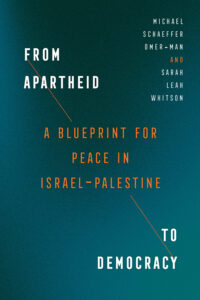
From Apartheid to Democracy, by Michael Schaeffer Omer-Man and Sarah Leah Whitson
University of California Press 2025
ISBN 9780520402003
In my two decades working as a journalist, I have never missed a deadline; this review was the first. The book, From Apartheid to Democracy, which offers not a plan for peace but, rather, a blueprint to get Israelis and Palestinians on the road to a final status plan, wasn’t a bad read. But it was exceedingly difficult for me, in the current moment, to suspend my disbelief and buy into the text’s premise. And though I read the book itself in just a few days, I struggled mightily with the feelings it brought up.
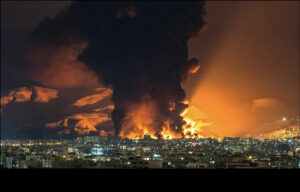
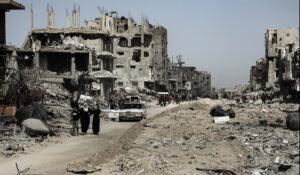
In case you have been living under a rock for the last month, here’s the context: The Middle East is burning right now as Israel, backed by America, tightens its grip on power and its hegemonic rule over Palestinians. Israel has busied itself pummeling Lebanon and Iran, suggesting that the state wants to control not just the Palestinians but all of the Middle East.
And Israel’s relinquishing of power and hegemony are precisely the conditions that must prevail for the critical movement From Apartheid to Democracy to take place.
In short: Peace first, plan second.
The book outlines what co-authors Sarah Leah Whitson and Michael Schaeffer Omer-Man call “The Blueprint,” which, simply put, is a new plan to break the stalemate that currently characterizes the (moribund) peace process and to get the people moving towards a lasting peace in Israel-Palestine. Whitson is the former executive director of DAWN, a nonprofit organization that supports democracy and human rights in the Middle East and North Africa (MENA); Omer-Man is the Israel-Palestine director.
This title joins the numerous books and initiatives that revolve around the idea not of dividing the land but, rather, of sharing it: Ali Abunimah’s book One Country: A Bold Proposal to End the Israeli-Palestinian Impasse springs to mind as do groups such as the Israeli Palestinian Confederation and A Land for All.
While many of the previous efforts to resolve the conflict have been based on the idea that peace is a precondition for Israel to end the occupation and to grant Palestinians civil and human rights, From Apartheid to Democracy flips the script. The starting point is this: There can be no peace as long as Israel is occupying the Palestinians and depriving them of their civil and human rights. So, rather than offering yet another proposal for sure-to-fail negotiations, Whitson and Omer-Man argue that Israel must first end the occupation, and the Palestinians must have all their rights. Only then can the two peoples decide, democratically, the future of their shared land. In short: Peace first, plan second.
After ending the occupation and extending full citizenship to all of the Palestinians who live in “The Territory,” as the authors refer to the land between the river and the sea, a three-year transitional government would rule over a shared state. At the end of this time period, Israelis and Palestinians would vote on the future configuration of “The Territory.” Remain together in one state? Split into two? A confederation? Whatever solutions are on the table would be put to a referendum.
It all sounds great and, believe me, it’s a version of reality in which I desperately want to believe, and live to see: My children are half Palestinian Muslim on their father’s side and I, an American Jew, hold an Israeli passport. I am as equally committed to the place as I am uncommitted to a name for the place. I don’t care what anyone calls it — I just want to be able to return there with my children, for us to move freely between all areas together, and for all of our rights to be respected.
But this vision feels farther away than ever.
It’s not just the war with Iran. It’s not just Gaza. As I write these words, my children’s land is being threatened. Years ago, portions of their father’s family land were already expropriated so that Israel could build some settler roads. Now, my former husband tells me, there are other family plots that will likely be taken by the Israeli government. As the government and settlers chip away at what remains of the West Bank, I wonder what will be left for my children to return to, to cultivate, to live on, if they so desire?
If the idea of Israel giving up its power seemed far-fetched in the past, in the current circumstances it seems, quite frankly, nothing short of delusional — especially with Trump in the White House. But the authors anticipated objections like mine. Even though they wrote this book well before the regional war (late at night, I wonder: will it become a world war?) unfolding before our eyes, Whitson and Omer-Man knew there would be cynics among us. Early on, they write, “The Blueprint cannot be forced upon Israelis or Palestinians; it requires a level of earnest political will where there is almost none today.”
They then describe the different scenarios that would basically serve as a “turning point” to create the conditions for the Israelis to sign on to the Blueprint: international pressure (a.k.a. BDS) or “unimaginably painful, intractable violence from which neither side can see a path to lasting victory – an unacceptably painful stalemate.”
Then they urge readers over and over again to suspend their disbelief, to check their cynicism at the door, and to step into the idea of a world in which Israel is willing to give up on its current Jabotinsky-esque designs for all the land between the river and the sea (really, as I posited earlier, to be the region’s hegemon).
But maybe, right now, in this dark moment, when all hope seems lost, this is precisely the book we need.
If you do manage to do what I couldn’t, the Blueprint does sound like a fantastic way to break the decades of gridlock and stalemate that have brought us to our current moment. But several issues remain: buy-in on both sides; the presumption that the Palestinians and Israelis will be on equal footing during the implementation of the Blueprint (which feels impossible to me after decades of occupation and oppression); and the glossing over of the emotional aspects of such a project. In regards to the latter, inasmuch as my most recent book, Crossing the Line: An Israeli-Palestinian Love Story, is flawed because it is an overly emotional argument for a one-state solution that neglects the nitty gritty of implementation, this book is the opposite: it is flawed for being a bit too cool and dispassionate, and neglecting the emotional aspects that could interfere with the implementation of the temporary one-state that would be a transition to…?
Something else, hopefully.
It occurred to me that, like Oslo, the transitional government could become another hollow process in and of itself that far outlives its legitimate term (à la Abu Mazen). In such a scenario, it’s not hard to imagine an eventual civil war.
Yet, for all my cynicism and disbelief, I remain a Jewish American Israeli mother of two Muslim Palestinian children, writing these words at a kitchen table under an enormous banner proclaiming Ramadan Mubarak. It’s Sunday now, but on Friday evening and for much of Saturday, my impromptu writing desk was covered with a tablecloth that read, in Hebrew, Shabbat Shalom. I often joke that we follow all the Abrahamic faiths — in our home we also mark the Christian holidays and I talk with the children about Christianity, taking care to explain to them the commonalities between the religions as well as the points of divergence. Most of the time, my former spouse and I are the friendliest co-parents you will ever meet — so friendly, in fact, that we seem to keep forgetting that we’re actually divorced. (That’s a story for a different essay, though).
My family is the physical embodiment of the kind of wild-eyed hope and optimism that underpins From Apartheid to Democracy. In many ways, my life is a testimony to the possibilities outlined in the book. And yet that my former husband and I had to leave the Territory to get married, to have this family, and to live in peace is a testimony of another kind.
But maybe, right now, in this dark moment, when all hope seems lost, this is precisely the book we need. Maybe we need a vision of another time, another future, than the one the United States and Israel seem to be co-creating with a war that may not yet be over. In fact, perhaps, if the war grinds on, it will, paradoxically, create the circumstances that Whitson and Omer-Man pointed to in the early pages of their book, and something so dark and so horrible will in fact bring about the conditions for a lasting peace.
Let’s hope they’re right.