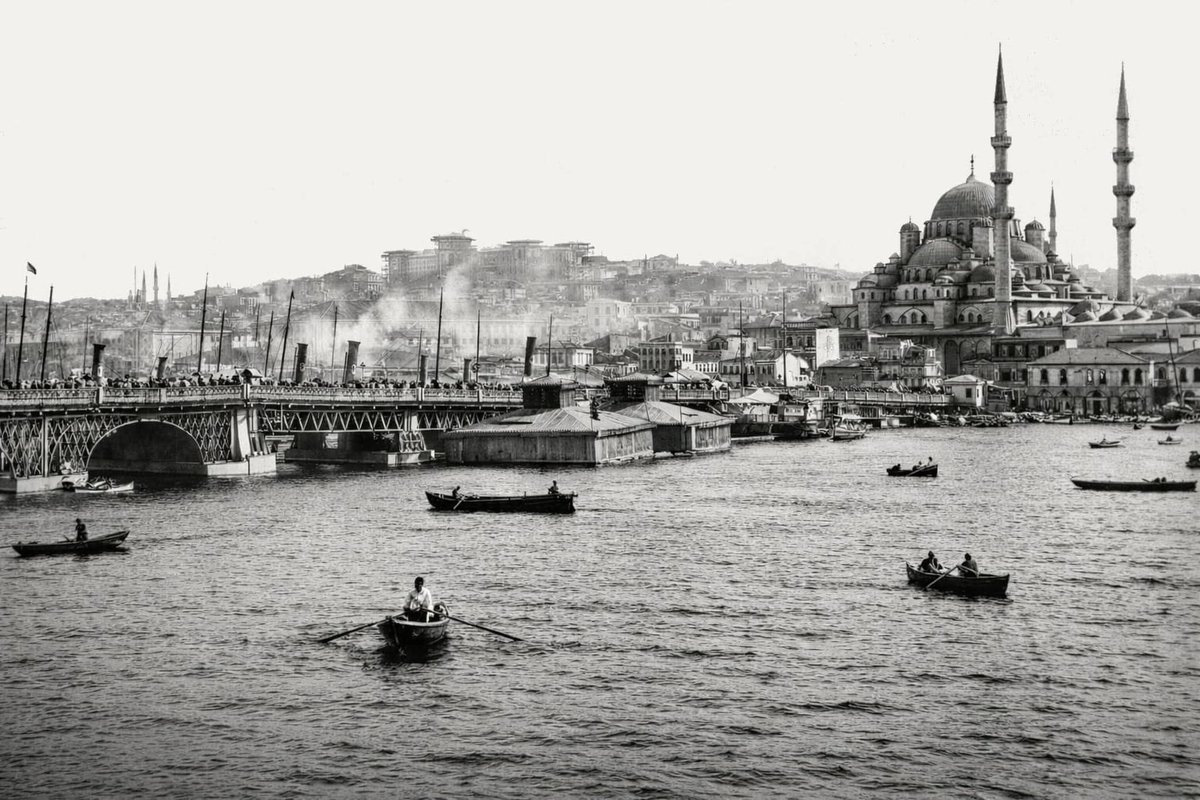
In exile from their ancestral homeland, the Bedir Khan family gathers in an Ottoman villa overlooking the Bosphorus, where a child's birth and apparent death gives way to an event that will shape generations to come.
Translator’s Note: Mehmed Uzun’s 1995 novel Bîra Qederê (The Well of Destiny) recounts the life of Jaladet Bedir Khan (1893–1951), a key Kurdish intellectual who helped shape modern Kurdish language and culture. Through a series of photographs and memories, the novel reconstructs both an individual life and a collective past marked by displacement, exile, and loss. Its fragmented, reflective structure not only narrates a personal history but also meditates on language, memory, and the fragile persistence of a literary tradition under erasure.
— Jeannette Okur & Tahirhan Aydin
Photograph 1: Jajo; Child of a Foreign Land, Emir Bedir Khan’s Grandson
1
Yes, as the saying goes, seeing and observing must come before speaking and expression. The novel Jaladet Beg wished to write may well begin with this very image. The first picture of the novel The Well of Destiny is this: “Salut de Constantinople, Vue de Moda à Cadi-Keuy—Greetings from Constantinople, a View of Moda in Kadıköy.” First comes the view and the perspective; then follow the words and the story. The year is 1893. It is spring; the month is May; the day is warm, clear, and beautiful. Spring has arrived, and May with it. Everything outside is green, the earth is warm, and the sky is crystal clear. Istanbul and Kadıköy are alive with color. The colors prevail; the world feels renewed. A new life is beginning.
The most striking part of the view is the sea. It envelops the entire photograph in a color that lies somewhere between blue and green. Shades of blue dominate. In the distance, a pristine white reigns supreme, while along the coast a deep darkness appears on the surface of the water. Between these two extremes are other shades of blue. The sky is clear. Where the sea meets the sky, the clouds are snow-white. Higher up, where the clouds thin out, the sky opens into blue. White is brushed across the blue. The clouds mingle together, yet they remain soft and simple. They carry neither the chill of snow and rain nor the threat of wind and storm. Instead, they possess a quiet elegance, as if they are bringing a message of new life to the world.
In the distance, where the sea meets the sky, the slope of a hill reaches down to the water. The shore and land begin there. The hill is high, long, and steep. It drops sharply into the sea; its surface is rocky, and it stretches outward like a long tongue of land. Above the hill are trees — thick and tall, though their kind is impossible to distinguish. Where the trees begin, green breaks the dominance of white and blue. A rich greenery, added to the colors of the scene, covers the entire upper part of the landscape. There, a beautiful forest keeps company with the sea and sky. Human life begins there, too, as houses appear among the trees on the hilltop. Above the trees, the roofs of a very large mansion come into view. The mansion is white and comprises several sections. Just beneath the roofs there are tall and wide windows. From the windows, one can take in all the colors of that beautiful day in May 1893. Even though the mansion lies far in the distance, its architectural features clearly show that it was built in the Ottoman era. Its design is not Byzantine; it is Ottoman. The owners of the mansion are sultans and princes of the Ottoman dynasty. Built on the top of the hill, the mansion — like the Ottoman family itself — keeps watch over the earth and the sky, over time and the passing ages.
A little further from the mansion, at roughly the same level, stand four villas — or as the Ottomans call them, pavilions. They are not as easily visible as the mansion; only their roofs and parts of their sides can be seen. They are much smaller than the mansion, yet they are magnificent estates nonetheless. Their roofs are red, covered with red tiles. The villas stand side by side, and through the trees one can glimpse a single window. The villa with that window lies farthest from the mansion. It also stands somewhat apart from the others. That villa — its presence, its colors and structure, its rooms and salons, its well and garden — is of great importance to the novel, The Well of Destiny, for it is there that the foundations of the novel are laid. The villa is one of the residences of Bedir Khan Beg, a Kurdish prince from Jazira in the Emirate of Jazira Botan. His son, Bedri Pasha, the Ottoman commander-in-chief, lives there with his family.
The hill ends with a cliff beside the villa of Bedri Bedir Khan Pasha. A strait runs past it and opens into the sea. Beyond the strait, a new hill begins, slightly higher than the first. But between the two hills, where the strait meets the sea, there is a long wharf. It appears to be about 100 to 120 meters in length. Various boats, caiques, skiffs, and small sailboats are moored along both sides of it. A little farther out, a larger ship has dropped anchor and lies still. At the very edge of the wharf, two small villas with red-tiled roofs like the others can be seen. They face the sea, with their backs turned to the hill. The new, higher hill is also covered with trees, and at the very edge of the photograph, half of a large mansion comes into view. This mansion shares the same architectural style as the other one.
The most interesting element in this picture is the presence of a person. In the foreground, there is a very small island. It is barely separated from the hill and shore; and one could easily reach it. The entire island is made up of cliffs and tall rocks. It is not a place suited for living or dwelling. Yet from it, one can see in every direction, like a falcon. In the picture a man sits on the highest rock of the island, looking toward the camera. Who is he? What kind of a person is he? What is he doing? The image does not tell. Although he is in the foreground, his face is not clearly visible. His hair is dark. His shirt is white, and the rest of his clothing, black. He inclines his head slightly, looking into the camera lens. First, he looks toward the photographer and then — one imagines — he says, “I exist. I am here. I am part of this picture, part of this scene…” The presence of this person completely transforms the photograph; it takes on a sense of life, as if vitality has been lightly cast over the landscape. The presence of such a figure in the first photograph of The Well of Destiny is important, because the novel rests not only on diverse and beautiful landscapes, but also on human experience. Humans — and their existence — are at its very core.
In the photograph, the man sitting on the rock has his back turned to the high hill where the mansion and villas stand. His back faces directly towards Bedri Pasha’s villa. If one were to draw a line from where he sits, it would lead straight to that villa. More than forty people live there, all belonging to the Bedir Khan family. The Bedir Khan family — or the “sons of pashas,” as they are called by the Ottomans — is quite large. In addition to this villa, they have several other houses and residences. They are all settled on the eastern coast of Istanbul, on the Anatolian side, in Kadıköy. They live in Moda, Fenerbahçe, Cevizlik, Bostancı, Mühürdar, Göztepe and Kızıltoprak. After the lands of Kurdistan, Istanbul — and Kadıköy in particular — became their second homeland.
Who is the photographer? The photograph does not say. But whoever he is, he is clearly a master of his craft. The image captures both the open landscapes of Kadıköy, with their distinctive colors, and a person at the center of it all. Neither the figure nor the view of Kadıköy escapes notice. The scene reveals something of Kadıköy’s beauty and richness, along with the life in it. The Marmara Sea, with its gentle waves, touches the shores and hills of Kadıköy. Trees and plants, in their seasonal colors, adorn the surroundings like fine embroidery. Kadıköy’s mansions and villas give the area a unique nobility, while the harbors and piers that surround it open it to the wider world. The ships gathered around Kadıköy add a fitting harmony to the scene. Forests and greenery make Kadıköy a place for walking, taking in the view, and resting.
On a day in May, in the spring of 1893, Kadıköy, its district of Moda, and the villa of Bedri Pasha Bedir Khan, appear so charming and colorful in a photograph.
The future promised them new, beautiful, and glorious things. But at a time when death seemed far from their minds, it arrived at their doorstep…
2
On a day in May, in the spring of 1893, in Kadıköy, Istanbul, there is a palpable sense of commotion, haste, and anxiety in the house of Bedri Pasha Bedir Khan. A child is on the way. Emin Ali Bedir Khan’s wife, Samiha Khanim, is about to give birth. The villa is filled with people. The day is beautiful, the weather is warm, and evening is drawing near. The scent of flowers and roses drifts up from the earth. The sea is deep blue, clear as a mirror, and perfectly still. Clusters of white clouds drift calmly across the sky. In the distance, two long, imposing steamships slowly move forward, one after the other, cutting through the surface of the clear water. Their smoke rises gently towards the sky. The sun peeks over Kadıköy from behind the clouds, its rays falling across the facade of Bedri Pasha’s villa.
The villa has three floors and was built in Ottoman style. The two lower floors extend wide on both sides. However, the top floor runs only lengthwise. For this reason, it may be described as having two and a half floors rather than three. The upper floor rises from the center of the house, lending the structure a distinctive architectural character. On the front facade of the upper floor, there is a long, wide window that gracefully enhances the building’s beauty. In front of the window is a small balcony, or bay window, as it was once called. From there one can count each of the sea’s waves, one by one. From there, the vast expanse of clouds and sky, water and sea, appears beautiful, truly beautiful, like a painting by a master artist. The villa’s roof slopes downwards on both sides and is covered with red tiles. These red tiles complement the colors of the house and its surroundings perfectly. The villa itself is white, while its surroundings are filled with shades of green and blue. When the color red is added, the palette becomes complete, bringing together the colors most cherished in Kurdish hearts: green, red, yellow, and white. Now in the evening, as the sun’s rays dance across the roof tiles, the colors seem to dance as well. The roof is fastened to the villa’s wooden walls with evenly spaced beams. In Ottoman architecture, these beams serve as both an essential structural element and a decorative feature.
Like all the villas, mansions, and houses in the area, Bedri Pasha’s villa is made of wood; it is built from planks, boards, railings, beams, rafters, supports, and wooden columns. Nine windows can be seen on the front of the villa through the trees: four on the ground floor, four on the middle floor, and one on the top floor. The window grills are intricately decorated. In front of the villa’s main entrance, there is a five-step staircase. On both sides of the entrance, small trees grow upward. The villa also has a small, charming garden. Now, the most important feature in the garden for the novel The Well of Destiny is the well. Just to the left of the house, beneath a tall tree, lies a well. It is a well that holds great significance both for the novel The Well of Destiny and for the inhabitants of the house.
As for the interior of the house, it should first be noted that it has eighteen rooms. There are two living rooms, a large kitchen, ten bedrooms, a library, a study, a long corridor, a spacious entry hall, and two bathrooms. Yet, despite its size and the large number of rooms, the house is not sufficient for the household. Bedri’s own family consists of more than twenty people. If one also takes the regular guests into account, this number grows even larger. And now, it has been over a month since his brother, Emin Ali Bedir Khan Beg, arrived with his wife and children and became their guests.
Yes, this is a visit born out of necessity. Istanbul’s fires are infamous. Every day, some place — a neighborhood, a part of the city — burns. Fireballs rise into the sky; houses are destroyed; families are left homeless. Each day, the firemen of Istanbul’s neighborhoods, with buckets and water tanks slung over their shoulders, run through the streets shouting as they try to extinguish those ominous fires. But alas… the fires are not put out, nor do the cries of the firemen help. Houses burn; neighborhoods are reduced to rubble; daily life is turned upside down. About a month ago, Emin Ali Beg’s house in Kızıltoprak, Kadıköy, also burned down. They gathered their belongings and their pots and pans and went to Bedri Pasha’s villa.
Dear author, as you know, details are essential for creation and construction. For a painter, the details of color and landscape are vital; for a musician, the nuances of sounds; and for a writer, the subtleties of words and language. Yes, even before I was born, the fires of Istanbul had devastated our home… I still remember that fire and Istanbul’s tulumbacıs, as you call the firemen, as a fragment of my life. On one side, the flames and the blaze, on the other, the shouts and clamor of the firemen — their faces, their bearing, and their clothing… One did not know whether to laugh or cry. There was also a group of firemen in our neighborhood of Kızıltoprak. Their cries still echo in my ears: “Oh you sooty-faced ones! Woe to whoever blocks our way! Here come the slaves of Kızıltoprak!…” With their crooked fezzes, curled mustaches, bare feet, and taut biceps, they were the self-sacrificing, barefoot, and wandering souls of Istanbul. Their presence was a mark of life itself: on one side, sighs, tears, and cries of anguish; on the other, laughter, jokes, and swagger…
Today, on this evening, as Moda’s romantic spring day slowly fades away, Samiha Khanim is in great pain in a spacious room on the second floor of Bedri Pasha’s villa. The men are downstairs in the living room; the women are upstairs. The child on the way will be Samiha Khanim’s second. Ten years ago, she gave birth to a child, her son Sureya. But not with such pain or strangeness… Her belly is tight like a drum. Her contractions are intense. She is short of breath. What a state she is in!
Most are forgotten, but some remain forever in one’s mind. My mother’s face was one of those that stayed with you always, like a shadow.
3
What a state she is in… If it continues like this, Samiha Khanim will die. Sunset gives way to evening, and evening to night; night creeps toward dawn, but still the child is not born. Samiha Khanim’s contractions suddenly increase. The pain comes in waves. Samiha Khanim is moaning, too ashamed to even cry out. She can only moan deeply. Bedri Pasha and Emin Ali Beg’s mother, Rushen Khanım, Bedri Pasha’s two wives, and several other women are gathered at Samiha Khanim’s side. Each of them tries to help in whatever way she can. No matter what Rushen Khanim does, old and experienced as she is, she cannot bring the child’s head out of the mother’s body.
“I’ve helped our women so many times, but I’ve never seen anything like this,” she says. “With these contractions and the dilation of her body, the child should have already arrived.” His head is visible, but he will not come out. What on earth is happening? I’m afraid we will lose dear Samiha. There must be a solution. There must be a solution…”
What is the solution? Bedri Pasha, Emin Ali Beg, and a few of their brothers are sitting downstairs in the large parlor, waiting for good news. Emin Ali Beg’s son, Sureya, who just turned ten, has been sitting on the floor next to his father, waiting for his brother or sister to arrive. But when his eyes grow heavy, one of the housemaids carries him upstairs to bed.
Emin Ali Beg is about to become a father again. He has two sons: Hikmet and Sureya. Hikmet’s mother passed away at a young age. Before Hikmet was even two years old, his mother was diagnosed with cancer and passed away soon afterward. The last two months of her illness shook Emin Ali Beg deeply. Hikmet’s mother, whom Emin Ali Beg loved dearly, wasted away before their eyes, dying in great pain and suffering. Neither Emin Ali Beg nor anyone else could do anything to prevent it. In her final days, Hikmet’s mother was reduced to skin and bones. When she died, Emin Ali Beg mourned for days. He suffered for months and secretly wept for his beloved during Kadıköy’s dark winter nights. Hikmet’s mother was a beautiful Circassian, a member of a prominent family among the Ottoman aristocracy. She was Emin Ali Beg’s first love. They had met in their youth. In the forests and gardens of Moda, they first spoke from a distance, with their eyes, and later, hand in hand. Back then, they never thought of death. After their marriage, they were blessed with a healthy, bouncing baby boy. The future promised them new, beautiful, and glorious things. But at a time when death seemed far from their minds, it arrived at their doorstep…
After the death of his soulmate, the love of his life, Emin Ali Beg had no intention of remarrying. But how could the son of the great Emir Bedir Khan — may he rest in peace — one of the Kurds’ most important leaders, manage his household without a wife? And now he had a son as well. No, that wouldn’t do… His sisters Melek, Ayşe, and Sariye — but especially their grandmother Rushen Khanim — pressured him to marry again. Marriage… but with whom, and how? But at the urging and insistence of the “women of the house,” he gradually warmed to the idea. This time, it would be with someone very familiar: Samiha. Samiha, who had grown up under his mother’s care and served as her handmaiden. Samiha, like a gold leaf, like a drop of water. Samiha, whose heart was gentle, whose mind was strong, and whose conscience was clear.
Everything and everyone that is beautiful and good is sacred. This has been one of my guiding principles. Grace, refinement, and beauty should form one’s philosophy of living. And goodness and beauty should be expressed through goodness and beauty… If I think and live this way, I am certain that my mother’s influence played a great role in it. My mother was an indescribable embodiment of kindness and beauty. Like my late stepmother, whom I never met, she was Circassian. But my mother had something more to her character than my stepmother; she also knew Kurdish and spoke it at home. I should also mention that my mother’s Kurdish was just as fluent as that of my aunts and grandmother. And, as you know, the beauty of Circassians is renowned. All that beauty shone brightly on my mother’s face. In life, one encounters many faces. Most are forgotten, but some remain forever in one’s mind. My mother’s face was one of those that stayed with you always, like a shadow. A round, fair, well-proportioned, and sensitive face…