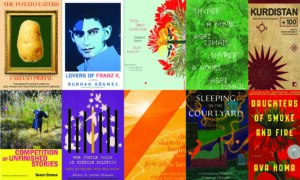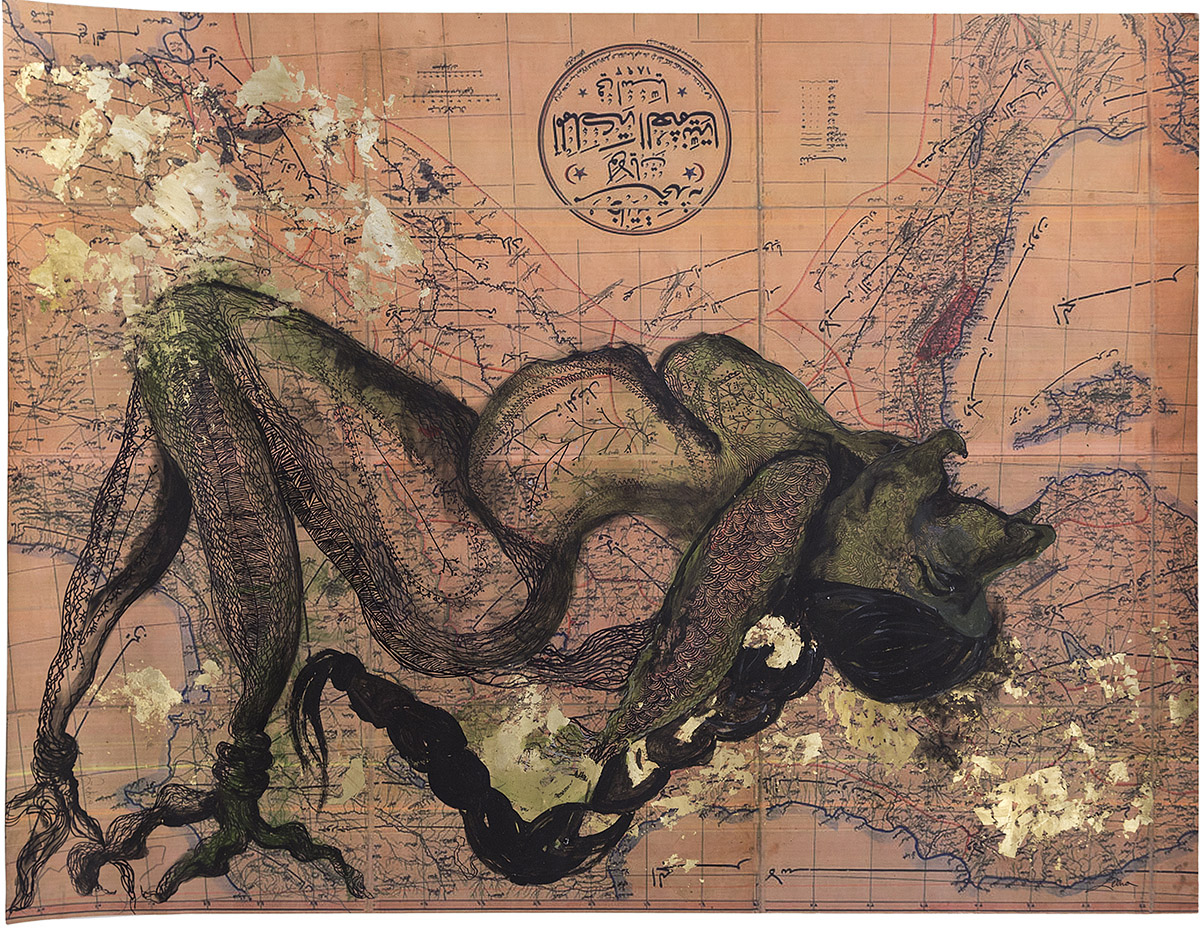

Like many Kurds living in exile, I feel Kurdistan fading into memory. Soon, I will forget the feeling of being surrounded by dozens of people claiming to be relatives, speaking to me as if I had lived in Slemani my whole life. Soon, I will forget the mountains closing in around the valley at dawn — so close I could feel my own smallness — eating bowls of salted pomegranate seeds in the garden, the humidity making the fireflies stick to our skin as though we were flypaper. Soon, I will forget the not-too-distant explosion that sent rubble crumbling from our roof and into my hair as my mother continued her conversation with my aunt, uninterrupted.
These memories are from 2003, but don’t let the year fool you. War in Kurdistan isn’t bound to time. I’ve already seen how desensitized we have all become to it; how mundane the conflict seems when it folds into our daily living as spectators and survivors. It wasn’t until I grew older — having spent an increasingly longer part of my life abroad, in Sweden, Norway, England, and the United States — that I realized how few news stations, in their already rare coverage of the Kurds, broadcast the brutality of unblurred bodies, unmarked mass burial sites, and children wrapped in bloodied shrouds.
Wars only escalated and the land grew more suspicious in the eyes of immigration officers. My constantly shifting visa status made it less and less likely I’d see Kurdistan in the near future. In true literary stereotype, à la Season of Migration to the North, I knew that by the time I could finally return (which still hasn’t been the case, unfortunately), I’d be nothing more than a stranger in a foreign land.
We are continually told, in the same tired op-eds, that individual Kurds have no choice but to accept their status as collateral damage for the sake of their people’s eventual liberation. If it’s not the Ba’athists, then it’s Daesh. If it’s not Erdoğan, then it’s the Supreme Leader. Martyrs in a long legacy of martyrs that are needed for a promised tomorrow.
And as the Kurdish autonomous region in northeastern Syria (Rojava) enters one of its most savage conflicts — with paltry outcry from the world, the social media algorithms focusing instead on Trump calling Syria’s newly elected Al-Sharaa a “young, attractive guy” — we have again accepted the mundanity of Kurdistan’s cyclical bloodshed.
But talking about Kurdistan means getting caught in its paradox. There’s such an urgency to reveal the depth of our suffering, the horrors of Halabja and Anfal, that it’s all anyone talks about, until we’re reduced to nothing more than casualties. For as soon as we move beyond being known as the largest stateless people, Kurdistan abruptly begins to feel inconsequential and hollow. It’s as though we’re shackled, the endless dissection of senseless violence becoming a sort of prayer, offered up in the hopes that it might one day provide refuge or enlightenment to those who have lost too much to bear.
How do we do reconcile a people’s fraught history without the fear of being reduced to what we’ve witnessed? What does it mean for the conflict in Kurdistan to be both overexposed and unseen, with the only language outsiders seem willing to hear being the one that leaves the most unsaid?
These are questions I’ve grappled with ever since I first learned about the Anfal chemical attacks as a child. I still remember my grandmother telling me about a mother in the village of Halabja who heard the bombardment and hid her newborn son in the basement bunker, only to find he had died because the density of the mustard gas made it settle at the bottom.
National traumas, those that come to define a people and sometimes their purpose, like that of Halabja, tend to be recounted nearly identically, regardless of the speaker’s demographic, political, or religious background. Being able to recite the events, even if one has never set foot in Kurdistan, is almost certainly how one earns an attachment to their Kurdish identity. In our centerpiece for this issue, Hoshang Waziri’s short story, “The Great Mother’s Vigil,” translated by Hassan Abdulrazzak, seven children witness the murder of a mother during a raid on their Kurdish village and narrate the event from their divergent vantage points. Rather than producing contradictory testimonies, their accounts converge into a single, cohesive voice.
In Hajjar Baban’s “What’s Form to Silence? Kurdish Poets on the Impossibility,” Sherko Bekas’s depiction of Halabja is one of suffocation. In his poem, “The Spoils,” (the title of the eighth chapter of the Qu’ran, from which Anfal takes its name), the speaker’s complaint to God of the attack is rejected on the grounds of it having been written in Kurdish rather than Arabic. Silence, in this case, “becomes the container for all that is unbearable or that can’t be known.”
When my grandmother relayed the story of Halabja, she anticipated this silence. In the years following, I developed an aversion to the thought of Kurdistan. I couldn’t fathom why I had been granted asylum and not that him over there (or her or them or the entirety of Halabja or the entirety of Kurdistan). Survivor’s grief, flashbacks of the attacks I had only seen through a television screen, struggled to escape my mind. It had become much easier living outside of that silence, even if that meant forgetting my Kurdishness, whatever that meant to a miserable kid living in Scandinavia. It wasn’t until much later that I was able to find the courage to face the silence and become one with it, as Hajjar so eloquently put it: “I want to continue in the tradition of making something new with silence without answering who I am.”
When The Markaz Review asked me to serve as a guest editor on a possible issue on Kurdistan, I hesitated. I’ve learned that the more I’ve tried to reconcile with my Kurdish identity, the more bewildered I’ve become by all its contradictions. But founding Henar Press, the first nonprofit dedicated to publishing Kurdish literature in translation, has brought me together with so many wonderfully gifted writers, translators, and artists who speak openly about the same struggle. I found solace in their rejection of the simplified answers sought by so many non-Kurds, about who we are or what it means to be Kurdish.
When the largest militaries, economies, and nations in the Middle East unite to erase all traces of a people, it demands nothing less than a miracle to preserve even a fraction of that existence.
I shared with the TMR team my frustration with the lack of complexity I see manifest when it comes to any coverage of the Kurds; I expressed, too, my uncertainty in providing a “clean” narrative. They said they would support me in however I chose to curate the issue and defer to my sensibilities. And so, it brings me great pleasure to be the one to announce TMR’s newest issue, HAWAR, featuring fiction, poetry, essays, reflections, and art from across the breadth of Kurdistan, at home and in the diaspora, much of it appearing in English print for the first time.
In collaboration with the editorial team, I took the lead on soliciting writers and curating the issue. I also suggested the name: HAWAR, which means “the cry.” It seemed the most fitting one, being the title, too, of one of Kurdistan’s oldest literary and cultural magazines. In fact, in six short years, Hawar, founded by the writer Celadet Alî Bedirxan, will be celebrating its centennial. For the uninitiated, its influence can’t possibly be overstated. The publication of its first issue on May 15, 1932, is rightfully celebrated annually as Kurdish Language Day. And yet, I find myself pondering why so little has changed for Kurdistan across all that time, as a nation, as language, and literature. But even within that pessimism, I’m struck by the tenacity of Kurds who continue to echo Bedirxan’s cry into the void all these years later. Why do we continue to do so when we have been repeatedly silenced or ignored? And at whom is this cry directed?
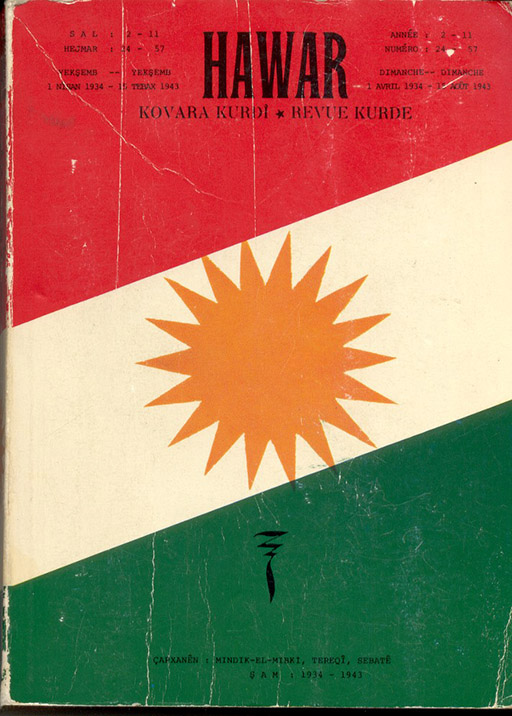
In many ways, the story of Bedirxan (and by extension, Hawar) is so emblematic of the Kurdish narrative that it borders on absurdity. A direct descendant of Kurdish royalty, Prince Bedirxan was studying for his doctorate in Munich when the formation of the Republic of Turkey made it impossible for him to return home, costing him his fortune. He spent years trying to seek a refuge, first in Cairo and later in French-Mandate Syria, in which he could finally write and publish without censorship. It was there that Hawar was published, running from 1932 to 1943, producing 57 issues in total. When the French-Mandate ended, so did Hawar.
Despite being the most renowned Kurdish linguist, compiling the first modern grammar of Kurmancî (the most spoken dialect of Kurdish) and pioneering its Latin-based alphabet through its use in Hawar, he died with hardly any money to his name, going from a professor and lawyer to a humble farmer living in destitution. Even his death is shrouded in mystery (some say he fell in a well, others that he died in a traffic accident). A few years after his death, back issues of Hawar were on the verge of vanishing entirely, with no museums, academic interest, or government intervention working to preserve them. Through some miracle, prominent Kurdish writer and translator Firat Cewerî traveled to Damascus and managed to smuggle the issues out, reportedly clearing interrogations with the help of spies along the way. He brought them back to Stockholm, where he was living in exile, so that they were republished in their entirety for the first time in 1998.
These near misses, which would have had cataclysmic ramifications for cultural and literary preservation, are exceptionally commonplace when it comes to Kurdish history. When the largest militaries, economies, and nations in the Middle East unite to erase all traces of a people, it demands nothing less than a miracle to preserve even a fraction of that existence.
Take, for instance, Nasim Stone’s profile of Goran Candan’s Kurdish Exile Museum — the first exile museum of its kind, located in Sweden — possibly one of the largest single collections of Kurdish books, magazines, newspapers, and other artifacts, some dating back to the 9th century. Candan, himself a journalist who had to flee Turkey to escape prosecution for writing in Kurdish, was recently forced to relocate the entire collection to a storage unit, because he was no longer able to afford the rent. Without support from government grants, nonprofit organizations, or Kurdish parties, and no interest from academic libraries, Candan may be forced to destroy a lifetime’s worth of irreplaceable heritage. To him, that would mean an end to his legacy, his lifelong work to ensure that “our children can read the traces of their ancestors’ lives, work, and hopes.”
More often than not, the culture most at risk is non-material in nature, as evidenced in “Memory as Resistance,” Ali Aliyev’s interview with playwright Zeynep Esmeray. Having spent most of her life as a nomad drifting between cities in her traveling theatre group, Esmeray calls herself a dengbêj, a Kurdish storyteller. “Writing things down for history is important,” she says, “but there is also this other thing: oral memory carrying. That is what art is. That is what theatre is. That is dengbêj.” Following this tradition, her theatrical performances are often improvised, drawing on the intersectionality of her marginalized experiences as a Kurdish trans sex worker living in Turkey. However, few safe areas remain for her to continue her artform as government raids on queer spaces, like Ülker Sokak, Istanbul’s queer street, and Kurdish theatres, still continue.
Even on the best of days, I fear that some certain inalienable parts of Kurdish culture may be lost to time. In an increasingly globalized world, there exist fewer reasons to engage in Kurdish when so few speak it, especially in Kurdistan, where the language continues to face heavy censorship. Hardly any institutions abroad teach it formally. And with continued displacement, these problems only grow exponentially, as outlined by Kurdish linguist Sheyholislami in “Kurdish Language at a Crossroads“: “… one of the most effective ways to unify populations is to promote a national language … once a language is established, people will gradually adopt the associated cultural, social, and political norms.” But what is Kurdistan without Kurdish?
There are no easy answers. I remain hopeful, however, that there will be a new generation reinventing their own Kurdish identity and Kurdistan. Holly Mason Badra, in “Ez Kurdim: Meditations on Ritual, Gathering, and Being,” recounts a memory of her toddler Iris finding her looking through a photo album, gazing at a photo of her on her own mother’s lap. Iris asks who is in the picture: “[Mom] holds me tight, her gold watch against my chest. She is beautiful. My smile is my daughter’s. ‘That’s my mom,’ I say. She is happy with this answer. I can’t tell if I want her to ask more questions or not. She takes the album from me, and I let her.”
When I think of little Kurdistans emerging in the diaspora, like Nashville, I can’t help but picture little trailblazers like Iris leading the way!
These days, I find myself going back to my childhood awe of the mountains of Slemani. In the ways I’ve tried to understand Kurdistan, its mountains seem the most contradictory. In contrast to Kurdistan’s situation, the mountains are immovable, permanent. Their existence is indisputable. Nor can the Kurds ever be etched out of their geology. I don’t think I’ll know for sure what compelled me to name this issue Hawar when Bedirxan himself proved how futile it is to call out to the outside world. But perhaps his Hawar wasn’t a cry for help. Perhaps it was a cry to other Kurds, our cry to each other, a reminder to depend on the permanence that cannot be taken from us: like the mountains, and the memories it keeps of us — our language, literature, poetry, music, dance, folklore, food, people. Perhaps all that Kurdistan needs to survive is that cry, our call to one another, that reminder that we are multitudes, and that we exist. To quote Hajjar once again: “I want to make friends with what I’ll learn in the mountains.”
If you would like to support and read more Kurdish literature beyond what is available and recommended in this issue, you can visit our database of Kurdish literature available in English, here.
Bijî Kurdistan!