Weaving together her father's silence with Kurdish poetic lineages, a poet considers how silence offers a home for what cannot be spoken.
“An arm that silence has twisted still rises from the earth.”
Paul Celan
“I cannot speak with my voice, so I speak with my voices.”
Alejandra Pizarnik

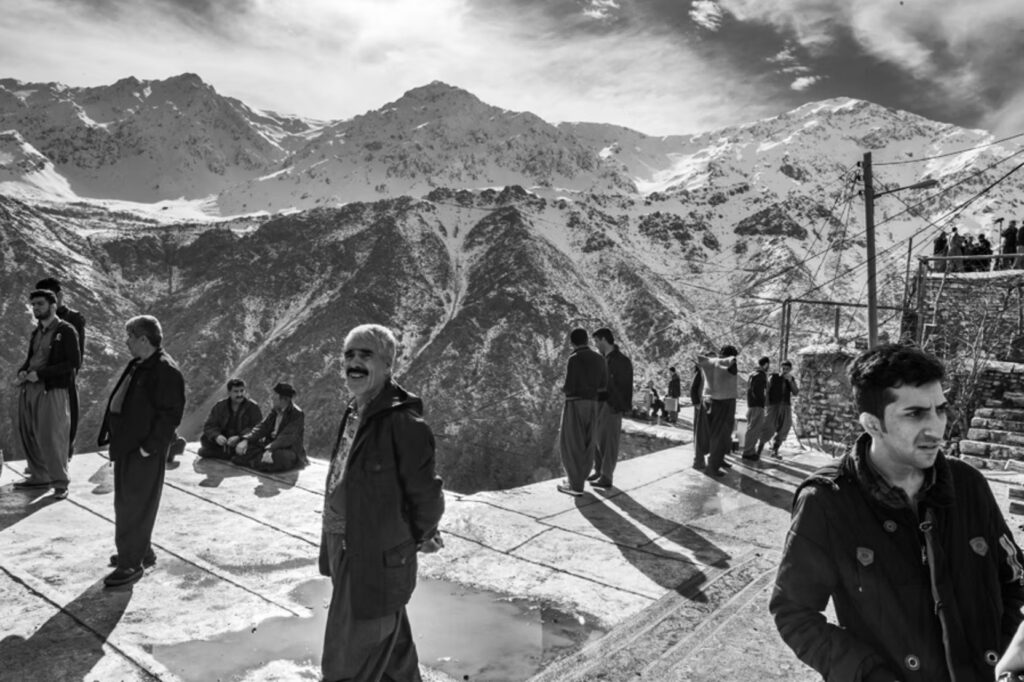
I think that certainty of lack is a different air to live inside. When I hear this phrase I can’t help but instinctively feel that it sounds like we don’t even have ourselves as friends.
Several years ago, I saw a Kurdish woman tweet about how there’s actually no Kurdish translation or origin to that phrase. The first mention of it is in a historical book written by two white men in 1992; the phrase appears as the title, followed by a subtitle informing us that this is a “tragic history.”
When those who have the power to write our history do so in submission to fantasy, a certain shrouding, what possibility are we left with?
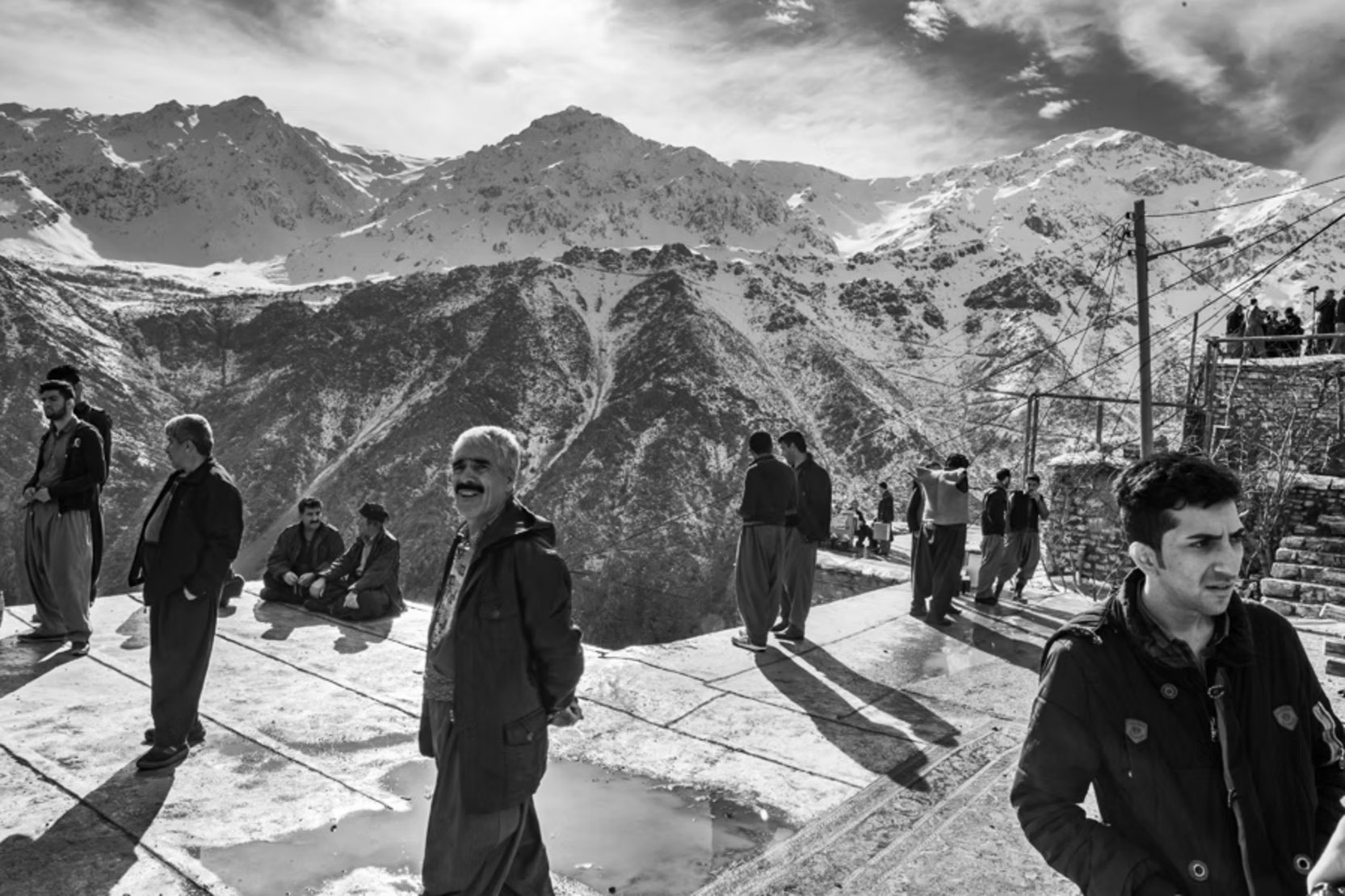
Earlier this year, a friend and fellow poet, Larena Amin, posted to her Instagram story, “You can never say you did not understand the Kurds. We spoke all of your languages.” This came in the midst of heightened repression, execution, and displacement of Kurds across borders, and failure of many to name Kurds. I immediately thought of my father, who speaks my mother’s language, and God’s language, as well as this other language of mist and fear. I thought of how, as Larena reminds us, despite knowing the languages of Iran, Iraq, Syria, and Turkey, Kurds have been marked as outsiders. There’s that simultaneous proximity and impossibility. We can make ourselves legible until there’s another war in which we are made both hyper- and in-visible, another room in which we cannot exist, until, even with our understanding, our language fails our faces. The mountains exist, as places of being, of making, even celebration, yet remain a site that at any moment we may have to retreat to, flee to, alone, when we are forced into isolation by the words or bombs of others. What else is there to do with language, how to be heard?
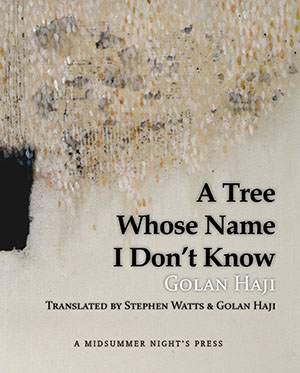 In his book, A Tree Whose Name I Don’t Know, Syrian Kurdish writer Golan Haji writes, “We have nothing but this silence — with its forgiveness and its cruelties.” How much is forgiven in our silence, that which doesn’t need to be said, re-lived? And how much is lost to/in it? All that can never be understood, all the pulling and pushing toward isolation. Is it forgiveness or cruelty when that which, once said, can be picked apart beyond recognition and must thus be held instead in silence, where unspoken beliefs begin to shape the air?
Much like the connections I make with writers like Celan and Pizarnik, I am thinking of the Martinican poet and philosopher Édouard Glissant. In his defense of the right to opacity for everyone, Glissant speaks of the responsibility and ineffability of defining identity: “It does not disturb me that there are places where my identity is obscure to me, and the fact that it amazes me does not mean I relinquish it.”
In his poem, “BLOOD ON THE STAIRS,” Haji opens with “What’s this grimace when / the cackling stops of a sudden?” When the poet faces silence, what’s communicated elsewhere? What does the face say, when meeting the horror that warrants a silence? To me, comedy is not far from horror. Both arise from deep trauma; are reactions to what cannot be spoken. In Haji’s “BLOOD ON THE STAIRS,” even laughter stops in the face of [ ]. What is it here that I’m trying to explain of the silence; what am I forcing an understanding of here, that Haji intentionally left opaque? When Haji writes, “The river of words is shallow, / the dead were swimming in it before you,” I feel silence communicating beyond transparency. What else, against the dead, can be said but silence?
If I am attempting to question how we view form and the ways we build a lexicon, I believe each Kurdish writer starts with the ways we build language out of “unbearable knowing.”
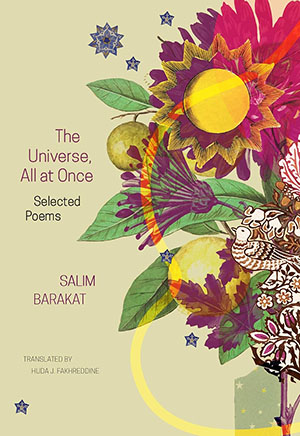 In The Universe, All at Once, Syrian Kurdish writer Salim Barakat considers the inheritance of silence, and, much like Haji, what the stakes are to force the word out of silence. “To cross the mountains is to cross through words the poets have forgotten”; and “These tweezers, to pull the word by its tongue.” Silence as form in Kurdish poetics becomes a place to be protected, legible only to those who know, and a reminder of its harsh necessity.
I’m thinking of how a Kurd chooses to write through the mountains, not necessarily aloneness but rather a landscape through which to remember. There’s language the Kurd tasks themselves with, and an understanding of a violence required to get there; “to pull the word” echoes the idea that closes Haji’s “BLOOD ON THE STAIRS,” of “letting speech bleed.” Barakat finds his way out of the force behind silence into a persistence against it.
In “The Grand Ghazal,” Barakat’s use of the ghazal form, its repetition and refrain, showcases the depth of silence as a form for Kurdish poetics; it’s present despite the named and more recognized container. Underneath the rhyme is a constant reminder of all the layers to the tragedy, the multiple shifts in each story. Barakat is able to write through, in the words of Glissant, the obscurity of identity, while simultaneously claiming it for himself. He writes, “I love them when they know a lot / about the white of a tired paper, blank like death,” and I think of how this “them” is not explicitly named, but is claimed fully, without exceptions. Just as in Aracelis Girmay’s “You Are Who I Love,” what’s clear is the love and belonging and claiming. Whereas “no friends but the mountains” leaves no room for one another, here, Barakat loves beyond reason. It’s possible that, across borders, and even our varying language, we are legible, lovable to each other. Of course, a phrase whose lineage we are unable to trace in our language (“no friends but the mountains”) cannot and was never meant to hold the complexity and depth of our love and holding for each other. Against forced isolation, recognizing or expelling the others’ gaze, we have a place for each other. You know, whether we find ourselves in war, or not — love. Barakat writes of the love, “a heartbeat below fury / or a stone’s throw above silence.” No matter the unspeakable endurance, the distance.
I love them
when they know
much that is
unbearable
to know.
—Salim Barakat, The Universe, All at Once
In addition to naming the belonging and love, Barakat forces me to ask: what is the result of holding our histories as Kurds? What is it to “know much that is / unbearable to know”? If I am attempting to question how we view form and the ways we build a lexicon, I believe each Kurdish writer starts with the ways we build language out of “unbearable knowing.”
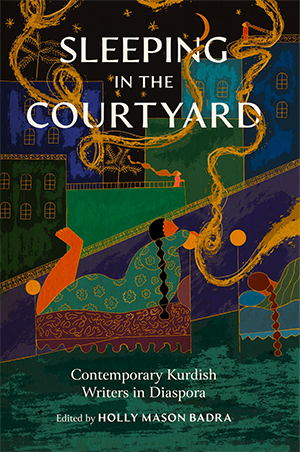 Sleeping in the Courtyard, edited by Holly Mason Badra, is an anthology of Kurdish writing that includes poems from contemporary Kurdish writers in diaspora. Whenever I’m asked about Kurdish writing, whether about women poets, contemporary poets, or our community, I think of and reference Holly’s work in curating this book. It’s a beginning, somewhere to imagine more from. When I read Zhawen Shali’s “A Night with No Country,” featured in Sleeping in the Courtyard, the contradictions she opens the poem with — “To get used to this new world / is not the problem. / Getting used to life / is not that simple. / I have always said so.” — made me think of the “unbearable” nature Barakat speaks to. Yet, still, within Shali’s abstraction and opacity, she is clear in explaining what life is. “Life is a sharp nail under the tongue of those days — / the days that enforce silence.” “Life is a homeless night.” Readers have the context upon entering: the poem is a translation from Kurdish (Sorani), and the title gives way to our own assumptions in connection, too. Beyond this context, Shali operates with the right to opacity, when writing, “Through strange ups and downs, / inside the jail, / there existed another jail / that introduced multiple shadows to my being.” The specific jail is not named, but those that know can trust the meaning and feeling of a word, can meet the speaker in “unbearable knowing.”
If Pizarnik “speak[s] with my voices” can echo a sense of [im]possibility in silence, then Shali’s “painting the walls with your voice” can equally evoke a sense of desperation, lack and longing, and building out of a void. Shali beautifully moves from the strangeness of the plurality and experience of imprisonment into a plurality of self — of ways to take charge of being.
Alongside the plurality in speech, Shali offers readers directives to fight against all that could force one into silence. “You need to throw stones at God’s windows / and wrestle with flames.” I wonder, what speech and movement are legible to God? In Sleeping in the Courtyard, Pınar Banu Yaşar writes “they are calling genocide a bookmark and God’s absence a statement / a miscommunication” and it makes me think of a poem by Sherko Bekas on the Halabja massacre which became a point of fixation for me in interrogating the language of religion and how that relates to the validity of a people.
I want to continue in the tradition of making something new with silence without answering who I am, without mentioning the word statelessness. I want language to do more.
The Halabja massacre took place on March 16th, 1988. Thousands of Kurds were killed by a large-scale Iraqi chemical attack. It was carried out during the Anfal Campaign, considered by some a genocide, whose name was taken from the title of the eighth chapter of the Qur’an (al-anfal) or “The Spoils.” In the poem, Bekas’ speaker is writing a complaint to God after Halabja, sharing it with the tree, then, the poem itself speaks, and the reader journeys along until the complaint is eventually rejected for being in Kurdish, with its messenger harshly stating that it must be in Arabic.
When I first read “Answer” by Sherko Bekas years ago, I knew immediately that it wouldn’t leave me. Again, I thought of my father, who knows Arabic and Persian and Kurdish. And his ability to speak of God in the language that makes it valid not only to other people, but also in the eyes of God. I also thought of the difference that remains between the Kurd and non-Kurd in the countries we inhabit, that we must know another language, and the rarity of another stepping into our language. And I thought of the use of our language, and from the use, a silence against validity. I kept thinking of the pulse underneath these words, the tree crying, the poem speaking, and then this mundane, “God’s fourth secretary down,” and the harsh and brief use of the word “idiot,” when stating “people here don’t know Kurdish.” There’s much to say about this poem. Halabja is a city now known for a massacre, a “suffocating,” as Bekas puts it. We begin with a suffocation, and the poet who dared to speak beyond it.
I first read Bekas’ work in the chapbook Fifteen Iraqi Poets edited by Dunya Mikhail. The first Kurdish poet I ever read, displayed within the label of a nation to which his writing didn’t seek to belong, and amongst writers whose own affiliations only served to highlight his otherness — those writers affiliated with Saddam Hussein’s Ba’ath Party, for example, were inevitably affiliated with support of massacres like Halabja. I originally had a deep sense of pride at seeing the word “Kurdish” in a book at all, let alone one of poetry. Later, I felt a sadness that I had not discovered Bekas in the context of his Kurdishness. A decade or so out from this first experience, I feel silence can be the only container for my awe, confusion, and admiration for the inclusion, for the belonging I felt at seeing his name, however clunky.
When these Kurdish writers are speaking to, in, and against silence, this silence becomes the container for all that is unbearable or that can’t be known. Silence allows for separation and belonging at once, which happen upon us both transparently and opaquely. I want to continue in the tradition of making something new with silence without answering who I am, without mentioning the word statelessness. I want language to do more.
There are ways that I’m stunned into silence that simply intersect with my Kurdishness, or the fact of my mother belonging to a different language, country, and culture, or the experience of being a woman, or attempting to find God in a language He might reject. I want silence to hold that feeling and then go beyond it, to be seen alongside my Kurdishness. All at once. And so, I think my words at times stand up to Bekas’ explicit nature, while also disappearing into Barakat’s expanse. I look to Shali’s directives as a possibility for movement forward. Then I am reminded of what I can’t know, or what my father is unable to make known; the tragedy out of which Bekas speaks, despite a tensing in the throat. I want to belong and know how I don’t.
I want to make friends with what I’ll learn in the mountains.