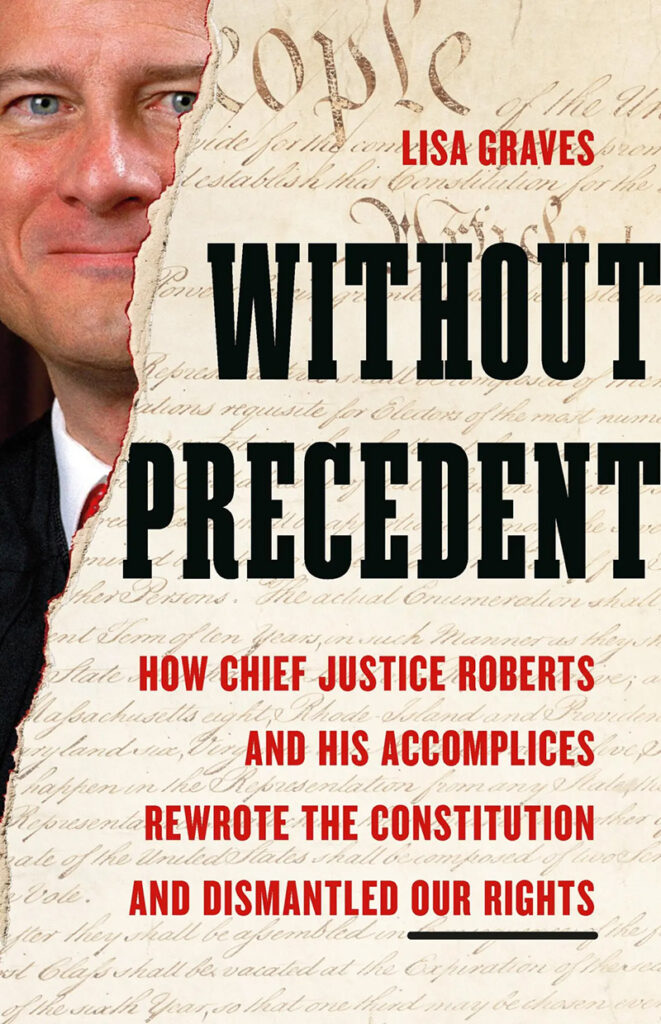
In this timely book, Lisa Graves demonstrates the extent — and danger — of the changes to judicial and executive power enacted by Chief Justice Roberts.
Without Precedent: How Chief Justice Roberts and His Accomplices Rewrote the Constitution and Dismantled Our Rights, by Lisa Graves
Bold Type Books/Hachette 2025
ISBN 9781645030676
Early in his second term, after addressing a joint session of Congress, President Donald Trump walked down the aisle shaking hands and then turned to Chief Justice John Roberts, patted him on the back, and said, “Thank you again. Thank you again. I won’t forget.”
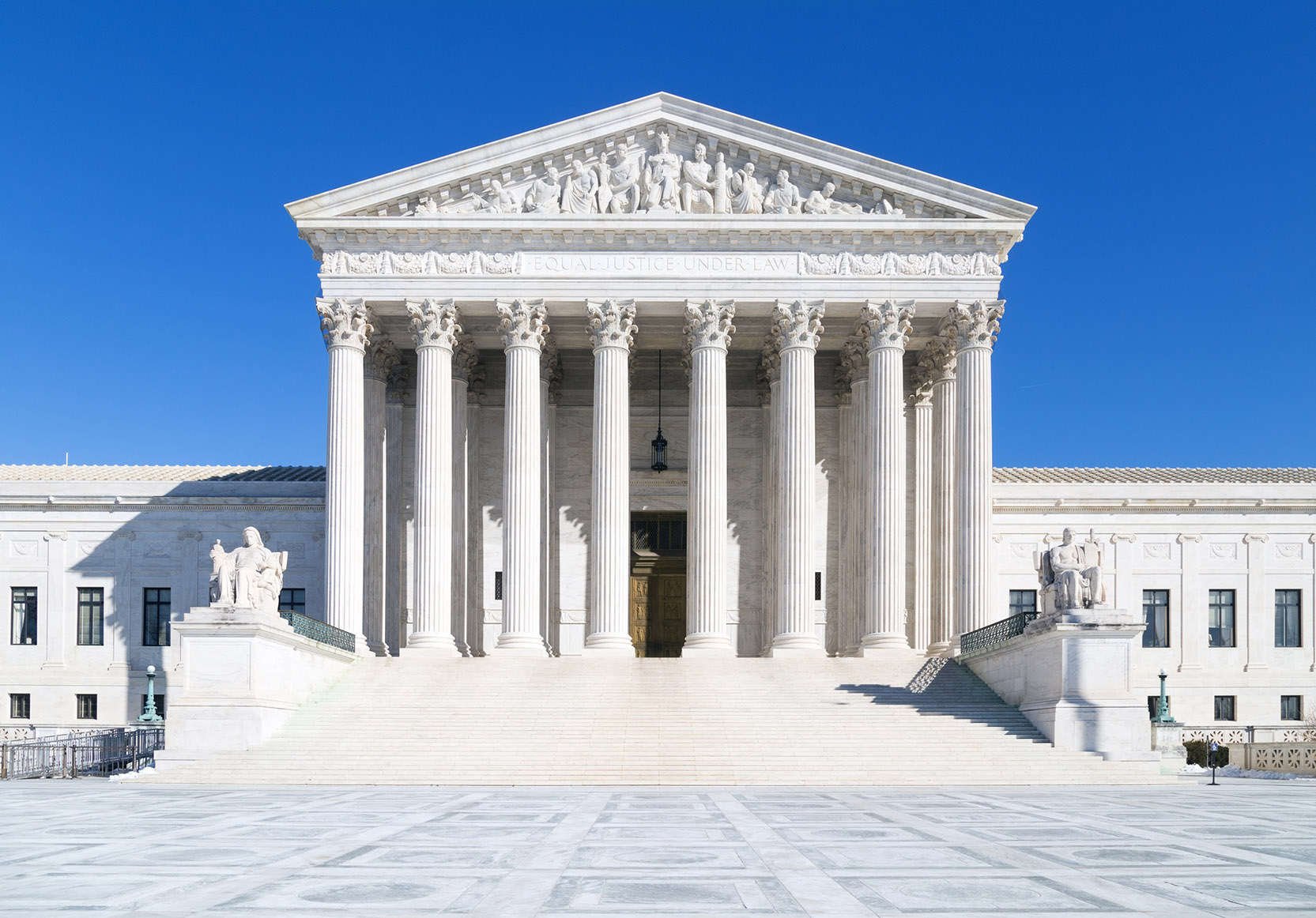
What had Roberts done to deserve such gratitude? A lot. In the aptly named Supreme Court decision Trump v. United States, the chief justice, writing the majority opinion on behalf of the six Republican-appointed justices, had invented absolute presidential criminal immunity, a concept that nowhere appears in the U.S. Constitution. As a result, Trump is now shielded from several pending criminal indictments. Roberts and his fellow Republicans also emasculated the Fourteenth Amendment’s ban on insurrectionists holding office, clearing the way for Trump to run for a second term despite his incitement of a deadly coup on January 6, 2021.
Indeed, during the twenty years he has served as the seventeenth chief justice, Roberts has been an obedient champion for the Republican Party. In her withering and revealing new book, Without Precedent, Lisa Graves describes in detail how Roberts “has established himself not as a fair referee but as a diabolically effective player rewriting the Constitution and remaking America in accord with his reactionary political agenda, as he strategizes how to move the ball forward and disarm the opposition.” Sound too hyperbolic? Read the book.
Graves know what she is talking about. After serving as Deputy Assistant Attorney General under Attorneys General Janet Reno, a Democrat, and John Ashcroft, a Republican, she was Chief Counsel for Nominations for Senator Patrick Leahy on the U.S. Senate Judiciary Committee, where she investigated the careers and ideologies of judicial nominees, including John Roberts. She learned how to examine the finances of sitting judges when she was Deputy Chief of the Article III Judges Division of the Administrative Office of the U.S. Courts with oversight of the Financial Disclosure Office. She was an adjunct law professor at George Washington University Law School and worked as the Senior Legislative Strategist for the ACLU on national security and civil liberties. From 2009-2017, she led the Center for Media and Democracy. Most recently, she founded and is the current Executive Director of True North Research, a national investigative watchdog group that describes its mission as exposing “the dark money fueling regressive agendas targeting vital institutions in our republic, such as our courts and public schools.”
In her highly readable and engaging new book, Graves employs both aspects of her experience. She offers a thorough legal analysis of how Roberts has turned the Supreme Court into the legal arm of the Republican party. And, of equal importance, she provides an in-depth investigative exposé of the corrupting influence of millions of dollars spent to groom ambitious hand-picked Republican lawyers — like John Roberts — first to serve on lower federal courts and eventually to secure lifetime appointments to the Supreme Court. Once they reach the highest court in the land, these justices receive lavish gifts cumulatively worth millions of dollars from wealthy individuals, and well-funded shadowy think tanks, with financial and ideological stakes in the outcomes of cases the justices choose to hear, thereby raising serious conflict of interest issues that Roberts has studiously ignored for two decades. According to Graves, Roberts is “by far the richest member of the Supreme Court, with a net worth of more than $25 million.”
Roberts has Steadily Advanced the Republican Agenda by Distorting the Constitution
Most people first heard of John Roberts during his Senate confirmation hearing on September 12, 2005, when he famously disarmed critics by assuring everyone, “I have no agenda, but I do have a commitment. If I am confirmed, I will confront every case with an open mind…and I will remember that it’s my job to call balls and strikes and not to pitch or bat.” As Graves convincingly demonstrates, throughout his tenure Roberts has been consistently pitching and slugging for the Republican team, betraying his promise to the American people. “I strongly suspected that assertion was not true then,” she writes, “and it is demonstrably untrue now.”
Graves accuses Chief Justice Roberts of “presiding over the most corrupt Supreme Court in American history.”
Delving into the most important Supreme Court decisions of the last twenty years, Graves reveals how Roberts conveniently casts aside long-established legal precedents to reach his pre-existing conclusions and how he selectively uses the theory of “originalism” — limiting the Constitution to its meaning in the 18th century — when it suits his purpose and then ignoring it when it doesn’t. By examining Roberts’ judicial legerdemain in detail, Graves reveals, among other things, that his “reactionary docket has included destroying environmental rules that protect our planet from predatory billionaires, overturning legal precedents that limited access to deadly guns, forging the shield of religious freedom into a sword to attack equality and access to health care, decimating labor unions’ power to bargain for worker’s rights, unleashing waves of billionaire spending in our elections in ways that corrupt our representative democracy and sever public institutions from vital traditions of impartiality.”
Graves also reminds us that, under the oath that Roberts took, he swore, “No one is above the law under our system, and that includes the President,” who “is fully bound by the law, the Constitution and statues.” But then in Trump v. United States, Roberts “took it upon himself to essentially rewrite the Constitution and the rules that always governed presidential power in order to wipe away the stain and consequences of Trump’s actions.”
Given the breadth of Graves’ analysis, it is useful to focus on one of the prime reasons Roberts was installed on the Court: to control the outcome of elections to ensure Republican victories. In his rulings she sees his “superseding allegiance” to the “reactionary political objectives of the Reagan branch of the right-wing movement: to the lost causes that even a majority in Congress would not dare impose, like dismantling the landmark Voting Rights Act.”
On June 25, 2013, Roberts rewarded his patrons handsomely by casting the deciding vote, and writing the majority opinion, in Shelby County v. Holder, an excellent example of the tactics he has used to advance the Republican platform in many other critical areas of the law. The landmark decision in Shelby struck down Section 4(b) of the historic Voting Rights Act of 1965, which contained the coverage formula used by the Department of Justice to determine which jurisdictions are required to preclear changes to their voting procedures given their histories of racial discrimination in voting. Congress had enacted the Voting Rights Act to address entrenched racial discrimination in voting, “an insidious and pervasive evil which had been perpetuated in certain parts of our country through unremitting and ingenious defiance of the Constitution.”
To reach his desired result, Roberts rejected the factual and legal conclusions of both a federal district judge and the U.S. Court of Appeals for the D.C. Circuit, which had upheld the constitutionality of Sections 4 and 5 of the Voting Rights Act. Those courts, unlike Roberts, had relied on relevant and substantial evidence in the Congressional record showing that Sections 4 and 5 remained necessary to combat ongoing racial discrimination. To achieve his assigned ask, Roberts gave no weight to the fact that Congress had passed — and Republican presidents had signed — legislation reauthorizing those sections in 1970, 1975, 1982, and 2006 (this last reauthorization good until 2031). And to finish his job, he cast aside no fewer than four Supreme Court decisions upholding the constitutionality of those provisions: South Carolina v. Katzenbach (1966), Georgia v. United States (1973), City of Rome v. United States (1980), and Lopez v. Monterey County (1999).
Instead, speaking for himself and his fellow Republican appointees, Justices Antonin Scalia, Anthony Kennedy, Clarence Thomas, and Samuel Alito, Roberts found that the country “has changed,” and the evidence of past racial discrimination bore “no logical relationship to the present day.” He cited what he called the “equal sovereignty of the states” — a sanitized version of the pernicious “states rights” doctrine that had been used to justify slavery — as if it meant that a state that engages in racial discrimination is equally entitled to as much respect as one that does not.
Justice Ruth Bader Ginsburg wrote a strong dissenting opinion that was joined by Justices Stephen Breyer, Sonia Sotomayor, and Elena Kagan, emphasizing the wealth of current evidence of persistent racial discrimination in voting. She acknowledged that while such discrimination had indeed decreased since the passage of the Voting Rights Act in 1965, much of that decrease was attributable to the enforcement of the Act itself. She wryly noted that “[t]hrowing out preclearance when it has worked and is continuing to work to stop discriminatory changes is like throwing away your umbrella in a rainstorm because you are not getting wet.”
Graves shows how the Shelby ruling has made it easier for state officials — especially in Republican-controlled states — to engage in voter suppression. Five years after Shelby, nearly 1,000 U.S. polling places had closed, many of them in predominantly African American counties. Fifteen states have passed laws that removed provisions such as online voting registration, early voting, shuttle services to take people to the polls directly after church, same-day registration, and pre-registering people under the age of 18 to vote. A 2017 study in the American Journal of Political Science found that the Voting Rights Act’s preclearance requirement led to greater representation of Black interests. According to the Brennan Center for Justice, the states most likely to enact voting restrictions were states with the highest African American turnout in the 2008 election. A 2020 study found that jurisdictions that had previously been covered by preclearance substantially increased their voter registration purges after Shelby. Virtually all voting restrictions after the ruling were enacted by Republican-dominated legislatures.
“Over and over, Roberts’s rulings have undermined Americans’ voting rights under a mirage of supposedly neutral principles, all the while advancing a reactionary agenda shared by a billionaire elite to which he seems deeply beholden.”
Follow the Money
“No Supreme Court majority in American history has ever been constructed the way the Roberts Court has — with the help of big, dark secret money,” Graves writes. What sets Without Precedent apart from other books and articles that have analyzed the judicial activism and reactionary ideology of the Roberts Court is how effectively she marshals detailed financial information to expose the role of wealthy right-wing operatives and well-funded organizations in helping groom and confirm Roberts and other conservatives for the Supreme Court. Once secure for life, they have been lavishly rewarded by their sponsors in exchange for advancing a regressive agenda restricting people’s freedoms and hampering government oversight.
“No Supreme Court majority in American history has ever been constructed the way the Roberts Court has — with the help of big, dark secret money,” writes Graves.
Graves identifies “the individual most singularly responsible for reversing Americans’ reproductive freedoms and other rights through the Roberts Court” as Leonard Leo. Leo served at the influential Federalist Society in various capacities for more than 25 years. In 2019, The Washington Post reported that the group had paid Leo an annual salary of more than $400,000 for a number of years. In October 2022, little more than three months after the Roberts Court reversed Roe v. Wade — the case that had protected reproductive freedom for almost 50 years — Leo accepted the John Paul II New Evangelical Award from the Catholic Information Center. He described how his mission of Catholic evangelization “extends to every facet of life, including law, public policy, and politics.” Graves reports that between 2014 through 2017, Leo-tied groups spent more than $250 million on getting Republican nominees approved to federal courts.
Graves documents how Roberts was “the first beneficiary of the twenty-first-century political machine funded to pack the Supreme Court with right-wing operatives,” and she accuses him of “presiding over the most corrupt Supreme Court in American history.” For example, Graves reveals, based on research by the public interest group Fix the Court, that since his ascension to the Supreme Court over 30 years ago, Justice Thomas has “accepted more than $4 million worth of secret gifts from billionaire benefactors who befriended him after he became a justice.” According to a ProPublica report in August 2023, Thomas “has enjoyed steady access to a lifestyle most Americans can only imagine,” including “at least 38 destination vacations,” 26 private jet flights, voyages on luxury yachts, “two stays at luxury resorts in Florida and Jamaica,” and other opulent vacations, all of it “underwritten by benefactors who share the ideology that drives his jurisprudence.” Tying everything together, Ginny Thomas, the justice’s wife of 38 years, introduced Leo at a 2017 gala event as having “single-handedly changed the face of the judiciary.”
And John Roberts has done nothing about this or the appearance of conflicts of interest by Justice Alito, which Graves also describes in detail. The ethical failures of Justices Thomas and Alito “represent an ethical failure by the chief justice who enabled them,” she writes.
All told, Graves concludes, “John Roberts has presided over a Supreme Court that routinely limits the rights of ordinary people while elevating the rights of corporations and the powerful.” The dramatic changes to the scope of legislative, executive, and judicial power that Roberts has orchestrated, she writes, “has strengthened both presidential power and corporate power in ways that make us less free and less safe and that even put the future habitability of our planet at greater risk.”
What is even more ominous is that Graves reached her conclusions before the chief justice presided over the Court’s recent manipulation of its shadow docket to enable Donald Trump to wreak havoc to the Constitution and the rule of law. Can’t wait to read her next book.