The Hafız Ahmed Ağa Library, which has survived five sovereignties over two hundred and thirty years, is kept alive by the descendants of a Greek girl enslaved in Chios in 1822.
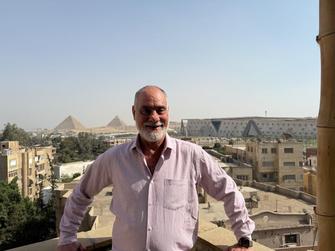
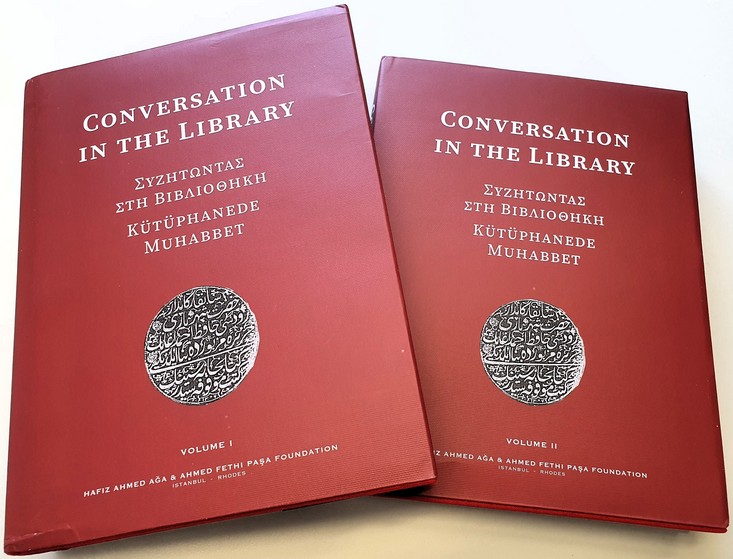
On the morning of May 11, Tarık Tüten opened the gate of the Hafız Ahmed Ağa Library on Orpheus Street in the medieval walled city of Rhodes, an Aegean island, to a group of convened scholars. It was the first international academic workshop ever held at the library, built around the two-volume work Tüten edited and published in 2025: Conversation in the Library — Συζητώντας στη Βιβλιοθήκη — Kütüphanede Muhabbet.
The work runs to 1,120 pages, brings together seventy scholars and one novelist around an eighteenth-century Ottoman manuscript collection that has survived five sovereignties on Rhodes, and sits in over two hundred institutions worldwide. Tüten is the library’s deputy trustee — the seventh generation of his family to hold the role. He is also the great-great-great-grandson of Şemsinur, a Greek girl enslaved in Chios in 1822 whose descendants have kept this library alive.
Several of the scholars at the workshop had contributed essays to the volumes and came now to work directly with the manuscripts that their research had drawn on from a distance. Gisela Procházka-Eisl, of the University of Vienna, who traced Ahmed Fethi Pasha’s diplomatic career through the Austrian press in Volume I, had come to present new research on Ahmed Fethi’s personal book list. The document led her to the building. “A manuscript truly lives,” Tüten said from Rhodes, “when it is read, studied, when its calligraphy and illuminations are analyzed, the content is questioned, compared, interpreted, and brought into scholarly conversation.”
The inscription above the library entrance bears the name of the Rhodian who built it — Hafız Ahmed Ağa. The inscription on the school across the street bears the name of the imperial princess his son was commanded to marry. Neither bears the name of the woman who became the mother of the line that kept both buildings standing for two hundred and thirty years.
In fact, Şemsinur does not appear on any inscription in Rhodes. She entered history as a nameless line item in an Ottoman State tax register, one of fifteen hundred enslaved people from the Greek island of Chios, taxed at the humiliatingly low levy of thirty-three piasters each. The first real acknowledgment of her existence appears in the dedication of Conversation in the Library, the work that her great-great-great-grandson edited around the library she helped preserve.
Hafız Ahmed Ağa was born on Rhodes in the early seventeen-forties. He was educated at the Enderun, the elite palace school inside Topkapı Palace, and rose to become Chief Equerry to Sultan Selim III, serving under three consecutive sultans. To do so at high levels, Tüten writes in his essay, “was arguably as challenging as winning three consecutive Olympic gold medals.”
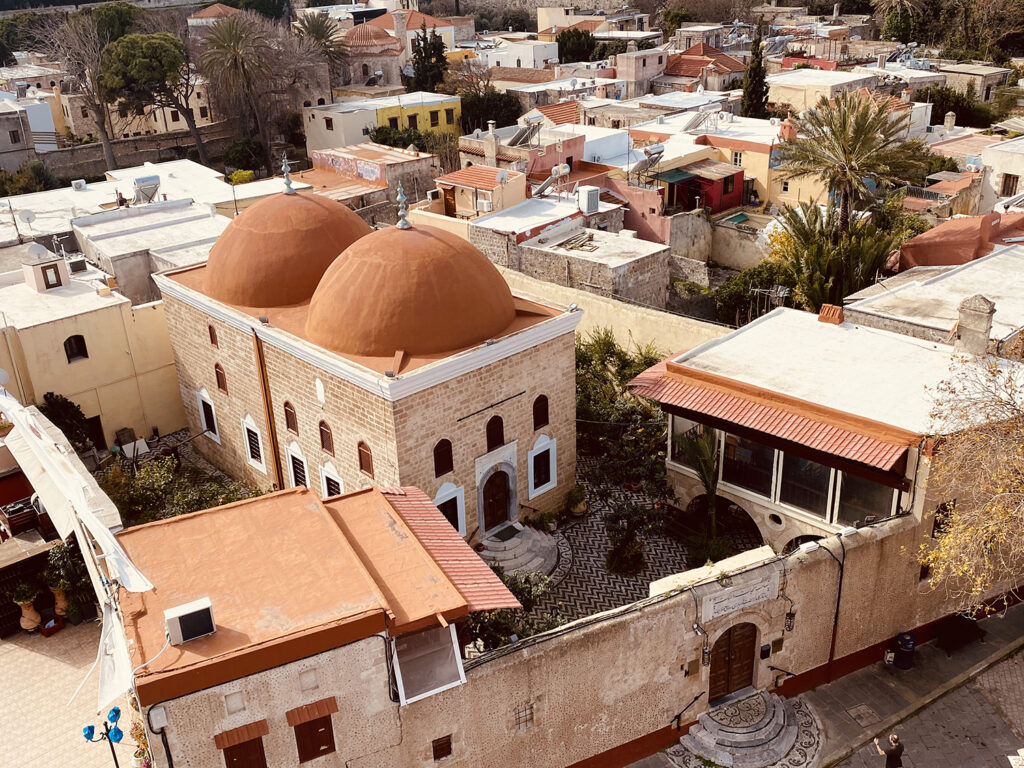
Within a year and a half of retiring in 1789, Hafız Ahmed Ağa had built a manuscript library in the Turkish quarter of the city’s medieval walled center — two domed rooms in a high-walled courtyard, holding eight hundred and twenty-eight volumes of jurisprudence, religious commentary, Sufi mysticism, medicine, astronomy, logic, history, and literature. He stamped each book with his personal seal, as John R. Barnes, who has spent decades cataloguing the collection, records in Volume I, so that every reader would know that he was, as the historians Cemal Kafadar and Gülru Necipoğlu write in their prologue to the volumes, “here in Rhodes, in a library built by a Rhodian, and reading a book endowed by that Rhodian.”
He set up the library as a vakıf, an Islamic charitable endowment that put the institution beyond the state’s reach. The deed he signed before the kadi, the religious court judge, wrote women into the governance structure explicitly: the mother first, then the wife, then the eldest child — a provision Elyse Semerdjian examines in her essay on the vakıf in Volume II. Few men of his era and position did that.
Hafız Ahmed Ağa’s financial base came partly from real estate in İzmir where Greek families paid rent, as Efthymios Machairas traces in Volume I. He died in 1801, murdered under suspicious circumstances during the hajj, probably on the Sultan’s orders so that his considerable wealth could be seized — a story Machairas reconstructs in the same essay. His wife Saliha was left with their infant son Ahmed Fethi in Eyüb, a district of Istanbul built around the tomb of one of the Prophet Muhammad’s companions and one of the city’s most sacred neighborhoods.
The volumes trace Ahmed Fethi Pasha across Europe. Procházka-Eisl follows him through Vienna in the eighteen-thirties, where Austrian newspapers tracked his every movement. Ömer Eğecioğlu, a researcher who has spent years documenting Ottoman cultural connections to Europe, records what those visits produced: Johann Strauss I dedicated the Ball-Racketen waltz to Ahmed Fethi in 1837; Josef Lanner dedicated Die Osmanen to him in 1839. Princess Metternich stood in as hostess at his Vienna balls because Şemsinur remained in Istanbul.
Ahmed Fethi was sent to London for Queen Victoria’s coronation in 1838 but arrived six weeks late, ill, and missed the ceremony. The actual Ottoman representative at Westminster Abbey was the ambassador Sârim İbrahim Pasha. On his way to London, according to research Eğecioğlu surfaces in the volumes, Ahmed Fethi stopped in Rhodes and visited his father’s library. Şemsinur never saw it. She spent her life in Istanbul watching a different water.
They renamed her Şemsinur — sunlight, in Ottoman Turkish.
Şemsinur was born in 1810 in Chios, an Aegean island famous for mastic resin. Farmers score the bark of the mastic trees each summer, letting the resin fall in drops onto calcium-whitened ground. The Sultan’s court prized mastic as a breath freshener, and Chios held a royal monopoly on its production. As long as the harvest kept flowing to Istanbul, the island’s Christian Greek population stayed largely exempt from the pressures bearing down on other communities under Ottoman rule.
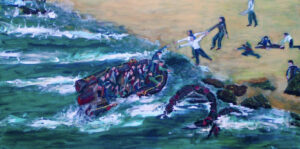
She was twelve in the spring of 1822 when Greek revolutionaries from the island of Samos arrived on Chios looking to ignite an uprising. The island’s elected leaders refused. The local Archbishop issued an excommunication against the instigators. The elders tried to bribe the Samians to leave. The Samians lit the fuse and fled when the Ottoman fleet appeared, leaving Chios to face what followed.
Ceyda Karamürsel, a lecturer in Ottoman history at SOAS University of London, spent years in the Ottoman State Archives reconstructing what happened next. The pençik registers, tax records that logged enslaved people as imports, list the names of captors who paid duties on each person they brought from the island. Buyers sold them across the empire, from Smyrna to Tripoli to Egypt to Istanbul. The register Karamürsel found contains fifteen hundred entries.
The massacre was not a religious eruption, Karamürsel argues. The Sultan used it as a deliberate political and economic tool to crush a domestic rebellion. The state sold Chiot women at rock-bottom prices in the streets of Pera, the European-facing quarter of Istanbul, rather than in the regular slave market, deliberately, as a warning to the city’s Greek population.
The girl from the house with the balcony crossed the Aegean in the hold of a ship. Hafız Ahmed Ağa’s widow, Saliha Hanım, purchased her. Nektaria Anastasiadou, the sole fiction contributor to Conversation in the Library, thinks Saliha must have been of Rhodian Greek origin because she raised her son Ahmed Fethi to speak Greek with native fluency. She converted to Islam, officially at least. She learned Turkish. They renamed her Şemsinur — sunlight, in Ottoman Turkish.
Anastasiadou notes the description preserved in family memory: Şemsinur was “exceptionally kind and selfless, to a degree that no longer exists today.” Karamürsel reads that differently: this is how people describe enslaved people in households built on absolute power. The selflessness may have been a survival strategy so thorough it became character.
In 1828, Ahmed Fethi came home wounded from the Russian front. He was twenty-seven and Şemsinur was nineteen. They married.
Sultan Mahmud II commanded Ahmed Fethi to marry his teenage daughter, Princess Atiye, which required divorcing Şemsinur. Ahmed Fethi begged for an exception and got it. He married Atiye in 1840 and kept Şemsinur.
Princess Atiye died in 1850, aged twenty-six. Ahmed Fethi returned permanently to the pink waterfront mansion he shared with Şemsinur in Kuzguncuk, a village on Istanbul’s Asian shore where Greek, Armenian, and Jewish families had long lived alongside Muslim neighbors. That same year, Ahmed Fethi sailed with Sultan Abdülmecid I through Lemnos, Chios, and Crete to Rhodes, where he ordered a clock tower and a school built next to his father’s library. Both were completed by 1853. He dedicated the school to the memory of Atiye Sultan. Şemsinur was alive when that inscription went up. She was in Kuzguncuk. He had sailed past her island. Ahmed Fethi died in 1858, leaving debts to pastry shops, butchers, watchmakers, and lavender sellers, as Procházka-Eisl notes in her Volume I essay.
Şemsinur lived another twenty-three years in Kuzguncuk. She never returned to the Aegean. On July 4, 1881, she learned that her son Mahmud Celaleddin had been arrested on charges of conspiracy against Sultan Abdülhamid II. She suffered a stroke and died the same day. She never learned what Kostopoulou reconstructs in Volume II: that the Sultan’s men took Mahmud Celaleddin from his cell and strangled him with a soaped cord. He was strong. He cried out and the animals in the neighborhood trembled. His screams stopped. His body went to the hospital wrapped in a sheet.
The volumes Tüten built are the latest act in that succession — not governance this time, but memory.
Among the library’s twelve hundred and eighty-eight manuscripts is a copy of the story of Yusuf and Zulaikha — Joseph and Potiphar’s wife, as the Bible tells it. The Quran calls it ahsan al-qasas, the most beautiful of stories. Yusuf is sold into slavery, enters a great household, suffers, rises. The library’s copy traveled from the Quran into Persian poetry, then into Ottoman Turkish, onto these shelves in 1793. The family that purchased Şemsinur owned, among their manuscripts, the story most like hers. It was already there when they bought her.
After Mahmud Celaleddin’s death, his sister Saliha Yegane took over the family foundation and began traveling regularly to Rhodes to protect the library, as Elektra Kostopoulou documents in Volume II. The institution their grandfather built, which their mother had entered as a slave, passed to Şemsinur’s daughter, then her granddaughter, then her great-granddaughter. The dedication of Volume I lists the matrilineal line down to Leyla Tüten, Şemsinur’s great-great-granddaughter, and calls it three hundred years of women’s empowerment.
The volumes Tüten built are the latest act in that succession — not governance this time, but memory.
Leyla Tüten was Tarık Tüten’s mother. She died at ninety-nine while the project neared completion. Her son placed copies in over two hundred institutions, from the Library of Congress to the Bibliotheca Alexandrina, and in May 2026, opened the library to scholars for the first time to work directly with the manuscripts his ancestor helped preserve.
The archive recorded what the system did to Şemsinur. What it could not recover was what she carried inside it. Tüten gave that task to Nektaria Anastasiadou — an act of restorative justice the archive could not perform — an Istanbul novelist who writes in three languages and holds a Turkish passport, someone formed by the same sea, the same entangled Greek and Ottoman world.
Anastasiadou’s short story “Tear Trees” takes the voice of an imagined Turkish woman of the present generation traveling to Chios to look for the house with a balcony. She finds herself in the kitchen of an elderly Chiot woman named Andromache. She makes fennel fritters from what she finds in the refrigerator. Andromache bites one and says: “Fennel fritters! That’s the way my grandmother made them, no tomato. Are your people from Chios?”
“In a way.”
Later, the narrator tells Andromache about her grandmother’s aversions: “Do you know what my grandmother never used in her food? Mastic. She didn’t even buy mastic lokum. Whenever my grandfather wanted mastic lokum, my grandmother said no. I asked her why. She said that mastic brings tears.”
“The Chiot woman forbade it,” Andromache says with certainty, as if she has witnessed my entire family history, all two hundred years of it. She sighs, pats my hand, and adds, “Remembering the island was painful for her.”
This is fiction. The mastic prohibition is Anastasiadou’s imagination, not documented family memory — but imagination built from the materials Tüten provided. The archive cannot tell us what Şemsinur carried in her body from the island. The story suggests one answer: grief passed down through habits across six generations, stripped of its explanation, surviving only as a refusal. She never used mastic. No one remembers why.
“Cooking is the last thing to die,” Andromache tells the narrator. “Whether you like it or not, you pass it down like genes.”
Anastasiadou’s story is possible because someone went looking. Karamürsel’s essay includes a figure who shows what happens when nobody does — an unnamed Cretan woman, encountered in eighteen-seventies Egypt by a British missionary. Enslaved in the same generation as Şemsinur, in the same circumstances, she spoke Arabic by then, wore Egyptian country clothes, and had children and grandchildren. A “settled sadness” marked her face. When asked about her family, she said “all was forgotten.”
“To stand in the courtyard of the library in Rhodes as Şemsinur’s great-great-great-grandson,” Tüten said from Rhodes, “is perhaps to complete, symbolically, a journey that history left unfinished. She crossed the Aegean at twelve in the darkness of rupture — not as a traveler, but as a child carried away by violence, loss, and the machinery of empire. The sea that connected the islands and the Ottoman world also became, for her, a sea of separation. She never returned to it.”
Şemsinur’s daughter Saliha Yegane made the first journey to Rhodes. Her granddaughter followed, and her granddaughter after that.
“The Aegean that once carried her away,” Tüten said, “now receives her story again, spoken freely, consciously, and with dignity.”
The Mediterranean is not scenery or geography. It is an archive of movement.
For a library like this one, Tüten said, the Mediterranean is not a border. It is the medium through which lives, texts, and memories moved. The manuscripts show this. Some traveled from Baghdad to Cairo, from Cairo to Istanbul, from Istanbul to Rhodes, crossed seas, changed hands, survived empires, each copy accumulating its own marginal notes along the way, the handwriting of readers who found something the main text did not contain, and which no other copy holds. “The Mediterranean contains both forms of movement at once,” Tüten said. “Creation and destruction, encounter and rupture.”
The book has traveled the same routes. A publication born around a library in Rhodes now sits in two hundred institutions, from the Bibliotheca Alexandrina to the Library of Congress — and in the Koraes Public Library on Chios, the island to which Şemsinur never returned. Christine Philliou, a historian at U.C. Berkeley, calls the volumes “a model of post-national history,” tracking the conflicts and connections that Greek and Turkish national narratives usually keep apart. The library sits between those narratives, belonging to neither, maintained by the descendants of a Chiot girl purchased in a slave market in 1822.
The inscription above the library entrance bears Hafız Ahmed Ağa’s name. The school across the street bears Atiye Sultan’s name. The dedication of the volumes Tüten edited records Şemsinur’s name at the head of the matrilineal line that kept the library alive through five sovereignties.
Looking out at the sea from Rhodes, Tüten said, the Mediterranean is not scenery or geography. It is an archive of movement. “Kütüphanede Muhabbet becomes more than a publication about a library,” he said. “It becomes an attempt to reactivate the Mediterranean itself as a space of muhabbet — a place where difficult histories are neither erased nor simplified, but held together within a shared human landscape.”