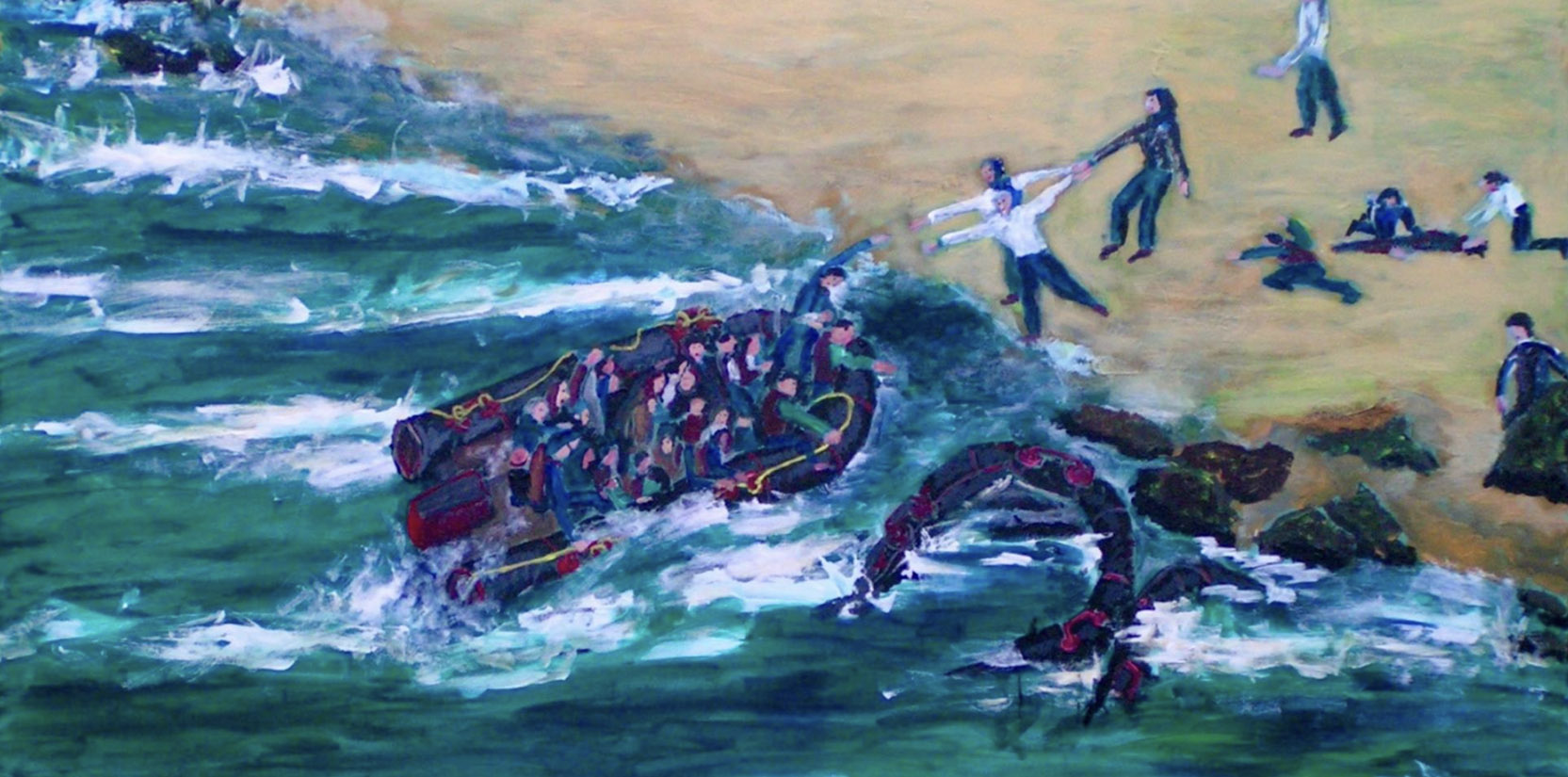
In this dystopian satire, a hotel worker struggles to understand what is happening in the midst of a refugee crisis, austerity, bureaucratic collapse, and the slow destruction of a Greek island.
No one comes to the hotel anymore. Weeds have sprouted through the roof, the window panes are shattered, and cats leap from every room, striped or black as asphalt, red with white flecks, orange and yellow, the most random color combinations, but always with the same exact gaze, the gaze of a murderer. The tourists disappeared last summer, when the refugees got stuck on the island. Hundreds of refugees arrived every day, three hundred, five hundred, among them old men, pregnant women, squealing babies. As soon as they neared the shore, they put on their life jackets, took out a knife and jabbed it into the inflatable boat so they’d be considered shipwrecks. Later on, there was that attack at the camp, the bomb that exploded. People said jihadists had done it as a reprisal because some Sisi supporters had found refuge on the island. I have no idea who Sisi is, but what a girly name for a guy. The bomb killed thirty people. A directive was issued, tourists should no longer come to the island. Anyway, they’d already stopped coming.
The last guest was a German. I was watching a Turkish television series. The TV was still working then, now it’s out of order, has been since last winter. He appeared suddenly, rushed inside. He asked me if I had a free room. I thought to myself, are you an idiot, man, don’t you see what’s happening around you? Meanwhile the cats had sprung to their feet, they were circling him and purring. The German knew Greek, he had a strange way of speaking, but he knew the language. He said he was some sort of expert and had come to conduct research, I didn’t understand what kind exactly. He asked, how much does the room cost? Nothing, I said. He insisted on paying. Look around, I said, the mattresses are disemboweled, the sheets are torn, the windows won’t shut. He insisted, I have to pay, that’s the right thing to do, and so on.
Before I took him to his room he cast a glance at the television. What’s that, he asked, something Turkish? Yeah, I said, Suleiman, you haven’t seen it? Suleiman the Magnificent. The show rocked that year even though it was being broadcast for the third or fourth time. Every afternoon, from six to seven, the village was dead quiet. Everyone frozen in front of the television. The debt crisis, poverty, unemployment, all erased. Suleiman was performing his miracle. The German marveled, you watch Turkish shows in Greece? Unprecedented, unprecedented, he murmured, I have to note that down, it’s extremely interesting. He took a notebook from his jacket and scribbled something.
I used to hate cats, now I’ve grown used to them. Not that I like them, not that I call out to them making ps-ps-ps noises. I just pretend they don’t exist. That’s what I do with cockroaches, flies, mosquitoes. And with mice. Fortunately, they’ve become scarce, done in by the cats. I don’t remember if the German arrived before or after the explosion in the camp. It must have been before. Afterward, communication and transport stopped, now not one boat is anchored in the harbor. Occasionally a sailboat passes off shore, leaning slightly, but I don’t see anyone at the helm. Strange.
The German was a quiet type. He’d disappear all day, lost in his research. I don’t know where he went. At night he wrote. Bent over a little table in the piercing cold, must have been the beginning of February, his scarf wrapped around his neck, the cats dancing and jumping all around him, every now and then he’d stop, stamp his foot nervously, bite his pen. Our electricity had been cut about a month after his arrival, so I found him an oil lamp.
He paid me every Monday. Fifty euros, a crisp, brand-new bill. I thought of asking him what I was supposed to do with his money. I wanted to say, do you see something I can buy? Naturally I didn’t say anything, I just took his money and thanked him. I’ve become a philosopher due to the situation. I used to get into arguments, express my opinion. Now everything’s the same to me. I know one thing, and it is that I know nothing. Isn’t that what Socrates said? Or was it Plato? I’m not sure. Anyway, I know one thing, and that is that I know nothing, that’s what I believe. I’d take the German’s fifty-euro bill and put it in a cookie box. I never counted them until the afternoon the crazy guy showed up, the one who claimed to be a policeman.
Where is the German? he asked. He’s gone out, I said. Did he return yesterday evening? He must have. I was sleeping, so I assume so. How long has he been staying here? Ι couldn’t remember. Wait a second, I said, I’ll count the fifty-euro bills. And then I realized the German had been staying at the hotel for two months. It was already spring. The crazy guy went on, did anyone visit him? Have you noticed any suspicious behavior? He was trying to appear calm, but his voice was trembling. I wondered if he really was a policeman. We didn’t have police on the island. The last cops had mutinied, the government had declared martial law, and the cops had attempted to escape in any way possible. Some drowned. People say the others are now hiding in the camp, wearing turbans, praying on their knees, beating their chests and saying Allah, Allah so that no one suspects them. Gossip. Nonsense. They all drowned. The sea doesn’t joke.
I’ve become a philosopher due to the situation. I used to get into arguments, express my opinion. Now everything’s the same to me. I know one thing, and it is that I know nothing.
It occurred to me that the German might not have come out yet, that he might still be sleeping in his room. Let’s go have a look, I said to the crazy guy. The room was empty and shockingly tidy. On his bed were a dozen curled-up cats. As soon as they saw us, they shot their tails high like flags, ready to attack.
The guy asked me, what’s that? On the little table was the thick notebook in which the German scribbled. The guy grabbed it and started flipping through. What does it say here? he asked. Whatever, I replied. He insisted, here, here. I bent down to see. It’s German, what can I say? I started laughing. It had been a long time since I’d laughed. Confiscated as an instrument of crime, the moron said. And then he left with the notebook.
I laughed again a few days later when Patú came to see me. She had tried to leave as soon as we were shut off from the rest of the world. She almost drowned like a dog and returned. She was Cypriot, very dark, brawny, and hairy. A while back she had opened the first and only brothel on the island, some said she was a transvestite. I don’t believe it because we did it once. Then again, I might not have noticed. I have good news, she announced, shouting from the stairwell. She was disheveled, her voice breaking from emotion. Cyprus will save us, she screeched.
Cyprus, which you people have ridiculed forever because of our accents, she said, strutting about. There was a plan, they’d been preparing it for a while in Nicosia. They’d put it in the works with complete secrecy when the third bailout package was signed. Tsipras, however, wouldn’t hear of it. To tease her, I said, Tsipras who? What bailout package? She began explaining… Tsipras, the referendum, Merkel, Schäuble and all that gang. Get to the point, I said. She shouted, Union! Union! The Cypriots had convinced the Europeans, soon the agreement would be signed. In three months, we’ll be united with Cyprus, Greece will be saved. A national guard must be formed on the island immediately to prepare for the officials’ reception. Patú had thought of me, I was one of the select, she emphasized. I could hardly control my laughter, but I wanted to see the extent of her insanity. Or her despair, same thing.
What will happen to the others? I asked. She fixed me with a questioning look. The others, I said, pointing with my head. I meant those in the camp. Even though the entire island was a camp by then, they’d occupied the whole thing, shacks all over the place, broken furniture, tents everywhere except the harbor and that narrow strip of land along the beach where the hotel was located.
I continued, will the camp also unite with Cyprus? Patú hadn’t thought of that. Her face darkened. I felt sorry for her and said, I’m with you! Everyone is with you for Union! She pranced down the stairs, completely satisfied.
The question of the German’s disappearance bothered me for a while. Where did he go when he left the hotel? He would leave early in the morning and return when it was already dark. What did he do all that time? He had nowhere to go except the camp. Impossible. Nobody went in there. After the first months, the situation had become rough. In the beginning, when they began arriving on the island in inflatable boats, we called them “the refugees.” The radio also called them “the refugees.” The nine o’clock television news presenter said three hundred refugees arrived today on that island, five hundred on the other island. As if they were all the same. We hadn’t realized that there were differences between them, that some belonged to opposing tribes who had hated each other for centuries. The fighting between them quickly got out of control. The camp director fled to the mountains, said he was a shepherd, pretended to have lost it. The two remaining policemen mutinied along with some others who had been sent by the central government. Now there must be three or four separate camps on the island. Only the resounding voice of the imam, chanting the same incomprehensible words each evening from various points of the island, seems to unite them.
The last news bulletins showed pictures of the capitol, crowds of people in parks, dazed expressions during freakish heat waves, people huddled up beside each other and trembling in the freezing cold, makeshift tents in city squares.
I don’t have any news from Athens. They held elections some time ago. They might have held them again. When they cut the television, I was a bit upset. Mainly about Suleiman. I’d gotten sick of the other shows, all those blondes, all those men in ties barking at the same time from their boxes on the screen. The last news bulletins showed pictures of the capitol, crowds of people in parks, dazed expressions during freakish heat waves, people huddled up beside each other and trembling in the freezing cold, makeshift tents in city squares. Sheets thrown beneath trees, arguments over plastic water carboys, frying pans on grills beside the streets. Athens might also have become a camp. Who knows.
I know one thing, and that is that I know nothing. That’s what I think. I go down to the harbor. The paved street leads to a wooden pier. Abandoned fishermen’s nets are rotting. Beyond, on a series of rocks, the lighthouse rises with a green lamp like a carnival hat. The sea’s surface is wrinkled, the waters move while remaining still, stirred by invisible black whirlpools hidden in the depths. I look at the edge of the horizon. I am seized by unbearable nostalgia. Nothing in excess, I say to myself. The Ancients are always useful.