A Mediterranean boat crossing, Mary shipwrecked in the Aegean, and a daughter’s scrolling screen collapse into a single shifting sea of image and memory.
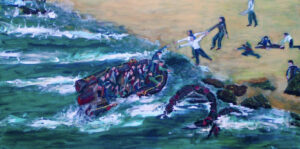
The boat was small. Smaller than promised, smaller than paid for, smaller than hope required. She could have sworn it was large when she first stepped onto it. And she blames herself now for not realizing sooner that no, no, this boat is small. Far too small. Shrinking, in fact.
The sea, too, was changing. It was less blue than memory. Memory-blue is always too pure, too saturated, like water in a child’s drawing. This blue was desaturated. Maybe when you’re dying your brain stops wasting energy on color.
She gripped the wooden sides. The planks beneath her feet groaned. Like a man, she thought, then stopped. Below deck, the others had gone quiet. Mothers with children. Men who had sold everything for whatever this was or was meant to be. I imagine them down there, in that dark space. Bodies pressed together, breathing in each other’s fear and hope, saltwater seeping through the wood.
No, wait. That’s not right. The boat was too small for others. Always had been. More like a crate. The kind that carries fruit. Or weapons. Room for just one. Two, if they didn’t mind the intimacy of drowning together. So: just her. But where is the oar? There had been an oar, I think, albeit crude. More like a board with ambition. But it’s gone now.
She had thrown it overboard when he went under (ah, so there had been a second), praying in her desperation it would reach him like a raft. But water doesn’t care about intention. It just keeps going. And so her calculations hadn’t balanced the way her son’s equations were supposed to.
He had always been bad with numbers. I imagine her remembering how his first-grade teacher had called them in. She’d gone alone. Her husband was in the shed, sanding a door for a man who wasn’t good for the money. She could still see the small classroom, smell the chalk dust and children’s lunches, feel the arms of the little plastic chair digging into her hips. “Your son doesn’t take to numbers,” the teacher had said. And her face had said: “You know he’s not like the others, right?” That had also been what the neighbors’ faces had said, and the pediatrician’s, and the man who sold watermelons on the corner. And yet her son, her bad-at-math son, had spent his life insisting that certain equations held: give something up, save something else. Subtract yourself from the world, add salvation to it. The mathematics of self-sacrifice. And in the end, she had watched him bleed out in front of a crowd for a math problem that didn’t hold. It didn’t hold then and it didn’t hold now; with the oar she’d offered the drowning man who drowned anyway. And the boat, if you can call it that, kept groaning. Like a man, she thought again. This time, she didn’t stop herself.
I should explain something. I am making this up as I go. Trying to reconstruct what I can’t possibly know. I’m thinking of Mary. That Mary. But when I try to picture her, I see Olivia Hussey from the 1977 television miniseries, Jesus of Nazareth. It still airs on Greek TV every Pasxa, like clockwork. We’d watch it in our pajamas, our fingernails red from dying eggs. We knocked them with a kind of hungry joy, as if we might crack open death itself. First tip to tip, then base to base. If one end broke, the other still had a shot. And if both were gone, you reached into the basket and tried again. That was the rule. That was the point. Pasxa was for trying again.
It is 3:47 a.m., everyone else is asleep, and the blue light of my laptop screen turns into the blue of the Mediterranean.
Now I picture Olivia on the boat, sea salt crystallizing on her lashes. Tears flowing and evaporating under hot studio lights. And then Zeffirelli shouts “Cut!”; the makeup artist blots her face, and she lights a cigarette. I don’t know what Zeffirelli looked like. My brain supplies a bearded man with shaggy brown hair and aviator sunglasses. Coppola, I think. This is the problem with history. I can only imagine it through what I’ve seen, and what I’ve seen never quite cuts it. I know there were dinosaurs, for example, but when I try to picture them, I see my plastic brontosaurus from age seven, and the cartoon ones from The Land Before Time.
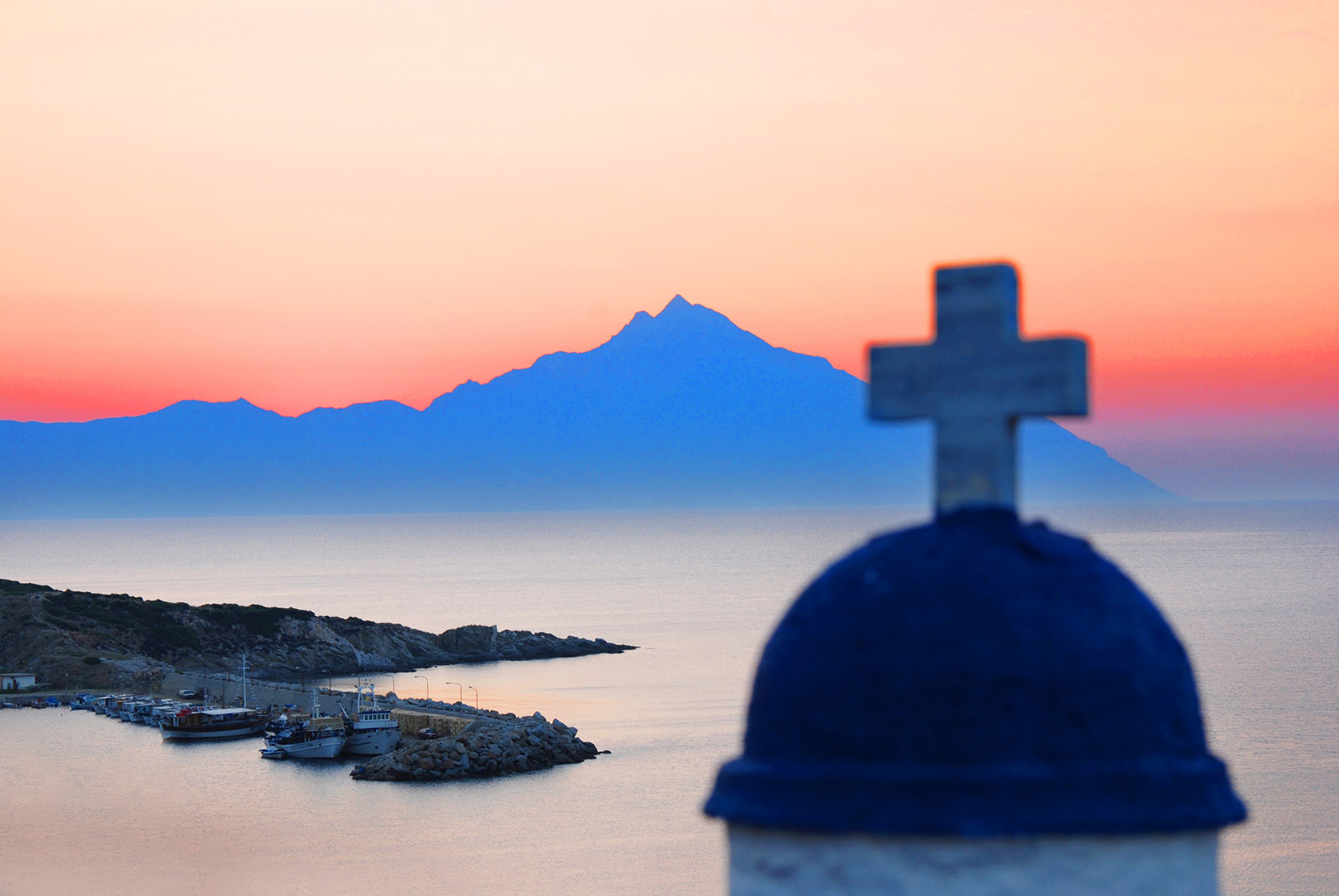
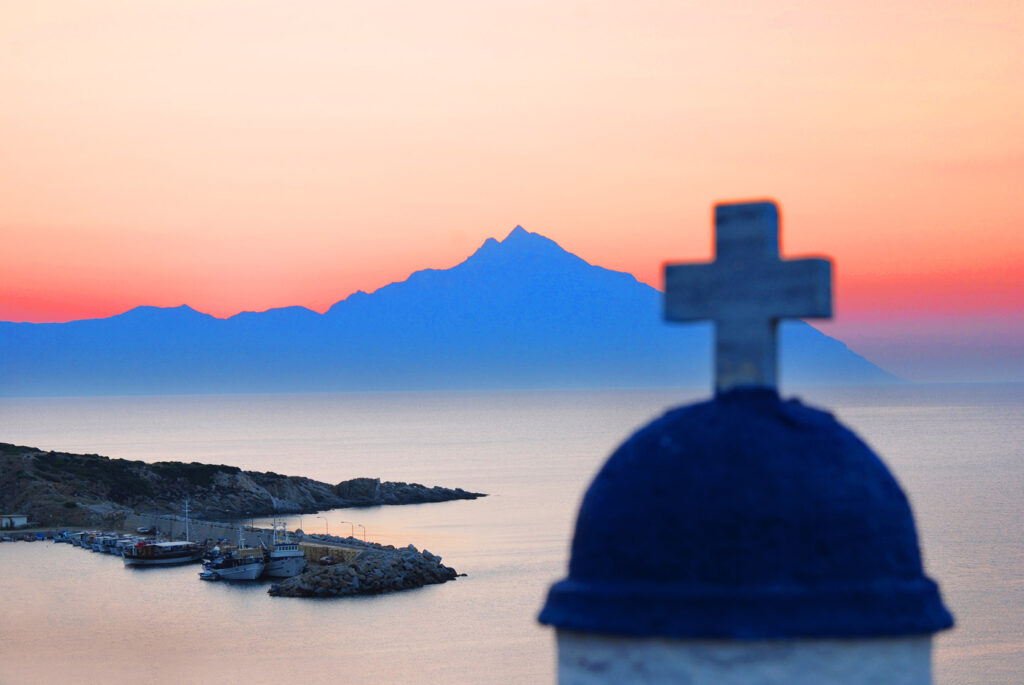
The story goes that after the crucifixion, Mary, adrift in the eastern Mediterranean, was shipwrecked on what would become Mount Athos. The Holy Mountain. Holy because she had perceived it, touched it. So holy, in fact, that no other woman would be permitted to set foot on it again. At one point, not even female animals, though I’ve never been able to picture how that was enforced. Somber priests chasing hens and goats from the churchyard, their cassocks flapping behind them like wings. They had made it so that, conveniently for them, the only woman allowed was one whose eternal absence was guaranteed.
It is 3:47 a.m., everyone else is asleep, and the blue light of my laptop screen turns into the blue of the Mediterranean. It bathes my face, my walls and bed sheets, my one leg poking out from under the sheets. I zoom in on northern Greece, descending from above, my cursor hovering like a tiny angel seeking a landing strip. The peninsula of the holy mountain takes shape, protruding into the Aegean Sea like a finger pointing accusingly eastwards.
I was twelve the year my father went on his pilgrimage. Just as his father had. And presumably his before that. It was also the year I got my period, and so, that year, I was made doubly aware of my existence as a woman in the world. In my young mind, I pictured a mountain made of marble, white and gleaming. I pictured God sitting at its peak like a king on a throne. That was then, but now I see twenty monasteries perched on cliffs above water that swallows boats whole. My father returned with a long beard, a beaded bracelet, and a vial of oil wrapped in bubble wrap. By Christmas, he was shouting at my mother for burning the potatoes.
God, as it turns out, is not perched at the top of a mountain.
I descend further. My laptop grows warm against my legs as the blurry image loads. From this altitude, the monasteries look like LEGO pieces dropped onto a green slope.
Zoom. Now, at close range, the image begins to splinter. From a 360° upload, a group of men stand in the courtyard: monks in cassocks, flanked by tourists in cargo shorts and walking boots. One of the men appears twice, slightly offset. A seam runs through his body, tearing it in half. The stone stairwell kinks at the joint and folds in on itself like bad origami.
God, as it turns out, is not perched at the top of a mountain. God is the sum total of the satellites, CCTVs, street view cars, and iPhones aimed at the earth. And omniscience is nothing but a patchwork of partial perspectives, stitched-together, trying to add up to totality. When God zooms in on Earth, does He wait for the image to load? Do the pixels, those basic units of digital seeing, distill into my neighbor’s burnt toast? A baby’s first laugh? The last selfie before the crossing?
I scroll again. The image won’t zoom any further. But I keep scrolling, absentmindedly. The screen hangs. My scroll wheel snags, freezes, then slips. Suddenly, I am inside. The smell comes first: incense and something earthier, like wet broom bristles. In the corner, a slow-blinking knot of prayer candles. On the stone walls, martyrs breathe faintly. Their eyes track me as I make my way to the front, where, just before the altar, a man in a cassock types on a MacBook.
“You weren’t supposed to get in this far,” he says without looking up. His voice is humid. I walk past him, into the sanctuary.
A bearded man with shaggy brown hair and aviators is on the phone, speaking English: “…more salt on her robe. More sweat. And restock the Egyptian Magic, for Christ’s sake.” The air shifts. I step back. A side door creaks open. A goat walks out, crosses the room. Click-clack, click-clack. It stops in front of me, looks me in the eyes, chewing on something invisible.
“Are you a boy or a girl?” I ask.
“Be-e-eh,” it replies.
The walls contract again. The floor hiccups, then stills. I am back outside, in bed, at satellite altitude. A fruit fly lands on the lower right corner of my screen. I make to crush it with my thumb. I squint. It is not a fly, but a small cluster of pixels, crawling across the blue, toward the outline of a country.
It’s her, I think. Mary-slash-Olivia. She’s ready for her close-up. Lights, camera… The dot keeps moving. No golden cinematic lighting, or orchestra. No wind lifting her robes. I scroll in. The sea jitters, then re-stabilizes. It is a boat, sitting oddly low in the water. It is the wrong boat. Which is to say, it is the right one.
I shut my laptop. My room reassembles itself around me. Outside, the first birds are starting up. In a few hours, my father will wake up and make coffee, put on the morning news, complain about the traffic. I swing my legs out of bed. The floorboards shift under my feet as I make my way to the kitchen. Beside the sink sits a small bowl, a dark stain dried into it. I place it under the tap and turn the water on. I turn away, and when I look back, the sink is full of grey water. The bowl has gone under. It didn’t make a sound.