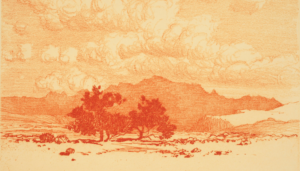
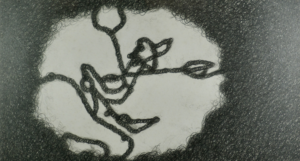
Kurdish artists occupy a fascinating locus in global culture, representing a people scattered across four countries and a large diaspora in Europe and North America.
In a sense, the Kurdish homeland is a chimera, consisting of actual places spread across parts of Turkey, Iraq, Iran, and Syria. Although Kurdistan doesn’t form a nation-state, per se, Kurdish identity is strongly characterized by particular forms of the Kurdish language, culture, and history. As such, Kurdish artists occupy a fascinating locus in global culture, because they come from a people spread across four countries and a large diaspora in Europe and North America. Inevitably, questions of identity, exile, memory, and cultural survival appear in their work. At the same time, as with all artists, we shouldn’t reduce Kurdish art to politics alone — many Kurdish artists explore universal themes including love and friendship, and they sometimes stray from representation into abstraction, and experimentation. We present here only a modest selection of the many Kurdish artists and photographers extant in 2026.
Those featured with bios, art, and comment:
Ebrahim Alipoor
Rushdi Anwar
Pedram Baldari
Huner Emin
Shadi Harouni
Hayv Kahraman
Shorsh Saleh
Medya Stemerding Shikhagaie
Sahar Tarighi
Murat Yazar
See also the work of our Featured Artist for HAWAR • TMR 60, in Rojda Idil Aslan’s Zehra Doğan, Kurdish Resistance Artist.
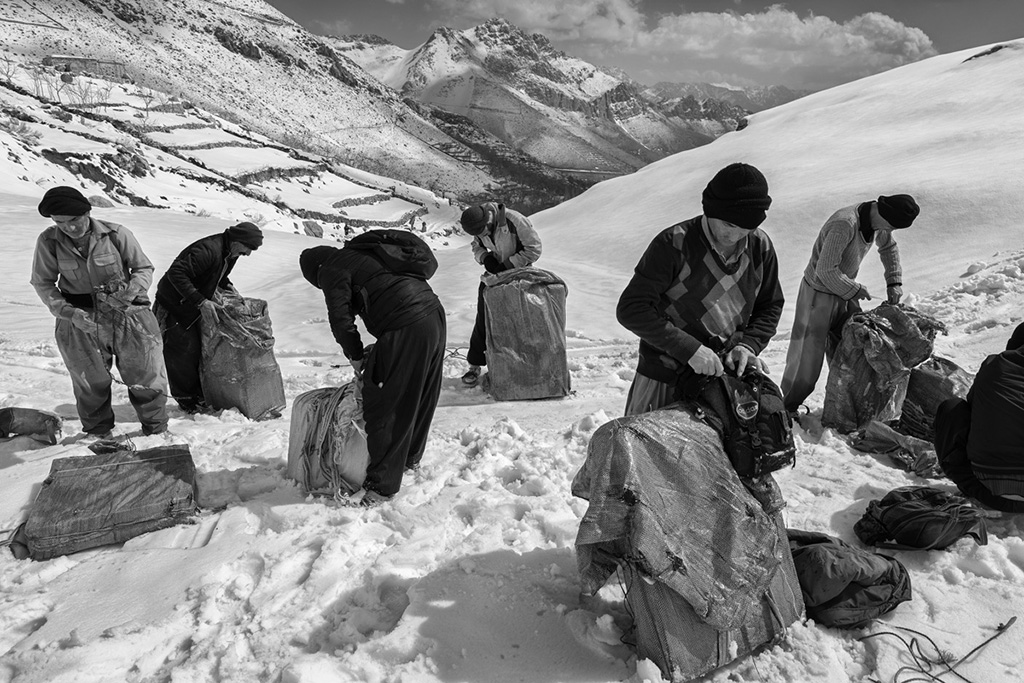
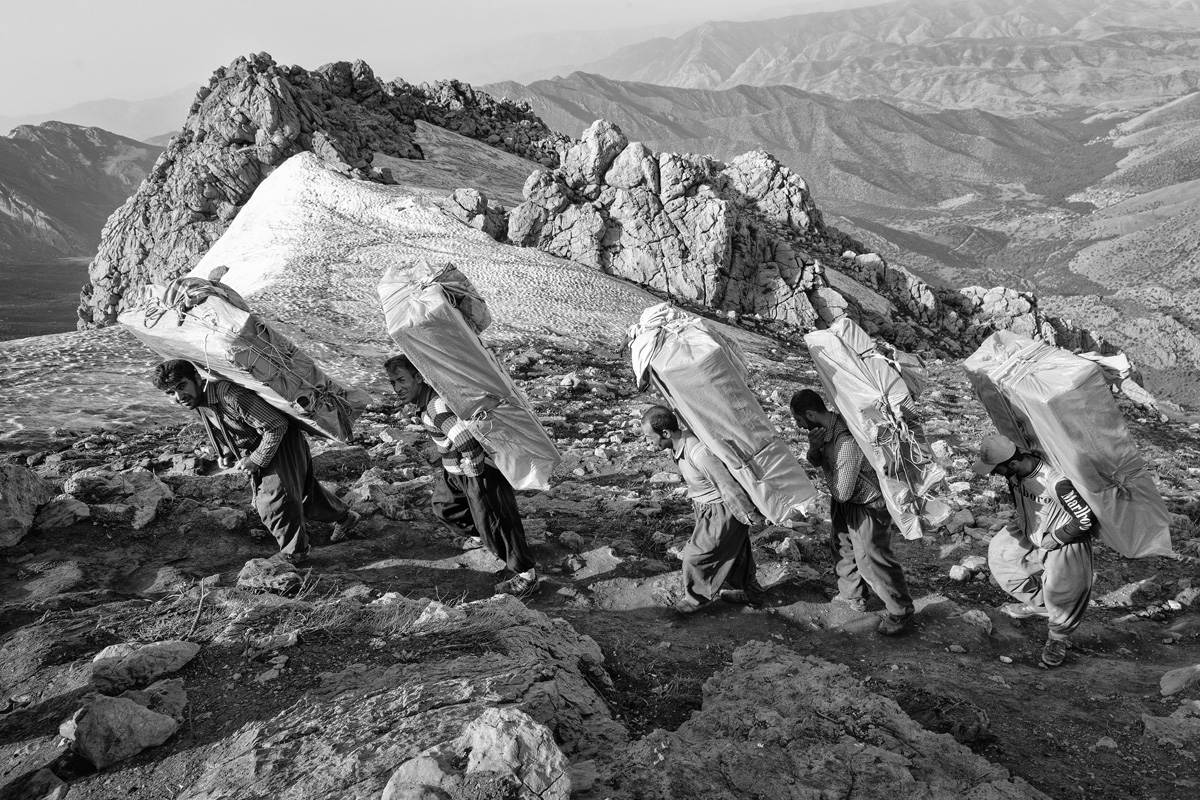
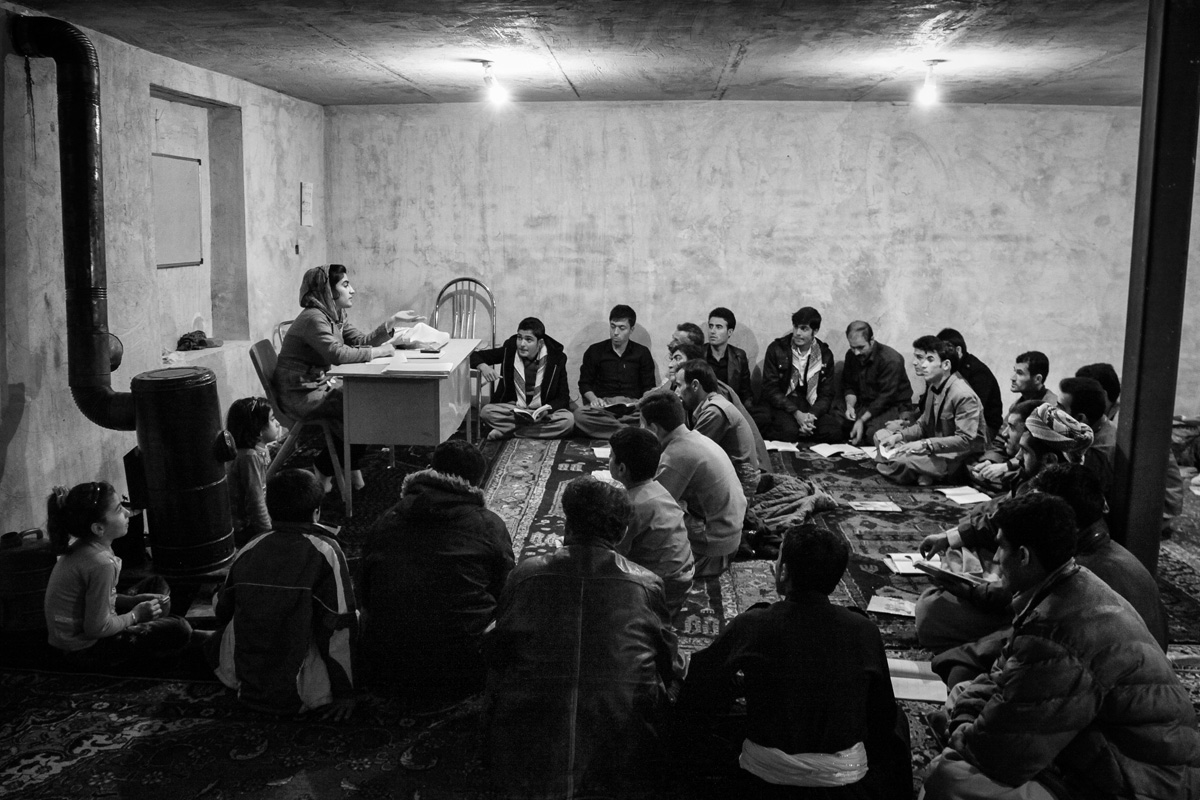
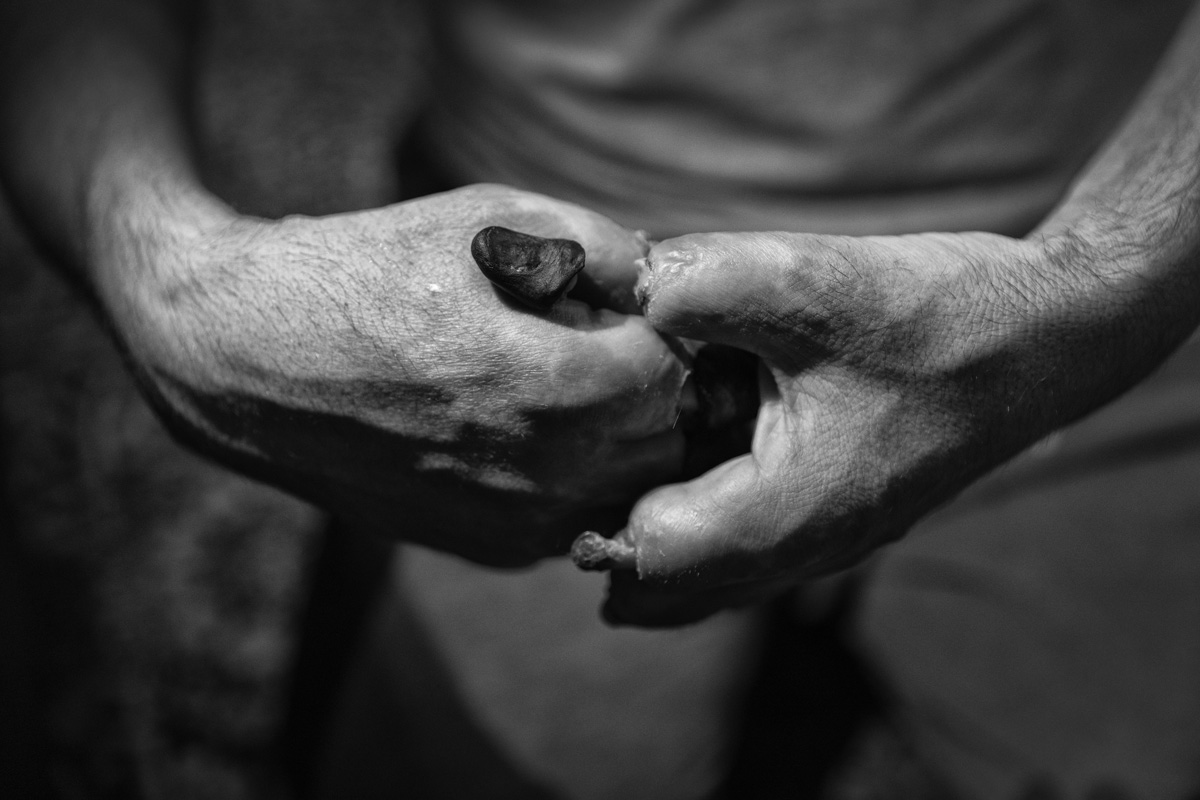
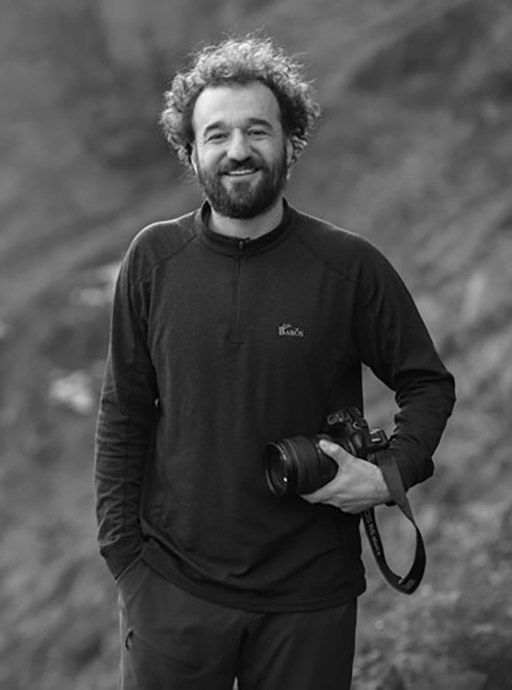
Ebrahim Alipoor is a photographer born in Baneh, Kurdistan, Iran. Alipoor’s work focuses on storytelling through photography, exploring social and political issues under challenging circumstances. He views photography as a powerful medium to engage audiences, particularly in regions like Iran, where governmental restrictions and censorship pose significant challenges. Despite these limitations, he seeks to connect with people and inspire change through his work. Alipoor’s photography has been exhibited internationally and has won several awards including Asia Portraits 2024, World Press Photo 2025. He has contributed to several films and made three documentaries.
From his series Bullets Have No Borders.
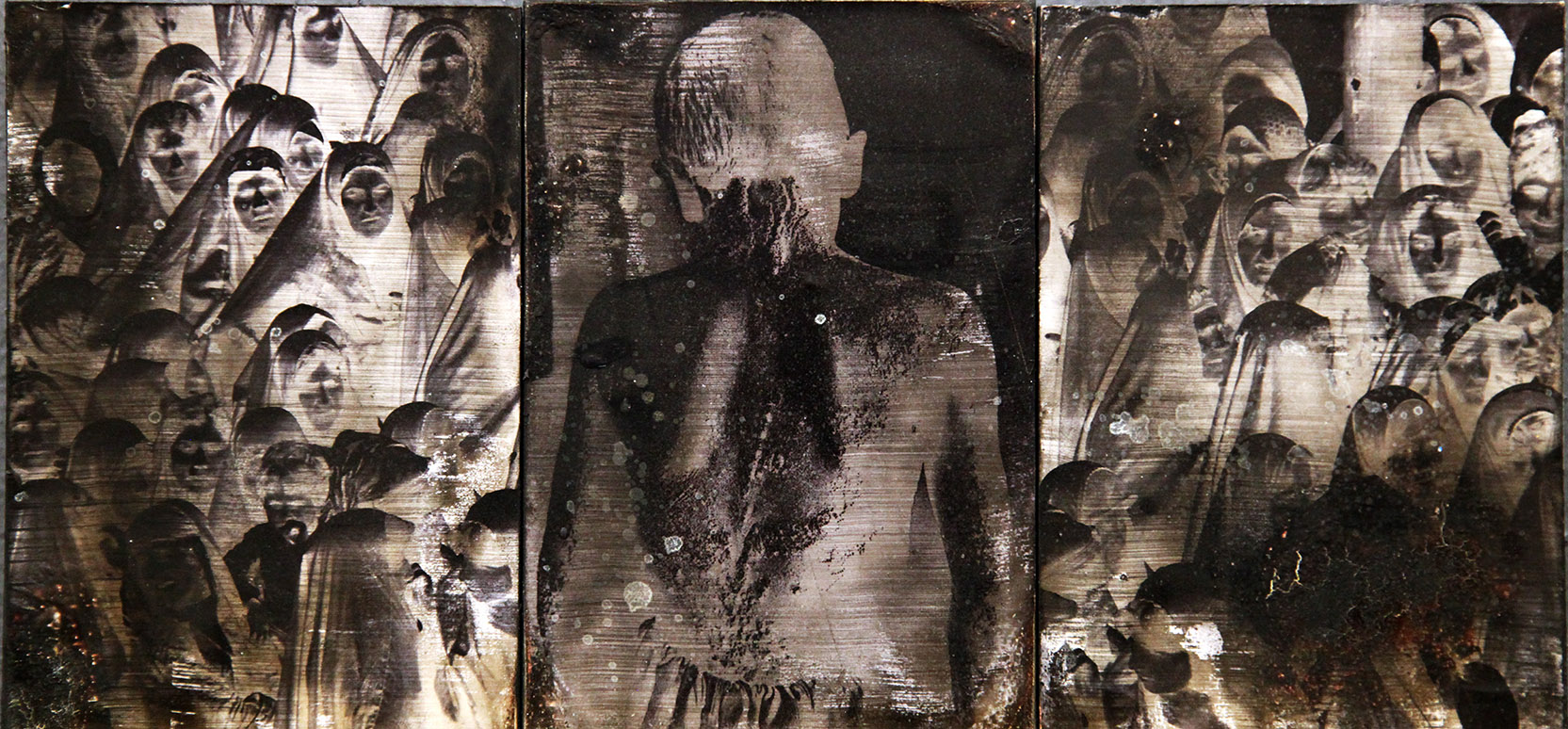 Rushdi Anwar, from "A Few Lines of History"—Photographic installation prints treated with smoke (soot), mounted on wooden panels; wooden shelves on painted wall. Photograph courtesy of the artist.
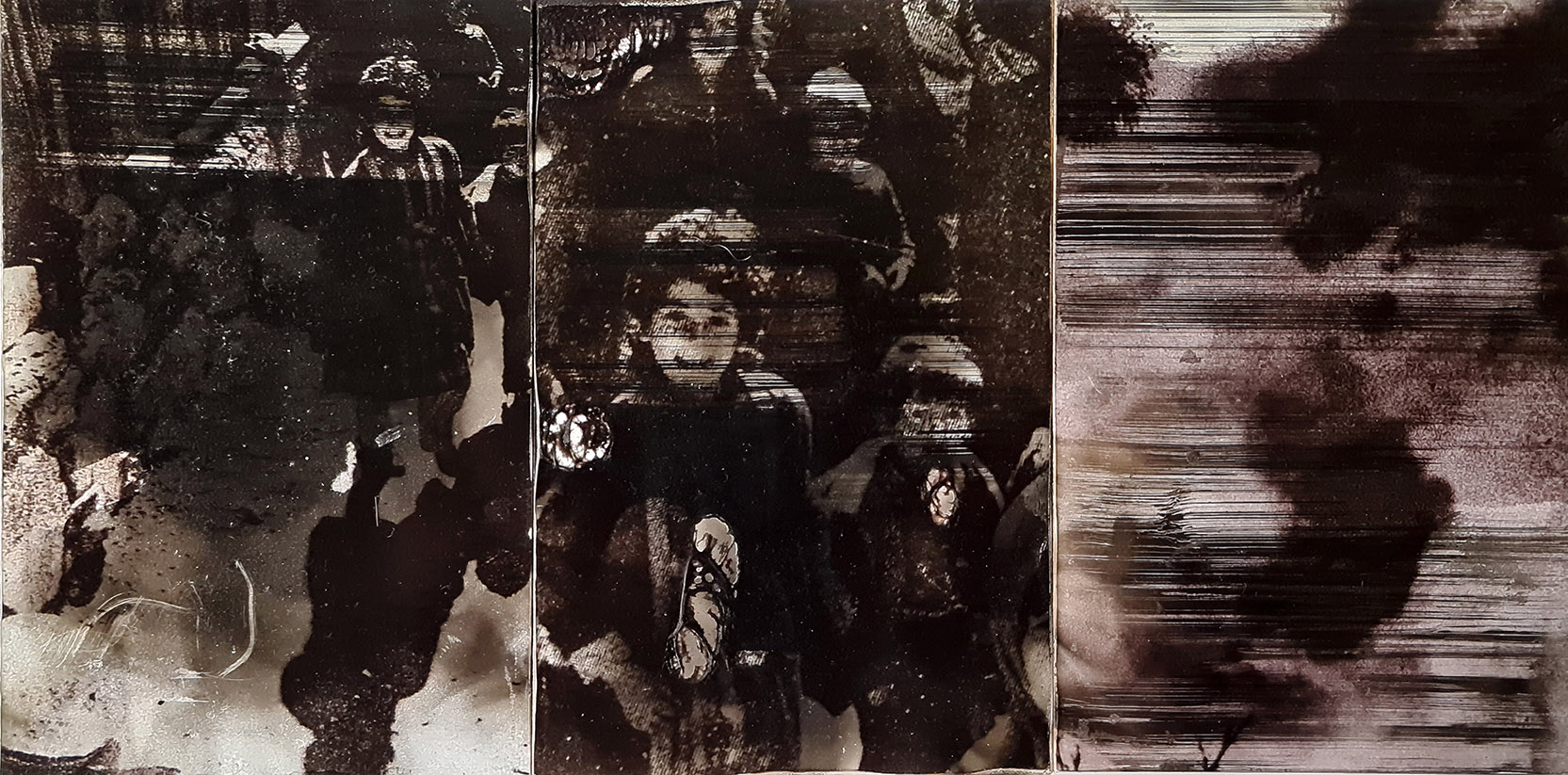 Rushdi Anwar, from "A Few Lines of History," photographic installation prints treated with smoke (soot), mounted on wooden panels; wooden shelves on painted wall. Photograph courtesy of the artist.
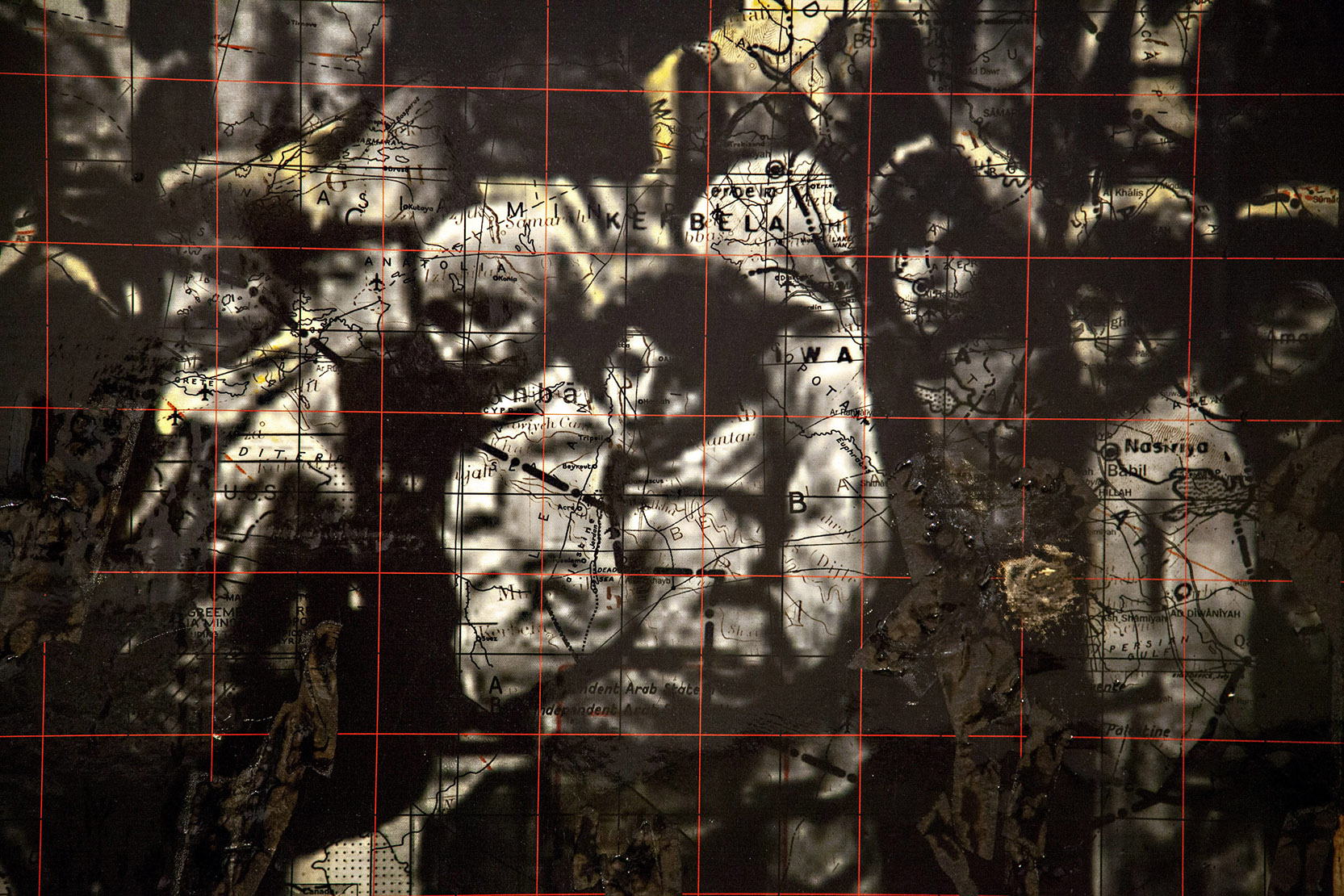 Rushdi Anwar, developed in response to the chemical attack on Halabja, the work uses soot-darkened photographs to reflect on memory, loss, erasure, and the persistence of historical trauma.
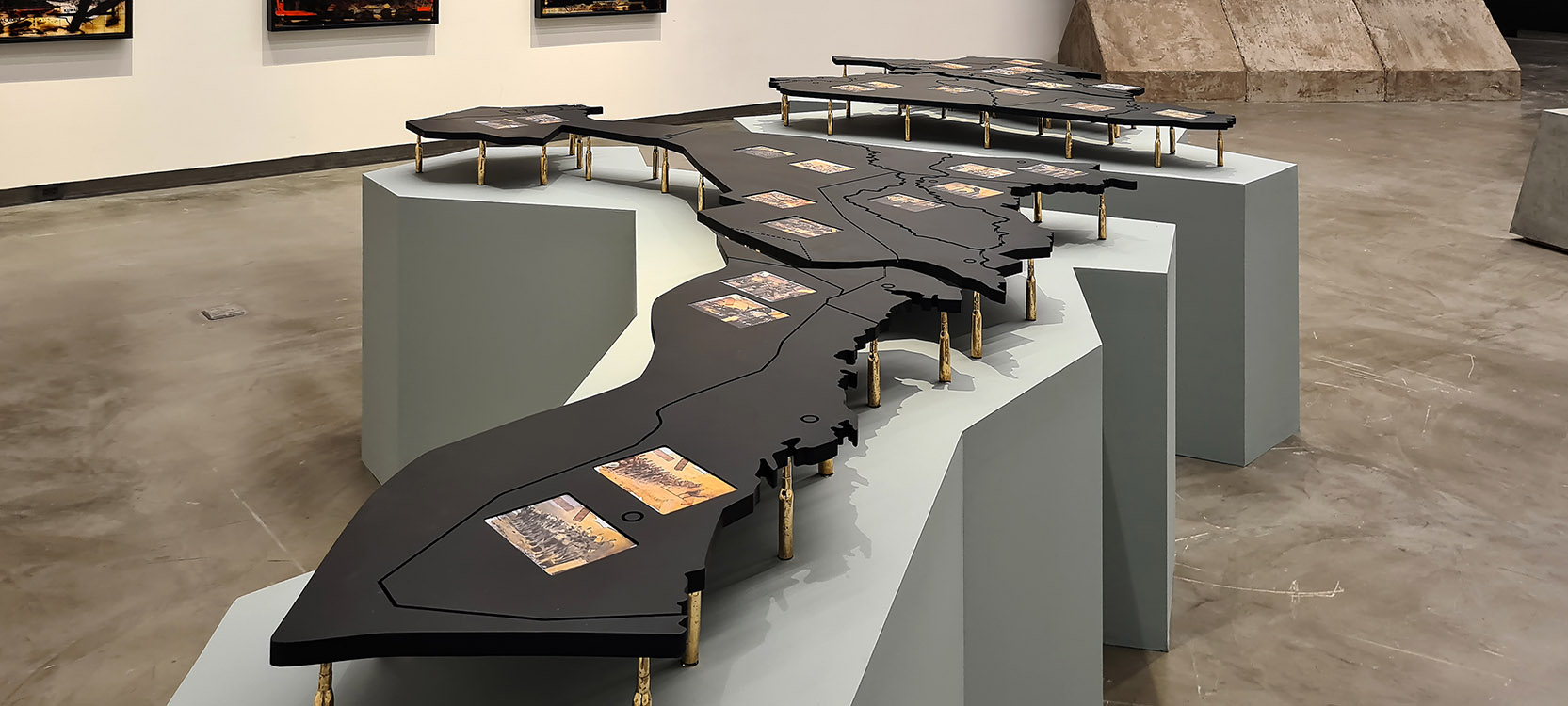 Rushdi Anwar, "They Filled Our World Full of Shadow, and Then They Tell Us to Seek the Light," installation view, Jim Thompson Art Center, Bangkok, Thailand. Digital-UV print on stainless steel, plywood, synthetic paint, and cast brass bullets, 2023 (courtesy of the artist).
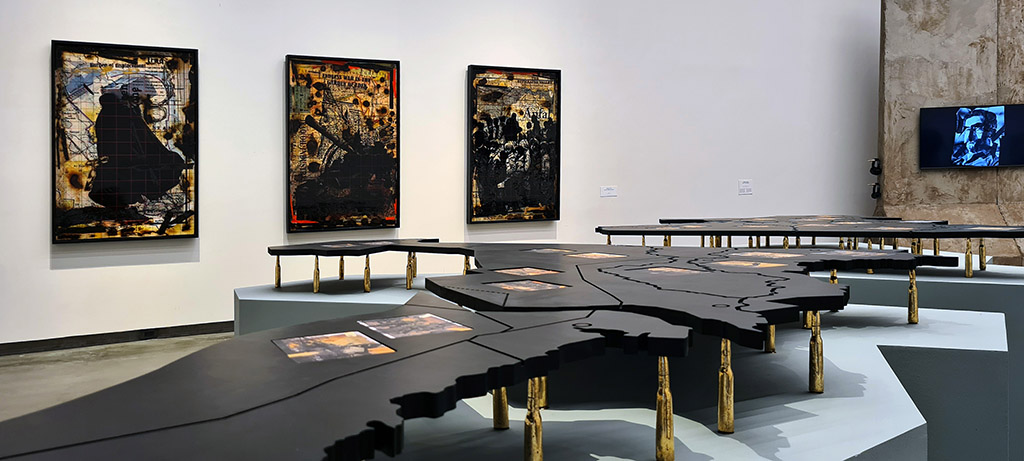 Rushdi Anwar. The work takes the form of a divided map of the Middle East, balanced on brass bullets, reflecting on the colonial violence of cartography and the legacy of the Sykes–Picot Agreement of 1916, which carved the region according to British and French interests. Within the work, Sykes–Picot becomes a symbolic starting point for the denial of Kurdish self-determination, marking the beginning of a long and ongoing struggle for Kurdish rights, recognition, land, and political existence. Embedded archival and artist-produced images trace histories of war, oil, shifting alliances, betrayal, environmental destruction, and survival across the region.
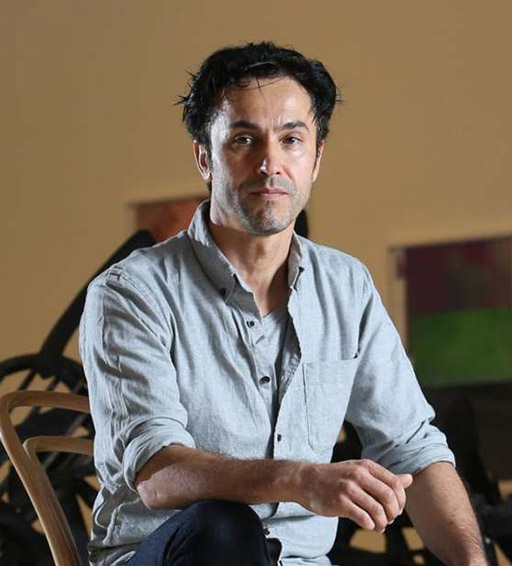
Rushdi Anwar is a Kurdish-Iraqi/Australian artist, researcher, and educator. Born in Halabja, Kurdistan, his multidisciplinary practice explores memory, displacement, colonial legacies, and resilience through photography, installation, drawing, sculpture, and multimedia. His work has been exhibited internationally, including at Sharjah Biennial 15, Artes Mundi 10, Bangkok Art Biennale, The National in Australia, and Gwangju Biennale. He is a Senior Lecturer in the Faculty of Fine Arts at Chiang Mai University and holds a PhD in Art from RMIT University. He lives and works between Thailand, Australia, and Iraqi Kurdistan. Find him on Instagram.
I Learned the Shape of Silence Through Black (ڕەش)
Black Is Not Something to Overcome. It Is Something to Enter.
When I was a child, like many children, I was afraid of darkness. The night was filled with stories of Jinn, of ghosts, of unseen presences that could not be named. Darkness was never simply the absence of light; it carried imagination of fear, insecurity, uncertainty, and the unknown.
Yet, within that same darkness, I also found protection.
In Kurdish, the word for black is ڕەش (Rash). Yet ڕەش does not simply describe a color. It carries emotional, historical, geographical, and psychological meanings that move far beyond darkness itself. Within Kurdish oral culture, poetry, dialect, landscape, and everyday language, it embodies a spectrum of experience — celebration and catastrophe, vastness and violence, intimacy and historical trauma, belonging and grief. —Rushdi Anwar
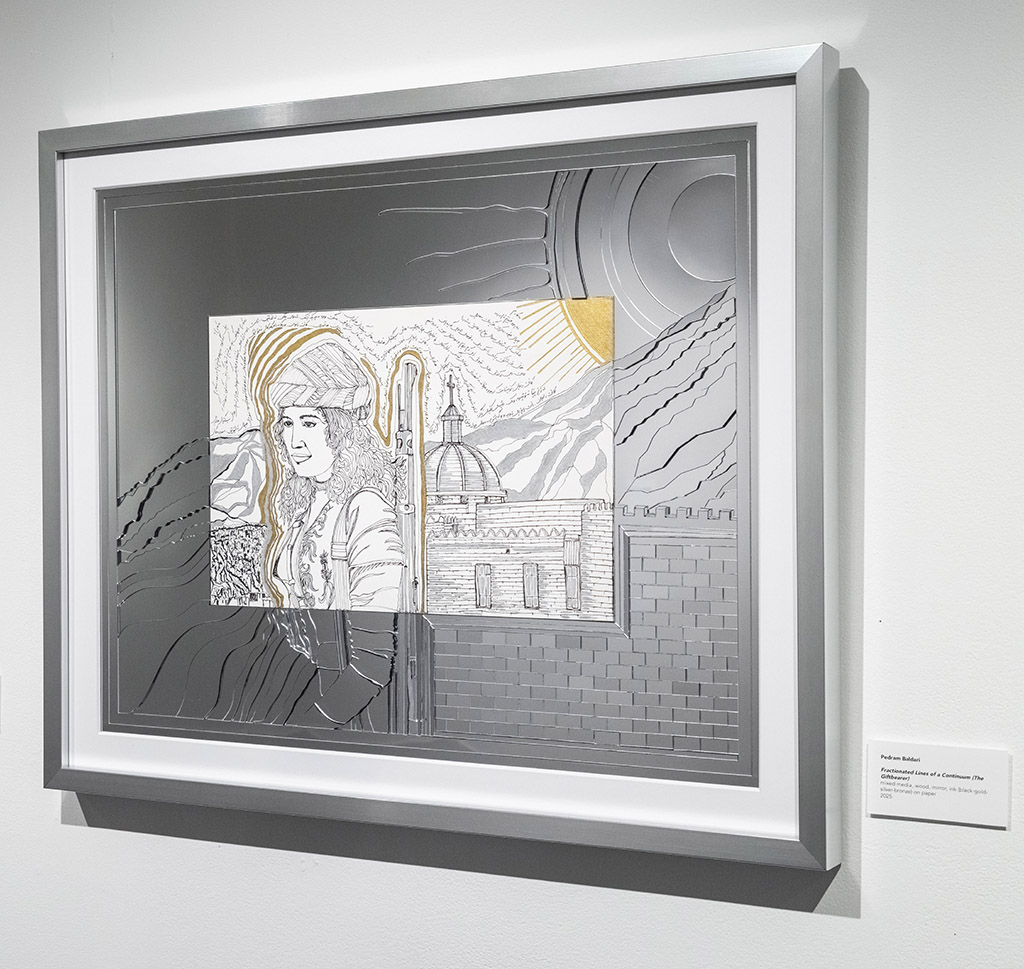 “Fractionated Lines of a Continuum” 2025, mixed media, wood, mirror, ink (black-gold-silver-bronze) on paper, 28”x34”, series of 9, (ongoing project).
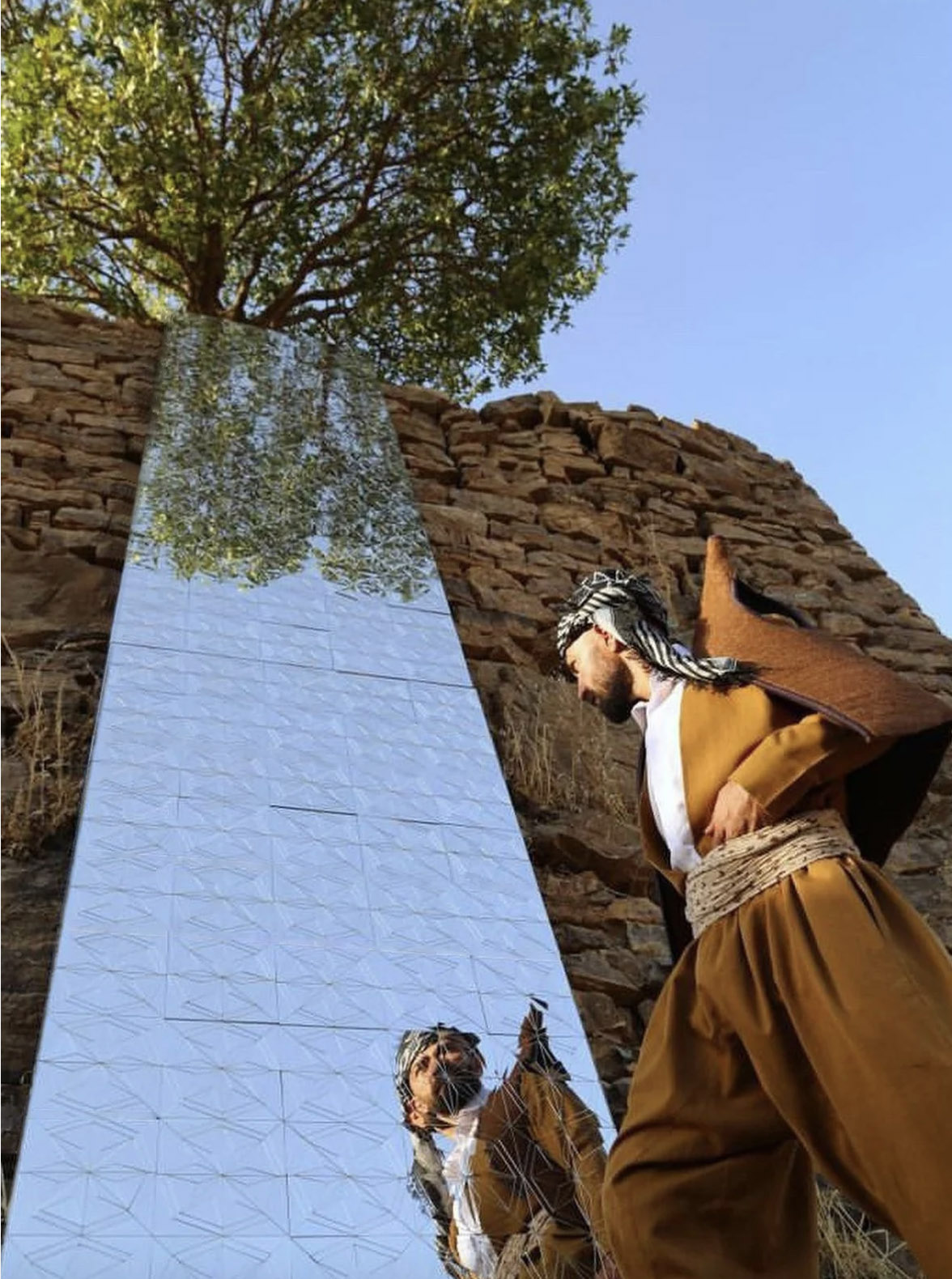 "The Heart of a Mountain" (2022) emerged from love for a place that has remained inseparable from my understanding of home. Installed at approximately 7,000 feet in Hawraman Takht, Rojhelat Kurdistan, the work reflects on the mountains not merely as landscape, but as living witnesses and protectors. For generations of Kurds, and particularly during periods of war, displacement, and state violence, these mountains functioned as places of refuge, passage, and survival.
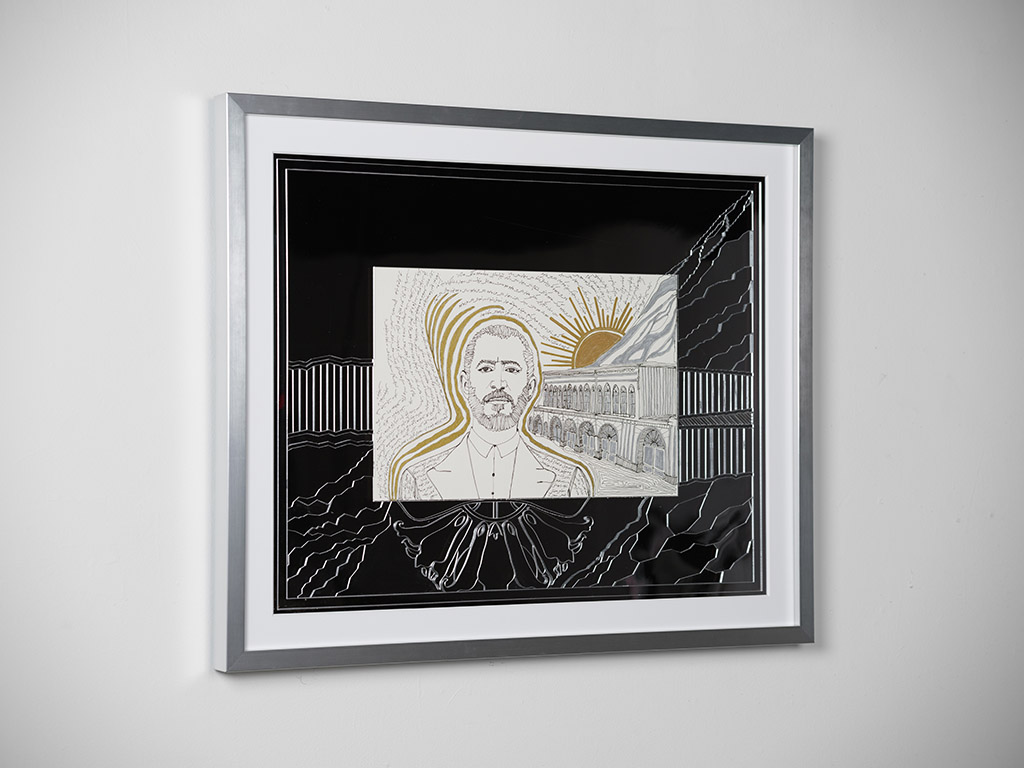 mixed media, wood, mirror, ink (black-gold-silver-bronze) on paper, 28”x34”, series of 9, (ongoing project).
Pedram Baldari was born and raised in the city of Sine (Sanandaj), Rojhelat, Eastern Kurdistan, Iraq. He is an interdisciplinary artist, architect, and scholar working in social practice, installation, sound, video, performance, sculpture, public art, curatorial, community-based work, and writing. His research explores the themes of land and belonging, artistic and knowledge production through the indigenous and stateless lens, in a statist socio-political and cultural construct, modes of colonialism, displacement-immigration, and conflict. Baldari has been featured in national and international art venues and biennials, and numerous institutions and galleries worldwide. He is currently based in the Detroit Metro Area and is an Assistant Professor of Art and Design at Stamps School of Art and Design at the University of Michigan, Ann Arbor.
The “Fractionated Lines of a Continuum” series emerges from contemplating the lives and stories of Kurdish political, social, cultural, and public figures. Each figure has lost their life for their belief, work, art, aspiration, or struggle at the hands of the occupying states of their homeland. While one is from a different region of Kurdistan, they have been a part of a continuous struggle against the systematic oppression of their people and, in doing so, have inspired one another and millions of their people both in their lives and in their deaths.
“The Heart of a Mountain” (2022) emerged from love for a place that has remained inseparable from my understanding of home. Installed at approximately 7,000 feet in Hawraman Takht, Rojhelat Kurdistan, the work reflects on the mountains not merely as landscape, but as living witnesses and protectors. For generations of Kurds, and particularly during periods of war, displacement, and state violence, these mountains functioned as places of refuge, passage, and survival.
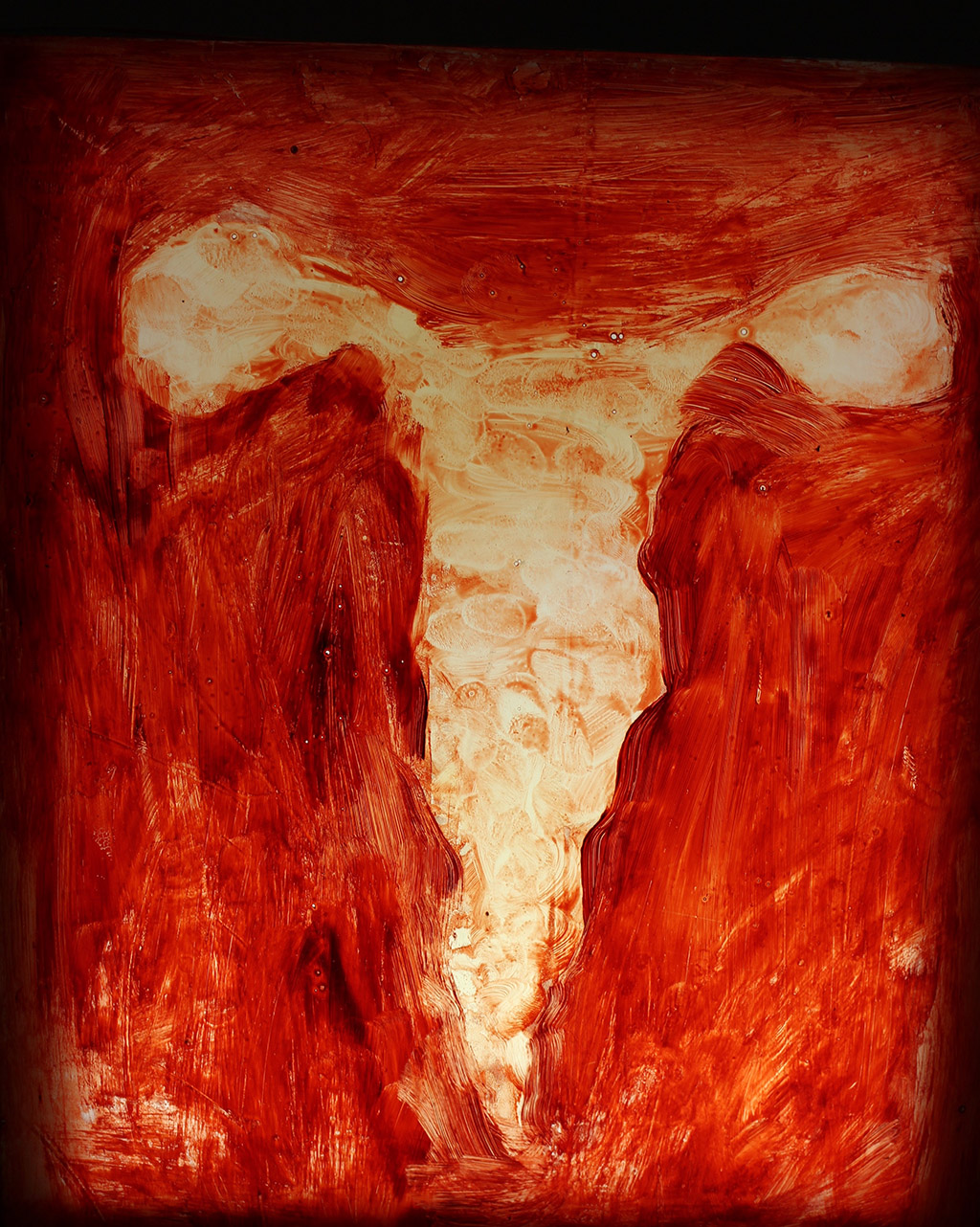 Huner Emin, "Blood Washing" series, 2017.
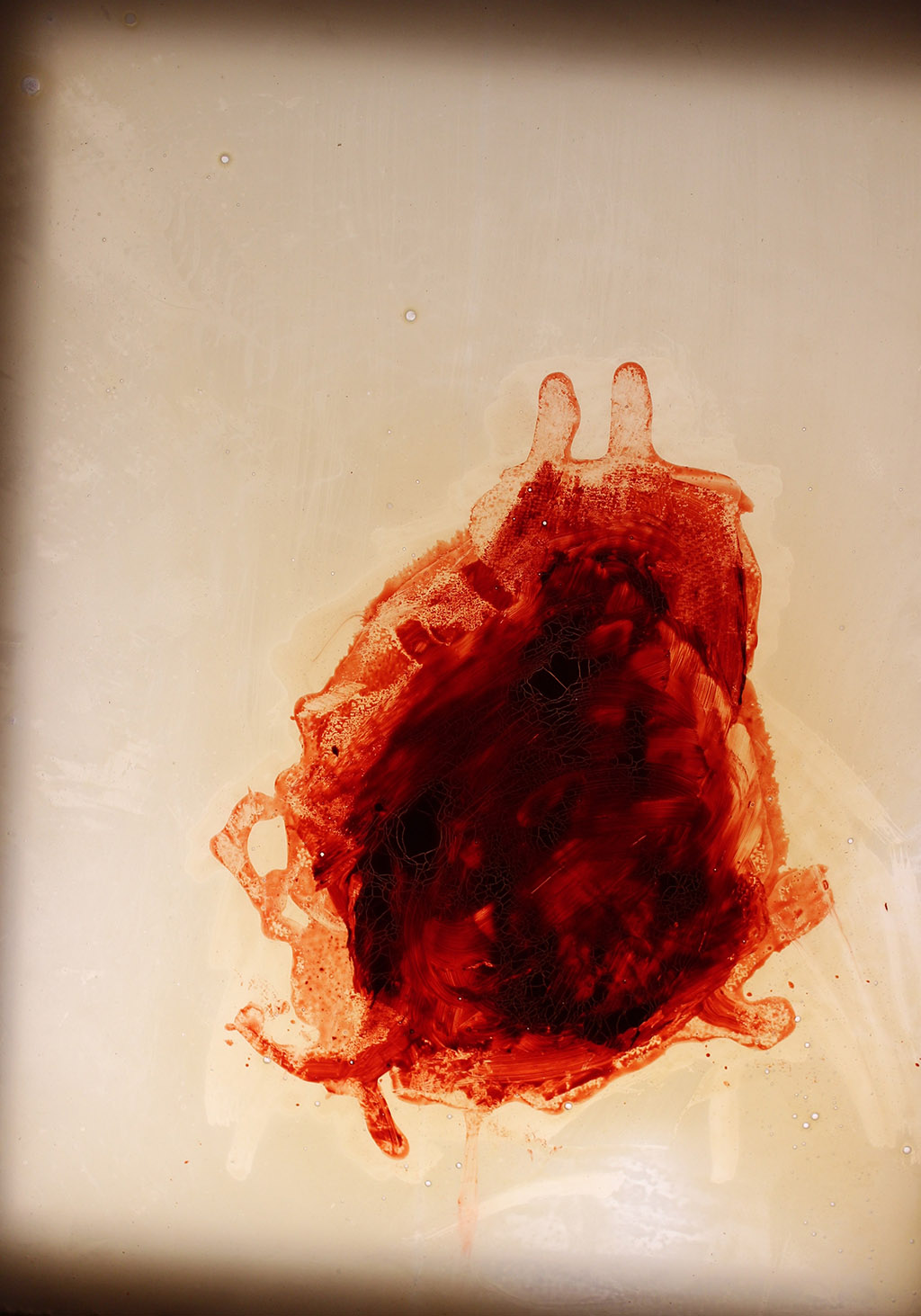
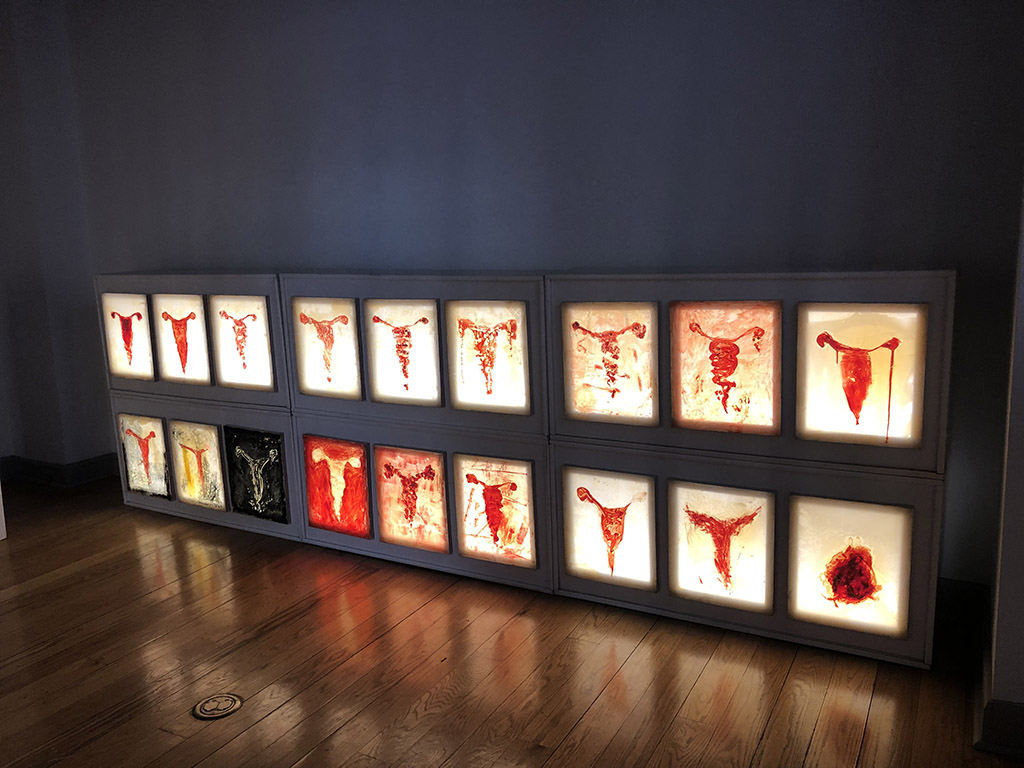
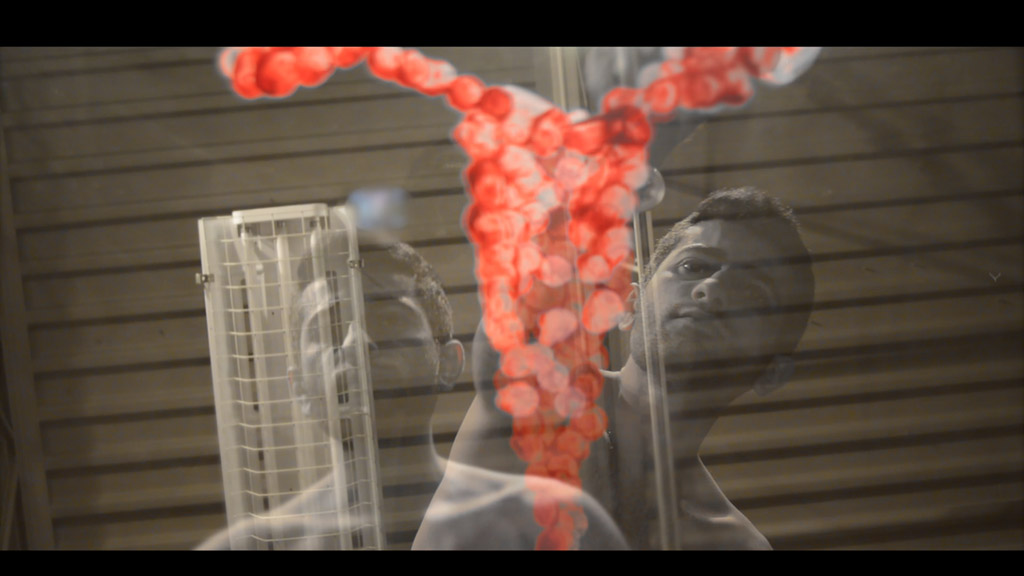
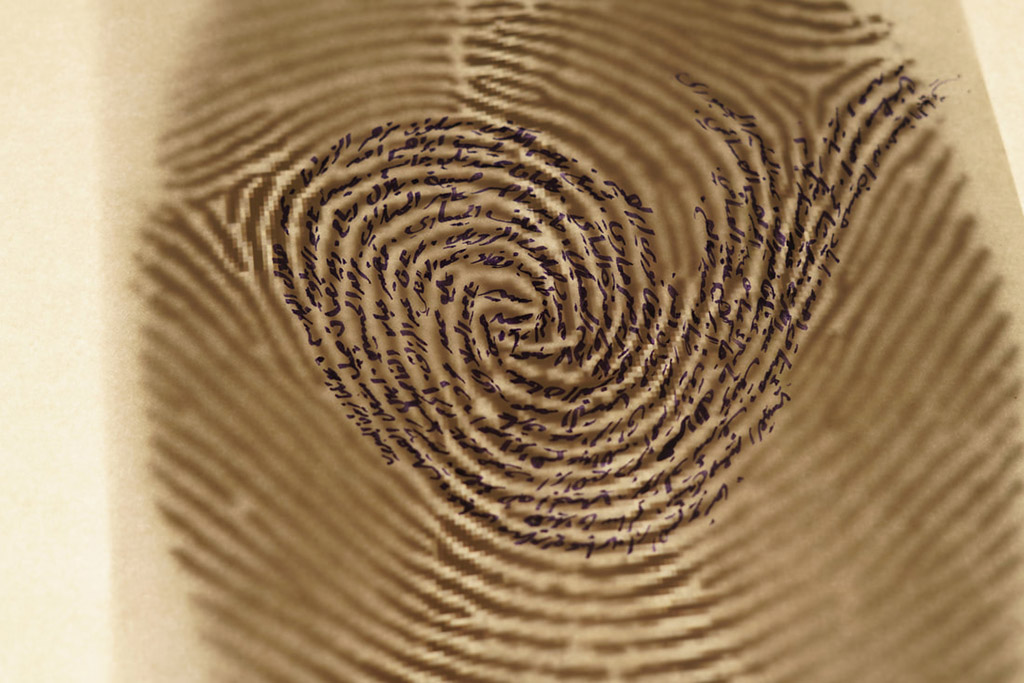 Huner Emin, “Manufactured Democracy”, 2021-2025, ink on paper, plexiglass, lightboxes, and video art 22”x22”, series of 40.
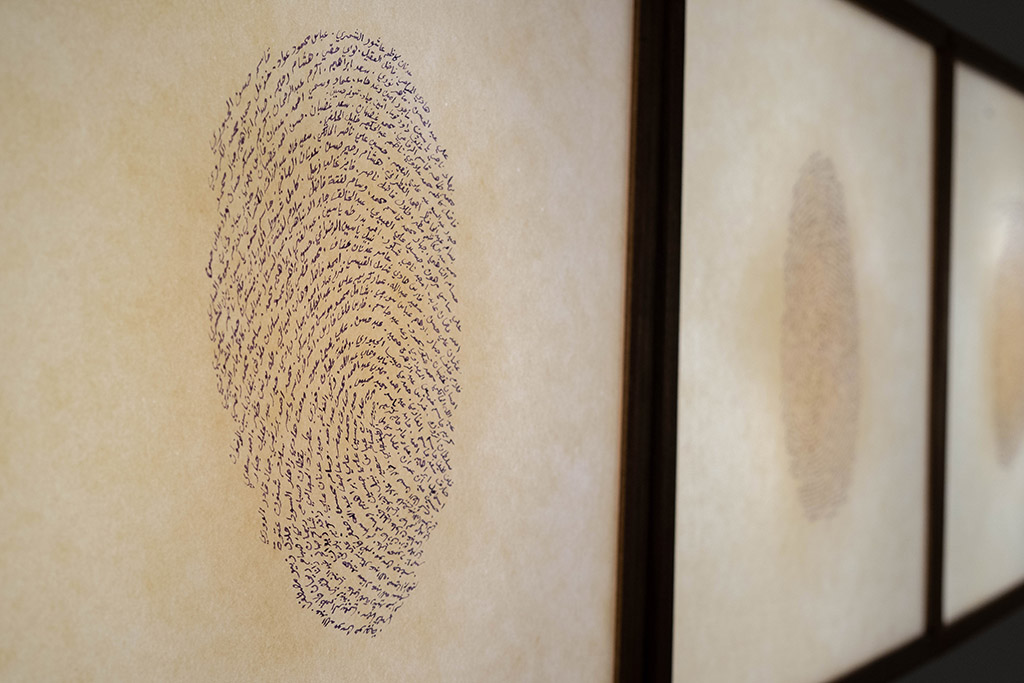 “Manufactured Democracy”, 2021-2025, ink on paper, plexiglass, lightboxes, and video art 22”x22”, series of 40.
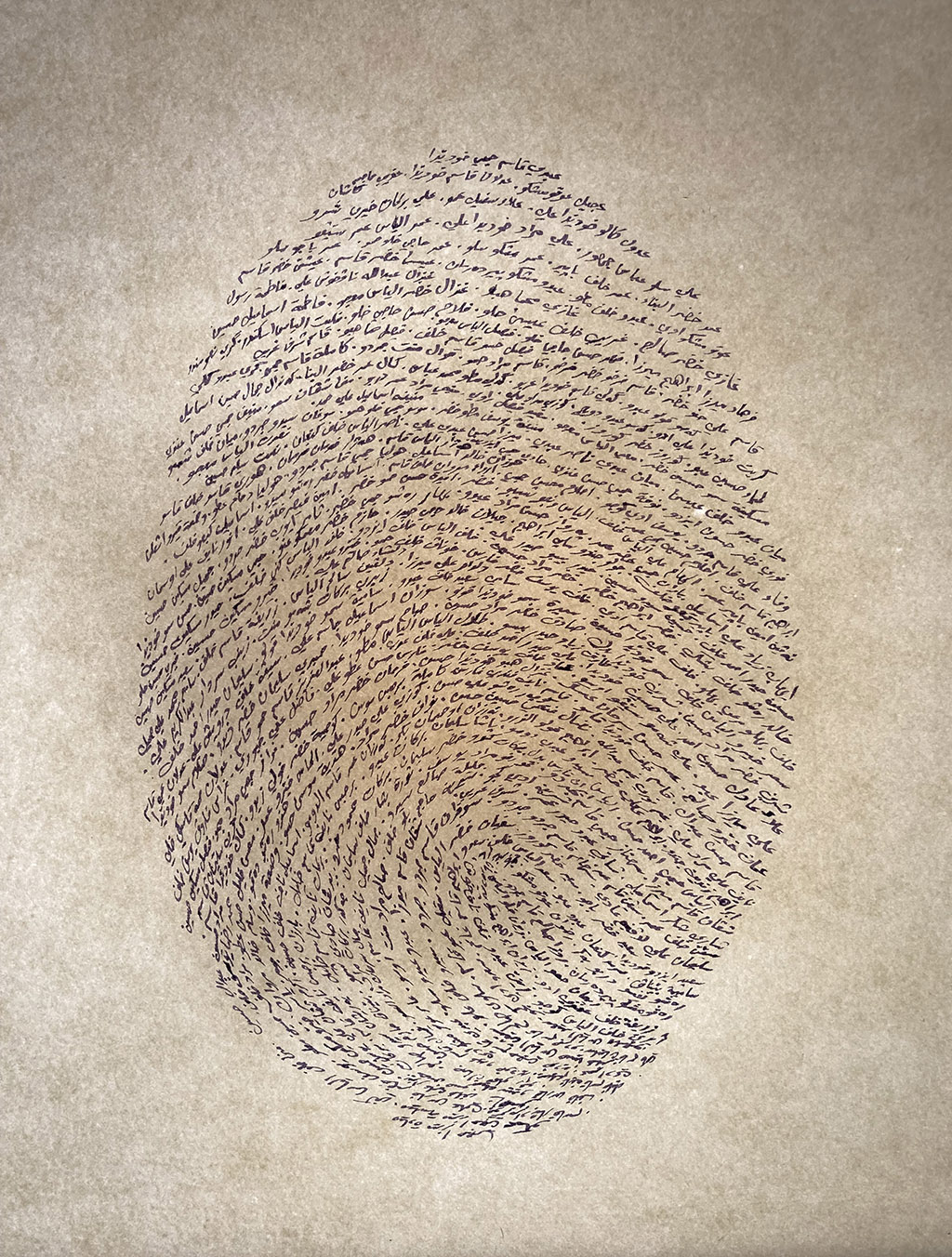 “Manufactured Democracy”, 2021-2025, ink on paper, plexiglass, lightboxes, and video art 22”x22”, series of 40.
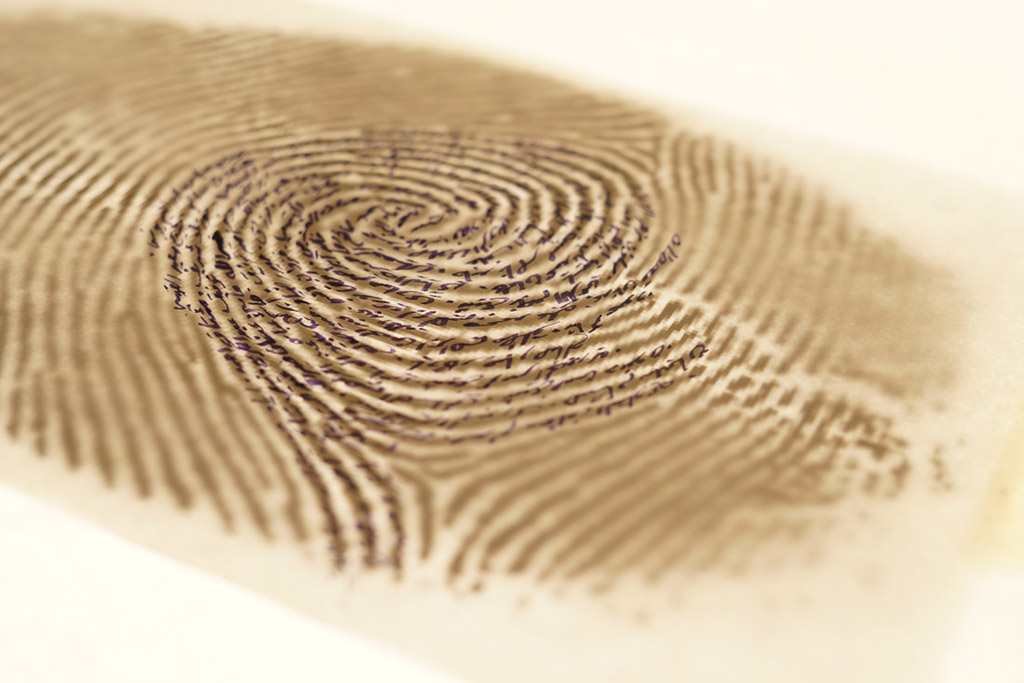 “Manufactured Democracy”, 2021-2025, ink on paper, plexiglass, lightboxes, and video art 22”x22”, series of 40.
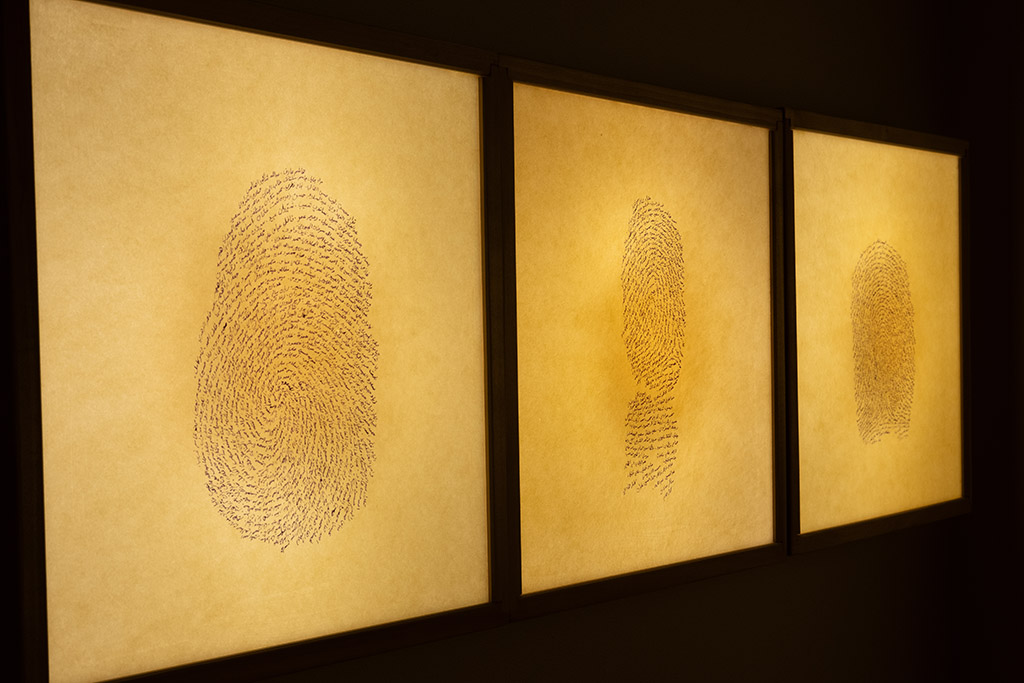 “Manufactured Democracy”, 2021-2025, ink on paper, plexiglass, lightboxes, and video art 22”x22”, series of 40.
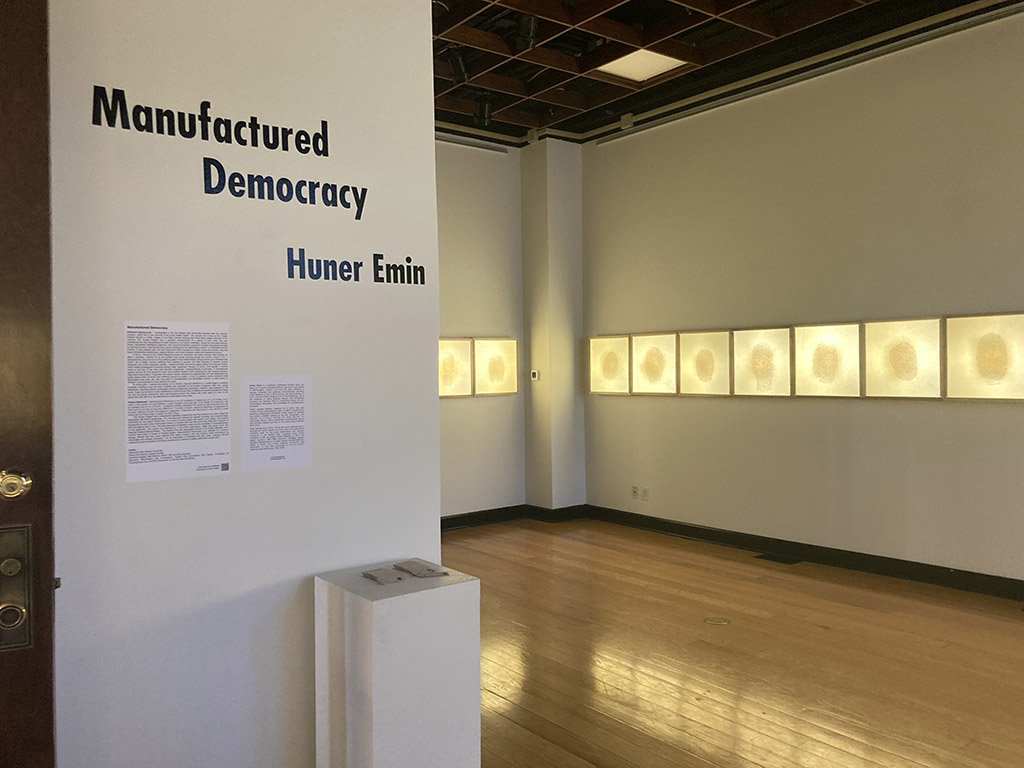 “Manufactured Democracy”, 2021-2025, ink on paper, plexiglass, lightboxes, and video art 22”x22”, series of 40.
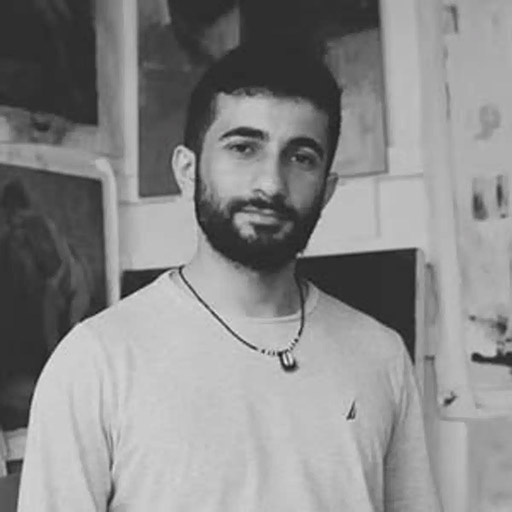
Huner Emin is a stateless multidisciplinary Kurdish artist based in Bloomington, Indiana. Originally from South Kurdistan/Northern Iraq, his work has been exhibited internationally, including at the CICA Museum of Art in South Korea, Agora Gallery in NYC, and Duhok Gallery of Art in Kurdistan/Iraq. Emin has received numerous awards, including the Dehaan Artist of Distinction Award, DC Art Commission fellowship, and Foundation for Contemporary Arts Grant. Emin studied western classical art in Erbil, Iraq, and earned an MFA in Studio Art with a focus on Painting from Marywood University in the United States. Since leaving Iraq in 2013 due to political and social issues, he has not returned. During the Arab Spring, his performance piece “Geruk,” which questioned governmental power and political dogma, led to his arrest twice between 2011 and 2013. In 2017, he created Blood Washing, a series addressing honor killings, which was first exhibited at the Maslow Study Gallery for Contemporary Art at Marywood University. Emin’s work continues to reflect his lived experiences and broader concerns in the Middle East, exploring themes such as the Anfal genocide (180,000 Seconds), Iraq War atrocities (Manufactured Democracy), and ISIL crimes (Testimonies from Mount Sinjar), ongoing.
Blood Washing
Emin created the Blood Washing installation after leaving Iraq. It reflects the power dynamic of gender in his patriarchal society and honor killing practices in northern Iraq. Emin risked death threats for his opposition to honor killing. Blood Washing is an installation of a dark room with light boxes illuminating the shapes of deformed uteruses. Juxtaposing the womb installation are two video art pieces positioned on the opposite wall to the lightbox installation. Both videos show the artist applying paint to a glass pane using his fingers to create the uteri images. Sketches of a uterus in various shapes and forms (deformed) are printed on latex, a symbol of female virginity or sexuality, and seen through light boxes. The title Blood Washing is a direct translation from the Kurdish language phrase for honor killing. The piece reflects the artist’s internal dialogue of living with fear, shame, and guilt, the result of complex images from his childhood memories of a groom showing proudly the proof of his bride’s virginity on a piece of cloth, memories of periodically hearing about people getting killed as a result of fornication, and images of the blood streaming down his face the night when he was running for his life.
Manufactured Democracy
A series of handwritten Arabic calligraphy of the names of individuals who lost their lives in civil wars in Iraq from 2003 to 2017. The work on paper, placed on lightboxes, is highlighted by the light reflected through fingerprint calligraphy. Fingerprints refer to the first Iraqi elections after the invasion, in which voters dipped their index finger in ink after voting, a process known as the “Purple Fingers Elections.”
Says Huner Emin, “I participated in the first alleged Iraqi democratic elections after the coalition invasion, which led to the removal of the brutal Baath regime. The process was known as the ‘Purple Fingers’ election of 2005. Images of my fellow citizens flashing their inked index fingers resonate in my memory. The ‘Purple Fingers’ was a symbolic representation of a glance of hope when Iraq was undergoing the most devastating domestic violence in its modern existence, caused by evacuated security forces, dismantled intelligence agencies, and unsecured borders opened to terrorist organizations funded by big local powers. Iraq had become a proxy battleground for international conflict. It is estimated that the number of Iraqi citizens who lost their lives since 2003 exceeds two million. Since the invasion, Iraq has faced infrastructure destruction, national division, and mass migration inside and outside the country.”
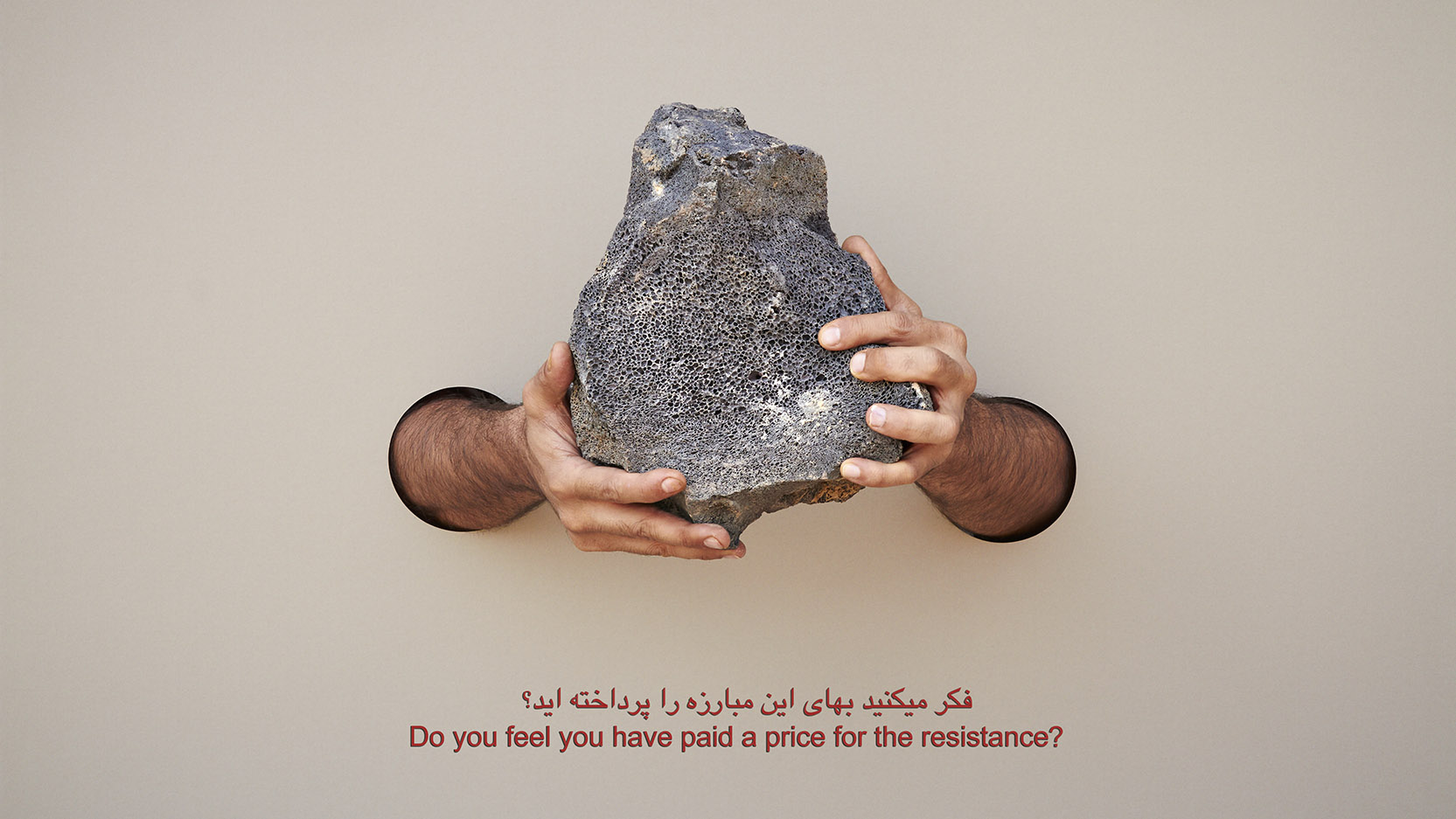 Shadi Harouni, from "The Price of Resistance" series.
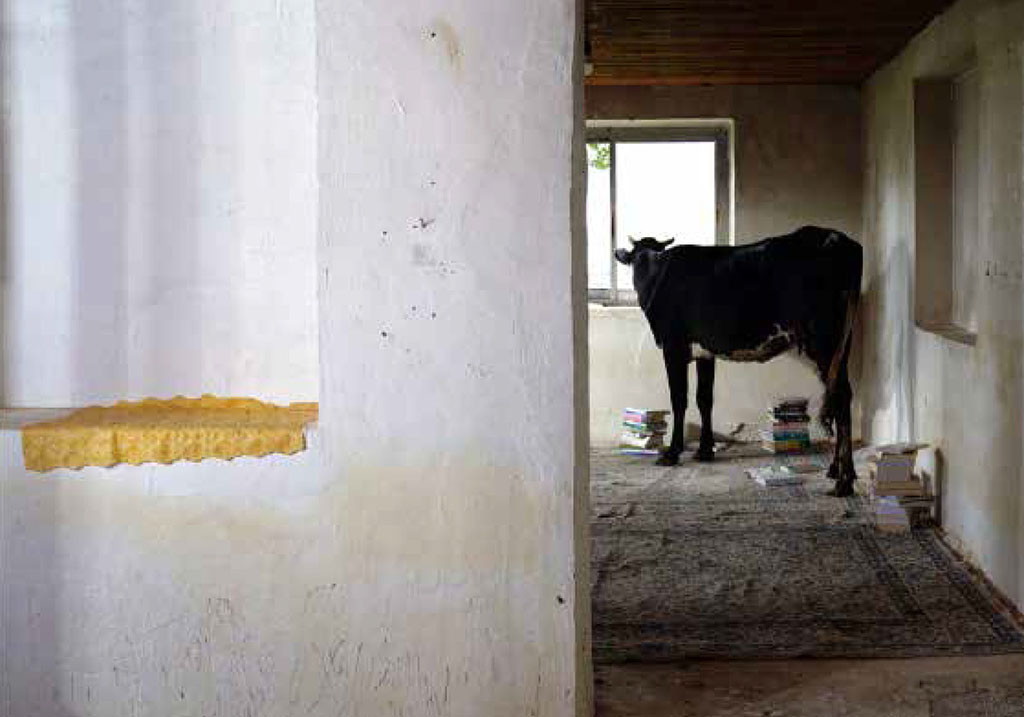 Shadi Harouni. The photo of the cow is an outtake from her film "The Owl’s Made a Nest in the Ruins of the Heart," 2021
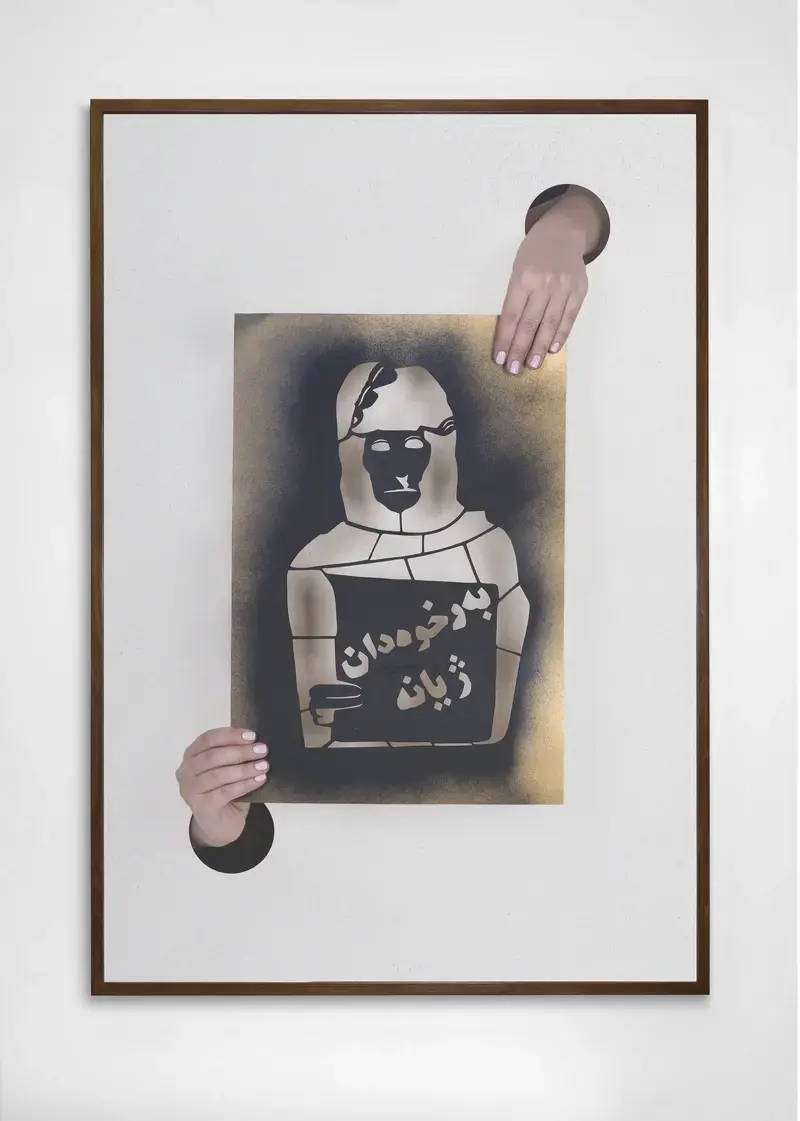 Shadi Harouni, "Resistance is Life" in the series "An Incomplete Timeline of Sorrow and Uprising," photograph, c-print on hahnemhule paper rag pearl 325 gr mounted on d-bond framed cm 130x76in (courtesy Galleria Tiziana di Caro).
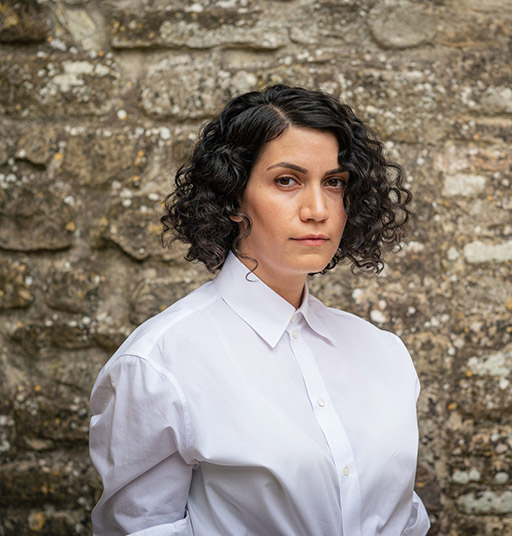
Born Hamedan, Iran, Shadi Harouni is a visual artist based in New York. Her research and material explorations are rooted in overlooked histories of erasure and resistance, ranging from everyday acts of dissent to global mass movements, from modern revolutions in the Middle East to historical transgressions in thought and poetry. Harouni’s practice combines various modes and media — film and photography, sculpture, and site-specific interventions — with texts and folklore. She works with spaces, objects, and sensitive subjects imbued with both utopian dreams and the broken promises of liberation and revolution. Harouni’s films and photographs, shot in dilapidated dwellings, factories, and declining mountain quarries throughout her ancestral Kurdistan, are intimate studies of the region’s histories of resistance, highlighting women’s contributions to the ongoing struggles for freedom and self-determination. Harouni is a lecturer, professor, and chair of the Video and Photography Department in the Steinhardt School of the Arts at New York University. She is represented by the Tiziana Di Caro Gallery.
Show in France through July 31, 2026, If Words Are to Be Sounded.
An Incomplete Timeline of Sorrow and Uprising was conceived as a public project commissioned by curator Zuzana Štefkova for ArtWall Prague, large scale panels lining the river embankment in the city of Prague for a period of four months in the first half of 2023.
“The Owl’s Made a Nest in the Ruins of the Heart” 2021, Film UHD, 4:3, 19 minutes
Produced in Iran’s Kurdish regions, the film depicts the interior of a timeworn house, where a cow freely roams without human intervention. This simple arresting image is accompanied by the voice of a Kurdish dissident, a former occupant of the house, who reflects on the spaces he has occupied throughout his life: from his childhood village home—“like a mythological character, human on top and animal below”—to prison cells once occupied by royal horses, to the featured house whose doors were at one point opened to roaming animals as an act of veiled protest. These accounts, marked by a decidedly ironic humor, are set against the complex and painful histories of global social and political crises, including a growing housing crisis that reflects broken political promises and vanishing hopes of the working classes around the world.
The title of the film is borrowed from a little-known Kurdish folk poem, one of many murmured in the Hawraman Mountains and amongst its diaspora scattered across the globe.
“I Dream the Mountain is Still Whole” 2017, HD video, 17:06 minutes
Set in a black pumice quarry in the outskirts of Bijar, the film traces the history of Iranian Marxist revolutionaries who, barred from continuing their work as intellectuals, have taken refuge in the isolated mountain quarries of Kurdistan, among other spaces of harsh labor. This is the second in a multi-chapter project made over years of travel to and from the mountains.
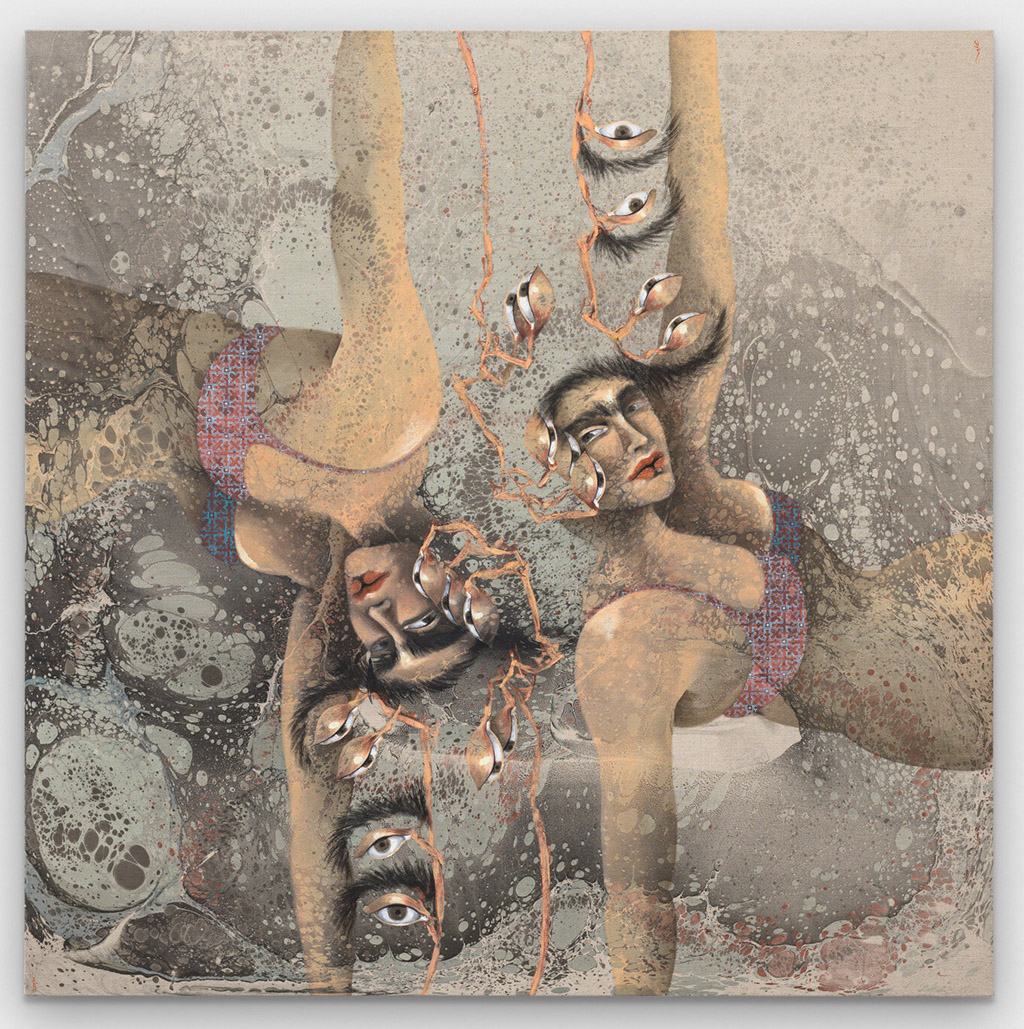 Hayv Kahraman, "Eyeris," 80 x 115 inches, oil and acrylic on linen, 2023 (courtesy Jack Shainman Gallery).
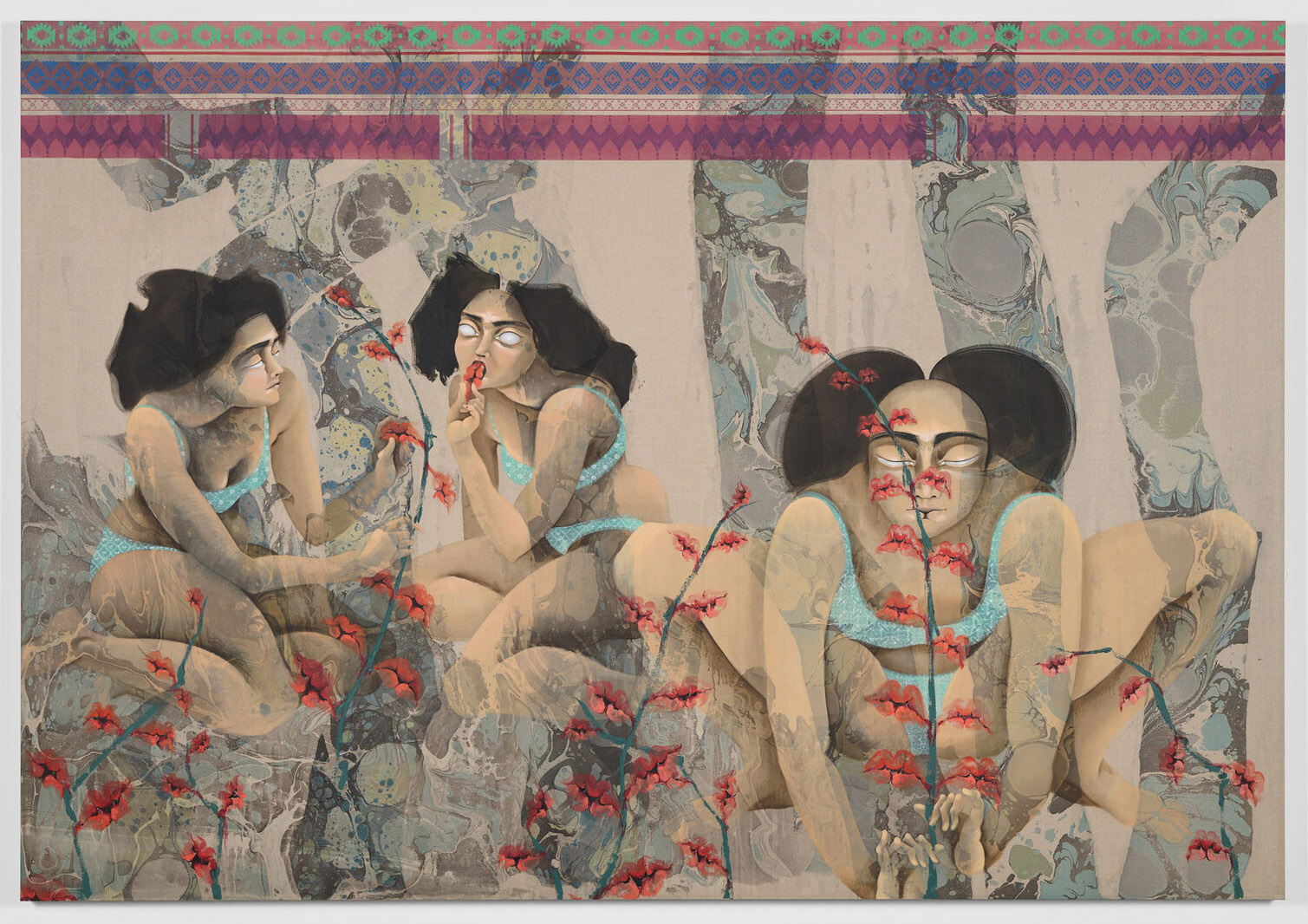
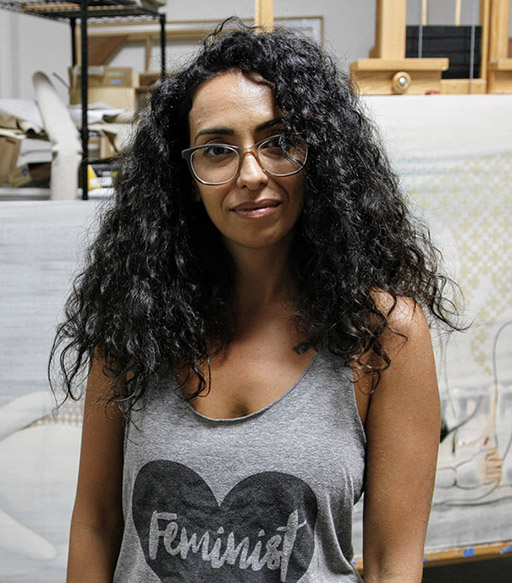
Among the best-known internationally, Hayv Kahraman is a Kurdish Iraqi artist, born in Baghdad, who lives and works in Los Angeles. Her multifaceted work — painting, performance, and sculpture — primarily deals with the body politics of migrant consciousness. Kahraman’s paintings take on themes of memory, violence, and involuntary migration as she processes her childhood in the war-torn country of Iraq and her adolescence in Sweden as a refugee. Recent solo exhibitions include Ghost Fires, Jack Shainman Gallery, New York, NY (2025); Look Me in the Eyes, Institute of Contemporary Art San Francisco, CA (2024), which traveled to the Frye Art Museum in Seattle, WA; The Foreign in Us, The Moody Center for the Arts, Houston, TX (2024); Gut Feelings: Part II, The Third Line, Dubai, UAE (2023); Gut Feelings, Mosaic Rooms, London, UK (2022); The Touch of Otherness, SCAD Museum of Art, GA (2022); and The Touch of Otherness, Vielmetter Los Angeles, CA (2021). She is represented by the Jack Shainman Gallery.
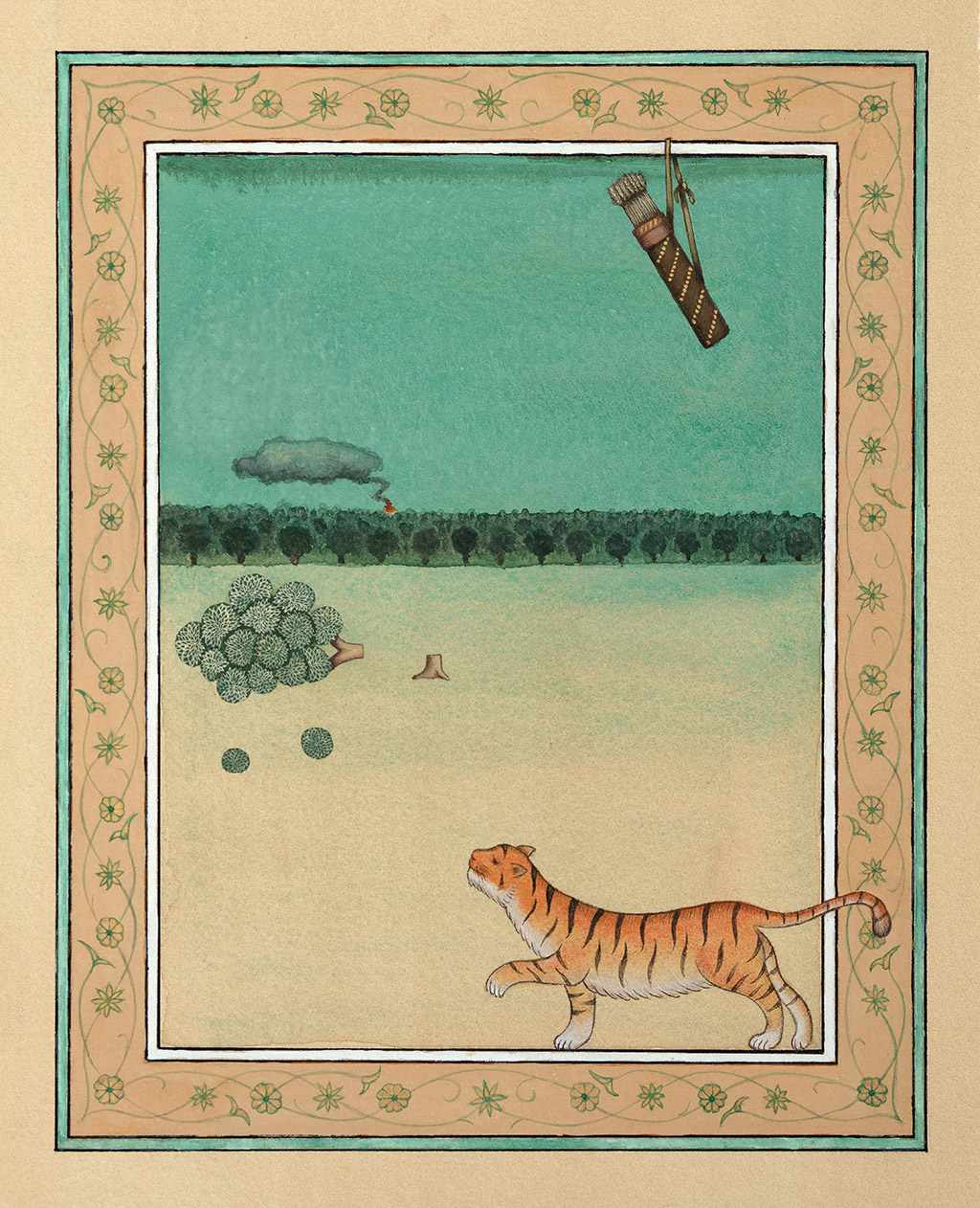 Shorsh Saleh, "Tiger Tiger Burning Bright."
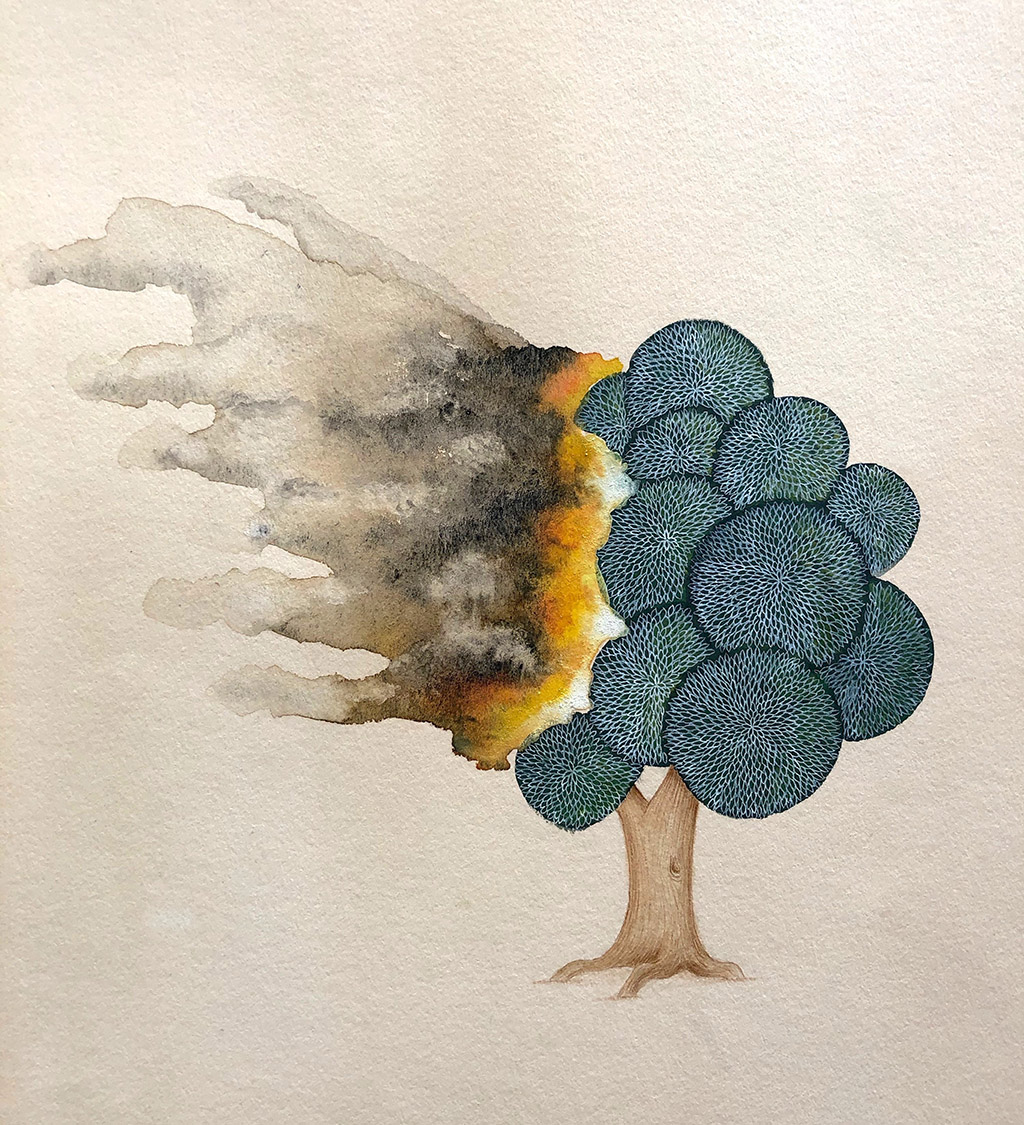 Shorsh Saleh, "Tree of Life"
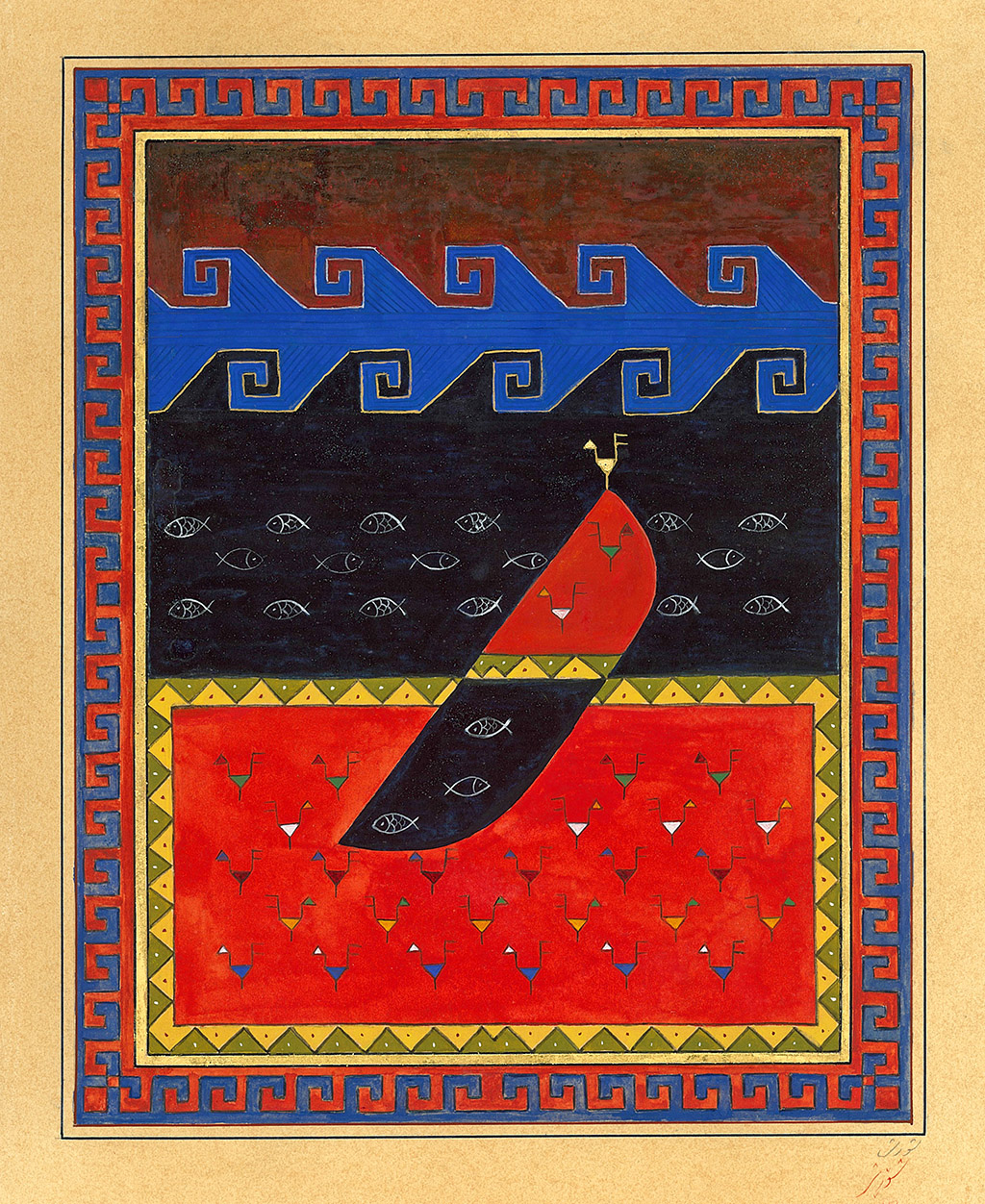
 Shorsh Saleh, "Crossing Border."
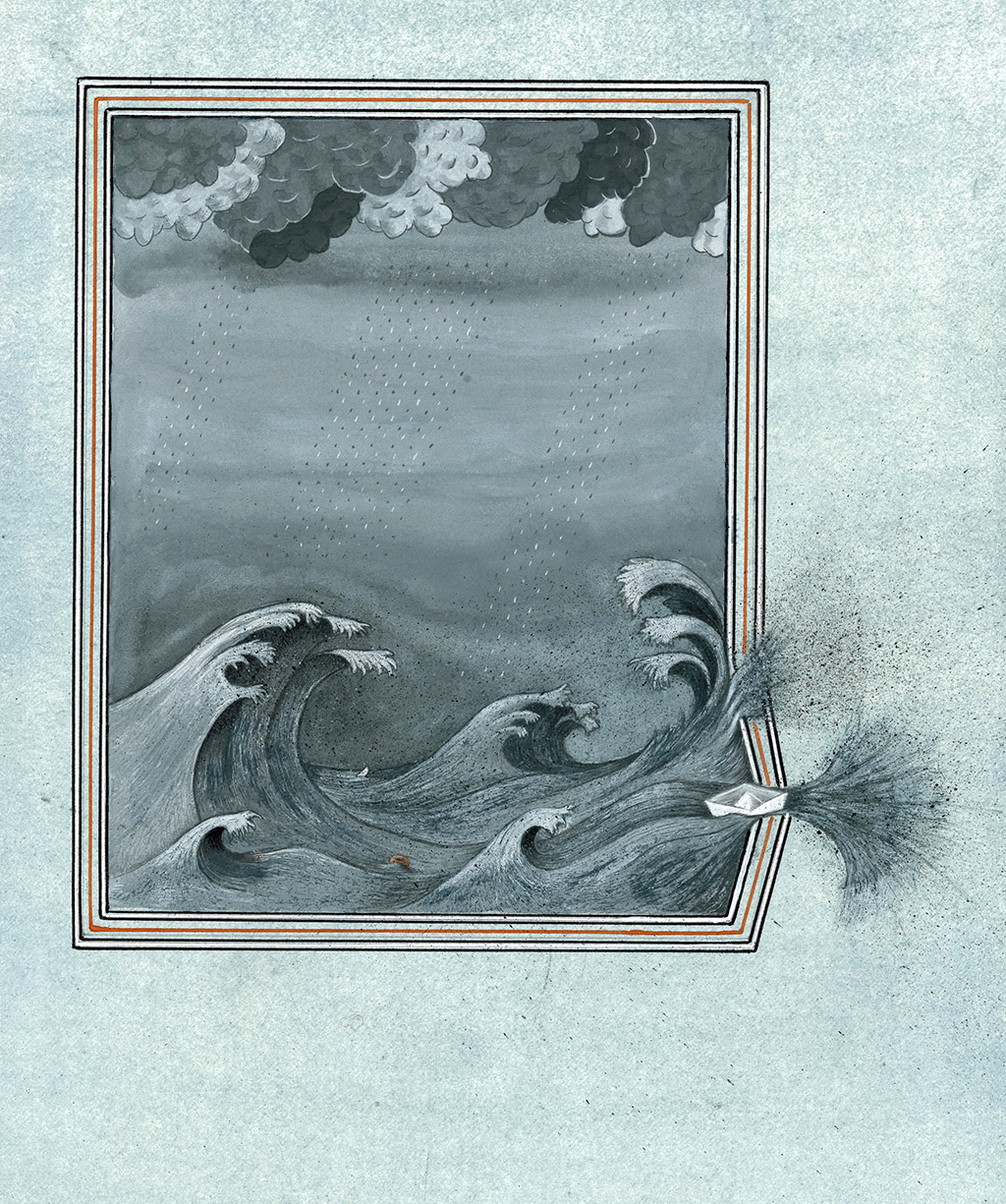
 Shorsh Saleh, "Capsize."
Shorsh Saleh is an artist and carpet weaver who uses his craft to tell stories of migration, inspired by his own experience. In 2000, during the aftermath of the Iraqi-Kurdish civil war, 23-year-old Saleh left his home and family in Iraqi Kurdistan in search of a more stable future. He arrived in the UK in 2002 when, in the lead-up to the invasion of Iraq, the Home Office was offering asylum to Iraqi citizens. However, Saleh’s application fell through the cracks and it wasn’t until 2010 that his case was finally accepted. He used that time to deepen his art practice, focusing largely on miniature painting and sculpture, and went on to study at the School of Traditional Arts in London. He has since joined the institution as a teacher of carpet weaving, with a particular interest in tribal designs and village patterns. His mixed media work has been exhibited around the world, including at the Royal Collection Trust, The King’s Foundation, British Museum and Islamic Arts Museum Malaysia. He currently has three pieces showing at the Migration Museum in London, including Waiting II, an installation inspired by his own eight-year asylum case. (Bio by Mariam Amini.)
“Capsize” and “Crossing Borders” highlight the tragedy faced by refugees. Human traffickers pack people fleeing war and persecution into overcrowded, unseaworthy vessels like rubber dinghies or rickety wooden boats. Because these vessels lack proper safety equipment and navigational gear, thousands of refugees perish each year crossing perilous routes like the Mediterranean Sea. The paintings are the reflection of the artist’s personal experience as a refugee, who attempts to convey the fear he experienced to the viewer.
Shorsh Saleh says: These two paintings showcase the negative effects of global warming. [The] human relationship with nature frequently shifts from stewardship to exploitation. Driven by rapid industrialisation and unchecked consumption, this misbehaviour manifests as severe environmental damage, including deforestation, pollution, and so on. Collectively, these actions threaten delicate global ecosystems and accelerate climate change. In these paintings I use trees as symbols of life.
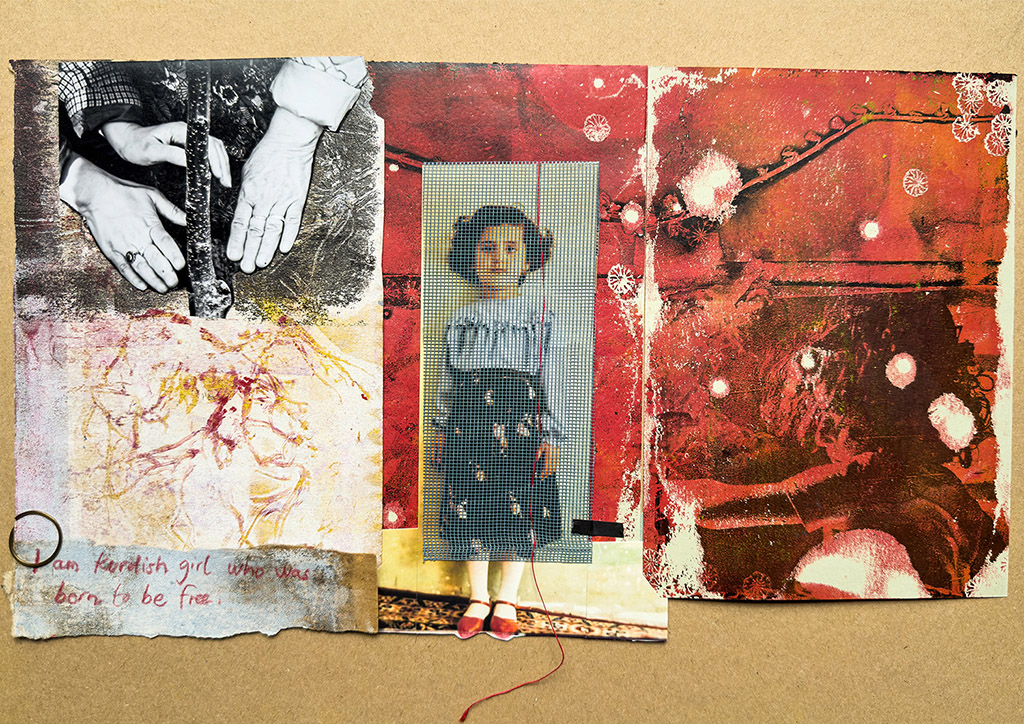 Medya Stemerding Shikhagaie, "Red Shoes" from the series, "The Fallen Leaves Are Dancing."
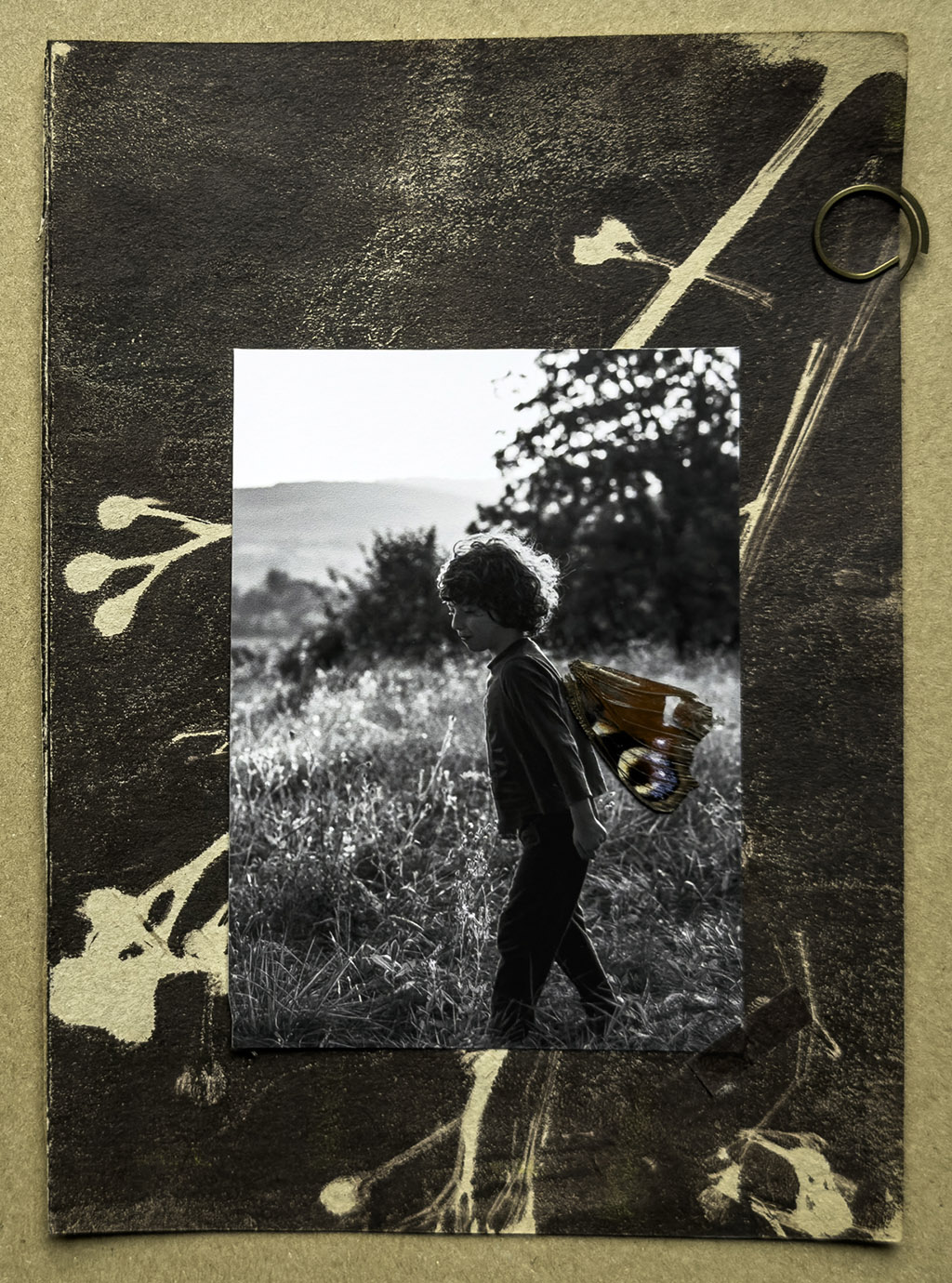 Medya Stemerding Shikhagaie, Untitled, from the series, "The Fallen Leaves Are Dancing."
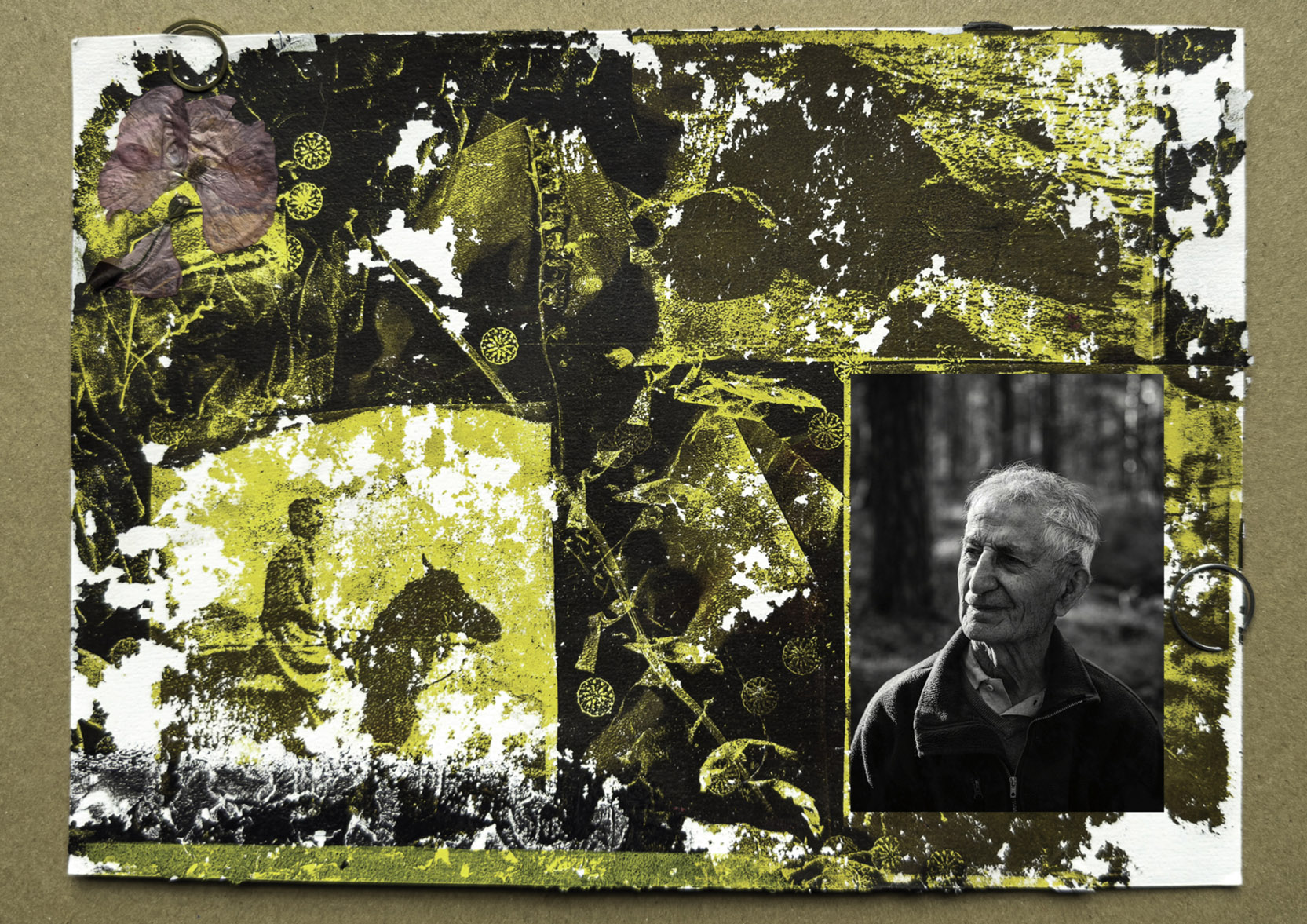 Medya Stemerding Shikhagaie, "Exile," from the series, "The Fallen Leaves Are Dancing."
Medya Stemerding Shikhagaie is a conceptual documentary photographer based in The Netherlands. She combines archival material, portraiture, and photomontage to explore displacement and diasporic experience. Drawing on her experience of being part of the Kurdish diaspora, Medya Stemerding Shikhagaie creates layered visual narratives that connect personal and collective histories. Born in Iran, she grew up as a Kurdish girl in a society where language, history and identity were systematically suppressed.
After her father, a member of a banned Kurdish political party, was forced into exile and the family home was confiscated, they lived under constant surveillance. When the artist was nine, the family fled and was granted asylum in Sweden, leaving them without access to their homeland in Iran — “an absence that remains central to how I construct memory, identity and image,” notes the artist.
“While this rupture undoubtedly influences my work, I am equally preoccupied with a more unresolved question: what does it mean to belong to an identity that cannot be fully shared or defined as a political question? Although Kurdish identity is being unified through struggle and resistance, my experience is that it is internally fragmented by distance, as well as by a lack of access to my heritage and history.
“In The Fallen Leaves are Dancing, I explore what has been lost and what persists through a visual language of layering and disruption. Using family archives, the only material evidence of my early life, I construct photomontages that move between documentation and invention. Landscapes, portraits and abstract forms overlap and fracture to reflect the instability of memory and the impossibility of returning to a fixed origin.
In this work, Kurdistan emerges not as a singular place, but as an imagined and shifting geography, held together by sensory fragments, inherited stories and gaps in recollection. Rather than attempting to reconstruct a coherent narrative, the work embraces dissonance and asks how identity can exist when it resists definition.
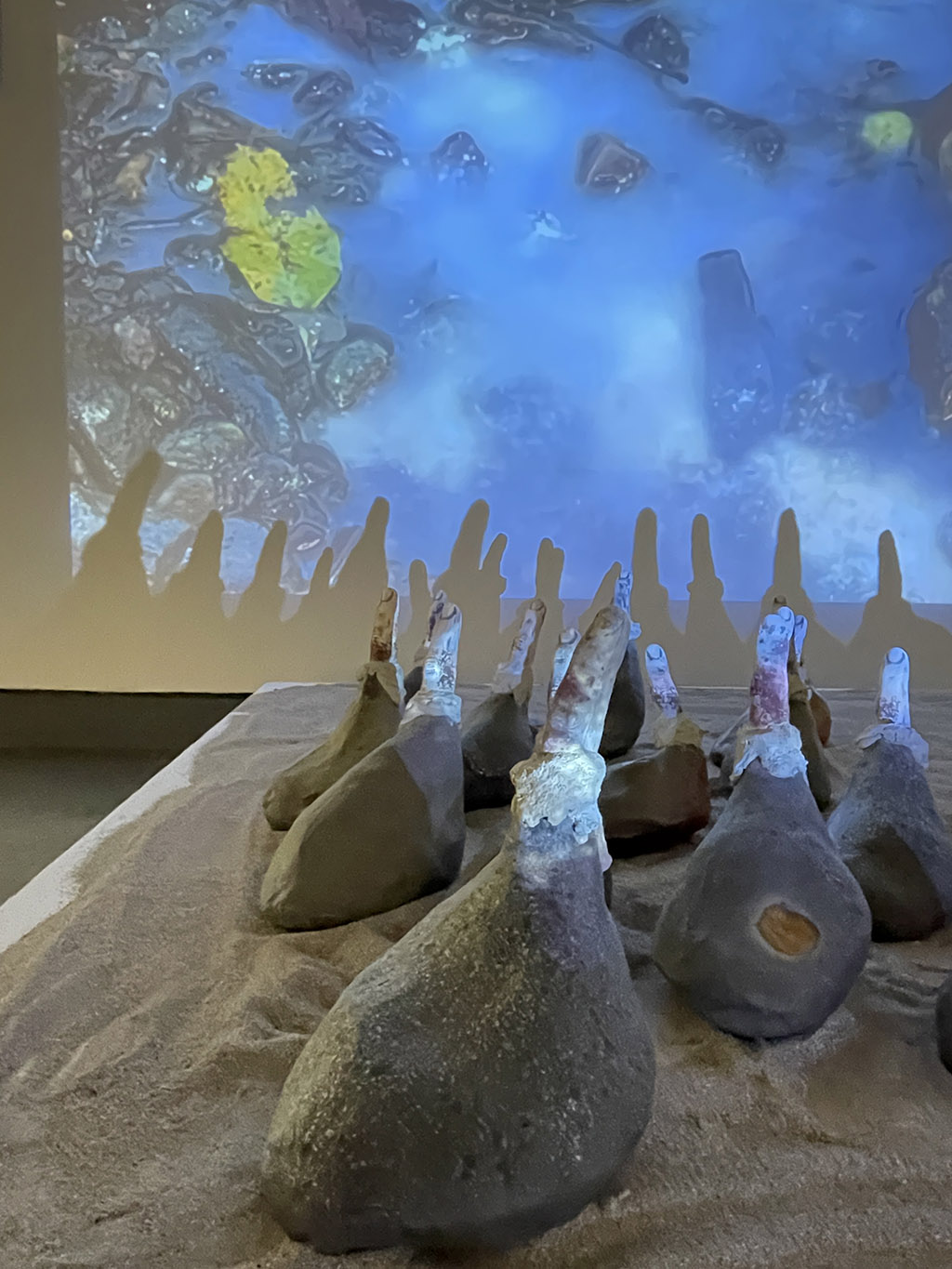 Sahar Tarighi, "Show me where the Roj_helat is," Ceramics, cement, sand, video, 2024 (courtesy of the artist).
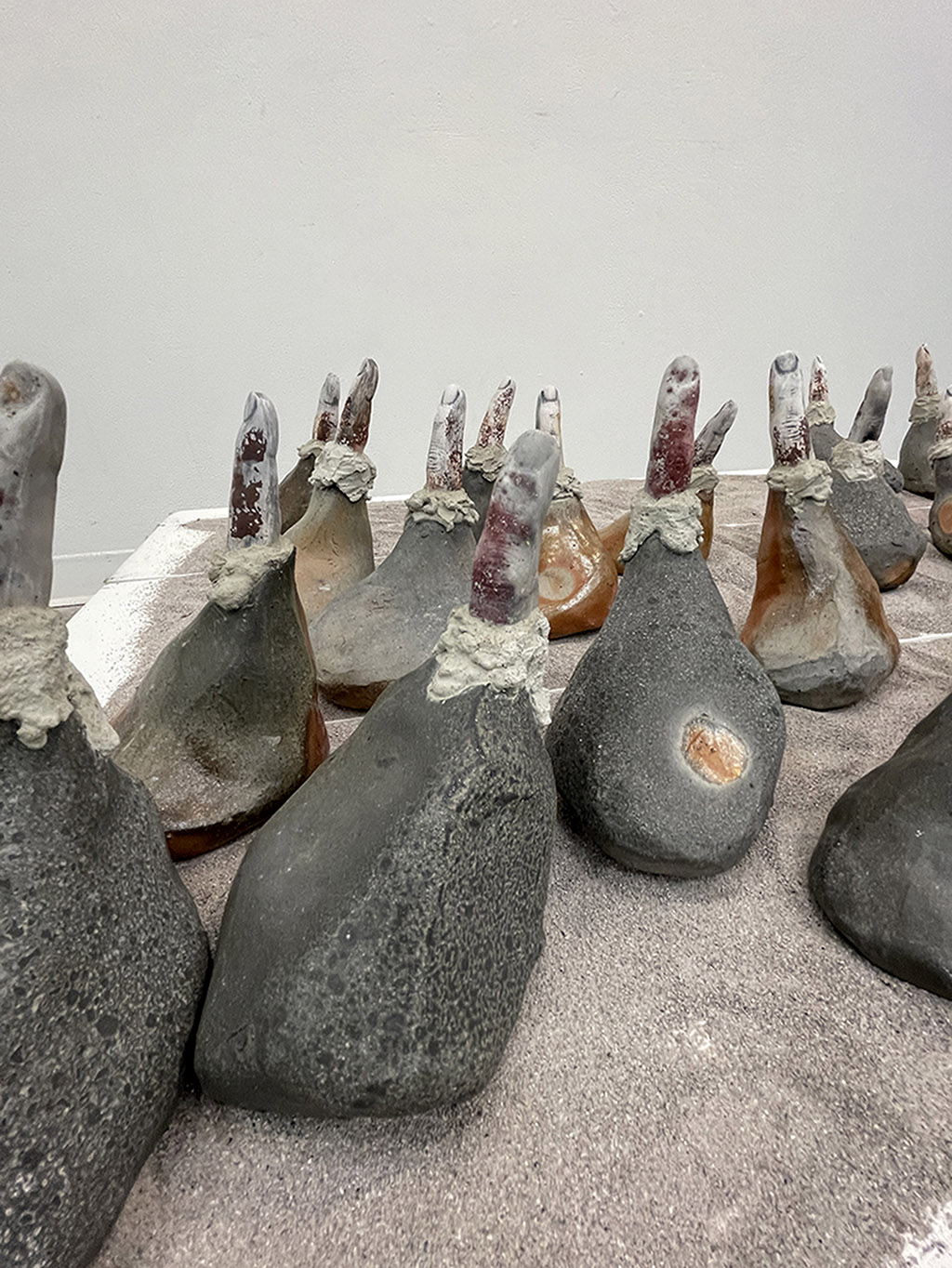 Sahar Tarighi, "Show me where the Roj_helat is," Ceramics, cement, sand, video, 2024 (courtesy of the artist).
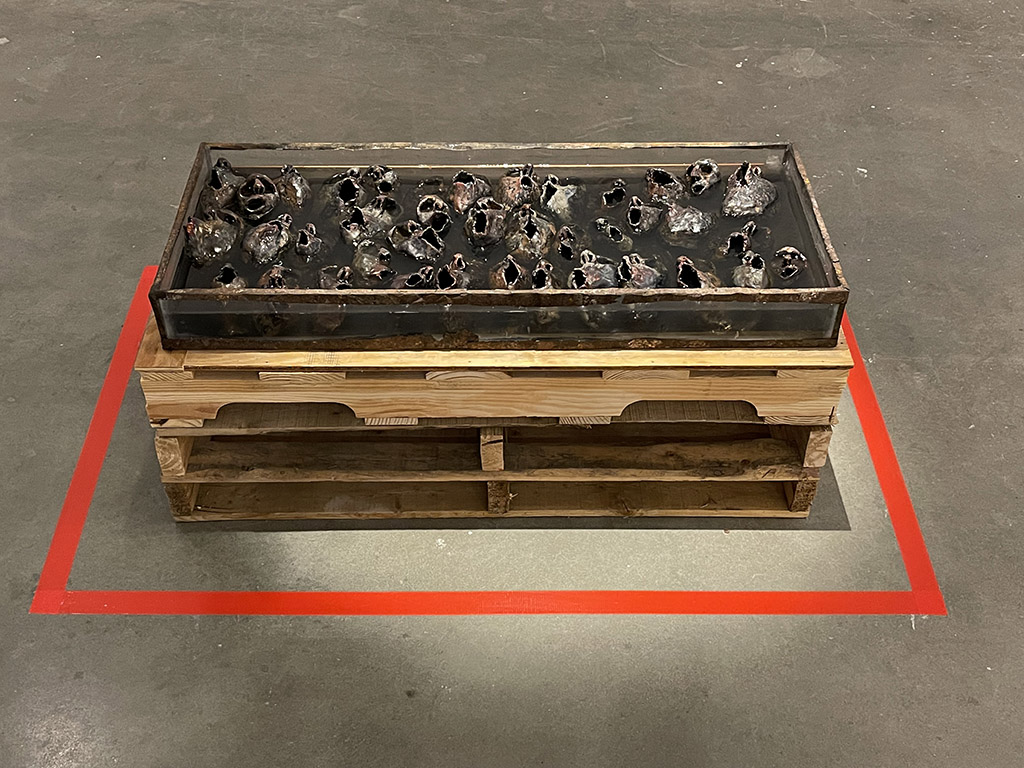 Sahar Tarighi, "Against Forgetting: Anfal Genocide," ceramics, wood, plexiglass, metal, dry ice, water, black paint and video, 2022 (courtesy Sahar Tarighi).
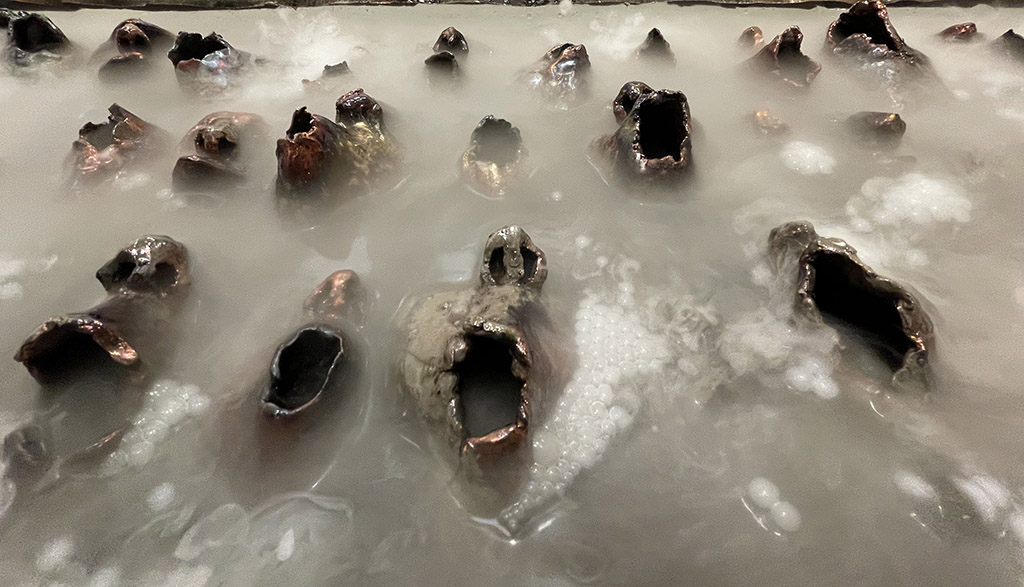 Sahar Tarighi, "Against Forgetting: Anfal Genocide," ceramics, wood, plexiglass, metal, dry ice, water, black paint and video, 2022 (courtesy Sahar Tarighi).
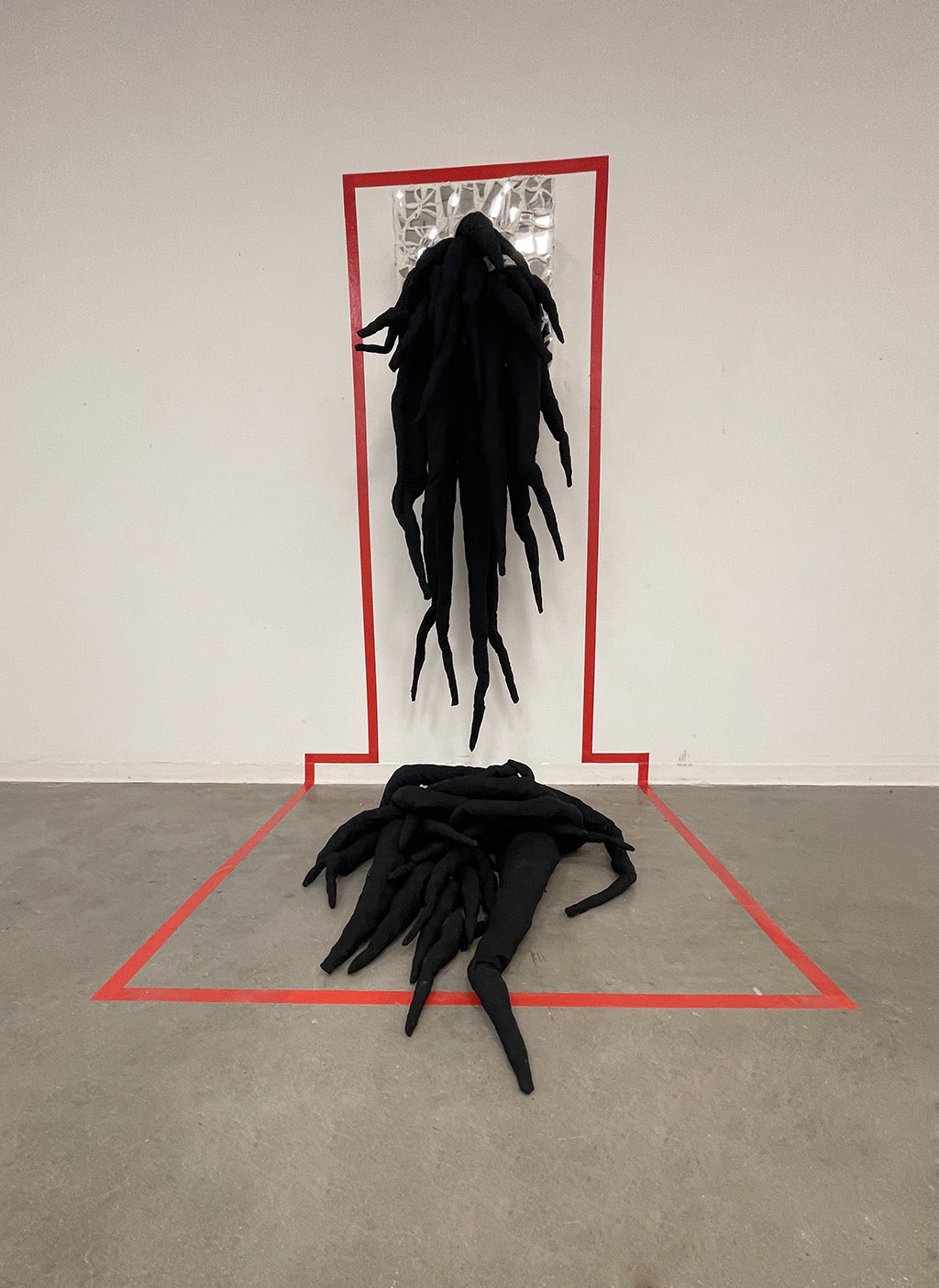 Sahar Tarighi, "Borders of Barriers Barriers of Borders," wood, fabric, mirror, joint compound, stuffing, tape, 2023 (courtesy of the artist).
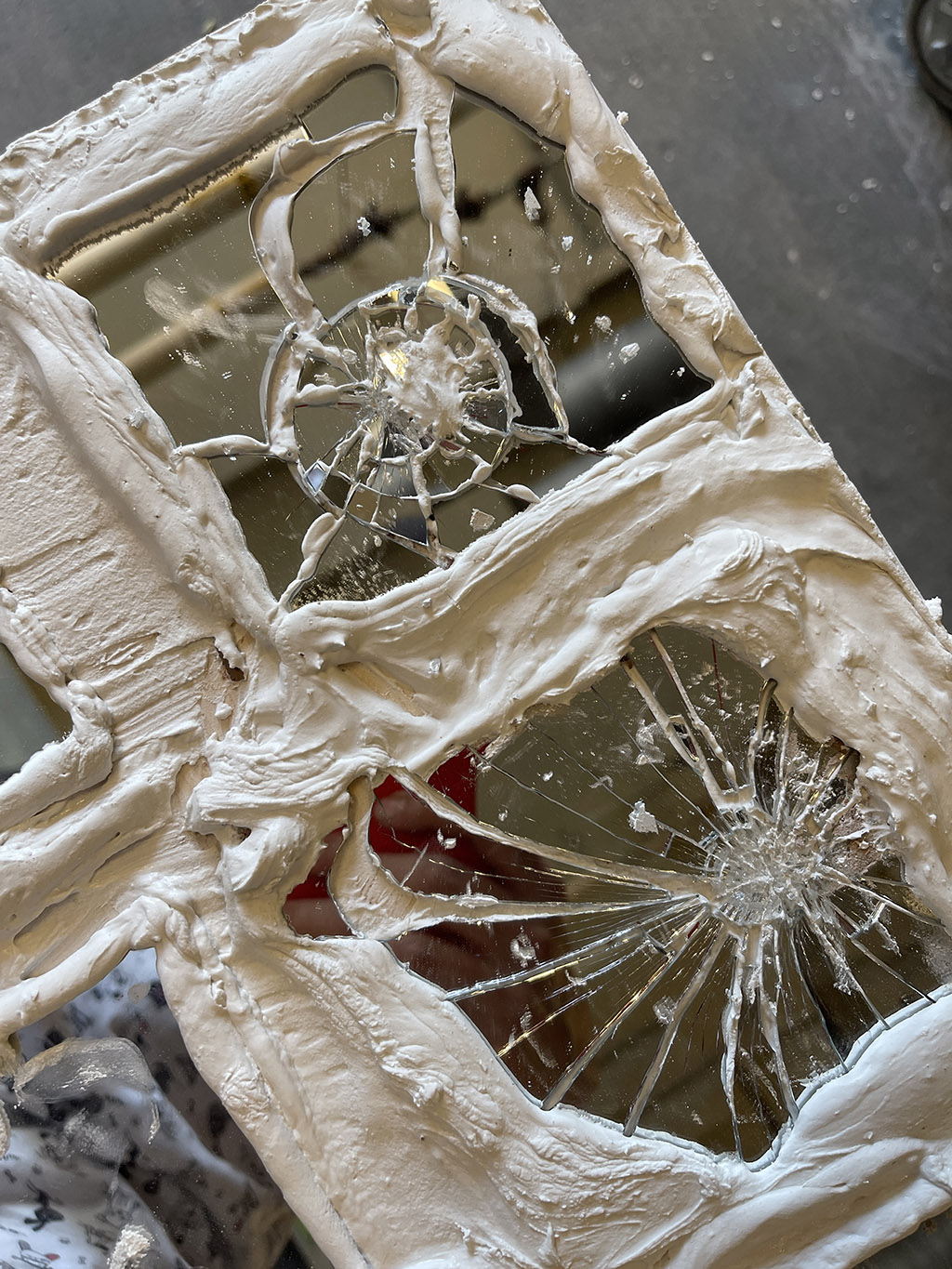 Sahar Tarighi, "Borders of Barriers Barriers of Borders," (detail), wood, fabric, mirror, joint compound, stuffing, tape, 2023 (courtesy of the artist).
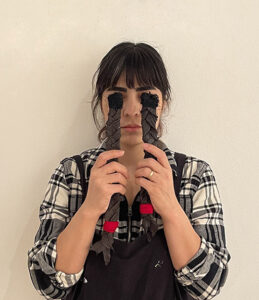
Sahar Tarighi is a Kurdish interdisciplinary artist based in Columbus, Ohio. Working across ceramics, sculpture, installation, video, curatorial, and social practice, her work examines histories of displacement and ethnic and cultural violence through the body and land as sites of memory, survival, and healing. Her practice conceives body and land as living archives in which memory, labor, trauma, and care are embodied, preserved, and transmitted across generations. Drawing from ancestral myths, oral histories, and collective memory, particularly those carried by Kurdish women, Sahar approaches art making as a material and embodied form of knowledge and as a means of resisting cultural erasure and dominant structures of power. Her work has been featured in national and international exhibitions across the United States, South Korea, Chile, Canada, and the United Kingdom, including the Berman Museum, NCECA, the Delaware Contemporary, the Materials Hard and Soft International Craft Competition, Workhouse Clay International, the Guilford Art Center Ceramics Biennial, and the CICA Museum. Sahar Tarighi is currently a Post MFA Scholar in the Department of Art at Ohio State University. Find her on Instagram.
Images 1 and 2, from Show Me Where the Roj-helat Is?, a series that explores displacement and the body’s capacity to carry place. The artist made organic ceramic forms, marked by the imprint of fingerprints, in her studio in Delaware before traveling with them across the United States. They were soda-fired at Arrowmont School of Arts and Crafts, finger molds were produced at Penland School of Craft, and the forms were later pit-fired during a residency at Watershed Center for the Ceramic Arts before returning to her studio. Their movement became inseparable from the work itself. As the objects crossed landscapes and accumulated material transformations, they mirrored the ways displaced bodies carry memory, change, and traces of every place they pass through.
Images 3 and 4, from Against Forgetting: Anfal, an installation rooted in the collective wounds of the Kurdish people and the enduring trauma of the Anfal genocide, which refers to a verse in the Quran and continues to shape Kurdish memory and land to this day. Between 1986 and 1988, the Ba’athist regime carried out a brutal military campaign known as Anfal, aimed at Arabizing strategic and oil rich areas of Southern Kurdistan. This campaign unfolded in eight phases, marked by chemical warfare, mass executions, forced displacement, the destruction of villages, and systematic erasure. It is estimated that over 182,000 Kurdish civilians, including women and children, were killed. Even decades later, mass graves continue to be unearthed, a persistent rupture in Kurdish memory and geography.
“My memory of Anfal is both personal and collective,” remembers Sahar Tarighi. “As a child, I witnessed families who had fled Southern Kurdistan in the aftermath of Saddam Hussein’s violence. In my hometown in Rojhelat (Eastern Kurdistan), local families, including my own, opened their homes to displaced survivors. One family lived with us for several months. At the time, I could not fully understand the weight of their experiences. It was only later that these childhood memories became part of my understanding of Anfal as a collective Kurdish memory that continues to shape generations.”
Images 5 and 6 are from the ongoing installation Borders of Barriers: Barriers of Borders, a body of work exploring the consequences of political borders on the Kurdish body and land through the practice of kolberi, a form of cross border labor in the mountainous regions of Kurdistan, particularly between Iran and Iraq. “Here, I envision the kolber’s bag as an extension of the body, a window into fear, uncertainty, trauma, and, at the same time, resistance. Pain, intestines, and braids rupture the back of the bag, spilling onto the ground. The bag becomes a fragile container, unable to hold the immense emotional and physical weight it is forced to carry. A red line traces its contours, outlining the body, the land, and the border. Throughout this body of work, I return to the Kurdish body and land as repositories of trauma and endurance, where grief, memory, and political violence are deeply lived realities rather than distant abstractions. This work is a refusal to forget. It understands the Kurdish body not only as a site of oppression but also as a vessel of resistance, knowledge, and survival.”
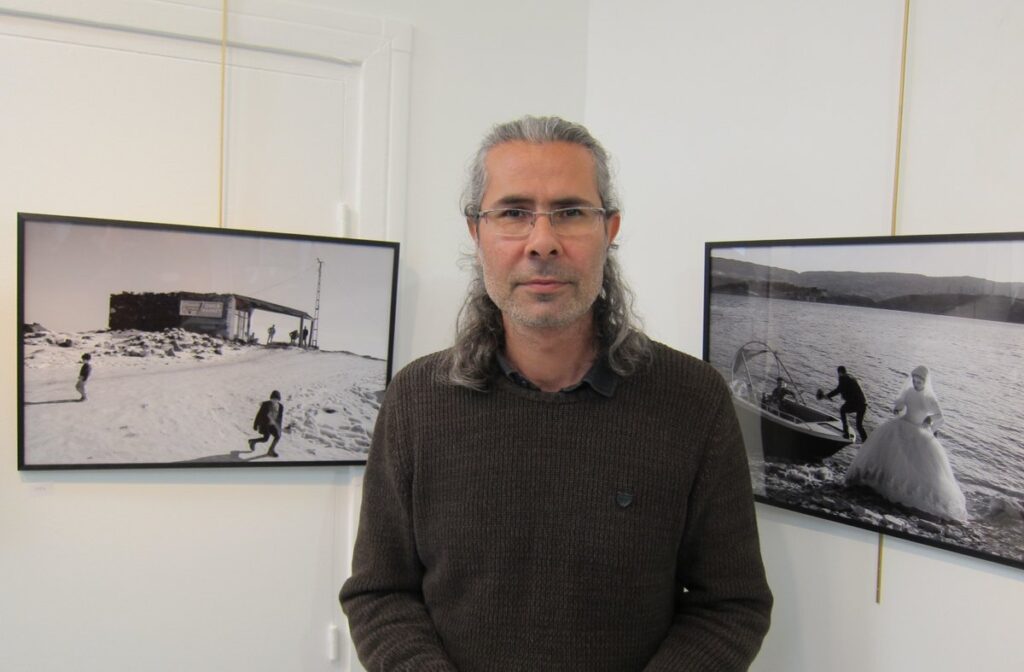
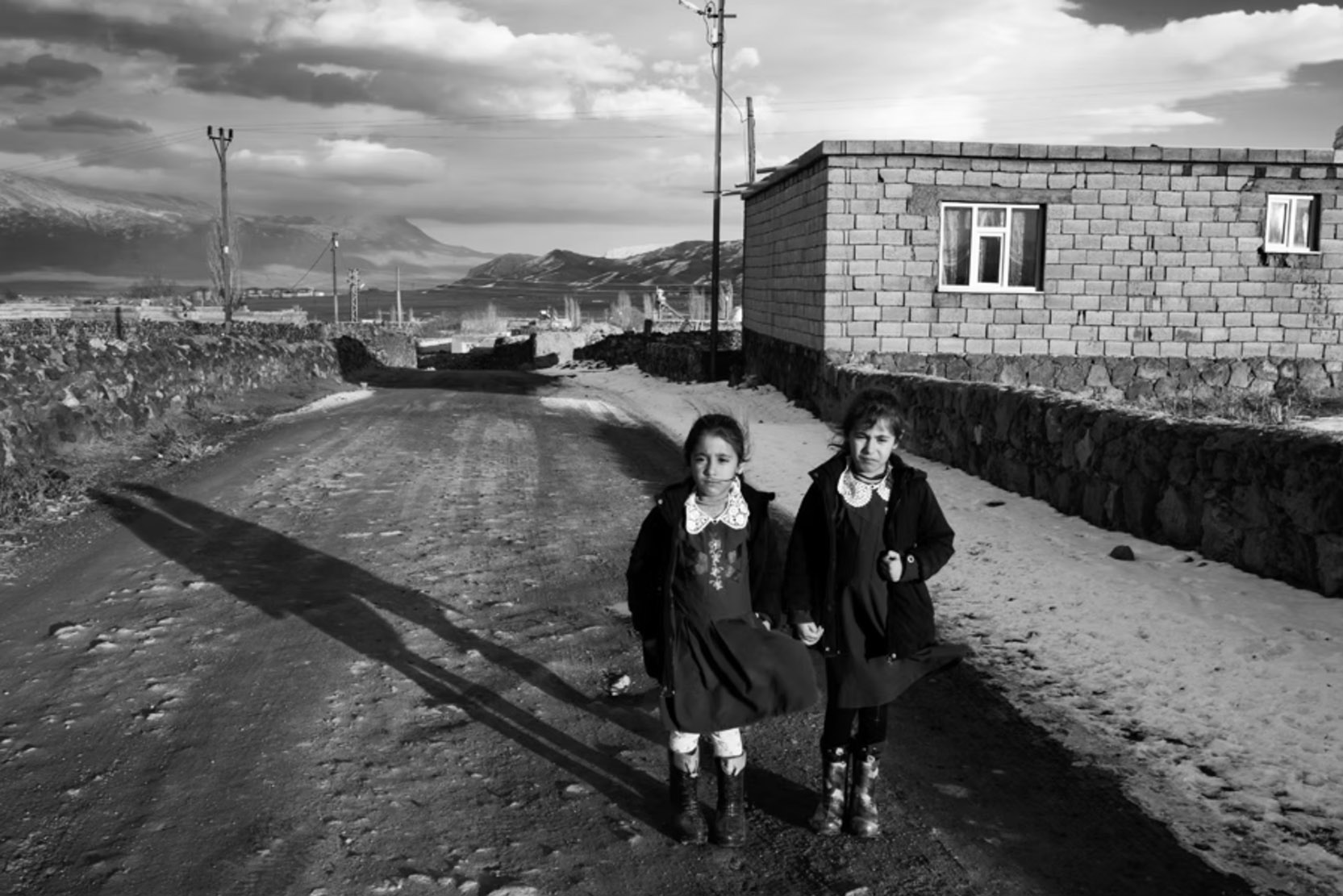 Murat Yazar (courtesy Murat Yazar).
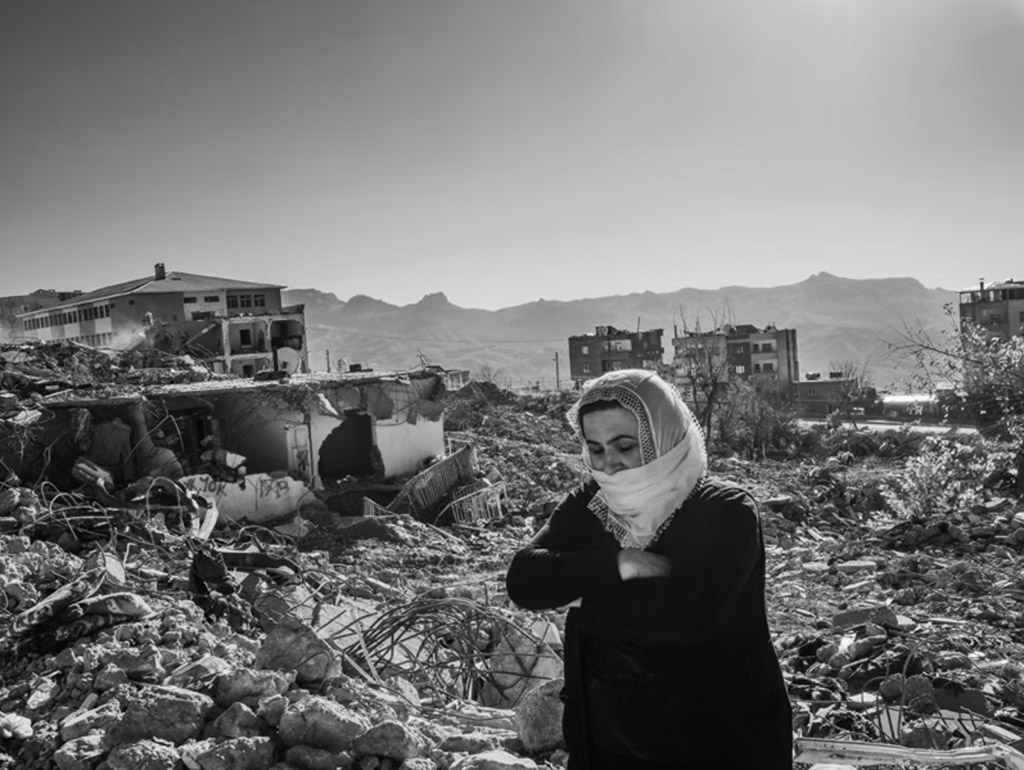
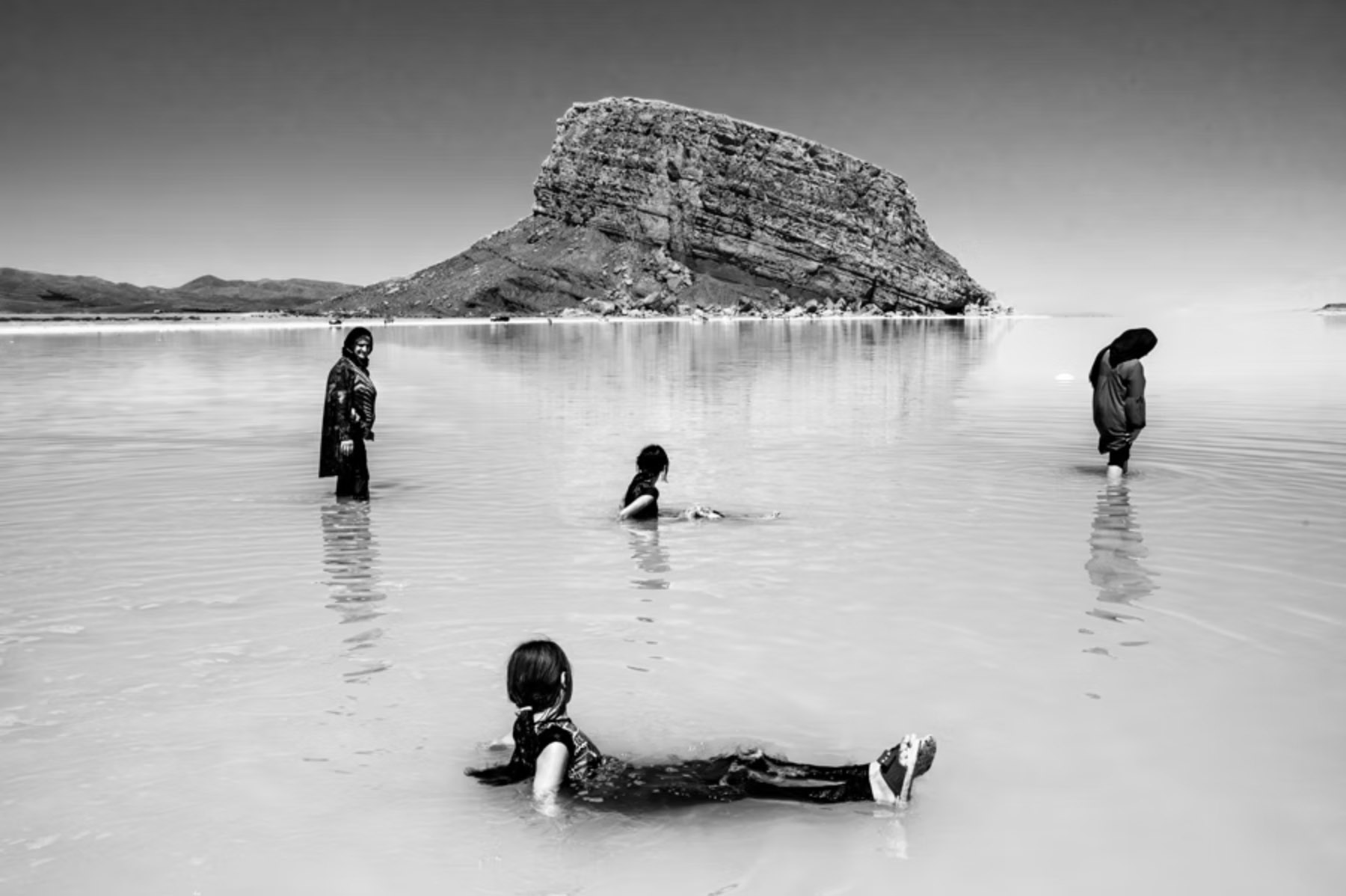
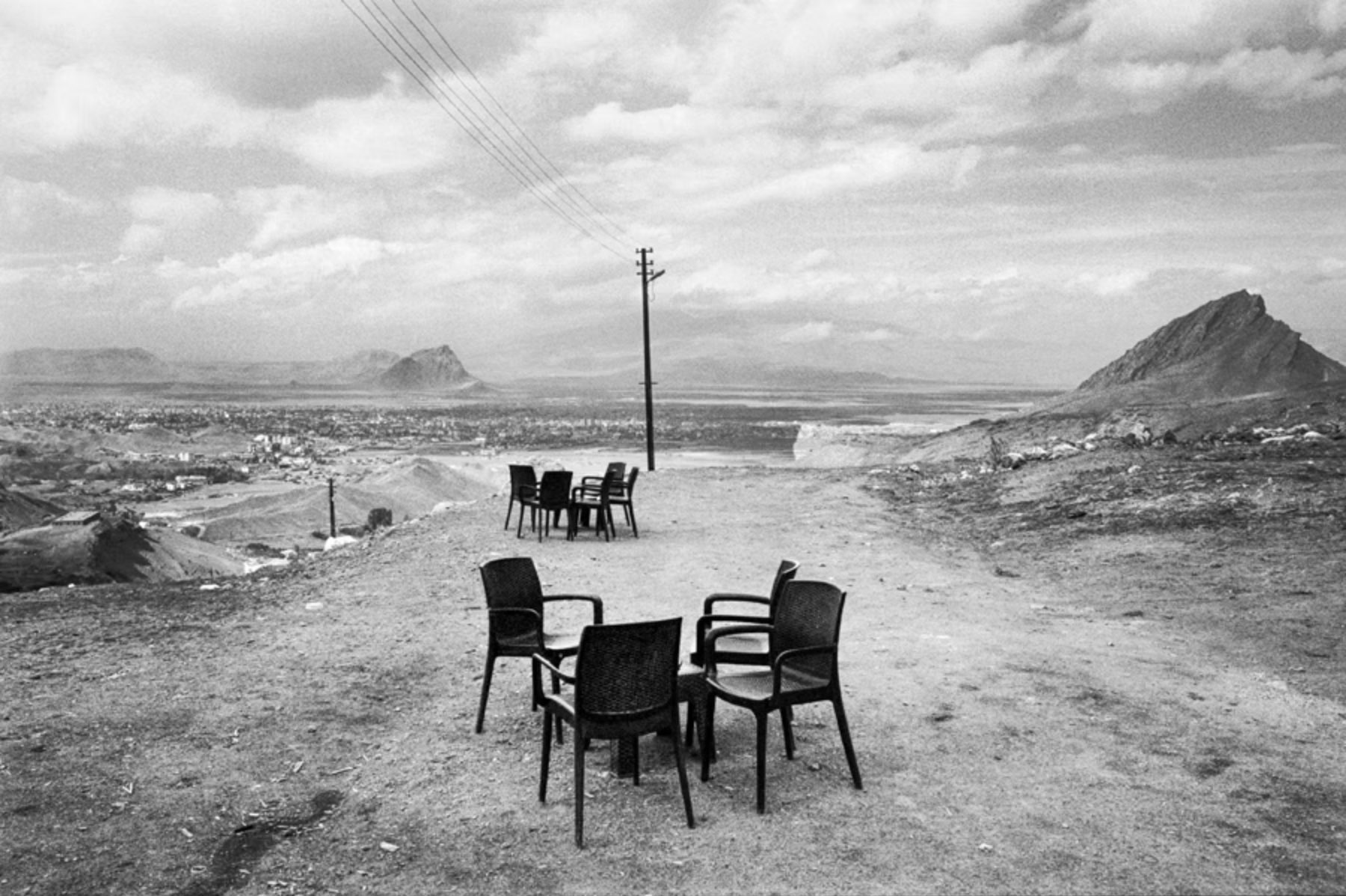
Murat Yazar is a Kurdish documentary photographer born in Urfa City in Türkiye. Since 2007, he has been producing long-term visual stories focusing on memory, migration, borders, and social transformation. His work has taken shape across a wide geography extending from Türkiye to the Caucasus, and from the Middle East to the Balkans and Europe. As part of the National Geographic-supported Out of Eden Walk project, he documented an approximately 1,200-kilometer route on foot from Urfa to Georgia. His projects and visual research have been supported by institutions including the Pulitzer Center, ISMEO, University of Rochester, and Cornell University. Yazar has received several international awards, including the Banff Mountain Photo Essay Grand Prize, the W. Eugene Smith Grant, and the RPBB Grand Experts Award. Since 2017, he has been living and working in Italy.