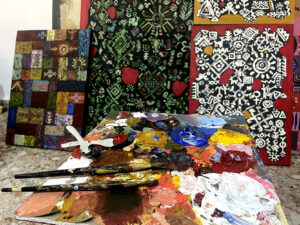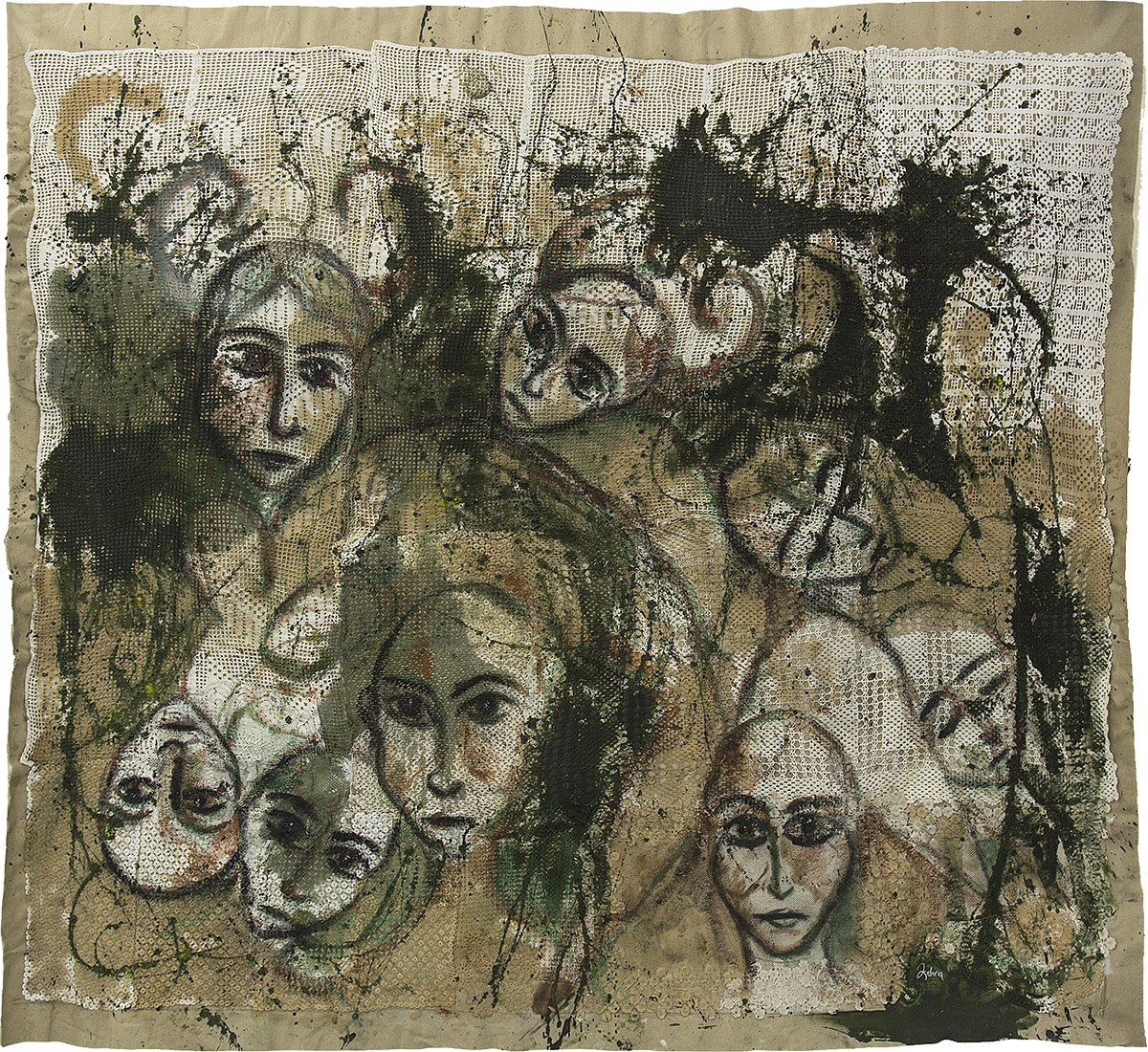
Doğan makes her paintings out of whatever is at hand — coffee, turmeric, cigarette ash, her own blood — blurring the line between the abject and the sublime.
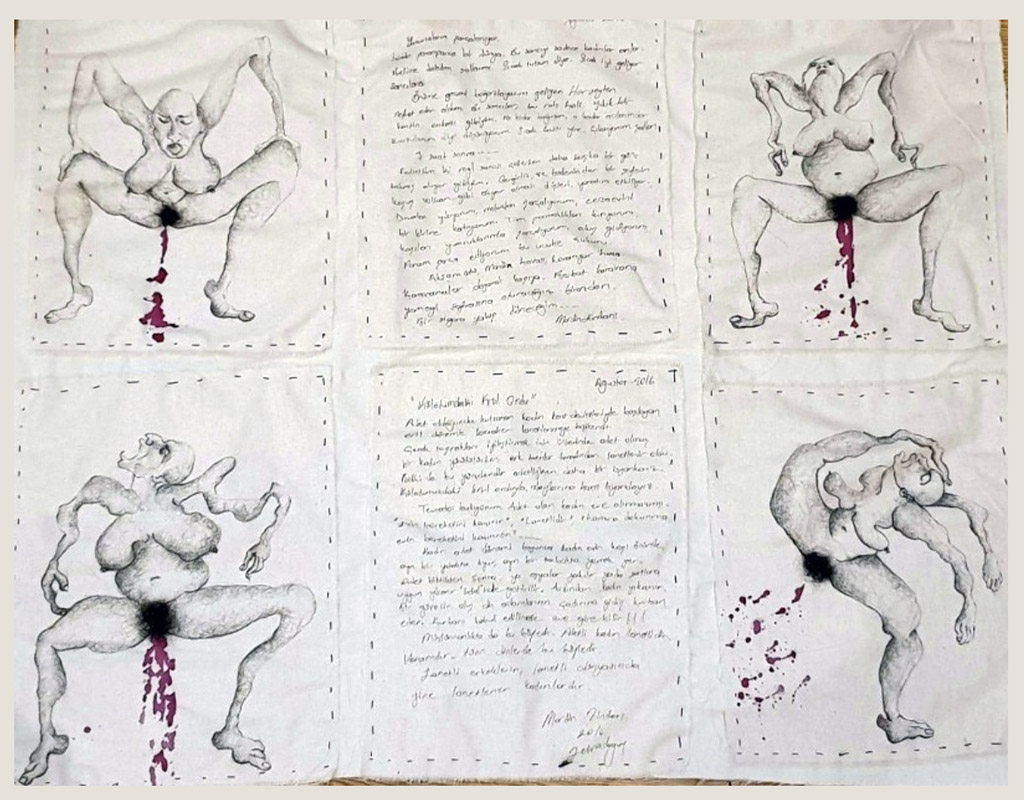
Zehra Doğan’s work returns, again and again, to what is forbidden. It accumulates quietly, often in secret, and was frequently smuggled out of the place it was made. And of all the substances she has worked with, it is the most forbidden — her menstrual blood — that she keeps for painting goddesses in all their many hidden and unsanctioned forms.
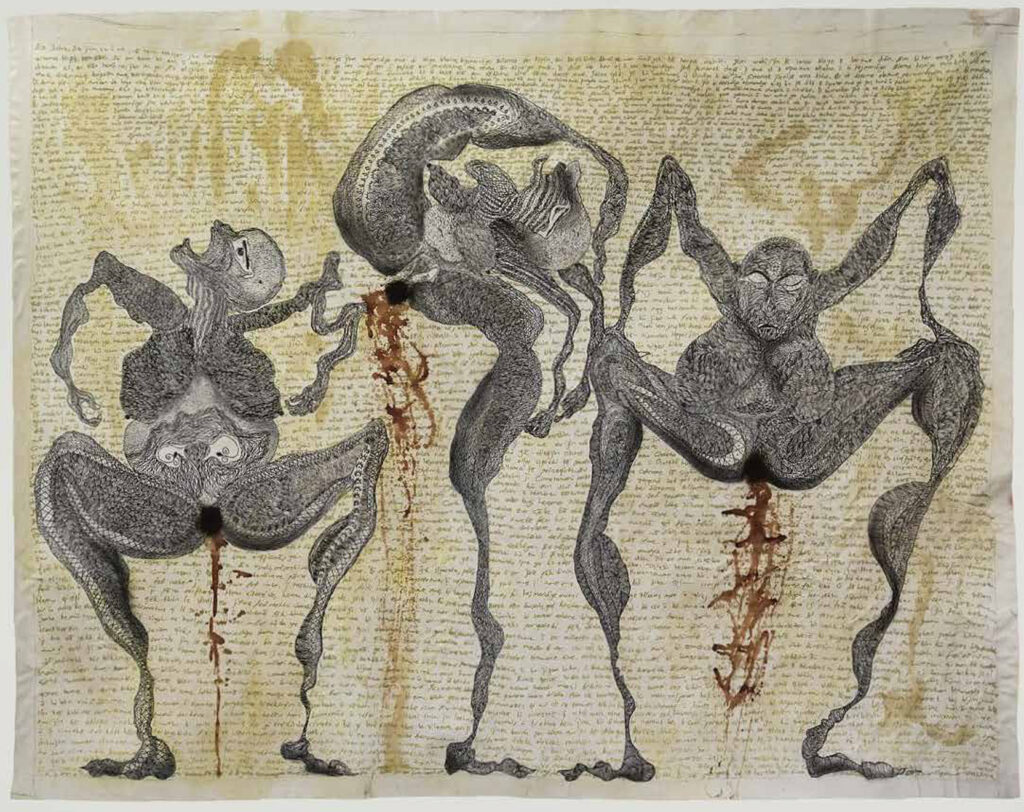
Menstrual blood, as the long inheritance of Leviticus would have it, is among the first of impurities: whatever it touches is unclean for seven days, and the menstruating woman is kept from the altar, the kitchen, the mosque, and on bad days, the house itself. The states and the scriptures, as ever, are in agreement about her body. She is something to be managed, wrapped in a respectability that only half-covers the violence beneath it, and kept at the edge of the clean world.
It is from that edge that Doğan paints, and she has a name for the place she stands. In a recent interview, she described herself as one of an “amorphous people,” and sets that against the state, which she calls a robot — mechanical, rigid, its eyes fixed straight ahead. “You break the robot with the amorphous,” with whatever it cannot categorize, she says.
Doğan was born in 1989 in Amed (Diyarbakır), Turkey, a place that has known prohibition intimately. She was political almost from the start, a child of Bağlar who took the world in early and never quite set it down. She completed Dicle University’s Fine Arts Program and took up journalism alongside it. For someone who belongs to an amorphous people, she says in that same interview, the vertical, objective discipline of the academy amounted to “a kind of suicide,” and it was prison, in the end, that became her real education, in both her art and her activism.
In 2012, she helped found JINHA, a news agency run start to finish by women, the first of its kind in Turkey. Straight away, Doğan went after the stories the national press would not touch: Yazidi women who had survived ISIS captivity, reporting that won her the prestigious Metin Göktepe prize in 2015, and the Kurdish towns sealed off under curfew. In the purge that followed the failed coup of 2016, the authorities shut JINHA down that autumn, along with scores of other outlets (the agency is presently alive and well).
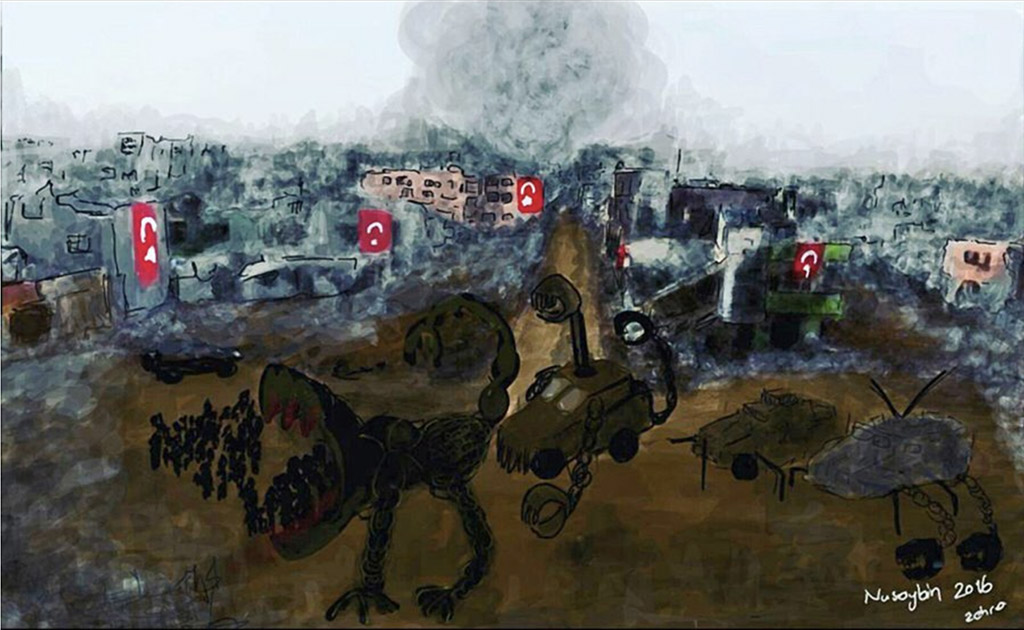
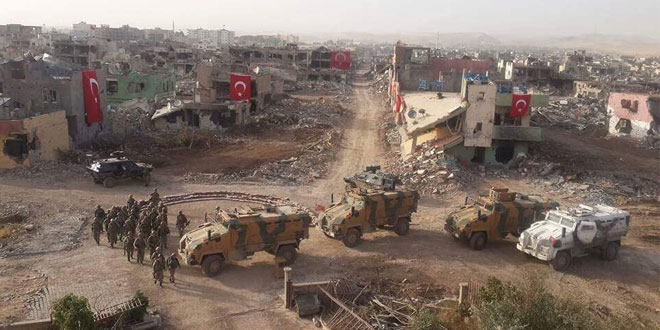
Then came the painting that landed her in prison. A photograph of the army’s handiwork at Nusaybin — the town in ruins with Turkish flags planted in the wreckage — had been circulating online and Doğan worked it up into a painting and posted it. The police took her from a café that July. By early 2017 the court had cleared her of belonging to an illegal organization but later convicted her for the painting itself, a sentence of two years, nine months, and twenty-two days. She served the time in prisons in Mardin, Diyarbakır, and Tarsus, and across all three she became more prolific than ever.
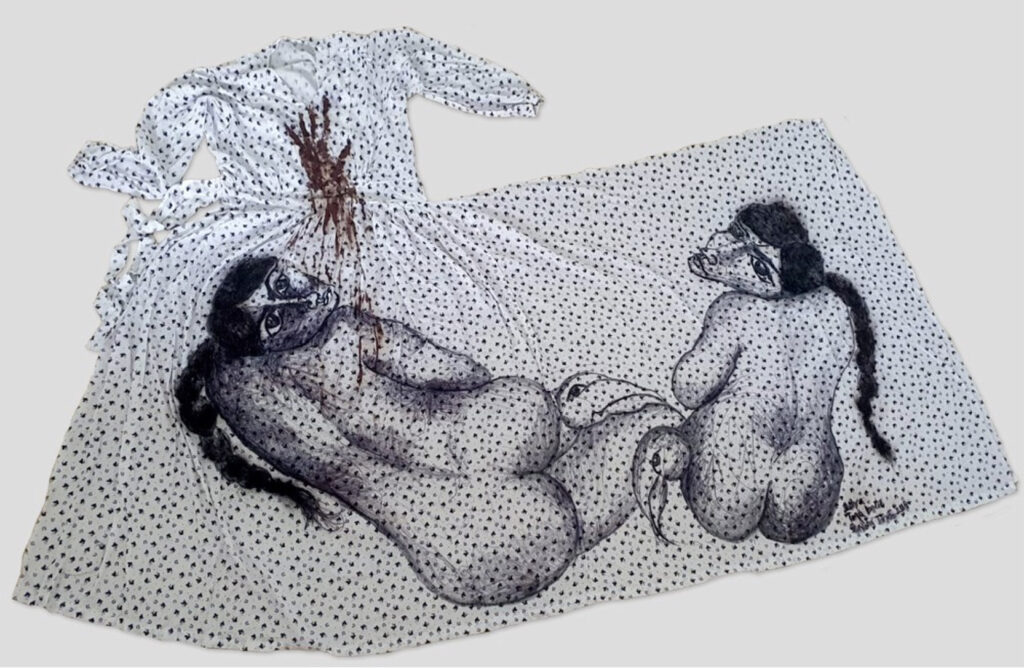
The materials came straight out of that confinement, and so did the cunning. Inmates were allowed four changes of clothing, so when her mother arrived on visiting days with clean clothes, Doğan would paint on them and hand them back to the guards as soiled laundry. Seeing only dirt, the guards would pass them out to her family without a second look.
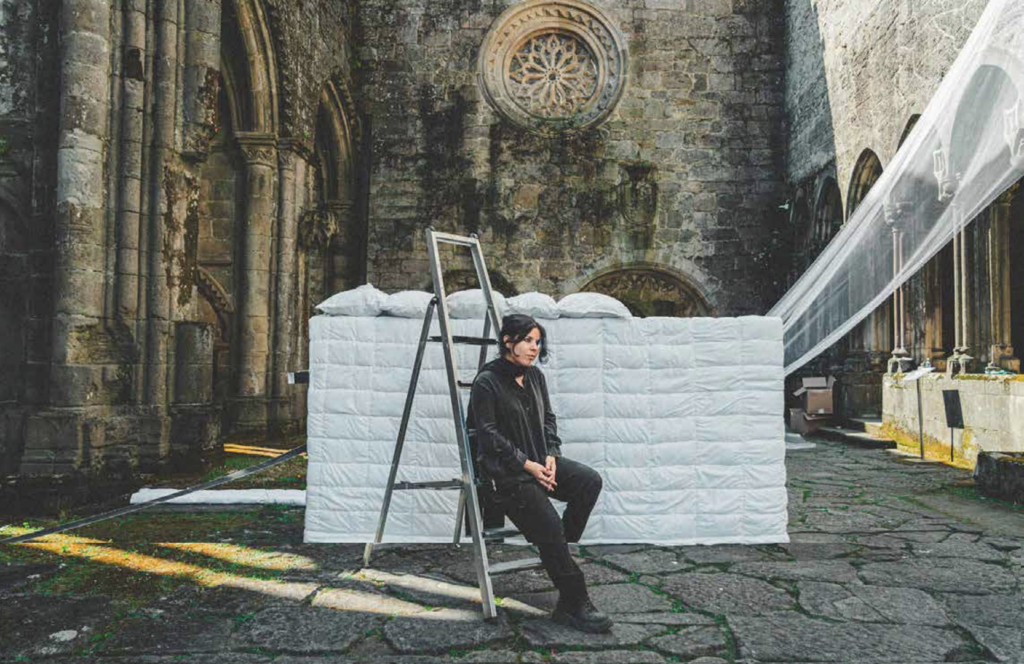
In a text from her portfolio, Doğan describes a guard once half-opening the cell to relay the prison warden’s unease. “I don’t know how to say this,” he told her, “but apparently you are making drawings with blood, is this true?” He had censored the word menstrual himself, settling instead for blood, with “patriarchal embarrassment.” The staff were disgusted; they feared the germs. “Today is a ‘disgusting’ day,” she wrote.
What Julia Kristeva called the abject — everything a body expels to keep itself sealed and presentable, the blood and waste and the leaking edge where the coherent self comes apart — Doğan treats not as horror but as pigment. In her hands, almost everything arrives doubled, each image shadowed by its opposite.
One of the figures she has painted over and over, since that first cell, is the Shahmeran: half woman, half snake, the Mesopotamian keeper of an underground wisdom the world above both needs and fears. There is “Êşa Şahmeran” (Shahmeran’s Pain) on a bundle scarf in Mardin Prison in 2016; “Şahmeran Zelal,” in Diyarbakır Prison in 2018; and, in exile, the figure migrating onto old Kurdish rugs in acrylic and gold leaf between 2020 and 2022, among many others.
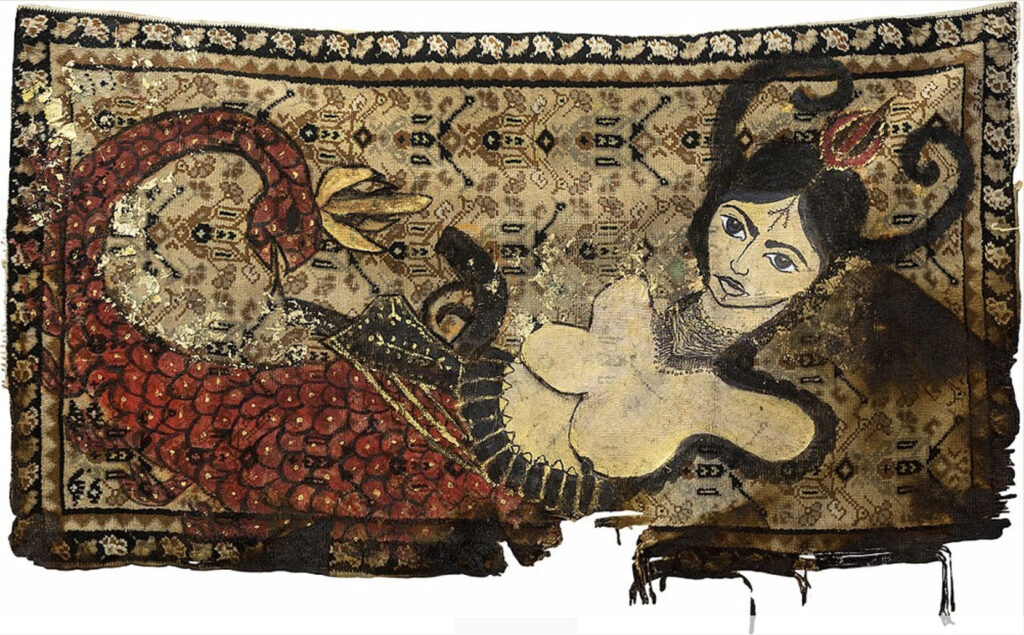
The snake-woman is the perfect emblem because she is already two. The monster underfoot you are meant to kill, and the queen and healer you are meant to revere. And she refuses to be torn apart. A single body holds both reverence and revulsion.
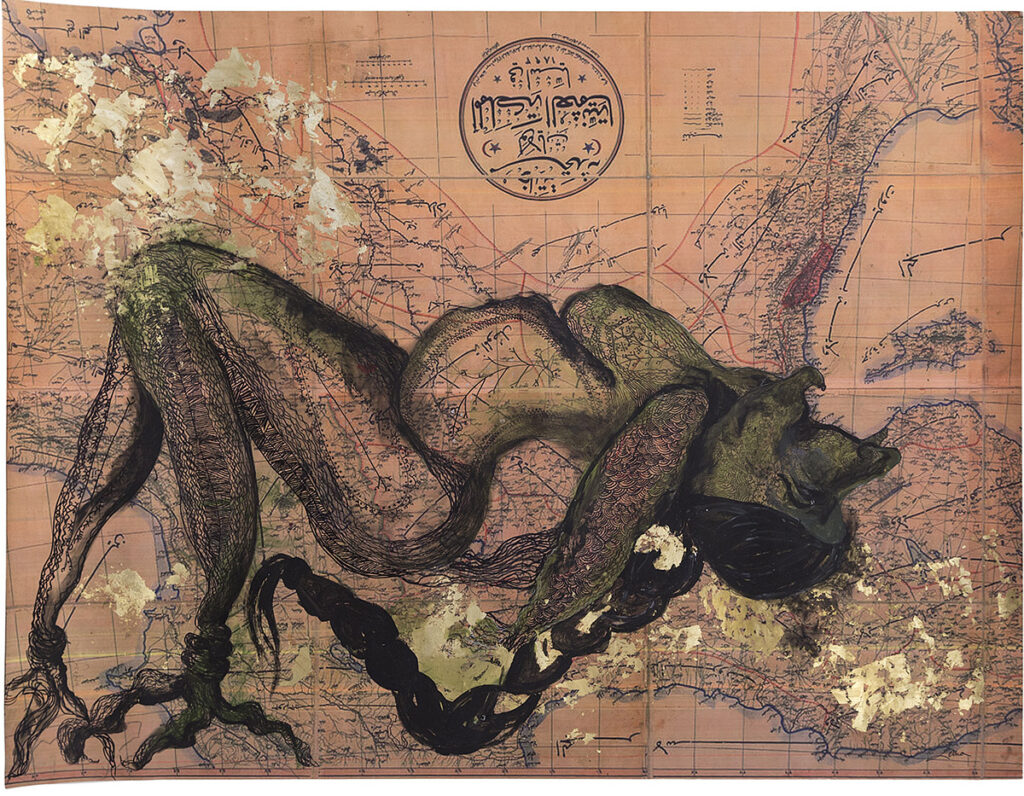
The doubling reaches the land and body, too. The female bodies Doğan paints are forever turning into the ground from which they came: women laid over maps of Kurdistan, braids rooting into soil like vines, hair becoming ivy…
“In sexist discourses,” she has said, “the earth is personified as a woman’s body, becoming … something to be possessed. I draw and paint women who oppose this fate.” So, she paints the body that is also a map, the violation of the one made plainly the violation of the other — the Kurdish woman’s body abject and sacred and occupied all at once — and where the language of conquest treats a woman as territory to be taken and controlled, she answers, simply, No. And then, doubling even that refusal, the woman who is also the land, who feeds from it and feeds it in turn.
Her work left prison before she did, the pieces smuggled out one by one. News of her case reached others, too. Ai Weiwei wrote in solidarity late in 2017, and Banksy, with Borf, gave a long Lower Manhattan wall over to her case in March 2018. He had painted, he said, things far more deserving of a sentence. She broke the ban on her letters and calls to thank him from Diyarbakır and to set down, in her own hand, what the place was: “a dungeon which has history of bloody tortures, in a town with a lot of bans, in a denied country.”
She also began Prison No. 5, her graphic novel, in 2017, drawing on the blank backs of the letters her friend Naz Öke posted. It is reportage of the daily life in the women’s wing and the prisoners’ solidarity, and it is history too. Diyarbakır’s Prison No. 5 is among the darkest names in Kurdish memory, a place that after the 1980 coup ran as a machine for turning Kurds into Turks. Published in 2021, Doğan’s novel won the Atomium/Le Soir prize and landed on the year-end lists.
She walked out of Tarsus on February 24, 2019, and recognition came fast. Tate Modern, the Drawing Center, the Berlin Biennale, the first Carol Rama Award at Artissima in 2020, two appearances on ArtReview’s roll of the most influential, an honorary membership of PEN International.
Recognition, though, has not been a way home. The United States refused her a visa in 2019, and she missed her own New York opening. Turkey’s highest court conceded in 2023 that the conviction had rested on a misreading and ordered a retrial. The terror-propaganda charges were thrown out in May 2024. Almost in the same breath, the Nusaybin prosecutor opened a new file and issued a new warrant, targeting once again what had always been inseparable in Doğan’s practice: her journalism, her art, her politics. Forced to seek asylum in Germany, she now lives in Berlin, works across Europe, and is at work on a video project about Rojava.
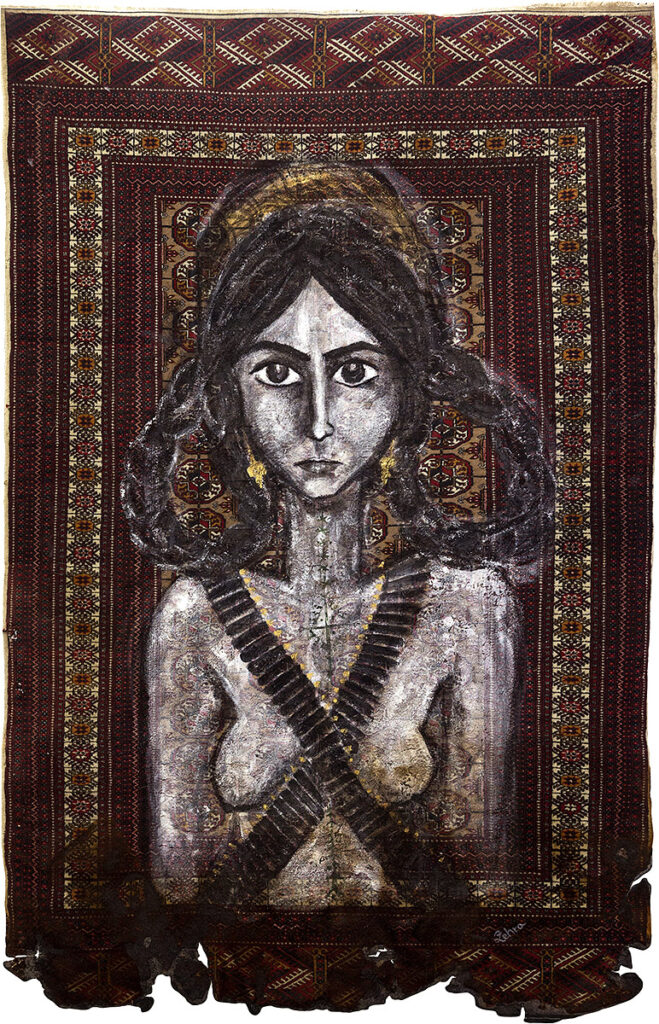
She still creates from a body that has been searched, sentenced, and forced out of the country, and what her paintings refuse is not the pain of these experiences, but the old, deep-set certainty that the unclean and the holy are different things, kept in different rooms, and that a woman belongs to the first. Doğan mixes these rooms. She paints the saint in the substance of the sinner and leaves us somewhere between the abject and the sublime, which in her hands were always close relatives.