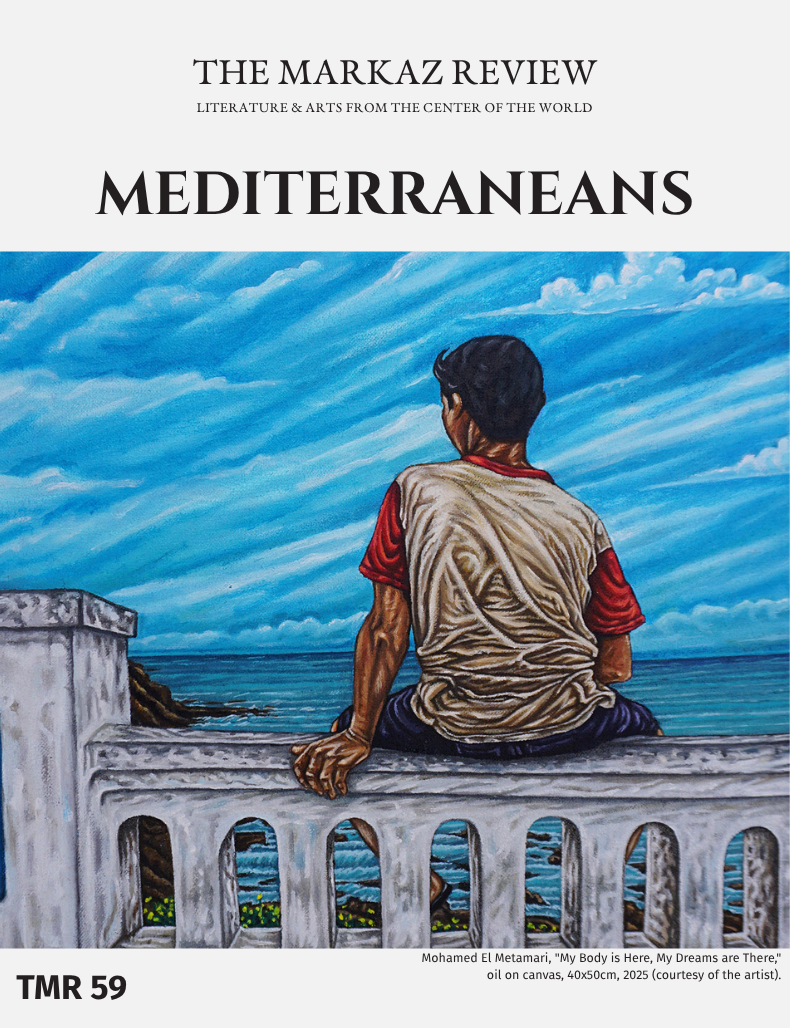
Across stories, essays, and art, our newest issue reveals not one Mediterranean but many, layered and contradictory, always in motion.
For as long as I can remember, the shores of the Mediterranean have felt like home. Whether in Beirut, Tunis, Marseille, or Barcelona, there is a familiar language to its waters, to the rhythms of its people and the textures of its cities. It is a shared history I feel in my body as much as in my mind. The Mediterranean holds together the contradictions of a life lived in motion: of migration and multiplicity.
For many, the Mediterranean is often imagined as a place of leisure: sun-drenched coastlines, a celebrated diet, and a slower, more sensuous pace of life. But beneath the famously warm hospitality runs a darker undercurrent — one marked by violence, by rupture, by the traces of fallen empires and bloody conquests that have shaped its shores for millennia. The same waters that carry moments of joy also meet shores shaped by war, displacement, and unfathomable violence.
This darker current runs deep in the mythologies of those who have long called the Mediterranean home. It is, after all, one of the oldest continuously inhabited regions in the world, its cities among the most ancient, each laying claim to deep and competing histories. As the Italian philosopher Federico Campagna observes, many of the foundational mythologies of the Mediterranean share a strikingly bleak view of human existence. From the Hebrew Bible to ancient Greek and Egyptian mythology, life is often framed as a fall into hardship, suffering, or grief. Campagna suggests that this worldview shaped two enduring responses for the people of the Mediterranean: either a hedonistic embrace of pleasure, or a turn toward narratives of redemption to make meaning within a difficult world.
In my mind, multiple Mediterraneans are layered on top of one another in uneasy coexistence: the golden-hazed beaches of Ibiza, where I once danced through the night before falling asleep on an abandoned sun lounger by the water’s edge; the quieter, more interior shores by a village in northern Morocco, where the first images of my debut novel appeared to me; the charged, electric evenings on the streets of Beirut, where I stood shoulder to shoulder with thousands of others in revolutionary fervor, imagining the possibility of a liberatory future as the sun set over the sea. Then there are the more haunting images that refuse to leave my mind — small boats cutting across the water pursued by European coast guards; the lifeless body of a boy — Aylan Kurdi, the waves lapping at his small frame, a stark reminder that, for some, the sea is not a place of pleasure but of necessity, risk, and often loss.
How do we reconcile these different visions of the same sea? What does it mean for the Mediterranean to be both a site of longing and a site of rupture, both a space of possibility and a space of constraint? These are some of the questions that our contributors grapple with in the essays, fiction, art, and reflections that make up TMR’s newest issue, MEDITERRANEANS.
“There are many Mediterraneans in my mind,” writes Gabriela Mitrushi in our centerpiece, “Don’t Forget to Say I Love You.” In this sweeping essay, Mitrushi captures the Mediterranean in all its contradictions: a place of memory and intimacy, but also of erasure, extraction, and violence. Moving between personal reflection and broader histories of migration, colonialism, and environmental degradation, Mitrushi challenges the ways in which the sea has been transformed into a dividing line that separates those deemed worthy of movement from those denied it.
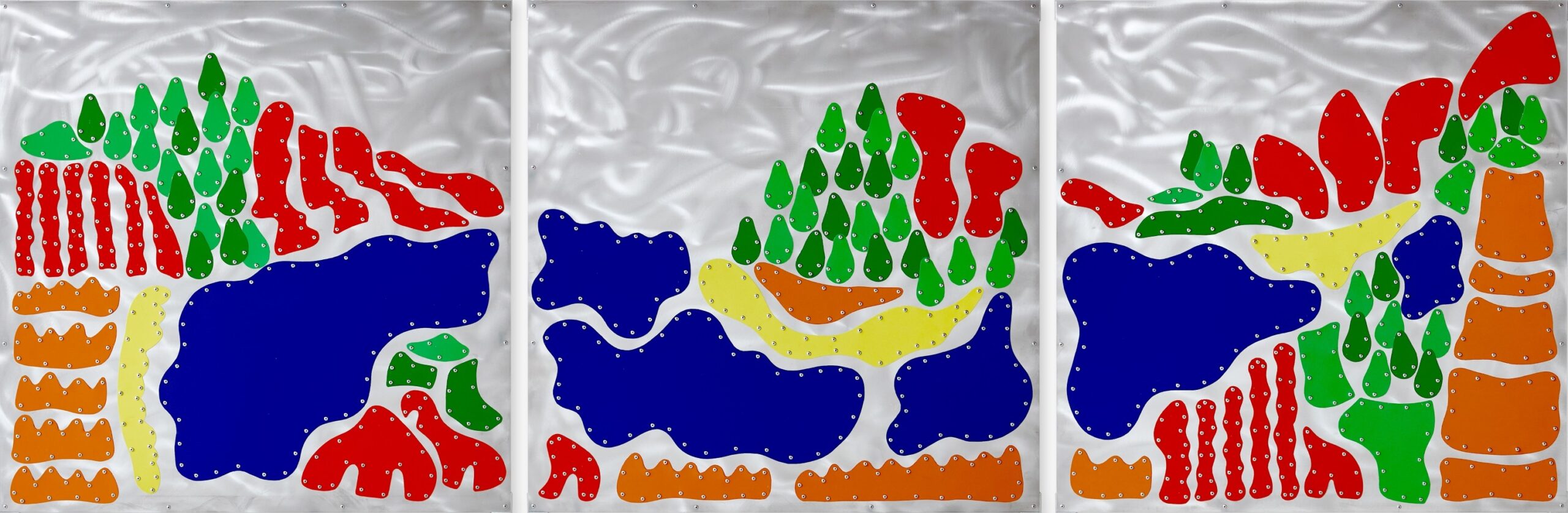
Movement is central to the Mediterranean. The sea has long functioned as a network of trade, migration, and exchange routes that bind a vast and heterogeneous region. Its port cities have served as points of encounter, where ideas, goods, and people have circulated across continents. The Mediterranean, in this sense, is not a fixed geographical place, but a flow of bodies and stories, a continuous transformation.
Unsurprisingly, then, migration emerges as a recurring theme in many of the pieces in our issue. Who is free to move across the sea, and who is made to stay? What becomes possible in the act of crossing, and what is lost, shed, or imposed in the process? These are not abstract questions, but ones shaped by policy, by borders, by histories of power that determine whose movement is permitted, and whose is refused.
In Xloi Karnezi’s “Zones of Exclusion,” a Mediterranean boat crossing, Mount Athos, and a daughter’s scrolling screen collapse into a single shifting sea of image and memory. In “On the Mediterranean as an Island,” Naima Morelli interviews Tunisian artist Kais Dhifi, where he speaks about speculative fiction, the politics of mobility, and why he believes the Mediterranean is not a sea but an island. In “Last Glance at the Bosphorus,” a short story by Nektaria Anastasiadou, a history teacher quietly begins to piece together the identity of a disheveled stranger on a ferry crossing the Bosphorus. And in an excerpt from Emanuela Anechoum’s award-winning debut novel Tangerinn, love and shame grow side by side in a crowded coastal bar populated by migrants, where a young girl learns what it means to belong. “To contain multitudes is a privilege,” Anechoum reflects. “To be incoherent is a privilege, to be unique and unrepeatable is a privilege. To be and to belong at the same time is a privilege.”
To live in the Mediterranean is thus to live with an acute awareness of impermanence. Civilizations have risen and fallen along its shores, leaving behind traces that remain visible in the architecture, languages, and cultural habits that persist long after political structures have dissolved. Walk through any Mediterranean city and you move through layers of time, each one a reminder that even the most enduring systems are, in the end, provisional.
And yet, living in a region that has experienced multiple world-ending catastrophes doesn’t inevitably conclude in pessimism. If anything, it produces a particular orientation toward life: a recognition that endings are inescapable, but so too are beginnings. The very word “catastrophe” — a Greek word suggesting the ending of one sentence and the beginning of a new one — implies a capacity for renewal that is deeply embedded in the Mediterranean imagination. It is a region shaped as much by reinvention as by loss.
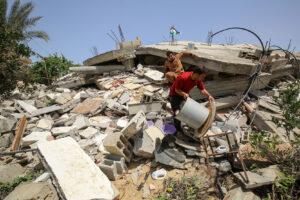
Nowhere is this clearer than in “Paradise” by Aisha Abdel Gawad, my first acquisition as fiction editor for TMR. Here we follow a day in the life of Moaz, a young man in modern-day Gaza, where the sea appears at the edge of a life constrained by siege. It is a beautiful, devastating story — one that captures how, while the Mediterranean exists as a site of historical pessimism, it can also offer, even in the most desolate moments, a fleeting glimpse of paradise.
And so what does it mean to belong to such a paradoxical space that offers both paradise and ruin?
One answer lies in the idea of multiplicity. The peoples of the Mediterranean have long resisted being reduced to singular identities. To belong to the Mediterranean is, in many ways, to carry within oneself a set of overlapping and sometimes contradictory inheritances. This fluidity is one of the reasons I continue to return to the Mediterranean, both in life and in thought. To stand on its shores is to encounter these contradictions in their full intensity, to feel at once a sense of belonging and alienation. In a world increasingly obsessed with rigid definitions of identity, the Mediterranean offers a different model — one that is more porous, more unstable, but also more generative. The region reminds us of the instability of empires, maps, borders, but also of the inevitable continuation of life. It reveals the cracks in the idea that we must be one thing or another, that we must belong to a single place, a single language, a single history.
All the pieces in this issue speak, in different ways, to this layered and often contradictory nature of the Mediterranean. Its beauty and its violence, its histories of movement and its realities of containment, its capacity to sustain life even as it bears witness to loss. As Rana Asfour writes in her introduction to our booklist for the Mediterranean, “to read the Mediterranean is to encounter it anew each time, a sea of stories, endlessly in motion.” A sea that connects and divides, that offers and withholds, that remembers and forgets.
If there is a unifying thread in the works gathered in this issue, it is not a single vision of the Mediterranean, but a shared insistence on its multiplicity. A place both literal and abstract that reminds us that the future is not guaranteed and the past is never finished, that identity is always shifting and that movement — however constrained — continues.
We invite you to take your time with this issue and to move across it as you might move across the Mediterranean itself: pausing, returning, seeing things anew, embracing the contradictions, and changing yourself in the process.
We look forward to continuing the conversation in the months ahead.
Saleem Haddad
Fiction Editor