In trying to over-explain historical events and the complexities of Kurdish suffering, this otherwise promising debut novel falters.
The Shadeless Border: A Novel, by Jiyar Jahan Fard (translated by Chiya Parvizpur)
Common Notions Press 2026
ISBN 9781945335709

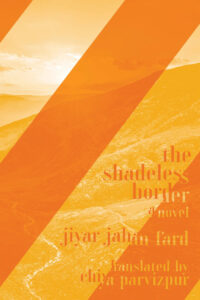 The Shadeless Border—the debut novel by Kurdish author, folklorist, and linguist Jiyar Jahan Fard—gives much-needed voice to the contested Kurdish-populated border regions between Iran and Iraq. This voice is figurative and literal, with the border itself narrating didactic, philosophical stretches of this exploratory and ambitious work. The novel is marketed as taking place in a single day, as a cluster of relatives attempt to repatriate the body of a Kurdish political activist named Azad who died in Iran without his passport. But this is somewhat misleading, as the novel’s real narrative unfolds across four decades, as well as three of the four nation-states occupying the mountainous lands that are home to the Middle East’s estimated 25-30 million Kurds. This historical backdrop feels burningly relevant in the context of this year’s U.S./Israeli war on Iran, which has seen western powers attempt to exploit and instrumentalize Kurdish suffering in these regions to suit their own agendas.
At times, especially in its second half, Fard’s novel is constrained by its earnest desire to educate the reader about Kurdish political history. Nonetheless, The Shadeless Border does important work in demonstrating that Kurdish suffering didn’t begin overnight, but forms part of a more complex regional history not reducible to newspaper headlines or the cynical tweets of Israeli politicians. And at his most creative, Fard offers a broader and bolder vision of life enduring in a region ruled by borders and acts of brutality that take on a dreadful life of their own.
Rather than employ generic magical realism, Fard links the more experimental aspects of his narrative to a specific cultural context. For example, drawing on his expertise in Kurdish linguistics and folklore, he writes in his native Kalhori, a form of Kurdish spoken by perhaps three million people across regions of western Iraq and eastern Iran and even more marginalized than the mainstream forms of Kurdish spoken elsewhere in the region. Throughout the novel, characters argue over whether Kalhori should be considered a “language” in its own right, or merely a “dialect that leads nowhere.” Kalhori is culturally and geographically linked to the syncretic, non-Islamic religion Yarsanism, whose primarily Kurdish followers known as the Kaka’i or Ahl-e-Haqq (“People of Truth”) number as many as three million. Among other beliefs, followers of this little-studied and frequently repressed faith ascribe holy value to orally-transmitted texts accompanied by a sacred stringed instrument called the tembur; they also believe in the transmigration of souls.
These beliefs provide a clear rationale for chapters written from the perspective of the coffin holding the dead Kurdish man and a tembur carved from the same tree, and then, more abstractly, from the perspective of both the border and Death. The idea that “souls undergo transformation and switch forms and frames” is used to universalize the Kurdish characters’ experiences, for example, when the border’s deadly rule is shown to extend from the Middle East’s battlegrounds to the maritime borders of Fortress Europe.
As the personified border states, “no narrative takes shape without my presence and existence.” This motif expands from the physical Iran-Iraq border to explore the psychic and romantic divisions precipitated by the geopolitical ordering of the Middle East. The border intrudes, for example, on the emotional life of Nadr and Asin, the novel’s romantic leads, casting a sinister shadow over their relationship in a context where the personal is inevitably political: “they had many arguments with me to try and free themselves from my influence… [but] I always found another corner of their minds to hide.”
These chapters are the most interesting in the novel. For example, in order to furnish the reader with narrative and political context, we briefly hear the perspective of the village tree from which the tembur and coffin were carved. The tree speaks through the objects it has become: “Many years after being cut down, I still resist to perish; I refuse to die.” The idea that “life and death come from the same tree” offers a creative reinterpretation of Yarsan belief, linking these cultural practices to broader humanist reflections. The reader is left wondering whether it could have been possible to take this narrative further and tell the novel’s whole story from the perspective of the tree and the diverse items it becomes after its felling.
As violence piles on violence, the narrative becomes increasingly breakneck, leaping from country to country…
Similarly, the bold articulation of the voices of Death and the border could perhaps have formed the basis for a more ambitious novel. Fard’s depiction of Death, “born from the latest belief of the Middle East and nurtured by the intellectual capital of Europe,” rides just the right side of cliché as it expresses specific political realities. Indeed, Death itself sounds shocked at the suffering of the Kurdish protagonists as they’re shunted around the Middle Eastern chessboard. Reading the chapters in which the border and Death are given voice, I was reminded of Iranian author Reza Negarestani’s wildly ambitious Cyclonopedia, which animates the Middle East as a Lovecraftian entity constituted of sentient oil, and hoped for a similarly bold denouement to Fard’s work.
Rather, the novel’s second half takes on increasingly conventional form, in brief chapters sharing the voices and experiences of Azad and his various family members. The historic narrative opens with the attempted Islamification of Yarsan villages. It then develops through the Islamic Republic’s post-1979 slaughter of an estimated ten thousand Kurds, and follows the unspeakably violent Iran-Iraq war, in which each state exploited the other’s domestic Kurdish grievances—culminating in the genocidal Anfal campaign wherein the West’s complicity with Saddam Hussein enabled him to massacre 50,000-100,000 Kurds. Fard’s cast of Kurdish intellectuals and political activists navigate this hellscape, fleeing into Iranian Kurdistan where they face fresh violence and discrimination. Scenes of torture unfold across long, straightforward, brutal pages. Fard himself has endured imprisonment in both Iran and Turkey as a result of his linguistic and cultural activism, and there is an indelible biographical truth to these depictions that lingers in the mind.
The reader senses Fard’s burning desire to share all the ways the Kurds have suffered.
The protagonists then travel on to bear witness to Turkey’s repression of its own Kurdish minority, suffer the loss of a child en route to Europe as refugees, and experience the intra-Kurdish civil war that plagued Iraq in the 1990s. As violence piles on violence, the narrative becomes increasingly breakneck, leaping from country to country, and the reader less familiar with Kurdish history may struggle to keep up with the closing sections that race through major historical events in the span of a few sentences: “During those years of civil war, living conditions in Bashur [Iraqi Kurdistan] were bad.” For example, the protagonists meet a taxi driver who explains the nature of discrimination against Kurds in Turkey. The episode recalls the journalistic cliche of a foreign correspondent being handed all the information he needs to complete his story by a preternaturally wise cabbie. Likewise, the scene in which the protagonists stumble across a Kurdish folk singer being stabbed to death by a Turkish paramilitary and using his last breath to sing a traditional song is pure melodrama.
The reader senses Fard’s burning desire to share all the ways the Kurds have suffered, and the tormented odyssey he depicts is no more harrowing than those genuinely experienced by many Kurdish exiles. After all, torture is formulaic and repetitive by its very nature, and the author may have felt it inappropriate to express these realities in a more creative style. Nonetheless, this comprehensive account of the Kurdish condition comes at the cost of a more detailed and deeply-considered depiction of specific aspects to this suffering, such as the way a mother might feel after successfully crossing the very border which cost her child’s life, or the condition of exile within one’s homeland.
Amid these heartfelt but sometimes clichéd depictions of Kurdish suffering, there are certainly also moments that explore the more unexpected, undiscussed, and absurd aspects of state violence against the Kurds, as when villagers come up with their own creative reinterpretations of Islamic theology to avoid having to fast throughout Ramadan; or a clueless Iranian interrogator is subtly mocked and resisted by his captives as he mangles the word “feminism”; or Azad’s corpse is propped up like a “slippery fish” to be subjected to ID checks at the border.
Likewise, though the Kurdish protagonists are generally presented in a heroic, tragic light, Fard is careful to make room for the ugly side of fratricidal intra-Kurdish violence and Kurdish collaborationism. We feel the pain of Iraqi Kurds suffering discrimination from their neighbors after they are displaced into Iranian Kurdistan, as they plead: “Aren’t you ashamed of equating us with Saddam? Do you know that same Saddam killed thousands upon thousands of us?” Similarly, Fard shows us the rationale of a Kurd who has sided with Iran’s anti-Kurdish authorities in striking if crude terms, as this torturer muses: “the Islamic Republic is the best form of governance in the world… I executed my own anti-revolutionary cousin.”
Again, these more complex and intriguing moments and characters could have been developed further, but are instead gradually overtaken by Fard’s determination to confront his reader with decades of Kurdish suffering. By the time we finally return to the border crossing where the narrative began, and it appears Azad’s corpse will be allowed to cross, the novel’s conclusion comes across as rather insubstantial, not to mention abrupt.
In 2026, The Shadeless Border will inevitably be read with relation to the present-day impasse faced by Iran’s Kurds. Fard consciously welcomes this approach by dedicating his novel to the 2022 “Woman, Life, Freedom” protests in Iran. This movement, inspired by the Iranian morality police’s murder of Kurdish woman Jina Mahsa Amini over an alleged hijab infringement, precipitated a national anti-regime uprising and international wave of solidarity. But it was soon bloodily suppressed, resulting in the execution of hundreds of Kurds.
The slogan has since been taken up by U.S. neocons and war-mongering Israeli politicians to justify their 2026 war on Iran. During the opening salvos of that war, it briefly appeared that the West was set to arm exiled Iranian Kurdish groups as boots on the ground; this plan rapidly foundered however amid geopolitical opposition and Kurdish hesitancy to embark on another proxy relationship with western powers absent any guarantees of genuine political support. Iran’s Kurds have thus been left exposed to retribution by Tehran for a war they did not start. Just as in the historical period Fard covers, the Kurds are once again the victims of “neighboring governments… fueling the flames of war to further their own agendas.”
The Shadeless Border is thus a timely intervention that, while reiterating Kurdish grievances and demands in fictional form, offers a broader anti-war and anti-border message critical of almost everyone—both Iraq and Iran, both western and eastern powers.
Fard clearly feels a duty to convey these complexities to his readers, to the point that this didactic impulse overcomes the more existential and reflective mien of earlier chapters. The result is a novel of two halves: an almost magical-realist philosophical exploration of the Kurdish condition, and a bold but ultimately hasty historical narrative. Both are wholly valid responses to Fard’s painful subject matter; either could have been developed further.