Historian Assal Rad talks about the impetus and intended impact behind her new book, Don’t Say Palestine.

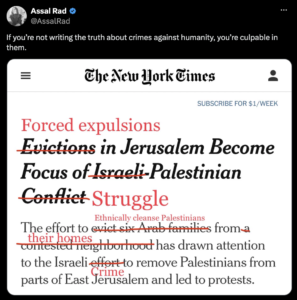
I first became aware of Assal Rad and her work on Twitter, back when it was still called Twitter and felt, for all its faults, like a real community. It was the spring of 2021, and Israel was bombing the Gaza Strip at the same time as it was undertaking both legal and military efforts to expel six Palestinian families from the Sheikh Jarrah neighborhood in East Jerusalem, an area, even according to the sanitized western narrative, considered to be under illegal Israeli occupation. “Evictions in Jerusalem Become Focus of Israeli-Palestinian Conflict,” read the headline.
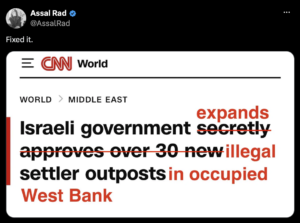
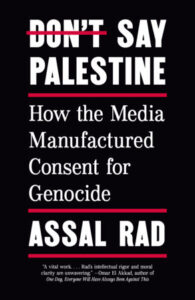 In the introduction to her latest book, Don’t Say Palestine: How the Media Manufactured Consent for Genocide, published by Penguin on September 8, 2026, Rad writes: “I remember pausing, then rereading the headline and subhead to take in the careful linguistic choices and the essential information that was missing.” A historian of the modern Middle East, Rad found herself taken aback by how the language had carefully avoided all historical context, how it had been “laundered to erase Israeli violence and Palestinian victimhood.” These were deliberate word choices, designed to craft a particular narrative. What if she changed the headline to reflect the actual reality on the ground? And so she did just that. The anodyne, bureaucratic “evictions” became the violent “forced expulsions.” The both-sides equivocation of “Israeli-Palestinian conflict” became the straightforward “Palestinian struggle.” In the subhead, “the effort to evict” became “the effort to ethnically cleanse,” and “contested neighborhoods” were restored to their rightful status as “homes.” The screenshot of the correction went viral. And, she writes, “as the post gained traction and the image spread, I realized it could do more than correct headlines. It offered a way to expose how reality itself had been slanted to fit our political ecosystem.”
What began as an occasional correction during 2021 became serious, ongoing work as the Gaza genocide began in October 2023. Rad slashed at headlines as consistently as those headlines slashed away at reality, trying to expose a narrative framework that not only excuses but serves as scaffolding for “the machinery of consent” required for the continuation of war crimes. Don’t Say Palestine is a meticulous documentation not only of the many war crimes of the Gaza genocide and how they were reported by legacy media, but also of the outright collusion between the media and the political establishment, particularly the Biden administration. The book, she writes, “is an indictment of the officials who used their power to aid a genocide, and a reckoning for the institutions that were ineffective in stopping the carnage they were built to prevent.”
I spoke with Rad on Zoom, my evening in Beirut, her morning in Los Angeles, a week after the release of the book. We discussed the power of language in crafting narrative, journalistic responsibility, where we are now—two U.S. administrations and three years into a genocide—and the possibilities for the future.
The conversation has been condensed and edited for clarity.
— Lina Mounzer, Editor-in-Chief
LINA MOUNZER for TMR: I think anybody who follows the news on Palestine and has spent any time on social media during the genocide knows your work and has sought the catharsis of reading your corrected headlines.
ASSAL RAD: I love it being described that way, cathartic, because for myself, I always say it was just an exercise in feeling sane. Because at a time when everything felt insane, the only spaces in which I felt normal were activist spaces online. It was cathartic for me, and it’s nice to hear that it was received that way by the public.
TMR: Very much so. You talk about this in the book, the deliberate dismantling of social media, partly because of the information it’s helping spread, but I think one of the big effects of destroying social media, at least for me, is that it also makes it harder for activists to find one another online. It’s not just that they don’t want the news to be disseminated. I think they don’t want people to form community around these kinds of subjects.
AR: Absolutely. And it’s not just that they don’t want us to form community. It’s that, as they double down on the level of atrocity—to commit genocide of course—they also want to make people feel so helpless that they sort of surrender to this feeling: We can’t do anything about this. There’s nothing that we can do to change it. They want to break down that sense of community through brutality, through the witness of brutality.
TMR: This is what [Naomi Klein dubbed] the shock doctrine, right? You’re brought to your knees basically, by shock after shock, and then you’re so destabilized that you don’t even know what you can do about it, and then things just come to pass without you being able to speak out or say anything about it.
AR: That’s exactly how it feels. And so whenever I’m giving these talks and people ask: what do we do? I respond that the first thing we do is not give up. That’s why, as I said, it’s good to hear that this work resonates with people, because sometimes it feels like you’re just talking to yourself on the internet, shouting into the void. But it’s important that we understand that this collective work is meaningful, because they’re trying to strip it of that meaning. It is, to me, connected to the work of dehumanization. You dehumanize a group of people, in this case Palestinians, in order to render them non-human and therefore justify their mass slaughter.
And yet they’re failing to do this, obviously. It’s become a negative feedback loop: the more backlash there is publicly, the more brutal they become, the more they double down, the more we’re repressed, the more our rights are being eroded. And it keeps happening over and over. This episode with Macklemore and Ed Sheeran and Robert Kraft is a perfect microcosm. You have this billionaire who just steps in and decides that this artist loses his place on a tour because he had the audacity to say “Free Palestine” and stand against genocide.
TMR: No, I’m sorry. It’s because he made Jewish audiences feel uncomfortable. Okay, this is me [sarcastically] correcting your headline now.
AR: Yeah, I mean, it’s wild, right? And they do feel uncomfortable, though. They feel uncomfortable because the state that claims to represent them is carrying out a genocide, while there are many, many Jewish people who do stand up against it. I think what’s interesting about that is how much the actions of Israel fuel hatred toward Jews, because [Zionists] conflate them. As much as we try to separate it and say, look, the actions of a nation-state that follows the political ideology of Zionism is not the same thing as Judaism—and every time we say it, they say, no, it is the same thing. I’m like, well, you’re conflating it. You’re repeatedly doing this. And yeah, the idea that you feel uncomfortable because another group of people are being slaughtered is absurd to the point that it’s hard to even articulate the absurdity of it.
TMR: Yes, and it very much ties into what you write about in your book, this shifting of language. I was being facetious, because obviously Macklemore is being censored for saying “Free Palestine”; he’s being censored for drawing attention to the genocide. But of course they shift it so that the headline becomes, oh, he made Jewish people feel uncomfortable. And of course Israel so fundamentally benefits from antisemitism in all kinds of ways.
AR: Which is why they fuel it. That’s the thing that’s interesting about it. It’s not being done accidentally. Israel feeds on antisemitism because the entire argument for the notion of the existence of a Jewish state is that Jews would not be safe without it.
And so you create an atmosphere where you associate all of your atrocities with a religion—even though many people who adhere to the religion don’t actually agree with what you’re doing—in order to fuel this notion of antisemitism. A more concrete example is when you hear historians like Ilan Pappe or Avi Schlaim talk about Zionist attacks in, say, Iraq, during the time of the establishment of Israel. Attacks carried out by Zionists, in order to make Jews feel unsafe in Iraq, so that they would leave. And then this becomes a talking point: look at what [the Arabs] did to Jews; they expelled them, or they weren’t safe, or they were attacked. So you create a sense of insecurity in order to justify the project itself. And that’s the very justification that still plays out. I mean, it’s not even coming from Israeli officials. That’s something that, for instance, Joe Biden said. He said, very clearly, that if there was no Jewish state, then Jews would be safe nowhere. Which was a wild statement for the president of a country that has one of the largest Jewish diasporas in the world, essentially stating that I, as president, cannot keep Jewish Americans safe. Another sort of absurd statement, but it does fuel this idea.
But what I see consistently now is that it’s backfiring. All it’s doing is rendering the word “antisemitism” meaningless because it’s used in every situation. Any critic of Israel is now antisemitic. I mean, that’s literally the definition they’re trying to push. And more and more people see through this. That’s why I say you get this doubling down and doubling down. But the PR campaign isn’t working, despite the fact that they’re pouring hundreds of millions of dollars into their hasbara propaganda. It’s not working because people cannot unsee what they’ve seen over the last three years. Besides that, the level of propaganda is just horrible. It’s very poorly done. I mean, if you go on Twitter and you look at the handle for Israel, which is run by the Israeli Foreign Ministry, it’s just a bunch of AI images and memes, and they’re getting dragged and ratioed on every single [post] because, again, the old propaganda system has broken down and it’s not working. And since we’re talking about the media, that’s true of the media system as well. Trust in the mainstream media is at an all-time low. It was actually the BBC that posted that a few months ago, some poll or some study that showed, essentially, that trust in the media is at an all-time low. And guess what? They got dragged for that, too. Because why do you think it’s at an all-time low? Because institutions like the BBC have been telling people not to believe their own eyes.
TMR: Yes, absolutely. And censoring the news very openly.
AR: Or [because] they’ve been dehumanizing Palestinians, and people are tired of it. So it’s a very interesting sort of ecosystem we find ourselves in, because there’s now this very potent struggle over narrative. Whereas I think before, if you go back three years ago, at least in the western world… That’s the thing I always like to sort of caveat as well. Because in the Global South, which is still being exploited by western powers and imperialism and colonialism, people are very aware of the fact that that era never ended. But within the western psyche, there’s this idea of, you know, the international rules-based system; we hear politicians within the west talking about it constantly. There’s a language of western superiority that’s built into that discourse. But the double standards, the hypocrisy—it’s all always been there. But Gaza brought it so fully to the surface that now even within the populace of the western world, they can’t unsee it. And so many, many people who weren’t privy to or didn’t quite understand the depth of that hypocrisy and dehumanization are now becoming, or have now become, aware of it.
TMR: See, I’m very heartened by that. As somebody from the region, living in the region, as you said, what we’re seeing play out is just what we’ve always known to be true, what we’ve seen play out our entire lives. It’s just writ large now, and suddenly you feel like everybody can see it, in a way that they couldn’t before. Even though it’s always been there. Which is frustrating. At the same time, I’m now hearing things that I never thought I would hear in my lifetime on some mainstream media channels. Like, for example, people pushing back on Israel’s right to exist, or assertions of the right to resist for Palestinians. And of course they’re shut down. But in terms of change…
I read a tweet by Michael LaRosa, who was the press secretary for the first lady in the Biden administration. I think he was quote-tweeting Mehdi Hasan. And he wrote: In the United States, polls don’t make policy. Policy makers do. Screaming, shouting and protesting are cute and exercising all of your freedoms of speech in defense of the Palestinians is admirable. But Mehdi is just a spectator… he has no idea how government, diplomacy, negotiation, or strategic alliances actually work. No amount of public support in polling or public protest will influence how or when those in power drastically change Israel policy… public opinion polls don’t dictate American foreign policy. Never have. Never will. And this reminded me also of reading about how UEFA, which is the Union of European Football Associations, was being pressured to drop Israel from the league, given that Israel has killed a record number of Palestinian footballers. And UEFA officials said that they faced a ton of public pressure to do that, to drop Israel from competition, but almost no political pressure whatsoever, whereas it was the opposite for Russia, where they had no public pressure, but a ton of political pressure. And so what do you make of this? How does policy change actually happen when you have this shifting media landscape where it’s getting more permissible to say things and yet policies stay the same? What is this barrier that exists between public pressure and policymakers? And in that case, where could there possibly be a tipping point?
AR: There are a few things. First, the statement. I was grinding my teeth as you were reading it because the condescension of American liberals is… I still find it shocking. That they continue to [talk like this] even though they keep losing elections. Tthis is the most amazing part: how many times do you actually want to lose major elections before you understand that this tactic doesn’t work?
That whole “people don’t make policies.” Well, then we’re not a democracy. Then you just basically very publicly declared that this is not a representative democracy, because ultimately what you’re saying is that what people say doesn’t matter, what they think doesn’t matter, what they want doesn’t matter. That this is not a government for, by, and of the people. That’s just not what it is. And it’s not even that they’re just saying it so bluntly; it’s that they’re so condescending about it.
A lot of people knew there were cracks, but now they’re broken open; it’s all shattered and everyone can see it.
It immediately made me think of someone like Hillary Clinton and [her statement about] the “basket of deplorables” in 2016, or piping up during the protests, the student encampments, to say something to the tune of how these students didn’t know the history. Well, I’m a historian of the region. Do I know the history, Hillary Clinton? Do the historians and professors on the campuses teaching the students know the history? Or do you, the politician, who’s an avid Zionist, who constantly talks about your love for Israel, do you know the history? It’s all so revealing, you know? And I always think that for me, as a historian of the region, as someone who has followed Palestine for such a long time and was really radicalized by Palestine, my political outlook came from looking at this injustice, especially through an American lens, and understanding that I and my country are responsible for this injustice. Within that sort of framing, it is unbelievable to me to see that there’s still this shift. And that shift has happened because people are sick of this condescension. And it’s not just about Palestine. So I’m saying, for me personally, this is all incredibly important because Palestine is important. But if you’re sitting in the western world, it’s not just about Palestine. It has so many implications. Palestine has become the litmus test for everything. So, this is yet another example. The fact that it doesn’t matter what the public thinks, it just matters what the policy is, is a problem that can be applied across the board. So it doesn’t matter what the public thinks about universal health care. It doesn’t matter what the public thinks about gun control. It doesn’t matter what the public thinks about endless wars. It doesn’t matter what the public thinks about billionaires paying taxes because it simply doesn’t matter what the public thinks. And this reveals so much corruption. In that sense Gaza is a reckoning for so many reasons. It has revealed the complete corruption of international institutions or the corruption of western governments, the hypocrisy, all of it, the media, all of the cracks that were in the system, the things that the Global South recognizes. So a lot of people knew there were cracks, but now they’re broken open; it’s all shattered and everyone can see it. So one of the arguments I make [in the book] is that the reason you see this doubling down, the reason it’s so important for them to protect this notion of Israel, is not even about Israel itself. Well, it is to some extent, right, because Israel serves a foreign policy interest. It’s sort of the western colonial foothold in the Middle East. But it’s also a test. Because [if support for it] fails, if it fails after all of this—the propaganda, the investment in all these different institutions, the fact that this narrative is repeated within our popular culture, media landscape, political discourse, education system—then it shows the power of actual people, and it negates that very statement you read out. It flips it on its head. It says, actually, no, we do have power. We do have influence. And I disagree with the idea that nothing has changed. Policies, yes. I’m not saying that policies have. The genocide is still happening. There’s ethnic cleansing in the West Bank. I mean, it’s a genocide against Palestinians, and that means it’s anywhere that there are Palestinians. Whether it’s the West Bank, or—
TMR: And in South Lebanon, actually, as well.
AR: And in South Lebanon. And the fact that Israel is doing what it is in South Lebanon, and of course that it continues to occupy Syrian territory, is a testament to the fact that it was a colonial project and an expansionist state [from the beginning]. Colonial projects are typically expansionist, and this is exactly what we’re seeing play out as well.
[But there is] a change in the political landscape in the United States as well. I mean, in the most propagandized country in the world, you still have a candidate like Zohran Mamdani, who became mayor of New York City, of all places, while very openly criticizing Israel. An endorsement from AIPAC is becoming a liability. And this would have been unheard of three years ago. You have candidates who openly appeal to their constituents and to the American public by saying that they don’t take any money from AIPAC. Now, AIPAC is still pouring money into elections, but you see they have to pour more and more and more. They keep breaking their own records of spending because the system that was working and that was in place for all these institutions is not working anymore. And that’s why they’re doubling down. They have to sell off TikTok because young people are seeing what’s actually happening. They have to suppress content and shadow ban on Instagram and on Twitter, because people are seeing what’s happening. The fact that they have to take these steps proves that what the people are doing is working because it’s forcing them into these positions. And I would say one consequence of the complete disconnect that the Democratic establishment has with its actual constituency is that Donald Trump won the election again in 2024. This disconnect has consequences, and that consequence is seen at the ballot box. So it’s not that I’m trying to paint some kind of rosy picture, like, oh, you know, the revolution is happening. That’s not what I’m saying either.
But seeing evidence of shifts ensures that we continue to do the work. That’s mostly what I’m trying to get at: it is enough for us to see that we, as a community, as a collective, we do pose a challenge, despite the way that the political establishment works. And we have to continue to push, because not only are we seeking justice in Palestine, but again, it’s a litmus test of how our collective power can be applied to other injustices as well.
TMR: It’s quite interesting, because, again, you talk about this in the book, the idea that we are up against entire systems. It’s not just individuals or reporters; it’s an entire media ecosystem, the way it feeds into politics and how they collude. You bring up a number of brave journalists who resigned or were fired for speaking out [Editor’s note: these include Jazmine Hughes and Jamie Lauren Keils from NYT Magazine and the NYT, Mehdi Hasan and Joy Reid from MSNBC, Mohammad Shalaby, Karishma Patel, and Gary Lineker from the BBC, and Valerie Zink from Reuters]. At the same time, there remain extremely high-profile journalists, like Christiane Amanpour, for example, who I read had voiced concern behind the scenes about CNN’s editorial policies on Palestine and yet who I watched perform verbal gymnastics in real time early on in the genocide to avoid asking certain kinds of questions. We’ve also seen other journalists aggressively refuting, interrupting, and arguing with guests, talking to people whose entire families have died and asking them: “Do you condemn Hamas?” Acting not just as stenographers, as you say, but as fierce advocates. The issue is systemic, to be sure, but systems are made and upheld by people. Where does individual responsibility, if any, lie among the journalists actually reporting the news? And, following from that, what do you think might be within the power or capability of individual journalists to do?
AR: I say this is not a case against individual journalists. I’m not a legal expert in any way. But at the end of the book, one of the things I try to argue is that I think that there has at least to be a discussion about [legal culpability] because if you look at the precedent of the Nuremberg trials and Rwanda, Radio Rwanda, there is definitely an accepted notion that there is a link between language and incitement. We know this, right? Incitement is a real thing, and there’s a connection between that and these atrocities that are being committed. Because people have to be convinced [of the atrocities]. I am personally convinced that ordinary human beings are not sociopaths. And when they see the mass slaughter of men, women, and especially children, they react to it. And that’s precisely what we’re seeing, right? People weren’t responding to rhetoric or debates or discourse. They were responding to raw footage of horrors and atrocities. And in order to justify it, you have to have this narrative formed around it. So I do think that there should be a consideration of what that legal threshold is. In that sense, there’s also a danger in it. There’s a slippery slope when we start to criminalize the actions of journalists, because I’m obviously an advocate of a free press, if it actually acted as a free press. That’s why I say this is not about individual journalists because they are more like the workers in the analogy. They’re not the owners, right? They don’t own the means of production in the system, they are the workers within it. And so that’s why you would go to the top to see, well, who is creating the standards by which they have to operate? Because if their guidelines were different, maybe many of [those journalists] would also be behaving differently within that system. Now, that doesn’t mean that’s true of all of them. Like you say, some individual journalists. Yes, of course I think about people from CNN like Jake Tapper and Dana Bash. But, would I even call them journalists? No, they’re commentators.
Incitement is a real thing, and there’s a connection between that and these atrocities that are being committed.
They’re very clearly infusing their political ideology into what they’re talking about. And what’s funny is that the only reason we consider them quote-unquote journalists is because they’re at CNN, and it’s assumed that these liberal corporate media institutions are more legitimate. But how often do we hear people from Fox News being referred to as journalists? People don’t even talk about Fox News because it’s so clearly biased, and it’s so clearly commentary more than it is news, that it doesn’t even sort of enter the realm of the conversation.
But liberal media isn’t treated the same way, and that was the other sort of point that I was trying to make. Because they present themselves as neutral, because they present themselves as unbiased and authoritative, but they’re not actually.
[In the book] I focus, for instance, on the Biden administration, and some people will say, well, why don’t you talk more about the Trump administration? First of all, because the genocide began under Joe Biden. It continues under Donald Trump, but without Joe Biden, there’s no genocide. That is just a fact. Without U.S. support, without the U.S. aiding, lying, vetoing, without them doing all of these things, what is happening in Gaza does not happen. And so they are responsible.
TMR: Well, they laid the groundwork for what was acceptable and what was not. I think by the time Trump came to power, we had already seen the rampant bombing of hospitals and schools and rescue workers…
AR: All of it, all of it was already established and normalized. By the time Trump takes over, it’s a genocide. Gaza is destroyed and mostly uninhabitable, and every international norm and law has been shattered in real time and covered up and lied about. So all of this happens under Joe Biden. But the secondary reason I focus [on that administration] is because they pretend that they believe in international law. Donald Trump doesn’t. Trump doesn’t even bother to engage in this discourse. He doesn’t post about the freedom of journalists. He walks around calling everything “fake news.” So yes, I think it’s more dangerous when you use this kind of language because it’s more convincing to the public. Because again, most people don’t want to hear, well, we’re just racist, and we don’t think these people are human beings, so it’s okay if they die. If they used that language, if Joe Biden was like, yeah, well, Palestinians don’t count as people, are people then still walking around calling him a decent man? No, of course not. So he can’t use that language, even though in terms of policy and clearly within [his administration’s] actions, that is exactly the case. They treat Ukrainians like they’re people because they’re white, and they treat Palestinians like they’re not, because they’re Arabs and Muslims. And they’re not all exclusively Muslims, by the way. That’s why I say Arabs and Muslims. Obviously, Palestinians also have a significant Christian community. But the general sort of dehumanization of the region is through that lens. [Because there are] non-Arabs within the region as well who are also Muslim, like Iranians or Turks, for example. But the whole region is dehumanized— this goes back to Orientalism and Edward Said, of course—in order to justify the exploitation of the region, its peoples, and its resources. This is the continuation. We are seeing [the continuation of] the exact line that centuries of colonialism have created. Literally, Palestine was colonized, and this has continued, and has to be justified, but that language of colonialism never painted the western world as the savages. It was always the others who were the savages, and that was a justification for benevolent western violence. And that’s why they use this kind of language. And I think it’s far, far more dangerous because it convinces people that they’re being moral, if that makes sense. Like they’re seeing their actions through this moral lens. And I think liberal language within media does that as well. So I focus on them, I focus on these institutions, rather than individual journalists for sort of these reasons. First, because I do want to make sure that people don’t misconstrue that I’m making an argument that we should start jailing journalists. Obviously, that’s not the argument that I’m making, but I do think that there are legal implications.
For instance, the person who writes a memo at the New York Times instructing their journalists not to use certain language. That is censorship; that is cover-up to me. And so that person, yes, there’s culpability. Because you’re directly telling them they’re not allowed to use this language. Maybe those journalists would use that language if they were not guided [otherwise]. You have within newsrooms like the BBC and CNN reporters who will come and say there was very clear pressure within these newsrooms not to use certain language. And so I do think that there’s a distinction between the worker and the owner.
TMR: I completely agree with you. I think my question was more about what is within their power to do as media workers? Because yes, they’re workers, but they are also among the people whom the system fundamentally oppresses even as they make it work. They’re implicated in the entire system. So if public pressure is the thing that is going to change things, that is eventually going to change policy, what can individual journalists working in newsrooms do, or is there anything that you think they’re able to do? Part of the reason that people still trust legacy media—no matter how flimsy that trust is getting—is that there’s still a kind of gravitas when you say the New York Times. It remains there. And so how do we remove our trust from these institutions? How do we turn our backs on them, both as readers and as writers, as journalists and as consumers of news?
AR: Well, first of all, we have a lot more independent media than we used to. Two examples that emerged during the last three years, for instance, are Zeteo—Mehdi Hasan leaves MSNBC, which is a staple of corporate media, and establishes Zeteo, in part because he loses his show because he’s vocal about Gaza. Then you have Drop Site News, founded by Jeremy Scahill and Ryan Grim. You also have the emergence of tons of Substacks. That’s what individual journalists [have the power to] do. You can leave the larger institutions that you work for, resign, quit, start your own Substack, work for independent, outlets. [The reason] I’m hesitant to [prescribe] that as a thing to do is because this is also people’s livelihoods, and I don’t know people’s individual situations. And oftentimes—you know, it’s a job. And the reason people are doing it is because they’re doing their job. That isn’t the same thing as being a soldier in the Israeli military that’s committing genocide and you’re just doing your job. It’s not the same. And we have to also be very aware of that. But we did see journalists who resigned, not in significant numbers, but there were journalists who resigned. We did see, in more significant numbers, journalists who pushed back. Petitions that were signed. [Whistleblowers] who went either on the record or spoke anonymously because they wanted the public to understand the sort of pressure that they were working under.
I think if there’s a collective pushback within these newsrooms as well, then that collective demand would carry more weight than these individual resignations.
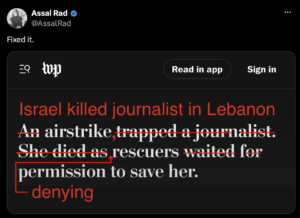
There’s a lot of layers to it, obviously. I don’t think there’s a one-bullet-point answer. But one of the things I saw [in my headline correction work on social media] is that a few times, journalists who worked at the New York Times would take issue sometimes if I criticized something. And I would engage back with them. I’d say, I’m not criticizing your investigation or your conclusions; I’m criticizing the framing and the overall way that this information is presented.
And I think with some journalists, they genuinely—just like anybody else in society—they think of [racism] in this extremely overt way. Like in the movie Get Out, [when they defend themselves by saying] I’m not racist, I voted for Obama. That kind of mentality dominates liberal thinking.
These caricatures are breaking down in real time because they’re seeing the humanity of Palestinians on their feeds every single day.
And sometimes it has to be addressed in a way that makes them understand: Well, what you’re participating in is inherently racist because you’ve created an entire narrative that inverts who the victims are in this situation. You’ve created an entire narrative that makes Israeli violence benevolent. It’s always self-defense, even when they’re committing genocide. There’s a refusal to engage with the reality of what’s happening. And I think a lot of them are unaware because they’re not self-aware. So I think to some extent the first step becomes making people aware of these things. And I actually think that’s why the headline corrections were effective. I think what made them effective was that all it required was looking at them. It didn’t require an explanation. You know, I could do a headline correction and just write “fixed it,” and people would get it based on what they were seeing. And what they were seeing was a subtle difference that still had a profound effect on meaning. And that’s what I mean when I say I think sometimes it becomes so ingrained. [Even myself], I’m very cognizant of many things and yet there are times that I engage in language where later I think, oh, why did I engage in this language? Because it’s been so ingrained in my mind that it’s hard to challenge it. Like you said earlier, you wouldn’t have believed that people would do things like question the right of Israel to exist. I completely agree. Three years ago, if you asked me, I would have had my opinion, but I don’t know whether or how I would have articulated it. Because of the context that we exist in, I may have been hesitant, because I know that I’m going to be smeared as being antisemitic, or, you know, a terrorist sympathizer. You’re going to be hit with these labels. But now those labels don’t have the same potency anymore, and so more and more people are speaking out.
I don’t know if that makes complete sense in the way that I’m saying it.
TMR: No, it makes perfect sense. It’s like forging a path forward, and then somebody comes along and, just by doing it, gives you permission to talk about things in a certain way, which then engenders the ability to see things in a certain way. As we say in Arabic, one thing pulls the next thing behind it.
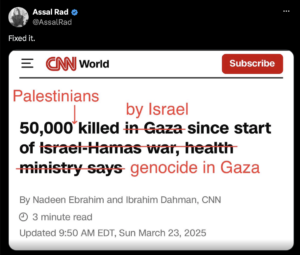
AR: It’s exactly that. And I hope that the exercise of headline correcting sort of did that too. It gave people a way of seeing it that then allowed them to talk about it more and more. And to my mind, it’s that exercise in and of itself that’s so important: to be able to challenge the language because you’re looking at it and you know that something’s wrong, but now we have more and more language to articulate that and to understand it.
And in these anecdotes, I’ll see people, Americans, who feel betrayed because they feel like they’ve been lied to. Oh, they made it seem like Islam is this horrific religion that’s just violent, that Muslims and Palestinian men are all terrorists. These caricatures are breaking down in real time because they’re seeing the humanity of Palestinians on their feeds every single day. They’ve literally been told for years that Palestinians don’t care about their children, that they willingly sacrifice their lives, that they want to be martyred and they want to die—
TMR: That they’re happy when their children die.
AR: Exactly. And that Israelis are the ones who are sad that they’re killing children. That they’ve been forced, the Palestinians forced them to kill their children. These are literal Zionist talking points. And that has completely been broken down because people are seeing these soldiers who celebrate this. They mock [dead] children, literally playing with the toys of the children that they’ve killed, and they juxtapose that with the images of Palestinian men who are comforting each other, who are wailing, who are searching for and holding their children…
These images completely dismantle that narrative. And that’s why people feel like they’ve been lied to. And it’s not that they feel like they’ve been lied to. They have been lied to. These are all the talking points that have been used over and over again, that Palestinians are a death cult, that Israel represents life and Palestinians represent death, when nothing could be further from the truth, you know?
I believe I say this in the acknowledgements of the book, but for me, my experience with Palestinians is that I’ve never seen a group of people who are more interested in life, who live life and love life. While in the western mind, they’re depicted as a death cult. So I think that breaking through that narrative is also a process of becoming cognizant of your own racism that you might be unaware of. In the same way that people do in many other situations. I mean, look at systemic racism in the United States against Black people, at anti-Blackness. So many people are unaware of their own racism, and sometimes it takes specific events, or people who have to break it down for them so that they understand: What you’re engaging in, what you think is funny or not a big deal, it is racism. These are the microaggressions that help sustain a system of racism. And that, I think, is one of the shifts that has happened in the last three years. Palestinians have humanized themselves. I mean, they should never have had to, right? But they’ve had to sort of dismantle this systematic dehumanization, and that’s why the rhetoric and the propaganda of Zionism, the hasbara, is not working anymore. That’s why Israel is now the most hated country in the world. I mean, poll after poll shows that. So it’s like, why did that happen? Because everyone sees it now. They didn’t see it before. And it’s horrible and tragic and so unjust that it took such a…
TMR: Price.
AR: It’s hard to even call it a price, but yeah, exactly. That the cost of it had to be something so egregious, that Palestinians had to be slaughtered on this scale in order for people to see them as human beings. I mean, it’s horrible to say it that way.
But that is the shift. That is the reason for it. It is the level of atrocity and brutality that could no longer be justified in a normal human mind, right? A normal, non-sociopathic human being could not watch this and say, I see how this makes sense. They just couldn’t.
TMR: I think it’s the brutality, and I think it’s also realizing that Israelis are proud of this brutality and are okay with it. I think it’s both of these things that contribute to the fact that they are so hated now. And it’s quite interesting, because I’m sure you’ve seen these reports that they’ve hired all these think tanks to do studies for them.
AR: Or created fake think tanks.
TMR: Well, see, that was going to be one of my questions. Because in the book you use this interesting phrase that I really liked, about what you call “the infrastructure of truth.” I thought that was such an apt way of capturing this entire ecosystem that tells you what you’re allowed to think and what you’re allowed to say. So if we think about the infrastructure of truth, and think about yes, how they used AI to create a fictional think tank out of whole cloth, that then produced papers and reports full of pro-Israel talking points, to essentially reverse-engineer a source that would support their propaganda claims if you’re a human and you’re carrying out research. And I was going to ask: What does an infrastructure of truth even look like when we have these kinds of capabilities to fabricate things out of whole cloth?
AR: I think sometimes—and I understand why, obviously, as technology changes, as we have the internet, social media, and now AI—the idea becomes, well, how is propaganda going to function in this context? And to my mind, the response is just that propaganda has always existed, regardless of the technology. Because what we’re looking at is ultimately a battle over narrative, right? And that battle over narrative has always been there. And there have always been people on either side of it. Like, I continuously use this example. I say: Listen, there were always abolitionists. It wasn’t that back then everyone just agreed that it was fine to enslave Black people or that it was fine to mass slaughter Jews during the Holocaust. Or that colonialism was just okay. I mean, yes, there were powerful institutions that carried out these atrocities and people within those populations who supported them. But there were always people who objected because there were always people who said, this is not right. And the reason I point that out is because we’re living through that context today. You know the phrase that people use, whatever you would’ve done during the Holocaust, whatever you would’ve done during slavery, you’re doing it right now.
It’s the truth. You’re doing it right now. Because even now, yes, there’s a quote-unquote debate, but that’s what the debate is. And propaganda and the way that information and narratives are formed just adapt to the technologies. So I don’t think it changes the overall landscape, but what it does show, what it illuminates—I should say highlights—is that exact infrastructure of truth that I was talking about. Because a lot of times you think truth is truth, something is what it is, but that’s not the reality we live in. And that’s why the battle over narrative is so important. I mean, I’m a historian, and as a historian, you look at the way that the story is told.
Do you believe that things bend toward justice? Because sometimes to me it seems like we’re seeking refuge in some imaginary future because the present is just so impossible to bear.
How is the story of the past told? It can be told in various ways. What happened happened, and that’s the truth, there’s nothing you can do about that. But the way that you convey that or articulate it or frame it changes the way that people perceive what happened. And that’s why I don’t think that these new technologies change the overall structure. They just create new avenues for how information is disseminated and controlled. Think back to early Zionist projects and phrases like “a land with no people for a people with no land.” They weren’t using AI to do that, but everybody’s heard that phrase, because they were disseminating this information with whatever technology existed for them to do it. And so, in that sense, yes, I think these new technologies obviously present new ways for information, misinformation, and disinformation to be disseminated, but we’re going up against the same thing. So it’s just another arena for the same battle, if that makes sense.
TMR: No, that makes perfect sense, and it’s a great answer also because it provides a little bit of optimism, because in fact I have a very pessimistic question. And it is very much colored by being in Lebanon, being in Beirut, with the [Israeli] drone just overhead every single day in the sky above. And the country is still at war, and in the south it’s the same thing that’s happening in Gaza. It’s being reported as a ceasefire; meanwhile, there’s bloodlettings that are happening every day, funerals that we’re going to, and it’s a very dark existence. So, on the one hand, I look at the news, and I see these things changing, and I’m heartened that they’re changing. But it also feels like they’re not really changing enough, or fast enough. And one of the things I’ve been thinking a lot about is, as you write at the end of the book, that “history is not kind to such complicity.” I hear people saying that a lot. And there’s also, of course, the beautiful phrase that Omar El Akkad wrote, which is also the title of his book, that “one day everyone will have always been against this.” And my question is, is this true? Or is this something we just say to comfort ourselves? Because, you know, we haven’t—as you also write in the book—we haven’t seen any accountability for the war on terror, for Iraq, but I’d add that we also haven’t seen it for any of the destabilization efforts or economic warfare or regime change operations that have been carried out against so many countries of the Global South, including Chile, Congo, Iran. So do you believe that things bend toward justice? Because sometimes to me it seems like we’re seeking refuge in some imaginary future because the present is just so impossible to bear.
AR: I think that’s a great question… and there are two caps I put on to answer it. One is my cynical cap, and the other is the optimistic one. Because I see both, and to be completely honest, I vacillate between the two. The cynicism, because the challenge is extremely daunting. The optimism—and if this is me being just absolutely candid—is because I don’t have another choice. I have to be optimistic. I have to have optimism, because I have to have something that motivates me to continue doing this work, because if we’re not, basically this is all pointless, as in there’s nothing we can do, and this is what’s going to happen—then we’re surrendering to them. And there’s a sort of refusal to do that, and that refusal to surrender to them is what creates the optimism.
No empire has ever withstood the test of time. Empires fall. Things shift, you know. It’s just what happens. And our lives are one piece within this larger history. So, there might be things that we don’t necessarily see in our own lifetimes, but I still don’t think that means that we don’t work toward them. You know, there’s this adage, I forget who it’s attributed to, but—I’m paraphrasing completely—something about how in a just society or in a good society, old men plant trees whose shade they will not see. It’s that concept that you do good, not for yourselves, but for future generations. I believe in that. So my optimism comes from that, and I talk about this in the acknowledgements of the book—my book is dedicated to my niece, who is nineteen years old. And at the end of my acknowledgements, I talk about my nieces and my nephews. I don’t have kids of my own, but I have nieces and nephews, and I just adore them. As most aunts do, they love their nieces and nephews!
And the experience of watching—it’s so hard for me to say sometimes—but the experience of watching Palestinian men, women, and children, the daily images of children… We’re meant, as adults, to protect kids. That’s literally built in; it’s wired into our nature. And so I think that’s the thing that sent so many people over the edge. I have American friends who, the way that they would frame it is: I have a daughter who’s five, I can’t see this anymore. Because that’s not what our brains are built to do; we’re built to protect children.
And having watched this while spending time with these kids was such a crazy juxtaposition. Just to go into my own life, I’m going to a piano recital for my five-year-old niece, and I go back to doing work, and I’m looking at the body of a five-year-old little girl torn apart. And that was so overwhelming to have to deal with, but then at the same time, that was the thing that made me think, we have to. I can’t close my eyes to this, because—God, these kids, they look like my nieces and nephews. They are the same. So no, there’s nothing that says that this can end tomorrow. But I override my cynicism with the fact that we don’t have another choice. We have to be optimistic, because we have to keep doing the work.
TMR: Yes, I think that’s really the only conclusion to draw. And I guess that this brings me to my last question for you, which is: what are you reading these days? Whose words do you turn to for solace, or information, or inspiration, when you need to remember that you don’t have another choice, or when you need to remember that there’s something else to the world?
AR: You know, you mentioned Omar El Akkad, his book is incredible. I recently finally read Perfect Victims by Mohammed El-Kurd. I look especially to someone like Mohammed, a young Palestinian with just so much energy and charisma in the way that he presents things. I love listening to him. But it’s not necessarily specific individuals. There’s the whole of the online community of activists. It’s listening to Palestinians who are in Gaza, who are still trying to live. Again, despite the portrayal that they’re a death cult, they’re trying, under the most horrific circumstances possible, to live. And I’ve heard a lot of people ask, how do they even live? And I say, that’s their resilience. That resilience that comes from wanting to live. So for me, it’s being part of this community online, and seeing the resilience of Palestinians who are still in Gaza and in the occupied West Bank, activists who are in the occupied West Bank, trying to at least document, trying to block house demolitions, the Palestinians documenting the pogroms that are being carried out every day.
Those are the things that inspire me to continue doing everything.
TMR: Thank you so much for that. I’m really grateful for this conversation, Assal, as I was grateful for your book. I was very happy to read it. Well, happy is the wrong word. Because I was following all the things you talk about in the book in real time. So it actually turned my stomach in parts, revisiting some of the worst moments of the genocide [whose reporting you dissect], whether Al-Ahli Hospital, Al-Shifa Hospital, the double tap on Nasser Hospital, the murder of Hind Rajab, the kidnapping of Dr. Hussam Abu Safiya…
AR: I absolutely understand what you mean, because I felt the same in writing it. And that was kind of the objective that I had. I wanted people to relive it, to go through it, to remember, and put it all in one place. “It’s easy to forget” is the wrong way of saying it, but when you watch it every day and you go to the next news cycle, and the next news cycle, and the next news cycle… So it was important to say: look at it all together. Just imagine the level.
TMR: Yes, it was really harrowing. And I wanted to say that even for somebody who has been following it very closely throughout, it was still extremely shocking. To see it all in one place together, it’s clear that the injustice is so vast and the crime so egregious that it makes you feel crazy all over again. And you think, how are we still inside it? How is this still ongoing? As I’m reading these words, it still hasn’t ended. And for me, that’s where I falter sometimes. It feels really hard not to falter. And I think about how there are so many other losses besides these losses we remember. Other losses that have not been recorded. And besides that, there is also the erasure of place, which is a whole crime unto itself. And yes, it’s hard sometimes. You hear the drone overhead and you’re aware that they’re constantly watching, that they’re planning their next moves. They’re still there and as emboldened as ever.
But this conversation, at least, is like a little bit of a reminder of the fact that we don’t have a choice. We have to keep forging onward. And I hope that your book—because it’s very clearly intended that way—fulfills its purpose as a document of accountability, where all of these crimes are recorded in meticulous detail, and that this record someday leads to some form of accountability.
AR: Thank you. I mean, I hope so. You do this work hoping that people will engage with it and find it useful. So I’m happy, based on this conversation, to hear that this was the case for you.