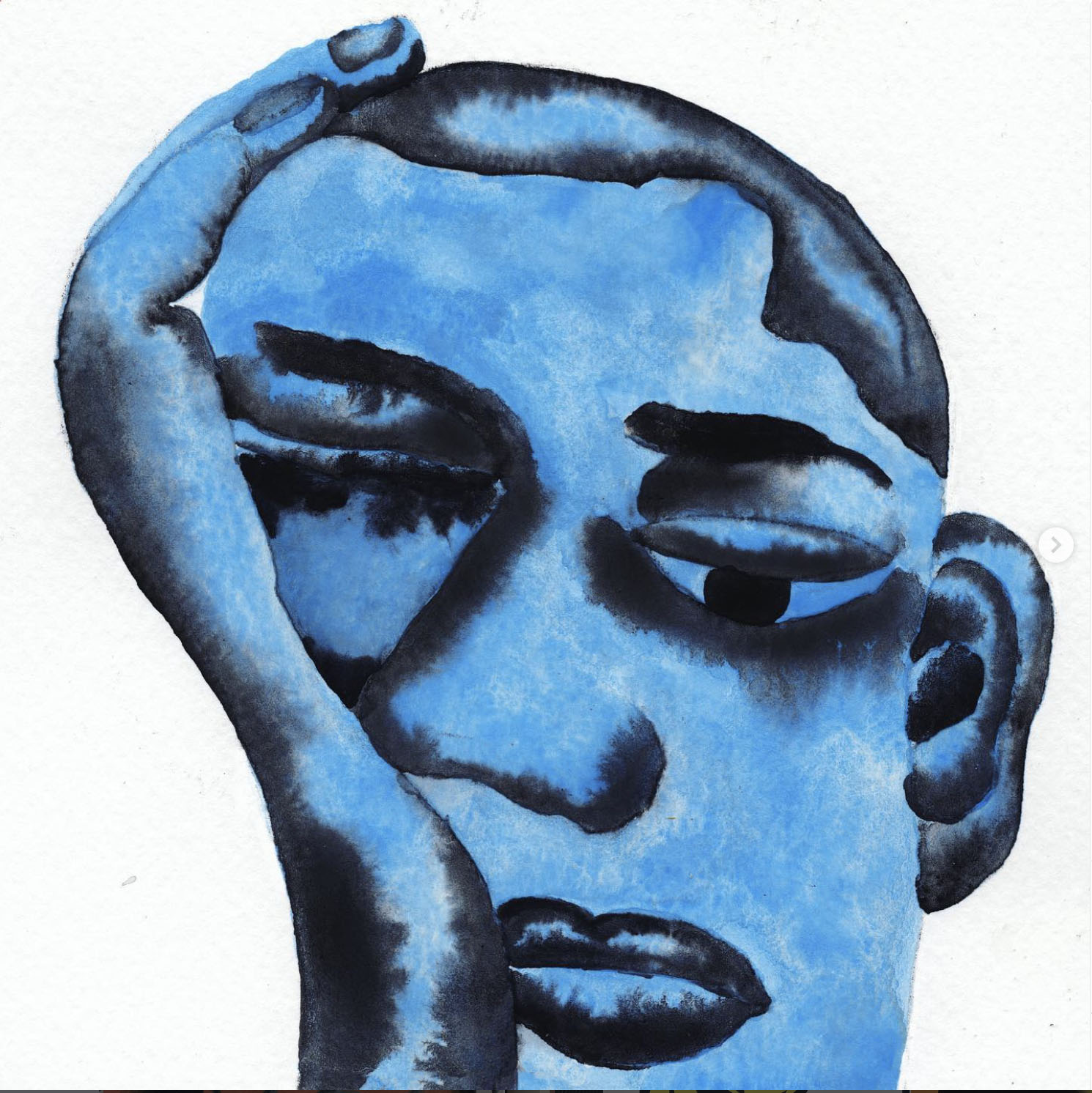
Egyptian author Shady Lewis reflects on translation, borders, bureaucracy, political commitment, and the uneasy ethics of literary awards.
Born in Cairo in 1978 and based in London since 2006, Egyptian author Shady Lewis interrogates the social and political afterlives of Coptic identity, migration, state power, and empire across Egypt and the U.K. His fiction traces how historical and political forces — such as religious authority, state bureaucracy, colonial legacies, and migration regimes — upend lives while simultaneously settling into the most intimate textures and affects.
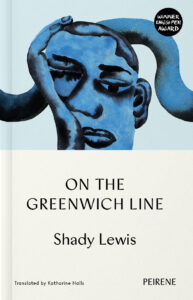
Lewis’ body of work has gained renewed international attention with the recent awarding of the 2026 James Tait Black Memorial Prize for his second novel, On the Greenwich Line (reviewed here last year by Valerie Berghinz). Originally published in Arabic in 2020, the novel was translated into English by Katharine Halls and published in 2025 by Peirene Press. It is now only the third translated work in the prize’s century-long history to receive the fiction award, and the first Arabic-language novel to do so in the category.
I spoke with Lewis about the trajectory of On the Greenwich Line and its recent James Tait Black Prize win, as well as the controversies and ethical tensions surrounding literary prizes more broadly. We discussed the role of humor in writing catastrophe, the shifting relationship between fiction and journalism in Lewis’s practice, what it means to be a politically committed author, and the fiction of borders: geographic, identitarian, linguistic, and otherwise.
Our conversation has been condensed and edited for clarity.
—Abdelrahman ElGendy, TMR Literary Editor
The Markaz Review: Congratulations on winning the James Tait Black Prize, a remarkable milestone in the award’s century-long history beginning in 1919. Since its inception, the award has only twice gone to works in translation in the fiction category: Monkey by Wu Cheng’en in 1942 and My Heavenly Favourite by Lucas Rijneveld in 2024. With On the Greenwich Line now becoming the third translation, and the first Arabic-language novel to receive it, how do you reflect on this? And what do you think it reveals about the kinds of texts that are able to circulate, and become legible, within Anglophone literary institutions today?
Shady Lewis: It’s true that Greenwich is only the third translated novel to win the award in almost a century. Even the Chinese novel that won in the 1940s or 1950s was a classic, so it’s not really in the same category. It’s quite astonishing that in the last two years alone there have been two novels in translation that won the award. The biography category has also gone to translated works. Egyptian author Iman Mersal, for example, won it a few years ago. Then last year, as I remember, it went to a Lebanese-French author and visual artist.
When it comes to translation, this award is judged by the English Literature department at Edinburgh University, and it’s quite literary. It ignores market considerations to some extent. So, it’s different from the Booker and similar prizes, where you can have celebrities on the judging panel. Here, the judges are academics and postgraduate students.
There is a strong anti-colonial and post-colonial sentiment within these departments, especially English Literature departments. That allows works from other languages and from the Global South to be considered and celebrated more than they might be in more mainstream awards. What I’m saying is that it’s a university award, influenced by the academic atmosphere and trends, which are related to post-colonial thought, especially now, when we are witnessing a genocide in Gaza that is still ongoing.
More broadly, there has been a significant surge in Arabic literature and Arabic authors within Anglophone literature. If you look at major American awards such as the National Book Award and others, every year you’ll find several Arab writers on the longlists and shortlists, and even winners. We’ve seen Ahmed Naji, Mohamed Kheir, Bothayna Al-Essa, and many Palestinian writers. That wasn’t the case a decade or two ago.
This is related to the broader rise of world literature, as readers have wanted more variety in what they read. Post-colonial thought and identity politics are no longer confined to universities; they have become influential among middle-class Anglophone readers as well. People want to read literature from the Global South and see the world from different perspectives. When that literature is connected to politics, it becomes even more appealing.
But that doesn’t necessarily mean these authors or works become mainstream or achieve massive popularity. The chances of that are still quite rare. We get one or two names every decade or two that reach that level of recognition among the English-language readership.
TMR: How do you think translation has shaped the life of this novel in terms of tone and meaning, not just at the level of language, but in the way scenes breathe, dark humor lands, and silences are carried across? And do you experience the translated text as a continuation of the original, as if it extends its life into another linguistic space, or as a distinct work that inevitably begins to live under a different linguistic and cultural grammar?
SL: I have two things to say about the translation. The first is that, in addition to English, the book has been translated into other European languages and is currently being translated into more. A young translator has almost finished a Chinese translation, for example, and is now trying to find a publisher for it. For all these languages, except English and to some extent Spanish, I have no real way of judging the quality of the translation; I can hardly read the title and my own name.
It’s quite fascinating to look at a completely different language that you have no idea how to read and know that it’s your book. These translations absolutely take on a life of their own.
The second thing concerns the English translation, which is the only one I can actually read.
There was something very interesting about this book. It operates on three different linguistic levels. One is my attempt to mimic a classical Arabic style when telling the story of Ghiyath and his travels. It is meant to evoke works such as One Thousand and One Nights and the stories of Sinbad the Sailor as he moves across borders and countries and encounters wonders. So, there is a section of the novel that deliberately imitates classical Arabic, though in a satirical way.
Then there is another level where I am writing in Modern Standard Arabic while trying to create the feeling, lightness, and rhythm of colloquial Egyptian speech. There are also a few passages that draw on the language of the Coptic Church, the way a priest might speak.
But a large portion of the novel consists of people in London speaking to one another in English. I tried to write these sections in the Arabic that we as Arabic readers encounter when reading translated literature, as well as in the language of Anis Ebeid’s [1] famous subtitles for American films. There is a very specific form of Arabic that we read and hear through movies. Some people even make fun of it. They say, “He’s writing literature that sounds like it’s written in the language of Anis Ebeid subtitles.” But I find that language fascinating — how you can make Arabic readers believe they are reading people who are speaking English to one another, even though everything is written in Arabic, just a very particular kind of Arabic.
I think that for my translator, at least in those sections, the process was easier because the text already sounded as though it had come from English in the first place.
The humor in many parts of the novel was also heavily influenced, consciously and unconsciously, by British television comedies more than anything else, as well as by some British theatre. I think transferring that from Arabic into English was less difficult, more enjoyable, and something that was accomplished very smoothly.
TMR: In the novel, bureaucracy is a force that shapes how people move, wait, and even understand one another, extending into life, death, memory, and beyond. How did you approach writing bureaucracy as something lived and internalized by your characters, rather than simply an external system they navigate?
SL: Bureaucracy in the U.K. has a very strong presence, especially if you are a migrant or come from a disadvantaged background, because it effectively governs every aspect of your life. That’s one of the things I’m trying to explore in my novel.
I’m not against bureaucracy or state intervention per se, not in the neoliberal sense. On the contrary, I understand where large state institutions and bureaucratic systems come from. In fact, there’s a scene in the novel where Kayode gives a speech in defense of bureaucracy, arguing that it protects us from ourselves in a certain way.
At the same time, this bureaucracy has inherited many characteristics from the bureaucracy of the empire. You can see a significant difference between how the French managed their empire and how the British managed theirs, and how those approaches later influenced the welfare state in each country.
In France, there is the idea that everyone shares a single identity and that differences of religion, ethnicity, and culture should disappear behind the flag of the Republic. In Britain, by contrast, there is a celebration of multiculturalism and diversity that often relies on the logic of “divide and conquer.” Across all kinds of institutions and departments, people are asked about their religion, sexual orientation, cultural background, and languages. The state celebrates Eid, Christmas, Hindu festivals, and many other occasions.
In this way, you live under a bureaucracy that resembles the empire on a smaller scale. Bureaucracy is a machine that produces identities, fixes them, and assigns them a place within a larger system. It requires people to behave in certain ways. Some things are permitted, while others are not. Much of this operates at an emotional and psychological level, not only through formal procedures.
What I am trying to do in the novel is challenge the logic behind that machine and introduce an idea that is now quite common: the fluidity of identity, the fluidity of borders, the fact that many of these borders are imagined, [which speaks to] the fragmented nature of our existence.
From that perspective, nothing appears fixed. Everything becomes fluid, marked by discontinuities and ruptures. That’s what I was trying to do in the novel, and to do it in a funny way — or at least I hope it was funny.
TMR: One striking feature of your writing, including On the Greenwich Line, is precisely that coexistence of dark humor and despair, often within the same moment or line. How do you understand humor as a narrative strategy in that context, and what does it allow you to articulate or approach that other registers might not? Do you see it as a way of coping with lived reality, or as something that changes how that reality is perceived, both in life and in fiction?
SL: I think there’s something very Egyptian about that, isn’t there? About our sense of humor in everyday life. It’s also a widely recognized feature of a strong tradition within Arabic writing. Perhaps the most obvious example is Emile Habibi, who has been a major inspiration for me.
At the same time, when I moved to the U.K. almost twenty years ago, I didn’t really know much about British culture. What I knew came from distorted images in black-and-white films about aristocracy and similar things. One of the things that completely surprised me when I arrived was how funny British people are. I became obsessed with British television sitcoms and spent years watching all the classics, including some that were admittedly quite low quality. What struck me was that there is a strong connection between British and Egyptian humor. Both often combine misery and humor in the same breath.
Until quite recently, I couldn’t fully explain that connection. Then I came across a book on comedy in Egypt by El Khachab. [2] In it, he traces many of our major comedy films and television comedies — even those of Ismail Yassine — back to British cinema. Some can be traced to French plays or Hollywood films, but many ultimately lead back to British films. So, there is a historical connection as well.
When I wanted to write a novel that was as Egyptian as it was British, this was one of the things I knew I needed to focus on: the mixture of misery and humor.
There was another reason as well. Just before I started writing the novel, when the idea was first forming, there was a major wave of refugees arriving from Syria. I found it quite upsetting to go to art galleries or theatres and encounter works dealing with what was then called the “Syrian crisis.” So much of it felt overwhelmingly sad and focused on pitying Syrian people.
To me, that felt quite insulting, because all the Syrians I know have a great deal of dignity. They would be uncomfortable being treated primarily as objects of pity. I felt that one of the most important things comedy can do is rebalance situations where there is a deep imbalance of power. You can feel sorry for someone you perceive as being below you. But when you laugh with someone, when you exchange jokes, there is an implicit recognition that you stand on equal ground.
There is also a matter of taste. Whenever I write something tragic, I’m always afraid of slipping into melodrama. In Egypt, we have a very strong relationship with melodrama, and it can become a bit much. One way of avoiding that was through humor. By being funny, I could prevent the work from becoming overly sentimental or awkward.
But then there’s the opposite problem: being funny all the time can become awkward, too. At a certain point, I find myself thinking that I need to stop joking and become serious, that this moment requires tragedy rather than comedy. So, I was constantly negotiating that tension, sometimes within the same sentence. I didn’t want one side to become excessive, so I would move toward the opposite pole. Then, when that became too dominant, I would move back again.
TMR: In addition to your fiction, you write a widely read weekly column in Arabic engaging with Egyptian politics and culture as well as global concerns, including the Israeli genocide in Gaza, the U.S. aggression on Lebanon, and its war on Iran, to name only a few. How do you think about the relationship between these two forms, the novel and the essay? When do you reach for each, what does each demand from you, and what can each do that the other cannot?
SL: I started writing as a journalist [for] Al-Modon, and that gave me seven years of training, writing two pieces every week. I also wrote for other publications, though not as regularly. That’s how I learned to write. I hadn’t trained as a writer before that. My background is in engineering, so writing was not originally my main field. From journalism, I moved into literature.
In general, in economies such as Egypt’s and in many Arabic-speaking countries, the field of writing is neither large nor specialized enough for there to be very strict boundaries between literature and journalism. This isn’t only true in Egypt. If you look at Latin America, many of the major figures in Latin American literature also worked as journalists.
If you look at the Nahda period in Arab culture, you’ll find that the same people who founded newspapers and developed the modern written Arabic used in journalism were also translators, lexicographers, encyclopedists, novelists, and poets. They were doing all these things at once. One example is Butrus al-Bustani, who was involved in all these fields and also translated the Bible.
I think that tradition continues to shape both journalism and literary writing in Arabic. The distinction between the two fields has never been entirely clear, and people often move between them, performing very similar roles.
Part of the reason is that we do not have enough production in the social sciences and humanities in Arabic. As a result, novelists and literary writers often feel a responsibility to perform many of those functions themselves. They write history, engage in political analysis, explore sociology, and address broader intellectual questions through their novels.
As for what one form can do that the other cannot, I always give the same example. I once wrote an article about marriage and the problems surrounding marriage for Copts in Egypt. That article later became the main structure on which I built my first novel [Ways of the Lord, published by Turuq Al Rab in 2018, ED]. In fact, I inserted the article into the novel exactly as it had originally been written, without changing a single word, and nobody noticed.
So, I think the two forms are much more flexible and interchangeable than people often assume, and you can move between them quite freely.
TMR: Your decision to refuse the Sawiris Cultural Award [3] in 2023 sparked intense controversy about the role of literary institutions in the Arab world. How do you view the rise of prize culture in Arab literature, and what impact do you think these awards have on writers, publishers, and the broader literary field? Is there a clear difference for you between prizes in the Arab world and the West in terms of funding structures and institutional affiliations? How do you approach deciding which awards to accept and which to decline?
SL: First, prizes and awards are very important for publishers, writers, and readers in the Arab world. They fill several gaps within the literary ecosystem. Direct state funding has largely disappeared. In countries like Egypt, publishing houses were once government-owned institutions, but that system either no longer exists or survives only in a very limited form. At the same time, the market is not deep enough to generate sufficient revenue for publishers and authors to make a living from writing alone.
As a result, many people depend on awards. Awards also generate publicity, helping readers decide what to read and bringing attention to books and authors. They inject money, energy, anticipation, and ritual into literary life. Every year, people follow the awards closely, waiting for shortlists and winners to be announced.
At the same time, awards culture in the Arab world shares many characteristics with that in the West. One example that comes to mind is John Berger. When he won the Booker Prize, he refused to attend the ceremony and instead went to a pub with his friends, where he delivered a long speech criticizing the entire concept of literary prizes. But he then accepted the money because, as he said, he actually needed it, though he did donate half of it.
Awards inevitably create hierarchies. They place some people at the top and distribute privilege, symbolic capital, and often actual capital as well. All of this depends on authority. The authority is the judging panel. But then another question follows: who appoints the judges? In most cases, the people who appoint them hold some form of political, administrative, or financial power.
What I find difficult is that many writers speak constantly about rebellion, resistance, and challenging authority. Yet when it comes to awards, privileges, titles, shortlists, and accolades, many become remarkably compliant. They accept the authority behind these systems without questioning it.
For me, the important questions are always: Who gives the award? Who appoints the judges? Where does the money come from? Where does the symbolic capital come from? How is it generated and circulated?
The political affiliations of awards are usually obvious. If you look at the major literary awards in the Arab world, you have the “Arabic Booker,” [4] the Sheikh Zayed Award, which is linked to the UAE, and the Katara Prize, which is linked to Qatar. If you accept one of these awards and travel to one of these capitals, you are, in some way, accepting an association with a particular political framework. Today, the term most often used for this is “culture-washing.” Around the world, people have denounced awards, book fairs, festivals, film festivals, and cultural institutions because of their political affiliations. What surprises me is how rarely this happens in the cultural sphere of the Middle East and North Africa, even though there is so much to protest.
As for how I decide whether to accept one award and reject another, I honestly don’t have a strict formula. Many different factors can influence the decision. Some of them are simply aesthetic. I might accept a prize funded by a capitalist or a major businessman because I genuinely need the money. At the end of the day, I’m a person with needs and responsibilities. On the other hand, I might refuse the same prize for purely aesthetic reasons because I don’t want to spend the rest of my life carrying a particular name attached to my work.
Take the Sawiris Award as an example. I sometimes joke that I might have accepted it if it were called the Nile Award instead. The issue isn’t necessarily the money itself; it’s the symbolic association. I don’t want to carry a businessman’s name on my shoulders for the rest of my career. That’s a slightly humorous answer, but the broader point is serious. If you look closely at almost any award, you’ll find traces of political influence and money whose origins may raise questions. For me personally, I don’t want to accept an award that would leave me politically embarrassed for the rest of my life, especially if it carries the name of a ruler, a ruling family, a king, a prince, or a sheikh. As someone who describes himself as a socialist, I would find that completely unacceptable. The best we can do is try to make the most ethical decision possible in the circumstances.
I also don’t think there is a significant difference between western and Arab literary awards.
For example, there is a French award for which I was shortlisted twice. It was associated with the Institut du Monde Arabe in Paris. Alongside the institute’s name was the name of a French publisher. When I looked into him, I discovered that the media empire he built had originally been financed through his work in the defense industry. He made his fortune producing weapons.
That led me to wonder why it is so often the case that people who produce weapons also want to fund literary prizes for their victims.
In any case, I withdrew from the shortlist during the Gaza genocide. That decision wasn’t only because of that publisher, although it was part of my thinking. The genocide itself was the main reason. The French government’s position on a ceasefire was, in my view, deeply shameful, and the Institut du Monde Arabe falls under the French Foreign Ministry and is appointed by the President of the Republic. At the time, I simply felt that I did not want to be associated with those people. I didn’t want to stand beside them, shake hands with them, let alone accept money from them.
Later, the French Foreign Ministry changed its position. Then I was shortlisted again for the same award with another book. I didn’t win; it went to a Palestinian author, which made me very happy because it spared me from having to answer the question of whether I would accept the prize or reject it. To be honest, I’m often relieved when I don’t win an award. It saves me from the difficult and sometimes torturous process of deciding what to do with it.
The James Tait Black Memorial Prize was very easy for me to accept. It came from a university, the judges were academics and postgraduate students, the award carried the name of a publisher, and the prize money came from his wife’s estate. The committee that selected the novel was itself involved in a dispute with the university administration, and the award almost did not go ahead. In fact, we issued a statement criticizing the university and expressing support for the union that was on strike. That doesn’t make me proud exactly, but it means I don’t feel ashamed of accepting it.
TMR: You’re often described in interviews in terms of intersecting identities and politics: a leftist Coptic Egyptian writer. How do you relate to these categories yourself, if at all? Do you find they meaningfully inform your writing and perspective, or do they sometimes obscure more than they reveal about the concerns and questions that drive your work? And how would you describe what drives your literary project?
SL: I remember doing an interview with a Tunisian website where I was told I would be introduced as a postcolonial author. I felt slightly embarrassed by that, not because there is anything embarrassing about being postcolonial, but because labels like that can feel overly grand.
Over the years, I’ve been categorized in many ways. In the U.K., I’ve been called a migrant writer or a diasporic writer. More recently, I’ve been invited to events with African writers. At first that surprised me, because I didn’t immediately think of myself as an African writer. But when you think about it, it makes sense. We are African, after all.
As I was saying earlier about borders and bureaucracy, these categories are often imposed by systems already embedded in publishing markets and ideological frameworks. There’s an expectation that you position yourself somewhere, that you belong to a camp.
For example, there was a period when my writing was primarily concerned with the Coptic experience. So, when people in the U.K. described it as migrant writing, it felt strange. I always thought of myself as a Coptic migrant; in my mind, I was still writing about the Coptic experience.
These identities can be useful guides in writing, but I’m not permanently attached to them. Sometimes I accept them, sometimes I resist them. Identity is fluid, fragmented, and often confusing. So, I might hold on to a category at one moment and let it go at another. Sometimes it’s simply pragmatic.
In my most recent novel, I moved in a different direction. [A Brief History of Creation and East Cairo] focuses on the history of Protestant communities in Egypt and the influence of American Christian missionaries on cultural production, identity formation, and everyday life in Egypt and across the Middle East and North Africa.
In that work, I became more interested in aesthetics and form than overt political argument. The politics are still there, but they are embedded in the details.
There’s been a long struggle between form and content, especially in Arabic literary circles. In the 1990s, there was a strong movement in Arabic — and particularly Egyptian — writing that looked down on ideology and political content, and instead focused on form, the body, desire, and so on. That was partly a reaction against official literary dogmas of the state, especially social realism inherited from Soviet traditions, where literature could become almost like political speech.
I don’t really share that sensitivity. I’m comfortable with my work being ideological, politically conscious, and direct.
◊
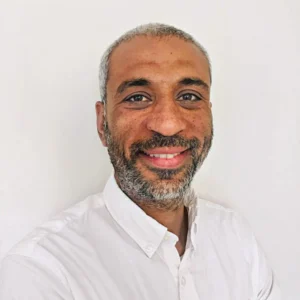 Shady Lewis, born 1978, is an Egyptian novelist and journalist whose writing centres on cultural and political intersections within and beyond the Arab world. He lives in London, where he has spent many years employed by the National Health Service and local authority housing departments, working with homeless people and patients with complex needs. He has published three novels in Arabic to date – The Lord’s Ways (2018), On the Greenwich Line (2019), and A Brief History of Genesis and Eastern Cairo (2021) – each of which engage with the social history of Coptic Christians and trajectories of migration from Egypt to the West, and a travel diary, Death Tourism, or a Comedy of Foreigners (2024). On the Greenwich Line has also been translated into German, French and Italian; the French translation was shortlisted for the 2023 Prix de la littérature arabe.
Katharine Halls is an Arabic-to-English translator from Cardiff, Wales. Her critically acclaimed translation of Ahmed Naji’s prison memoir Rotten Evidence was a finalist for the National Book Critics Circle Award for autobiography, she was awarded a 2021 PEN/Heim grant for her translation of Haytham El-Wardany’s Things That Can’t Be Fixed and her translation, with Adam Talib, of Raja Alem’s The Dove’s Necklace received the 2017 Sheikh Hamad Award.
◊
[1] Anis Ebeid (1909-1988) pioneered Arabic subtitles for foreign films in Egypt and the Arab world since 1947. Anis Ebeid’s translation style became a running joke in contemporary Egypt because its subtitles translated casual dialogue into overly high-brow, literary Arabic, making everyday conversations sound dramatically poetic or unintentionally funny. The phrase “translated by Anis Ebeid” is frequently used as a humorous shorthand for this style of exaggerated, classic subtitling.
[2] Qahqaha Fawq al-Nil: Iqtibas al-Kumidya fi al-Sinema (Laughter Over the Nile: The Appropriation of Comedy in Cinema) by Walid El Khachab.
[3] The Sawiris Cultural Award, one of the most prestigious and lucrative literary prizes in the Arab world, is funded by the Sawiris Foundation for Social Development, established by the Sawiris family, one of Egypt’s most prominent business dynasties and the founders of the Orascom conglomerate. The family member most associated with the award is Naguib Sawiris, an Egyptian businessman, investor, and billionaire.
[4] The International Prize for Arabic Fiction (IPAF), informally known as the “Arabic Booker,” is funded by the Department of Culture and Tourism in Abu Dhabi. While it was originally mentored by the Booker Prize Foundation, the two are independent, separate organizations.