Select Other Languages Français.
The civilizational supremacy of the West is under threat, insisted U.S. Secretary of State Marco Rubio, in a speech in Munich.
I am haunted once again by The Souls of White Folk. You know, the souls of warring white folk that the great sociologist W. E. B. Du Bois wrote about in his poetic, piercing text from 1920. The essay was published in the aftermath of the first world war, as we now recount that period of imperial warmaking and colonial worldsharing, with the certainty that a second one was to follow. Sitting in London at the edge of another world war (lucky enough, or are “we” already in it, and which one is it, only the third?), I have been rehearsing in my head the sarcastic observations, the exclamations populating The Souls of White Folk.
This silent rehearsal has become a compulsion ever since I heard U.S. Secretary of State Marco Rubio deliver a speech at the Munich Security Conference. There and then, on February 14, 2026 to be precise, Rubio rallied “Europe and America” to fight together for “thousands of years of western civilization.” “That is what we are defending,” Rubio declared in Munich, “a great civilization that has every reason to be proud of its history.” For five centuries, he told his European friends in praise, “the West had been expanding — [with] its missionaries, its pilgrims, its soldiers, its explorers pouring out from its shores to cross oceans, settle new continents, build vast empires extending out across the globe.”
While Rubio, this proud child of western civilization, did not once utter the word “white” in his entire speech marking the shared colonial history and mutual “destiny” of Europe and the United States, the vivid imagery of his beloved missionaries and pilgrims, soldiers and explorers, empires and settlers seizing land across the world was evocative enough. Right then, in my head, the exclamation of Du Bois rang out: “whiteness is the ownership of the earth forever and ever, Amen!”
Civilizational pride, unapologetic, was the condition for “partnership” in the restoration of the West’s dominance.
The Secretary of State’s glorious story did not end there however — it had its highs and lows, its heroes and villains. Rubio lamented how after the Second World War, “for the first time since the age of Columbus,” the West was “contracting” in 1945, when “the Great Western Empires had entered into terminal decline, accelerated by godless communist revolutions and by anti-colonial uprisings that would transform the world.” While many came to believe then that “the West’s age of dominance had come to an end,” Rubio promised the U.S. would renew and restore it. “The United States of America will once again take on the task of renewal and restoration, driven by a vision of a future as proud, as sovereign, and as vital as our civilization’s past,” he proclaimed. Although the U.S. was prepared, if necessary, to undertake that task alone, “it is our hope to do this together with you, our friends here in Europe,” Rubio declared in Munich. Only a few weeks prior, U.S. Special Forces had abducted President Nicolas Maduro in Venezuela, accelerating the dissolution of “the rules-based global order” facilitated by Israel’s genocide in Palestine. Thrilled, Rubio’s European friends, politicians and bureaucrats of the highest rank, gave him a standing ovation. To their relief, what Du Bois called “the title to the Universe claimed by White Folk” could still be shared.
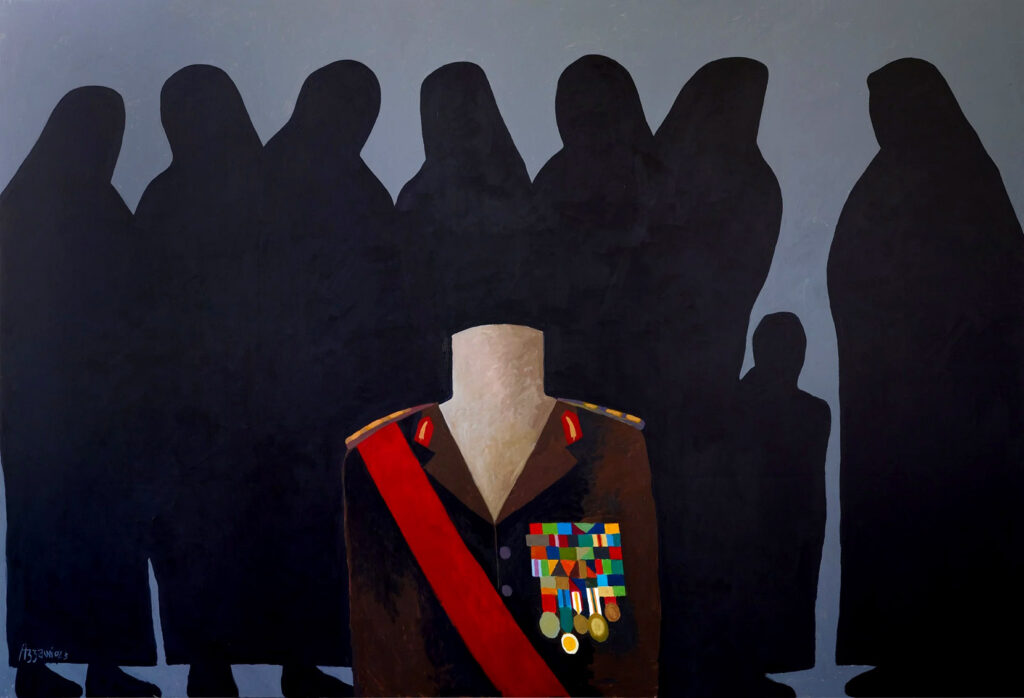
But the Secretary of State had demands for the very souls of the European folk he rallied thus in Munich. “We want allies who are proud of their culture and of their heritage, who understand that we are heirs to the same great and noble civilization,” Rubio insisted, “we do not want our allies to be shackled by guilt and shame.” Civilizational pride, unapologetic, was the condition for “partnership” in the restoration of the West’s dominance; it was necessary for renewing what Rubio distinguished as “the greatest civilization in human history.” Very well then, “super-men and world-mastering demi-gods,” Du Bois rang once again, “here is a civilization that has boasted much. Neither Roman nor Arab, Greek nor Egyptian, Persian nor Mongol ever took himself and his own perfection with such disconcerting seriousness as the modern white man.”
The civilizational supremacy of the West was under threat, Rubio insisted in Munich. If deindustrialization had meant the loss of “independence” and “supply chain sovereignty,” it was mass migration which he singled out as the “urgent threat to the fabric of our societies and the survival of our civilization itself.” As for international institutions, he finally declared, “we can no longer place the so-called global order above the vital interests of our people and our nations.” In Gaza, it was not the United Nations, but American leadership instead, he insisted, that “freed captives from barbarians and brought about a fragile truce.” The barbarians threatening the West’s glory — Palestinians, anti-colonial militants, migrants, godless communists, Venezuela’s “narcoterrorist dictator,” as Rubio named Maduro in Munich — they had to appear in this civilizational epic.
And appear they did in the Secretary of State’s call to arms. “The radical Shia clerics in Tehran,” Rubio underlined, were constrained last summer not by the United Nations but by bombs dropped from American B-2 bombers. “We do not want allies to rationalize the status quo” represented by the U.N., Rubio asserted; “we in America have no interest in being polite and orderly caretakers of the West’s managed decline.” Instead, the U.S. Secretary of State rallied for an alliance “that is not paralyzed into inaction” by the fear of war, an alliance that would not “ask for permission before it acts.” And so, it was. Two weeks later, with no “permission” from the U.N., bombs began pounding Iran again as the United States, together with Israel, launched Operation Epic Fury on February 28. And today, once again, from the genocide in Palestine to the attempted destruction of Iran along with Lebanon, we see in action what Du Bois called “that chiefest industry — fighting,” which Rubio’s mighty civilization has excelled at. “This is not aberration or insanity,” Du Bois had written on the First World War, “this seeming Terrible is the real soul of white culture—back of all culture—stripped and visible today.” He keeps ringing in my head: “whiteness is the ownership of the earth forever and ever, Amen!”
Today, no one knows what the future holds. Commentators observe the scarcity of rhetorical labor offered by the United States to justify its war on Iran. Others note the “uselessness” of liberal apologists to the few attempts the U.S. has made to morally arm the war it is waging along Israel — “the right no longer caters to, nor needs, its liberal outriders.” With or without the allyship of his European friends giving him a standing ovation then, Rubio’s speech in Munich may prove to be the ideological omen of a coming world order mapped by the unwieldy might of bombs, nuclear or otherwise. How different would that order be from the previous constituted by violence and war, legal or illegal, waged for imperial domination and colonial worldsharing? Karl Marx understood this well: between equal rights, force continues to decide. Meanwhile, the proud souls of war folk neither require permission, nor offer apologies.
Select Other Languages Français.