Olive tree, immortal mama root, we are you, and you are us. Who uproots, severs, burns a thousand-year-old life? “And land, like language, is inherited.”
—Fady Joudah, “The Land Has Hands,” Exhibit G

I started reading Fady Joudah’s forthcoming Exhibit G just as I began working on this issue. Throughout, I kept returning to one poem: “The Land Has Hands,” in which a Palestinian woman returns to the rubble of the home from which Israeli colonizers displaced her and her children during the genocide. In the original clip Fady responds to, the woman’s son posts the video as one of those darkly absurd moments of levity amid catastrophe. His mama walks through the piles of rubble and into the blown-apart kitchen. He asks her what the soldiers took, and she ignores all the debris and shattered walls and answers, “The jar of makdous I had stored and hadn’t opened yet!”
Fady, however, takes the mother seriously. He brings us to another scene in which soldiers pose with a stolen jar of makdous, sneering as they hold it up, and forces us to reckon with what the moment reveals. Yes, the occupiers colonized the jar and the makdous; they staged themselves as their owners. But the mother knows they will always fail to grasp what the jar remembers. She knows what the jar contains of her, and what it contains of the land. She knows that “To eat makdous is an art and bread the artist. Your tongue will need to listen. You must bow to the land that gave you garlic and peppers and bow to the olive tree.” She knows in her body what Mahmoud Darwish’s line invokes as Fady returns to it again and again, a haunting refrain: “And land, like language, is inherited.”
While thinking about how I wanted to approach the Anthropocene in this issue, this poem was looping in my head. As we wrote in our call for submissions, Anthropocene is the name given to an epoch in which human activity has irreversibly altered the conditions of life on Earth: seas swallowing coastlines, forests burning beside high-rises, poisoned rivers, disappearing species, while billionaires dream of colonies on Mars. I was—am—very interested in what it means to think of non-domination not only amongst humans, but between humans and the planet’s majority of creatures. What does it mean to encounter the world without an intent to conquer, to afford an ocean—in the sense of Édouard Glissant—the right to its opacity, or to unlearn the urge to bend and break mountains and fields into usefulness and utility?
This unsettling is vital, but, unexamined, it also risks flattening the historical reality of the Anthropocene, a reality concentrated inside the Palestinian mother’s stolen jar of makdous. Because anthropos, after all, has never referred to all humans equally.
Long before climate collapse became a global talking point, Indigenous worlds were being reordered and destroyed in the name of civilization and progress. Colonial histories imagine settlers arriving in empty wildernesses, a terra nullius. In reality, they encountered inhabited worlds: Indigenous cosmologies grounded in kinship between human and more-than-human life. Colonialism upended these worlds, creating hierarchies that cast some as civilized and others as primitive, closer to flora and fauna, and therefore extractable.
These logics persist today, reverberating through the U.S.-funded Israeli genocide in Gaza and Lebanon, in the colonial wars ravaging Sudan, the Congo, Kashmir, and elsewhere. They surface in droughts and fires, border regimes and greenwashed developments, in AI data centers devouring water and energy. These logics are not exclusive to the west, though their global reach has been profoundly shaped by western colonialism, imperialism, and racial capitalism. In the Gulf, for instance, massive petro-capitalist and extractive economies fuel ecological devastation and imperial ambition. Too often, these histories of violence disappear when ecological crises are reduced to a problem of universal “human impact.” Erased are the worlds of relation the Palestinian mother infuses into her colonized jar of makdous.
It is precisely this tension that TMR stakes our Anthropocene issue into, to interrogate together these entanglements of racial capitalism, imperial violence, and ecological devastation. We asked our readers and writers to think with us: Can you tell us of worlds ending and already ended, and of what survives and what haunts us into the future? How do histories of extraction sediment within language itself? What does it mean for narrative structure to decenter the anthropos? What happens when a sentence refuses colonial conquest, when a line break invokes occupation, exploited labor, or food sovereignty?
It is no surprise that, for an issue concerned with disrupting the stability of the anthropos and rethinking modes of relation, poetry emerges as a haunting, relentless mode of inquiry. George Abraham’s excerpts from When the Arab Apocalypse Comes to America move through grief, displacement, and the violent transformations of human and animal life, family and empire, image and language. “How can any kingdom, animal or otherwise, language our deaths / when our murderers slur us into creatures? Wild beasts. Camel / riders. Little snakes slithering from the singular wound.” Maya Salameh’s “INHUMAN RESOURCES” traces the militarization of everyday life, moving through institutions, professional networks, family memories, and cultural spaces to understand war as an ecological system—one that consumes bodies, land, resources, and atmosphere while embedding itself in the infrastructures of the ordinary. In “The Ossuary of Evolving Forms,” Umniya Najaer makes the page itself a site of planetary encounter, moving between bodies, geological time, missiles, minerals, and imagined futures as language stretches, disperses, collapses, and gathers.
In essays, our centerpiece, Cynthia Kreishati’s “Hunter, Trickster, Gatherer,” considers drone warfare in Lebanon and the technologies that turn landscapes and bodies into sites of pursuit, asking what forms of gathering and care might resist a world organized around hunting. Sherena Razek’s “Elemental Intifada: How Palestine Unmakes the Anthropocene” begins with the handful of soil she carried from Burqa and Ein Karem in Palestine to tell us of the memories held by land, water, and fire, and what it means to consider the environment as a militant freedom fighter in our struggle toward collective liberation. “The Last Barbary Lion” by noam keim [sic] follows the last known photograph of a wild Barbary lion as the author moves across Morocco, France, and the United States, tracing colonialism, displacement, ecological loss, and the paradox of yearning to return to landscapes and histories that have disappeared. And in “Weeds of the Anthropocene: A View from Palestine,” Silvia Hassouna traces the colonial histories embedded in the category of the “weed,” by drawing on the 2020 exhibition Weed Control, which invited Palestinian artists to reimagine plants targeted for eradication.
In fiction, “The Long Middle” by lisa minerva luxx [sic] follows Nar and a fractured band of revolutionaries across an uninhabitable landscape, carrying a movement forward through hunger, grief, love, and uncertainty. In “The Belt Starter,” Nour Shtayyeh traces the intimate entanglement of family, labor, and environmental loss through a father and daughter confronting Aqaba’s vanishing reef.
The issue also brings together three excerpts from recently published or forthcoming works of fiction, all of them translations. In “Wardens of the World,” translated from Turkish by Nicholas Glastonbury, Sema Kaygusuz imagines a future remade by state violence and ecological devastation, and asks what it means to search for an ethic of living that refuses the scientific rationalization of the human body. An excerpt translated from Arabic by our executive editor Rana Asfour, from Hamed al-Nazir’s The Lemon Tree Family, conjures a war-torn Sudan where the boundaries between the living and the dead, memory and reality, begin to collapse. And in Event Horizon, translated from Swedish by Saskia Vogel, Balsam Karam moves between exile, state violence, and cosmic vastness as a mother witnesses her daughter’s execution and grief begins to take on the shape of myth.
For this issue’s conversation, Samira Makki interviews artist Dala Nasser to discuss her work with frottage, fabric, rivers, ruins, and cemeteries, considering how bodies, animals, trees, stones, and landscapes can carry traces of violence that resist languaging.
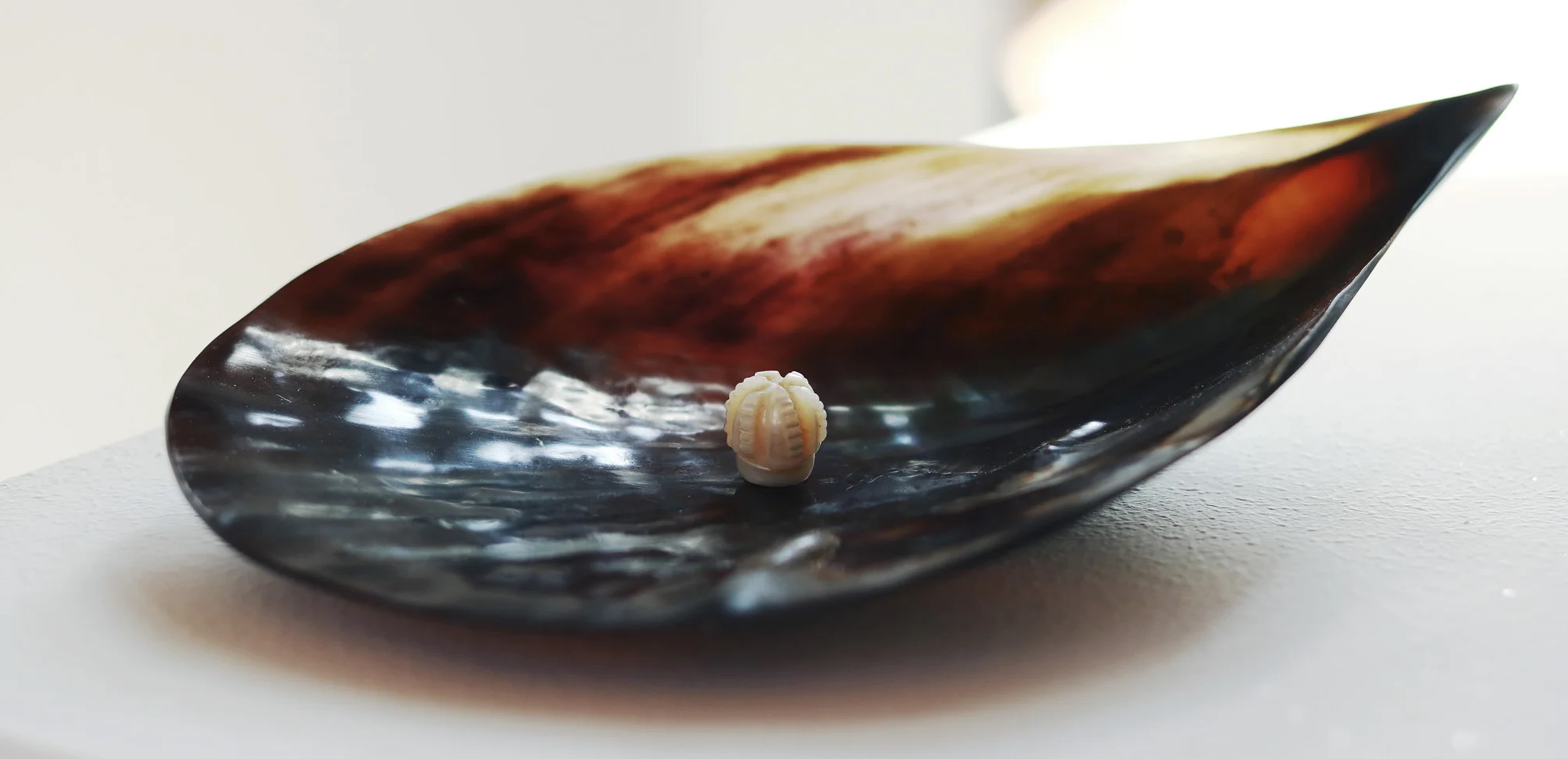
And finally, our featured artist for this issue is Monira Al Qadiri, who was profiled by TMR’s art director, Nour Annan. Al Qadiri’s multidisciplinary practice explores the intertwined histories of pearling, oil, and extraction in the Gulf. Through sculpture, film, and performance, she examines the cultural and ecological legacies of petro-capitalism, and what may lie beyond it.
Across these works, land remembers; animals disappear and return; seeds evade the archive; water carries traces of violence; bodies, ruins, and elements hold what history tries to erase and revolt as freedom fighters. Again and again, these pieces ask us to attend to what it means to understand that “land, like language, is inherited.”
We invite you to sit with the haunting pieces in this issue, think alongside them, and join us for a soon-to-be-announced roundtable discussion, where I’ll be in conversation with several of our contributors. Let us, together, consider how we move from here toward the serious work of worldmaking.
—Abdelrahman ElGendy
Literary Editor