A former greengrocer living among the banished women and children of the Outskirts witnesses an act of state violence that will transform her community.
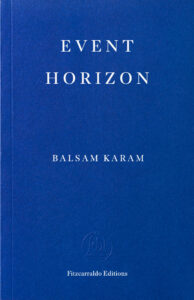 Event Horizon, by Balsam Karam and translated from Swedish by Saskia Vogel, is a haunting work of speculative fiction that collapses myth, fable, and political allegory into a profound meditation on oppression, solidarity, and the possibility of resistance. Set in a world where women and children are banished to the Outskirts, the novel follows Milde, a young rebel whose defiance leads her to an experimental mission into deep space. In this excerpt, we encounter the Outskirts through the eyes of a former greengrocer whose quiet rituals are interrupted by a devastating act of state violence.
— Saleem Haddad, Fiction Editor
On Earth in a place like any other, where a gridded city reached for the sea with wide beaches that sometimes repelled the sea and sometimes invited it in, one of the mothers of the Outskirts had been kneeling in the lantern light on the boardwalk, pushing a bicycle chain into place.
As always at night, she’d just risen from the ground any ground and shaken the sand and shells from her sweater—the starry sky black and infinite had revealed itself and her finger had followed Ursa Major towards Orion and Ursa Minor and onwards to Gemini and Virgo, and stopped at Venus, bigger and brighter than ever before.
She studied the stars in the sky and in the torch light made careful notes on the span of the sky and the celestial bodies’ activities on this night, first noting the date and time then recording every difference from the previous night worth recording (not many) and divining the conditions for tomorrow night (very good) and what the stars were saying on the whole about the state of the world as it was right that moment (surprisingly much).
Soon the glittering gold notebook Essa had given her was full and once again she’d have to carry off white paper bags from shops in town and, in the light of the only lantern in the Outskirts, measure, cut and bind her own notebooks to have with her wherever she went. Every birthday she asked Essa how she’d been able to afford this, and every year Essa answered with only a kiss and two cups of hot coffee for them to take to the slope in the afternoon light, sitting down where the bushes along the slope thickened just as the sky raised the mist above the Outskirts and let it fall into twilight.
Here at the boardwalk, the sky was still bright with stars and the road leading out empty and smooth. She tucked her notebook away and picked up a full bicycle basket from the sand, pedalling slowly as she set off along the road, polishing as she went the fruits—found in rubbish bins around the city—to a gleam against her sweater now in tatters across her body. She nibbled the ripe plums she’d pinched from the greengrocer’s stand which she’d once owned and thought warm thoughts of Pepe and his cart.
Maybe Pepe had noticed her walking around the stand, from one side to the other, earlier in the day right as the afternoon crowd grew denser and bag after bag was held out to him for weighing and payment; maybe he’d flinched when she, having snuck around the watermelons and swedes, suddenly appeared in line with the ears of corn ten for two and plums both yellow and pink; maybe he’d wanted to say something but stopped himself, not sure if she wanted to be seen or intended to come and go unnoticed. She’d been sneaking, that much was true, but she wasn’t ashamed of what she was doing; there was no shame in taking what you needed, and besides, who but Pepe would let her help herself to the earth’s bounty, just like she had offered him that one day when it was still her stand? Here you go, is what she’d said, arms outstretched as if in an embrace, and Pepe had watched as she turned and like now began to make her slow way to the Outskirts.
Early summer, the jasmine shrubs in bloom along the streets leading out of the city. This mother of the Outskirts, once a greengrocer, was now on her way home to those she loved and that loved her back, and everywhere she felt as if from the warming world to the embracing trees and everything in between she was wished well. The rats that had spent the day hiding from white tourist feet crept carefully along the road and struck by tenderness she tossed them two soft tomatoes and her half-eaten plum. Take it, she said quietly and cycled on, enjoy.
She wasn’t aware of this, but later that same night she’d be the last of the mothers to see Milde alive as she cycled past the disused execution site and noticed it was illuminated.
During the day, the nooses hung high enough to catch the eyes of passers-by when a gust sent them swaying over the wall, but now—just as the sun was beginning to rise—two of the four floodlights were on and a white van was parked outside.
The greengrocer stopped, leaned her bike against the wall, climbed onto the saddle to take a look.
There was a woman, young, gaunt. Surrounded by two white men and another two beside. She had short hair and an eye patch, hands tied behind her back.
One of the men, a boy, tore off the patch and handed it to the other. He addressed her, waited for a reply. She replied, but what did she say? Impossible to hear and soon the exchange was over.
The boy fitted a dark cloth over the woman’s head and took off her slippers. He led her to the noose, white as chalk, and the woman held her head high as it was tightened.
All was early summer yet, and now—as before—the jasmine was jasmine and the sky was streaked blue-green and every dawn henceforth was bound to this.
From that place came no sound other than the men’s voices as this mother once greengrocer climbed down from the saddle and rushed away from there.
Later, when a courier delivered to Essa a cardboard box, crammed at the bottom of which were her daughter Milde’s few belongings, the mother once greengrocer upon seeing the eye patch realized at once who that young woman had been. The mothers and children of the Outskirts would set off that same night for the city, down the slope and onto the highway, past the petrol stations and in among the whitewashed houses that marked the beginning and end of the city. In groups and lines through the city, two by two or four by four, like a scattered then gathered string of pearls, the mothers and children of the Outskirts would walk, letting every burning car become a lantern and every hurled stone a song; along the boardwalk that the children had so often walked with a cooler on their arm or a rake in hand were now burning piles of sun loungers and rubbish bins overturned on the street; along the avenues where the children had dragged their cut-up feet, the mothers now walked, stopping at every café and restaurant, asking people to get up, to join them. The children and mothers cried out for no rest, no peace until the Outskirts that Milde loved and that loved her back were informed of what had become of her, but no news came and no Milde returned home.
As if hunted, the greengrocer would set off through the sugarcane fields sharp against her bare feet and continue up to the mountains where glowing red they towered in the east. She would climb to the steppe and into the half-desert, on up to the caves that offered cool relief and peace. Once there, surrounded by rock and dust, she would seek out the place where her hero Milde had once been in hiding and would herself lie down.
Back then—when no one but Milde was being searched for and no one else was accused of setting the fire that had spread in the heat from the city planning office to the Ministry of Education and on to the embassies next door—the Outskirts had collected the coins from every sold beach ball, towel and ceramic necklace, and bought Milde all the tins and bottles of water she could carry. They’d asked her to be as careful as could be and told her that she’d be checked on from time to time, be given everything she needed from time to time—but she had to understand that it was of the utmost importance that she stay in hiding and not get ideas about returning home, Do you hear me? Not for a while, Essa had pleaded, as she packed her daughter’s bag—Don’t come home for a few months, Essa had said turning to Milde who nodded and promised without hesitation, Yes, absolutely, a few months, no problem.
There, perhaps leaning against the same wall, the mother once greengrocer would sit for two days and three nights, taking neither food nor water, sleeping only when the sun was beating white and large against the cave walls and the ammonia of evaporating urine rose towards her face.
By the time the mother once greengrocer returned to the Outskirts, a story had taken shape in her mind, and she stuck to it when she began to write.
So it was and so it went, she wrote—such was Milde and such was her eternal life.