At a rooftop yoga class in Amman, a woman finds herself caught between missiles overhead and expats whose freedom to move extends well beyond their yoga mats.
I can’t remember who added me to the expat yoga group chat. For the past year I’ve been going on about “craving movement” to anybody who would listen. I still don’t really know what I mean by this, except that I have this nagging urge to be wrung out like my grandmother’s kitchen towels.
Everyone, in return, has been offering their curated solutions: dabke classes, beginner ballet tryouts, run clubs, pádel tournaments, private pilates sessions. Just last week, a colleague who knows of my plight asked if I’d like to join her for an animal flow seminar at a new performing arts academy in Abdoun. She said I had to confirm as soon as possible because there was a waiting list. I could not imagine that many people queuing to crawl on the floor for forty dinars. But as always I said thank you, tell me more, maybe next time.
The class was cancelled anyway, along with seventy percent of the flights going in and out of Jordan. The instructor, who is German, couldn’t make it because of the flight suspensions. I learned this from the academy’s Instagram page. At this point, I’m probably following all of Amman’s gyms and workout studios and dance centers, including a women-only water aerobics club and a hula hooping collective that meets on the rooftop of a hostel in Jabal Amman.
The hula hooping collective has also suspended their activities until further notice. We are approaching the turn of summer, warm weather unfolding like a lullaby across the city, yet people are reluctant to be in exposed spaces. Jordan’s national security sirens are still blaring across the kingdom at least twice a day, missiles flying overhead en-route from Iran to Israel. The high-pitched alerts come in pairs; the first one wails like a police siren to signal danger, the second a steady, piercing note to signal all clear. Sometimes the two arrive in the span of ten minutes. Other times there is an apprehensive hour between them.
The sirens are a little reminiscent of Covid curfew days; the only other time the government has ever needed to activate them. But those were only inconvenient at most. They arrived at the expected hour every evening, became part of the city’s musicality. Nowadays these auditory disruptions make my gut clench with excitement and dread. In my neighborhood, the sirens are so intrusive it is as if they are coming from inside the house. We are expected to take shelter when we hear the first siren, in case the missiles are intercepted and any wreckage falls from the sky, yet many people enjoy catching sight of the missiles and cheering, especially in the nighttime. Two days ago, a little girl outside of Amman was injured from debris, but the news reports did not go into more detail about her condition.
The expat yoga WhatsApp group seems oblivious to all of this. For some days now, a few women have been trying to secure a new rooftop for their weekly vinyasa flow, since their old spot isn’t available anymore. There are two-hundred and fifty-three other members. Most of them use foreign country codes. I have never participated in any of the sessions. When I first joined the group last summer, there were several yoga instructors who, sporadically, announced that they were hosting a session, usually outdoors, on a friend’s terrace or in their backyard. They followed a come-as-you-may, pay-as-you-please model. Nowadays you are required to register for classes beforehand—at a gym or studio—and pay a minimum of ten dinars. Once a month, someone sends a message announcing that they are leaving Jordan, in case anyone would like to buy some used IKEA furniture. Each time, a man named Chris replies with a lengthy message reminding everybody to please stick to yoga-related affairs. On a weekly basis, several people ask if anyone has an extra yoga mat. One time, unprompted, a woman asked if anyone would like to buy her used yoga mat for five dinars. No one responded to her.
I’m scrolling through my phone on a Saturday afternoon when a new message pops up. Hello lovely people, a woman named Maya writes, I’m happy to announce that I’ve secured a beautiful rooftop close to Paris Circle. If you’re looking for some stillness amidst this chaos, join me this evening at 7:30 for an easy vinyasa flow. All levels are welcome. Bring your own mat. Suggested contribution 8JD.
Attached is an image of a woman, presumably Maya herself, in a wheel pose: her palms and the soles of her feet planted firmly as the rest of her body arches above the ground, the tips of her auburn ponytail barely brushing the mat.
I have spent the better part of my day tucked into the nook of a sectional couch like a foldable chair. I stare at the arc of Maya’s body and, in a kind of visceral reaction, begin to extract myself from my miserable corner. For the past week my shoulders have been hunched forward, neck bent low over my screen, waiting for news of a ceasefire. Last night I spent two hours like this in bed, watching reel after reel of horror until the wave of missiles passed and the sirens finished their loud business and I could fall asleep.
Paris Circle is a ten-minute walk from my house. I throw my phone to the side and straighten my back.
“Mashi ya mama, do what you want. But if a drone falls on your head, don’t call me crying.”
“What’s wrong?” my mother asks. She is sitting next to me, alternating between Al Jazeera on TV and Al Jazeera on her phone.
“I think I’m going to go to a yoga class.”
“Yoga? Since when?”
“Since now, Mama, I feel like my body needs it.” I unfurl my legs and stretch them out. “Can’t you hear my knees cracking?”
“Yoga where?”
“Close by, on some rooftop.”
“Didn’t you see the video this morning? A drone fell on that cafe in Um Uthaina, the one next to Auntie Hiba’s house.”
“It fell on the patio, Mama, no one got hurt,” I say. It takes some effort to get off the couch. “And anyway, our area is ‘moderately safe’ according to the infographic you sent.”
She raises one eyebrow at me, pushes her reading glasses up with her index finger and then returns that same finger to her screen. “Mashi ya mama, do what you want. But if a drone falls on your head, don’t call me crying.”
There really is something special about Amman’s rooftops. My grandmother once said that God gave us a beautiful sky because he wanted to compensate for such an ugly city. Whether Amman is ugly or not, I can’t say. The answer depends on an array of shifting factors; who’s in town, the state of traffic, my menstrual cycle. What I can agree on is that our sky is singularly beautiful. We city-dwellers understand this, like primordial knowledge. We treat our sky the same way coastal towns treat the sea, always orienting ourselves towards it.
Each family has its own rooftop ritual. My father likes to go up on Friday mornings to survey the neighborhood on its day off. With his hands clasped behind his back, he trails along the parapet and peeks down at the street, the backyard, the neighbor’s garage. Who has gone to pray? Who is hosting a lunch? And my grandmother still likes to hang her laundry on a clothesline rope on the roof, even though we bought her a washer-dryer two years ago. It had been my mother’s idea. A woman of discretion, she detests the sight of her mother-in-law’s nightgowns hanging out in the open.
“But you can’t even see them from the street,” I remind her every so often.
“Even so, even so,” she replies every time.
Personally, I enjoy the sight of air-dried laundry, especially the long-sleeved pieces, how their upside-down arms hang limp in surrender. Against my mother’s wishes, I’ve started air-drying my pillow cases on the roof. Just the pillow cases, because I like the smell of the sun in my bed at night.
Maya’s beautiful new rooftop belongs to a refurbished apartment building, one of many convenient atrocities taking over Jabal Al-Weibdeh. They all have the same lifeless sandblasted limestone, the same stubborn refusal to blend in with the neighborhood’s weathered architecture. Everybody loves Amman’s old charm, until they have to live in a building with outdated kitchen cabinets and no elevator. On my walk, I pass a new Vietnamese restaurant, a cobbler arguing with a young man parked in front of his shop, a corner cafe with an English-only menu, an old woman in a pink nightdress admiring some jasmines—her own perhaps—and two thrift shops.
I arrive two minutes early to find three women standing outside the building, all chatting in different Englishes. I recognize Maya from her auburn hair, gathered in a loose bun. My first thought is that she is short. The second, as foolish as it sounds, is that I was expecting her to look exactly like her photo, like food ordered online. Feeling both betrayed and vindicated by the false advertising, I wonder if I should turn back. But it’s too late; my yoga mat has given me away, and now Maya is waving at me. She asks, in an Australian accent, if I am here for the yoga class.
“Yes, it’s my first time,” I say, as if to justify something.
“Excellent,” Maya says, breaking into a wide smile. “That’s everyone then. Shall we go up?”
I thought we would be more people. Maya unlocks the door to the building. I am the last one in, and I follow the girls down a narrow hall that smells of fresh paint and sawdust. We climb one flight of stairs after the other in silence, passing two apartment doors on each landing, each door flanked by worn out sneakers, potted plants, and coir mats which say WILLKOMMEN or AHLA W SAHLA.
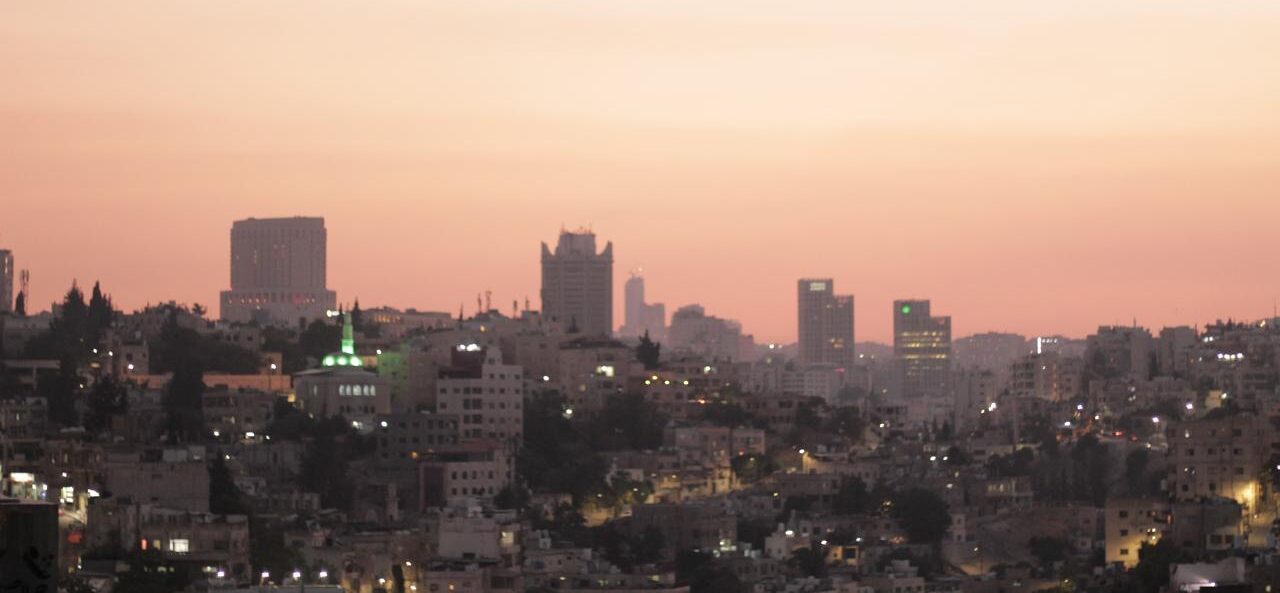
Mellow daylight greets us at the top of our fourth flight of stairs, beckoning us through a white metal door held open by a concrete block. The rooftop is more of a terrace, a long rectangle paved with quarry tiles the color of half-ripe apricots. Beyond the low parapet are blocks upon blocks of houses lining Amman’s hills, which weave over and under each other like waves. On our left, an array of outdoor furniture wrapped in a dusty film of plastic: several stacks of rattan chairs and tables, a couple of chaise lounges. On the other side, a sizable wooden pergola, two construction workers, and the obnoxious sound of a jackhammer.
“Wow! What a view!” exclaims one of the women. She is clearly American.
“It’s beautiful, isn’t it?” says Maya.
“It’s much nicer than the old space,” says the other woman. Something about the way she lingers on her consonants is unmistakably Italian.
“What did the old space look like?” I ask.
“It was old,” the Italian woman replies with a shrug, and that’s that.
“I guess we can take this side,” Maya says, walking towards the stacked furniture. She puts her bag and yoga mat down and begins to push a stack of chairs. The others follow suit. I stay still, glancing back and forth between the workers and the women, who have now made room for a small clearing by the ledge. They dust their hands and unfold their mats onto the floor, Maya’s perpendicular to the rest. I am confused about the entire arrangement. Who gave Maya access to this building? Why haven’t the workers left yet?
“There’s space here,” Maya tells me, pointing to a spot that would put me in direct view of the men. I wasn’t expecting there to be an audience. I freeze, unsure how to take my overshirt off, bend and stretch my body in leggings and a tight sports top. I turn to the men. They have put the jackhammer aside and are now smoking cigarettes by their side of the ledge. The shorter one looks back at me, cigarette hanging between his curved lips, and I can tell that he knows I’m a local. I look away quickly. This is my mother’s biggest nightmare, I think, her daughter flaunting herself, on a rooftop, to an audience of strange men. I have never considered myself prudish, but at this moment I feel like her, discreet and filled with bodily shame. What if they just stand there watching the whole time? What if they try to take a video of us? The tension between their side and ours eludes the other women, who have by now completely forgotten about the existence of anybody else on the roof. I want to run inside. Instead, I walk up to the American woman, who is sitting in a corner mostly obscured by a stack of chairs.
“Do you mind if we switch places?” I ask. “I don’t want to stand in front of the men.” As I explain this I feel smaller and smaller, like I am committing a cowardly act. She agrees without a second thought, jumping up and taking her mat with her.
This is my mother’s biggest nightmare, I think, her daughter flaunting herself, on a rooftop, to an audience of strange men.
As soon as I settle on my mat, a siren wails across the sky, the first of the day. Our first instinct as a group is to let out a little laugh, as if to say: Not again! Over the past week, this reaction has become the norm, as if the missiles are a minor and almost amusing inconvenience. As if the rising and falling notes don’t activate that dreadful sensation in our stomachs that something terrible is happening. We have learned to push this sensation away and laugh.
In the first days of the attacks, the warning siren was trailed by the fervid voice of a man declaring unintelligible instructions into the skies. He enunciated his words heavily and carefully, pausing after each phrase to take a breath. It was unfortunate for him that none of us could make out his muffled words until they were transcribed and circulated online: In light of the ongoing military escalations in the region, and the detection of flying objects over the Kingdom, citizens are urged to remain indoors and to stay away from windows and exposed areas, for the sake of public safety and security. My family and I debated whether the announcement had been pre-recorded, or if the same military officer was perpetually stationed in a control room, clutching his microphone and awaiting instructions, sipping sweetened black tea to warm up his vocal chords. If this was the case, we joked, was the officer disappointed or relieved, three days in, when the government decided to abandon the announcements?
We all crane our heads to the sky.
“Do you ladies prefer it if we go down until it’s over?” Maya half-shouts.
The Italian woman gets up, puts her hands on her waist, and squints into the sky. “I think it’s okay,” she declares, as if her vantage point has revealed to her that it is indeed okay.
“Don’t be afraid!” one of the workers calls out from beyond my barricade of chairs. “Nothing’s going to happen.”
“He’s saying nothing is going to happen,” I translate to the girls.
“Inshallah!” the American calls back. “Shukran!”
The siren winds down. We decide to stay put until the second one goes off.
“Will this be a weekly thing?” I ask Maya, even though I have no interest in joining again.
“Well, it usually is. But I’m going tomorrow to Damascus for five days, then I’ll be back here for a week before heading out to Sydney. Might be able to squeeze another session in.”
“Oh, I don’t think I’ll be around then,” the Italian woman says, settling back next to me.
“Gaza?” the American asks, her legs spread out in front of her, manicured feet flexing then pointing in Maya’s direction.
“Just the West Bank this time,” the Italian replies.
The American hums thoughtfully. “What about your flight to Sydney, is it still on?”
“It hasn’t been cancelled yet,” Maya says. “Hopefully things calm down by then. Although I wouldn’t mind spending a few extra weeks in Amman. You know, I wouldn’t even mind staying in Damascus.”
When I was a child, my grandmother used to drive up to Damascus every weekend, returning with fresh spices and cotton underwear and assortments of sweets. I hated the itchy underwear but loved the bags of sugar-covered chickpeas, the shoe-shaped candy that tasted like pineapple and banana. Damascus is only a three-hour drive from Amman, the West Bank just over two. I have never been to either.
I can hear the practiced voice of a news reporter floating from somewhere behind us. The two men have extended their break, it seems, to follow what’s happening. I wonder if they are Syrian, if they have thought about returning now that the regime has fallen, if they have at least gone back to visit. Maybe they are in fact Egyptian, or Palestinian, or Jordanian. All the same, I wonder if they feel as immobilized as I do now, sitting here among these women, with their NGO jobs and diplomatic passports, their ease of movement across the Levant.
“Maybe we should just start,” Maya says, checking the time on her phone. The blue of the sky has softened, a stretch of warm pastels now rising like steam from a place beyond the horizon. We find our seated positions, legs crossed, eyes closed. We begin with some breathwork, long inhale, even longer exhale. Maya asks us to scan our bodies, drop our shoulders, unclench our jaws. Her voice is warm and measured, almost musical, like she is reciting not instructions but poetry. The jackhammer resumes, and I can feel its chisel vibrating in my chest. I try to take a deep breath, but my lungs refuse to expand all the way. I keep glancing up, searching for any signs of contrails over my head. They are easy to spot in the daytime, thin lines of vapor left behind by the missiles. It’s different at night, you can see the flare of the missiles as they fall in formation like pulsing stars into the distance.
Even if you can’t see the missiles, sometimes you can hear them puncture the airspace, soft thumps like irregular heartbeats. The first time I heard them, in the middle of the night, I thought the door to our roof had been left ajar, that the wind was making it bump against the wall. My father was still up, preferring to wait for the second siren than to be violently woken up by it. When I asked him about it, he laughed and said, “That’s not the door, my dear.”
It’s hard to sit still, and I’m relieved when Maya introduces some movement. We climb into mountain pose, swoop down into chaturanga, push ourselves up into downward-facing dog. As I take my third exhale, the adhan diffuses into the air around us, and although I am facing my own unmanicured toes, I can picture the exact appearance of the sky. What a blessing, I find myself thinking, to live somewhere where the sunset is not only visual but auditory, where even those who cannot see the sky can still acknowledge the sun’s gentle departure.
Maya leads us into warrior pose, right leg planted behind us, left leg bent in front, and tells us to swoop our arms up from our sides to the tops of our heads, as if we are holding a ball between our hands. Looking to my right, I realize that my ball is considerably smaller than the other balls, and readjust accordingly.
“Make sure to melt the shoulders down,” Maya says in that same rhythmic tone of hers, and I know she is talking about me. We transition into warrior two, our balls disappearing unacknowledged. Our torsos twist to the right, arms extended on either side, parallel to the ground. We take turns bending in each direction, curving the corresponding arm over our heads. Maya says we should feel the stretch in our sides. At some point, she says we must make sure to pull the right hip crease back. I have no idea what this means. My left thigh has begun to burn. Why am I even here?
Now that the sun has set, everything on the roof acquires a duller appearance. The tiles, drab and unremarkable, no longer resemble apricots. Honking of all kinds rises from King Hussein Street: the long, irritating honk of an impatient driver, the deep, startling horn of a truck, the cacophony of vehicles the moment a traffic light turns green.
I have never witnessed a more blasé assembly. What would it take to break their immutable dedication to vinyasa, an actual missile?
We are in cobra when the sight of two shadows over my mat snaps my body back into a cross-legged position.
“We have to move the furniture,” one of the workers announces. In one sweeping motion the plastic cover is pulled off, releasing clouds of dust into the air as the men get to work. My barricade is being compromised, I realize with a panic, chaise lounge by chaise lounge. Other than a gentle clearing of the throat by the Italian, nobody else reacts. I have never witnessed a more blasé assembly. What would it take to break their immutable dedication to vinyasa, an actual missile?
I throw on my overshirt, which does little to protect me from the threat of prying eyes and falling objects, but at least it offers the illusion of security. Every time we lower our bodies to the ground, I have an urge to flip myself around, keep my back snug against the mat. Yet my arms push my torso up into cobra, and the cycle repeats.
Maya narrates the progression of nightfall over the shuffle of furniture rearrangement. In runner’s lunge, as we plant our right palms into the mat and open our left arms towards the sky, she says, “Turn your heads to look at the darkening blue sky.” And later, when we switch sides, she repeats the instruction, the sky “an even darker blue now.” She wants us to open our chests, but a spot between my shoulder blades refuses to comply.
The workers dismantle the final tower of chairs with the leisure of a day’s end. And there they are again, those heartbeats thumping in the sky, and now the workers are debating if this means that the sound barrier has been broken, or if the missiles are being intercepted. If something falls on us, on this roof right now, how would the news announce the casualties? Three Arabs and three foreigners? Two men and four women? One local, two migrants, and three expats?
“Let’s take a little pause here,” Maya says, instructing us to lower ourselves into a wide-legged forward fold. “Allow your torso to move to one side, and then the other, and appreciate this moment that you have carved out for yourself.”
I stare through a passage of legs—mine, the Italian’s, the American’s—at the inverted skyline of Amman, warm windows glowing from buildings which hang over a dark abyss. From the corner of my eye I can see the last chair disappear, and then two pairs of lingering legs telling us to please close the door on our way out. I let my arms fall to the mat and begin to sync my movement to the other women, brushing my fingers across the mat as my torso sways with the same surrender, I realize, as my grandmother’s laundry on the roof.
I am now the only Arab on the roof, an immaterial realization that arrives of its own accord. I wonder if this has crossed the other women’ s minds as well, whether they have implicitly designated me as the odd one out, the only local among expats. Or is it possible that I have imagined an alliance between the three of them that doesn’t exist? I play around with this thought, contemplating where our identities overlap, where we belong in relation to each other. Maybe Maya is as distant from the Italian woman as she is from me. Maybe the Italian woman shares more with me—some sort of Mediterranean sensibility—than she does with the American. Maybe the American and Maya are colleagues, or neighbors, and their alliance is social and circumstantial and has nothing to do with nationality.
The moment arrives for us to lie down on our backs. We stare up at the night sky as Maya’s voice guides us through reclining pigeon pose, supine twist, happy baby. We are nearing the end of the practice. We allow our arms and our legs to fall naturally around us, to feel heavy against the ground. We deepen our breaths, counting to five for the inhale and seven for the exhale. The back of my head is damp with sweat and a shiver runs down my spine, the pleasant kind.
“I’m going to go around and apply some pressure on your shoulders and hips,” Maya says. She is almost whispering now. “If any of you are uncomfortable, you can fold the edge of your mat so I know.”
My eyes are closed, but I can feel her kneeling over me when my turn arrives. She places one hand on my right shoulder and the other on my left hip and pushes down, then switches sides and repeats. She smells like freshly cut grass. I miss the weight of her hands the moment she lifts them up.
One, two, three, four, five. Pause. One, two, three, four, five, six, seven, release. Everything around us is so still it is as if we are the only people in the universe. It feels like a lifetime ago that I had climbed up to the roof, inconceivable that only one hour separates that moment from this one. We have all survived, I find myself thinking. And despite the banality of this revelation, its self-indulgence—of course we have survived—I entertain this sense of victory.
And then I peel open my eyes. No second siren, as of yet. Nothing but the night sky—how absurd that we are so attuned to this vast and mysterious thing. There are so many stars above me, invisible lines running between them all. Most of them hover in place, but one is blinking, softly and steadily. Another appears to be heading east, slow and determined as a snail. So many stars, blinking and zooming across the deep sky, so very unlike stars.
This work was supported by the Oxbelly Residency.