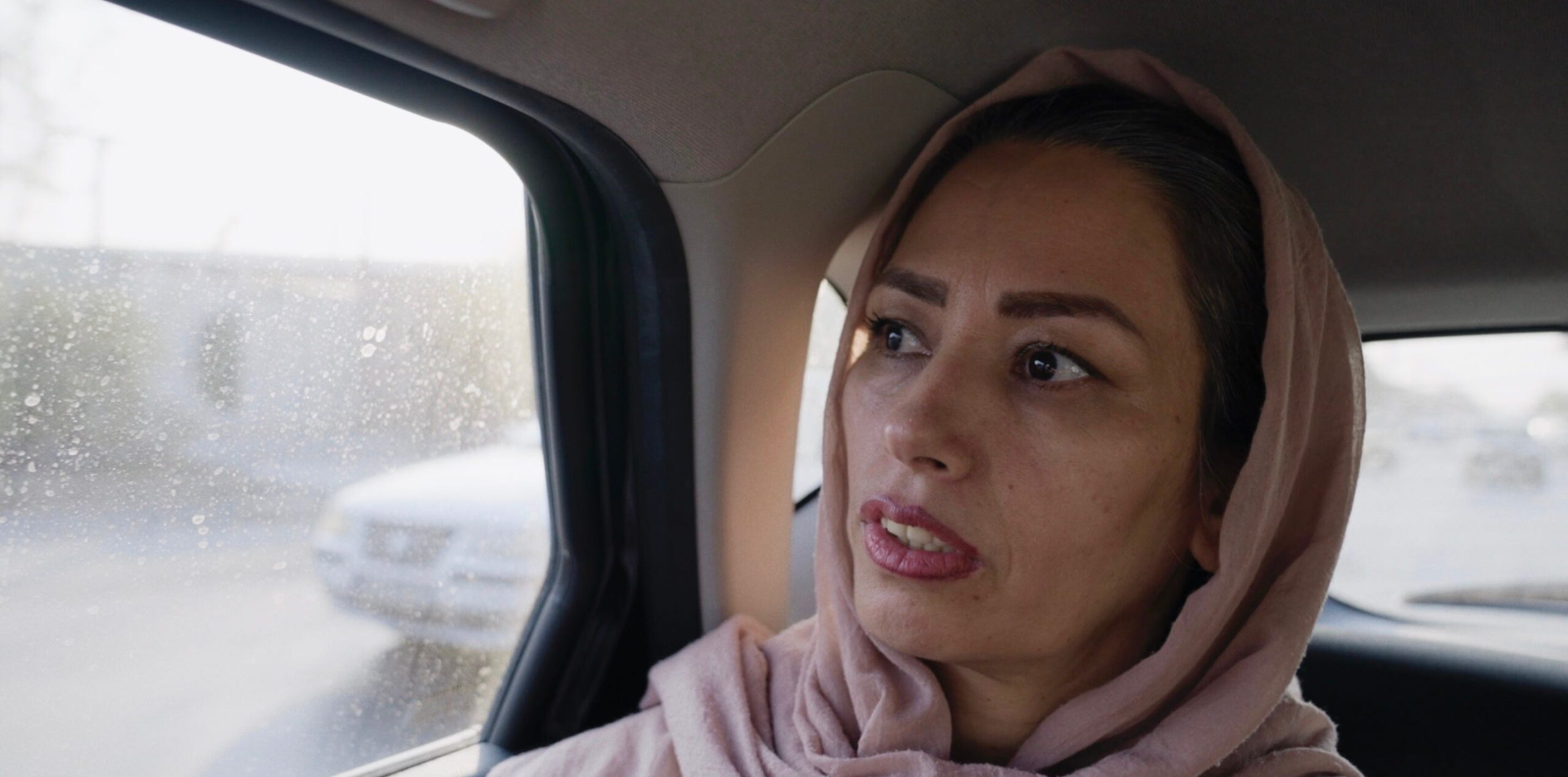
Iranian filmmakers Tanaz Eshaghian and Farzad Jafari's true-crime documentary explores the cost of forgiveness under an ancient law.
A man buys a house outside Tehran and notices, not long after moving in, something pushing up through the carpet. He pulls the carpet back and sees a leg. There is a man sealed into the floor like a secret the building itself had been keeping. It’s the kind of opening that belongs to a thriller. And An Eye for an Eye is every bit a thriller.
Except the film isn’t fiction; it’s a documentary by directors Tanaz Eshaghian and Farzad Jafari. An Eye for an Eye premiered at Tribeca in June 2025, where it received a Special Jury Mention for Documentary Feature and an award for Best Editing. The body under the concrete belongs to a man named Hossein, the house’s previous owner. The woman who put him there, with help from her own children, is his wife, Tahereh. By the time the film catches up with her, she has already served fourteen years in prison for his murder, claiming she acted in self-defense against a husband who beat her. Iranian law allows a man to divorce his wife whenever he chooses, without justification, while a woman has no equivalent right. She can only petition a judge and prove that the marriage has become intolerable, a high bar rarely cleared. So this abused wife turned to what she said was her only recourse.
The film opens like a crime procedural, with investigators discussing how they reconstructed the murder at the crime scene and an investigative journalist laying out the details of the case he’s been covering. Eventually, the authorities float a theory that Tahereh couldn’t have managed the killing, or the burial, without a man’s help—and that the man in question, a shadowy, never-seen figure referred to only as Hamed, may have been her lover. This mysterious Hamed is arrested twice, but is never convicted or heard from in the film. In Iran, adultery is considered a far graver disgrace than murder, and an affair would do more damage to Tahereh’s standing than the killing itself—an incentive in its own right to explain her silence, whether or not Hamed was an accomplice.
As in the films of master Iranian filmmaker Asghar Farhadi (A Separation, A Hero), ambiguity threads through Eshaghian and Jafari’s film, and almost no one is entirely good or bad. The killers are sympathetic because of the life they endured under their father’s tyranny, while the victim’s family is largely driven by revenge, with little compassion or acknowledgment of the struggle the other side of the family has endured.
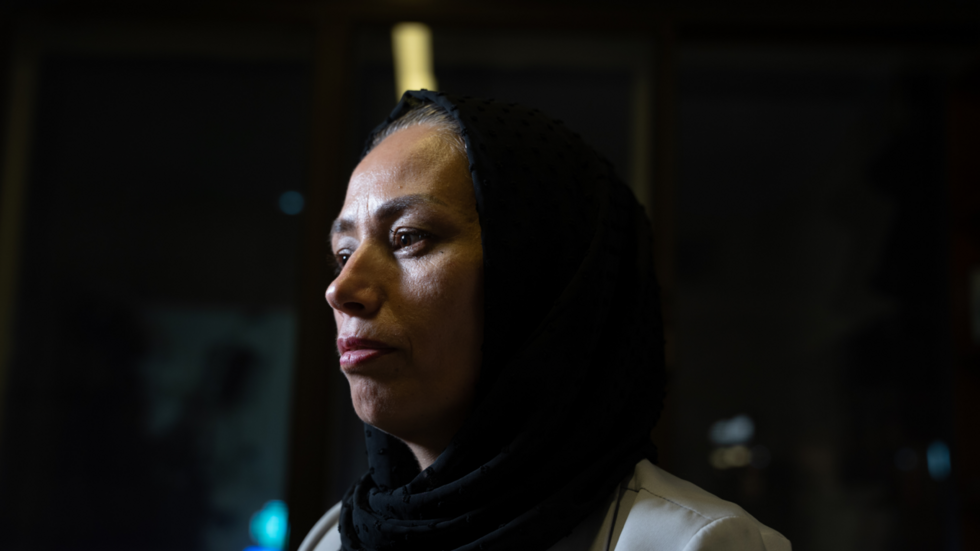
That refusal to sort its subjects into heroes and villains is what makes An Eye for an Eye far more than true-crime tourism. It’s really a film about qisas, the Islamic law of retaliatory justice that Iran still enforces. Under this system, a murder victim’s family—not the state—decides the killer’s fate: execution or diya, blood money, paid in exchange for forgiveness. Fourteen years after Hossein’s death, with Tahereh released on bail, that decision falls to his family, chiefly the victim’s brother Bashir, and they are given three months to name their price. It lands at 1.3 billion tomans, somewhere near $30,000. For a woman who has spent over a decade in prison and her grown children, the sum is so far beyond what they could raise that it functions less as restitution than as a death sentence with paperwork attached.
For a moment, it looks like the victim’s family might bend. Bashir is inclined to take the money and let the matter end. Then, mid-film, a gut-punch plot point eliminates Tahereh’s best chance at mercy, leaving Hossein’s mother in charge. Fourteen years have done nothing to soften her desire for revenge. She is unmoved by her grandchildren, who are also her own blood, and remains resolute that her son’s killer be executed.
At eighty-four minutes, the film ping-pongs between the two families, granting the filmmakers extraordinary access, as they lament their distinct situations that have grown from the same fateful night.
Tahereh herself does not make this easy on the audience. She’s cold, guarded, oddly remote for a woman fighting for her life on camera—and without an iota of remorse. It’s her son Mohsen who carries the emotional weight instead, racing against the clock with the help of anti-execution activist Ms. Jabarzadegan, to raise the sum in an impossibly short window. At one point, they enlist popular Iranian actor Ali Shadman to make a public appeal on the family’s behalf. Time is working against them: the online fundraising drive collides head-on with Iran’s real-world unrest in late 2022, triggered by the death of Mahsa Amini, a young woman who died in police custody after being arrested for not wearing a hijab. The government throttles internet access nationwide. Donations stop. It’s a reminder of how thin the membrane is in Iran between a private tragedy and the state’s grip on daily life.
Everything the film has been building toward arrives on judgment day, in the form of a courthouse hearing. It’s the first time both families have been in the same room in fourteen years: Hossein’s mother refuses to bend, Tahereh’s children beg, Shadman launches into a passionate soliloquy, and the whole negotiation threatens at any moment to combust.
It’s the rawest scene in the film—and even here, Eshaghian and Jafari never let their own hands show. Eshaghian (Be Like Others and Love Crimes of Kabul) has spent her career training a camera on exactly this fault line, where religious law collides with women who have nowhere else to turn. The filmmakers wisely allow the viewer to make their own judgments, refusing, all the way to its devastating final act, to tell the audience what to feel.
That restraint is baked in from the start. Early in the film, anti-execution activist Jabarzadegan cites the Quran’s own version of the title—an eye for an eye—and then, just as pointedly, paraphrases the line that follows it: “however, it is better if you forgive.” An Eye for an Eye holds both of those ideas up at once and won’t let go of either. It’s a fascinating, at times maddening look at a justice system that can feel, from the outside, almost medieval in its logic. Yet the film makes those caught in its maelstrom powerfully human, because it never stops being about a mother who won’t forgive and a son who can’t stop trying to make her. An eye for an eye, the saying goes, leaves the whole world blind. This film keeps its eyes open through all of it and dares you to look away first.