After fifteen years away, a woman returns to Latakia and reconnects with an old friend, confronting the distance between the home she carried with her and the city—and self—to which she has returned.
Fifteen years later, she returned. The apartment she found, deep inside the cavern of a dilapidated residential building, was spacious, run-down, and overlooked the Mediterranean. The rent was five hundred dollars a month. “Five hundred dollars a month!” she exclaimed repeatedly, in front of her aunts, uncles, and various cousins. “For a flat in Latakia? In this small town that’s barely out of war?” She stopped, a little too late, when she realized she was being met with bewildered stares: a mix of envy, resignation, and mockery at her naïveté. Still, it was a spacious, well-lit, and well-ventilated apartment, with dusty furniture, two busted couches, and peeling paint. It needed work, but nothing she couldn’t manage.
Aunt Nihad was delighted when she heard she was returning. “Stay as long as you like,” she had said. She stayed with her the first week: warm and sunny spring days in Sheikh Daher, a few minutes’ walk from the central square. The streets were unlit after sundown, and most buildings loomed dark; the few flats that glowed had not yet exhausted their solar reserves. The only lights came from passing vehicles and ground-level shops, each with its own loud generator, making the city—seen from above, eight floors up, where Aunt Nihad lived—look at night as though it were being overtaken by fires or strewn with smoldering embers. From this height, the surrounding buildings seemed deserted, save for the few people sitting on balconies with flashlights or, more quaintly, candles set on flat saucers. These were less lights than scattered sparks, like the fragile butterflies that somehow floated up here in the daytime.
When her mother learned that she had paid two months’ rent in advance, she was upset. “Why did you do that without consulting us? What if the man cheated you on the monthly rent?” Her thick, shiny nose creased sharply on the phone screen. “Well, he did,” Aunt Nihad confirmed loudly, “and there weren’t any better options that suited your daughter’s preferences.” Even pixelated, in the palm of her hand, her mother’s gaze seemed taut with consternation.
During her first week, she visited various relatives who had remained, arguing with nearly all of them about her intention to live on her own as a single woman. She was also criticized for wearing her hair silver. Aunt Nihad even offered to dye it on the spot—she worked as a coiffeur on the side and would do it for free!—but she firmly declined. Strangers—women as well as men, especially the fixers—then asked, in all seriousness: was she Christian? Was that why she didn’t wear makeup either? Or was it something she had picked up in Europe? She had to remind them, again and again, that she had not lived in Europe but in Istanbul, and that neither her silver hair nor her lack of makeup required an explanation. Before her return, she had told herself she would try to be more patient and understanding of those who had endured the worst and survived, but she found it difficult still to accommodate their prejudices. She decided, earlier than felt right, to cut ties with some of her more rigid relatives, though that didn’t bode well. Even Aunt Nihad—whom she loved and who had lost ten years to Assad’s prisons—she could not bear for more than an hour at a time. The thought embarrassed her.
No sooner had she arrived at her aunt’s than a wave of unrest and massacres swept Latakia and the entire Syrian coast.
There were armed skirmishes in the streets, partial curfews, and muffled calls from loudspeakers urging people to stay away from windows. From the balcony, she saw a pickup truck dragging a swathed body down the length of the street; when it stopped, neighborhood kids ran down to kick it. Across the city, protesters chanted: “One leader forever / Our prophet Mohammad,” and, “Ha hiyeh, ha hiyeh / We’ll eliminate the Alawiyeh.” The chants seeped into her dreams. More than once, she asked Marwan to walk with her—not in support, but as a witness—a shawl drawn over her hair. The crowd was nothing like the one she had joined at the beginning of the revolution fifteen years earlier. These were grim, hardened, bloodthirsty young men, carrying a flag that wasn’t the Syrian one. The Taliban flag. They were calling for a mobilization. She walked with Marwan from Slaybeh to Quwatli Street, through the old bazaar and past the French cemetery, then back through al-Amerkan and 8 Azar to Baghdad Street, where the Latin Church stood unchanged, facing the port, the sea line now indistinguishable from the night sky. The alleys and side roads, poorly lit and crowded with clusters of youths—mostly boys, more rarely girls—folded into one another like the junctions of a maze. It dazed her, but Marwan told her she would remember everything soon enough, would not get lost, would feel at home again, soon enough. Back at the apartment, Aunt Nihad was glued to her phone. There was talk of an armed insurgency against the new government. She relayed the stream of reports social media fed her: The Alawites are coming for revenge! Regime remnants are planning a coup! They want to overthrow the president! From her phone came the voice of a sheikh declaring: “We will kill all the Alawites. We will descend from the mountains, so the land will be ours again, by God’s will.” Marwan saw how tormented his cousin was by this rhetoric, how reluctant she was to contradict her aunt too harshly. A college student in his early twenties, muscular yet disinclined to exert himself, but exceptionally kind and always eager to help, he would say, “Mom, this is foolish talk you’re listening to. Not all Alawites …”
No sooner had she arrived at her aunt’s than a wave of unrest and massacres swept Latakia and the entire Syrian coast.
Still, the violence seemed to recede from the city during her stay at Aunt Nihad’s, and so she was able to find the flat she would eventually settle on.
“In al-Amerkan!” Raghda exclaimed. “How did you manage to convince our Christian brethren to welcome a Muslim into their midst?”
“I worked my charm,” she replied, almost humbly. “During our search, Marwan kept greeting the neighborhood fixers with an emphatic Assalamu alaykum. I had to step in with a more neutral Marhaba and an open smile.”
She and Raghda met at al-Masabih, the same men’s café they had frequented in their rebellious adolescence—a decayed tooth of an establishment at one end of the southern corniche, barely two stories high. Its upper floor had been leveled by a shell or a storm, and murky water ran from the exposed edge onto the patch of pavement by the entrance. Nothing about its patrons seemed to have changed; only now the walls were bare, stripped of the Arab nationalist icons that once covered them. The café’s bamboo tables and chairs remained as they were—fragile, beyond repair—promising seated patrons humiliating falls.
As for Raghda herself, she saw her now, across fifteen years that collapsed in a succession of instants: a thin, reserved woman with short, rust-colored hair, wearing a light, sky-blue dress. As soon as she felt her friend’s slender arms wrap around her waist, she felt light again.
“You’re paying a lot for it anyway, so they might as well accept you gladly, no?” Raghda added.
“Very true,” she answered.
Raghda spoke at length about their mutual friends and acquaintances, about weddings and divorces, new friendships and old enmities, her talk skimming the surface, all generalities and outlines. The names came faster than she could place them. They left her strangely unmoored.
She reached for the teasing tone that had once come so naturally between them. “How come you lived in Mersin for—how long did you say? Four years!—without telling me?” But her teasing faltered, the years between them reasserting themselves. “And you got married, and then divorced—how come?”
“We lost contact, you and I,” Raghda shrugged.
She opened her mouth to object, but Raghda continued, “My sister died of ovarian cancer. She was the one who’d convinced me and my then husband to come to Turkey. I got divorced soon after she died. I can’t help but think the two things are somehow linked. That’s when I came back to live with my mother. This was in 2016, at the height of the war.”
Yes, she had read about the death of Raghda’s sister and had never called. The newly formed furrows in Raghda’s cheeks seemed impossible to ignore, as though the intervening years had left their mark there. When Raghda spoke, she did not meet her eyes but looked absently at her forehead.
“Why did you come back?” Raghda seemed to whisper.
The bluntness of the question did not surprise her; its simplicity did. Everyone else had asked what she planned to do now that she was back. Only Raghda had asked it so directly.
“I’m not sure,” she said. It was her turn to shrug and crumple a napkin. “The night I arrived, my aunt told me she had woken up to the sound of an explosion in the building next door.” Around them, young men sat beneath drifting hookah smoke, chatting lazily and sharing phone screens, while a few older men sat at the back playing backgammon. “I didn’t hear anything, I was so deep in my sleep after more than twelve hours of travel by air and land, hauling my luggage over two hundred steps. The next day, we heard reports of an armed robbery in the neighborhood.”
“By remnants of the regime of course, right?” A flicker of Raghda’s old animation returned. “Now anyone with an undeclared weapon is ‘remnants.’”
“It’s the kind of thing the previous regime would pull—create a boogeyman.”
“The first day I arrived,” Raghda said, “a Chechen soldier climbed into the backyard, machine gun slung across his back. He gestured for something to eat, and my mother gave him what little we had.”
“How’s your mother? Does she still have that vibrant saffron color in her hair?”
“She’s almost eighty. Frailer than ever. Her hair’s the color of wilting lilac now, with only saffron at the tips. She can’t eat anything without throwing up in her seat, into folded napkins—then coughing, then taking a shallow pull from her inhaler.”
They moved to the slender balcony, a precariously jutting strip with barely enough room for three knee-high tables, each with two backless chairs. The breeze offered little relief.
“Meanwhile,” Raghda continued, “my brother is becoming a sheikh.”
“Your brother?”
“You’re not familiar with my brother, are you?”
“No, you always kept your family away from me.”
“That’s for your own good, believe me,” Raghda said. “He’s always been religious. A couple of years ago, he refused to hand over a property belonging to a charity where he was the deputy director, so the security forces arrested him and held him for nine months. The terrorism lawyer who took his case was the son of dad’s cousin. We paid him eight thousand dollars, and of course he split it with the security branches. The mind-boggling thing is that this cousin isn’t Alawite—he’s Sunni, just like us—and yet now my brother talks about the ‘Nusayris,’ says they deserve what’s happening to them, and loudly proclaims that the blood of Ahl al-Sunnah must be avenged. He never stops telling me—I swear he mentioned it this morning—that I should remarry, because ‘it isn’t right’ that I’m unmarried ‘at my age.’”
“Did he actually say that, ‘at your age’?”
“He did. He says it all the time.”
“Is that a compliment or an insult?”
Raghda shook her head. After a moment, she asked, “Did you visit your spinster aunts?”
“Oh my god, yes. Like everything in this country, they seemed both worn out and exactly the same. Huda, the older one—”
“The Qubaysi.”
“With a curdled soul, let me tell you. I handed her a bag of sweets and she said, ‘What is this you bring with you?’ I said, ‘Namoura with cream.’ She laughed and said, ‘No, I mean the attempted coup!’”
“Oh my God,” Raghda laughed heartily. The sound made her giddy. It unraveled a knot somewhere inside her. She hadn’t realized until then how tightly she’d been holding herself.
“‘The Diwani Family Military Branch,’ Marwan calls her.”
“And the other one, Rana?”
“Still funny, still absent-minded, still hostage to Huda’s miserliness and control. The second time I visited, I bought licorice juice for her and me, despite aunt Huda’s repeated protests—she didn’t want dishes to clean. I practically yelled at her: ‘This is a plastic bottle, these are plastic cups, they’re all disposable!’”
“You know,” Raghda said, “I saw her—your aunt Huda—the other day, in the Ugharet vegetable market. She recognized me, to my surprise, and started rattling off the prices of dates, fruits, vegetables, pastries, then, in the same breath, said ‘remnants’ were stopping buses on the Latakia–Homs highway and killing all the hijabi women on them. I had to tell her, ‘You shouldn’t believe everything you hear on social media, auntie.’”
“Get this: during my first visit, she interrupted me to say, ‘Can you put a ribbon in your hair or a bobby pin? It’s too messy.’ She—and I feel bad saying this—wasn’t wearing her hijab. Her hair—you know how the Qubaysis wear it really short?—yeah, just above her shoulders, it was thick with grease. Said she hadn’t showered in ten days, to conserve water… I feel miserable for her.”
“I still remember when she came to offer condolences after my sister died. As she was leaving, I caught her glancing at herself in our living room mirror with something like barely concealed glee, and I heard her—I could swear a smile was playing on the corners of her mouth—I heard her whisper to herself, ‘The time of departure is near.’”
She had nothing comparable to offer in return. No parallel grief, no corresponding memory. She had simply been elsewhere. “Life,” she thought, and immediately winced at the banality of the explanation, its evasions.
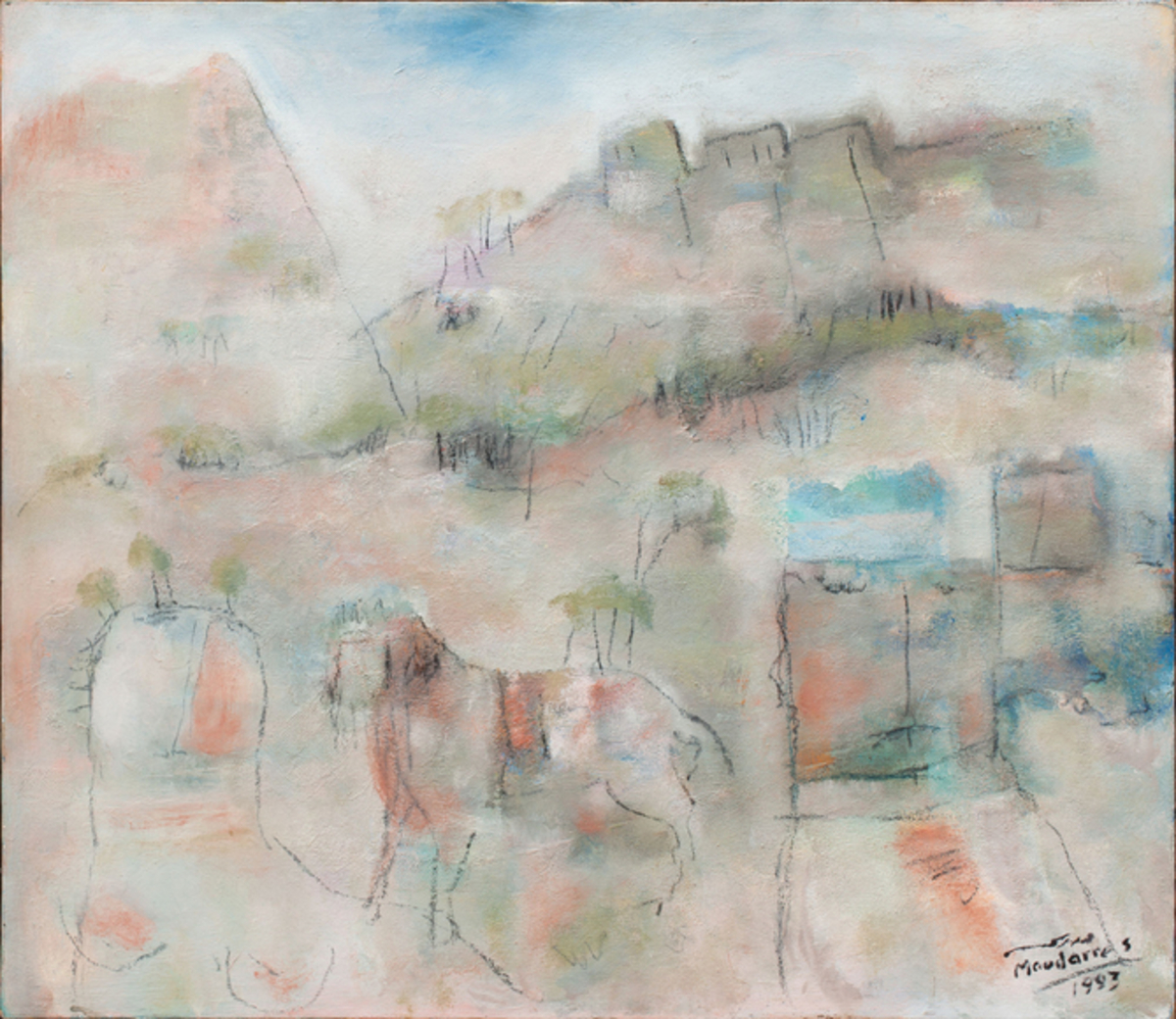
A few days later, she claimed a table at a swanky café in al-Amerkan, a short walk from her new flat, and waited for Raghda. She spent the whole morning there, listening. She spoke to the cleaning lady, who wasn’t sure she could keep coming—she was a Murshidi from Sqoubin. HTS—or al-Hay’a, “the Committee,” as most people called it—were setting up checkpoints and asking passengers where they were from. The young waiter at the coffee machine was from the Aleppo countryside—thin, brown, with cropped black hair and a discolored front tooth. His smile was earnest. He confirmed the cleaning lady’s story, adding that his brother worked with al-Hay’a. “More than once,” he said, “my brother had to threaten to shoot if someone hurt a civilian.” Around her, voices overlapped: “Siesta is an English word? Are you sure?” “She found the bodies of her sons and her grandson, not just any bodies.” “Yeah, he’s going back to Romania, through Armenia.” “You can’t manage five restaurants—what is it, a restaurant a day?” “I paid four hundred thousand for soup. It’s the cheap things they cheat you on, not the expensive ones.”
When Raghda arrived, they burst into laughter: both women were both dressed in black, with touches of leather. “Like we’re teenagers again!”
Before they sat down, she asked, “Do you like the place, or should we go somewhere else?”
Raghda glanced around. “Let’s walk. The weather’s too nice.”
They headed down the corniche.
“Remember Mrs. Arwad?”
“That hag. Of course I do.”
“She had us hauled in for interrogation in tenth grade.”
“Yes, for listening to metal and wearing black nail polish and pentagram pins. How could I forget? They had no idea what any of it meant. What happened to her?”
“Her husband left her and her son and fled to Greece by dinghy.”
“Suits her well.”
They traded news of old classmates. Zena had returned from France and married Toshka, now improbably a businessman. Iskandar was still in Belgium. Everyone else seemed either married, abroad, or both.
“Toshka and Iskandar used to be intimidated by you, you know,” Raghda said.
“I don’t remember intimidating anyone.”
“You did, you always had strong opinions—so principled, so tongue-sharp.”
“I’ve been told I’m judgemental,” she conceded.
“You are,” Raghda smiled. “Not necessarily a bad thing. I’ve always liked that about you.”
A wilderness of vines, pipes, and plaster patches sprang up beside the sidewalk. There was a squat orange tree, its fruit glowing among the green leaves.
“Do you think I judged you?”
“Yes,” Raghda said immediately.
They walked a few paces without speaking. She felt a tightness in her chest. She wanted to ask, How? She found herself silently leafing through the years, trying to remember what version of herself Raghda had known. Yet there was no reproach in Raghda’s voice, only a curious openness. Maybe some other time, she thought. I’ll ask.
“How long are you planning to stay?” Raghda asked.
“I’m not sure yet. Three months. Maybe forever.”
“Do you still have your Turkish residency?”
“Yes.”
“Are you scared of getting stuck here?”
“Yes.”
The air was heavy with humidity. They reached the side entrance to the National Museum, a low, reticent stone building set around a quiet, lush courtyard, its defining feature a long rhythm of broad, rounded arches beneath a pitched roof, each deep-set and casting heavy shade, repetitive and hypnotic.
“Remember how we used to come here and fool around with the boys?” she said.
“We were the school sluts,” Raghda said.
“We didn’t do much at all though.”
“Still, we were reckless,” Raghda insisted. “We could have gotten into worse trouble than we did.”
The real space was not the building itself but the courtyard. They both tried to peer inside, to catch a glimpse of it. Light pooled in the center, while the edges remained shadowed, cool and quiet, with a scattering of benches. The unseen details reassembled themselves in their memory.
“I missed this place so much. It’s sad we can’t go in now.”
The greenery inside was dense, untended, overgrown: ficus, eucalyptus, and carob for shade, bougainvillea, oleander, and leaves pushing through the railing bars. They passed one of the countless contraband sellers of car fuel stationed by the museum wall, his wares poured into plastic water bottles—five, eight, ten liters—fluorescent green and yellow.
“You look like you’re about to cry,” Raghda said. “Is this the first time you’ve come here since you arrived?”
“No, of course not, I—” she scrambled for words, “I don’t know. When I stayed with Aunt Nihad, it was like something in me was breaking every day, she’s so poor… she can’t afford water services, so we had to lug—Marwan and I—those huge jerrycans, bigger than the ones back there,” she gestured at the man well behind them now. “She relies on my uncles. My spinster aunts, too—I felt it for them, all of them. I love them and I can’t help any of them. And why do I even want to help them? They’ve never needed my help.” Tears blurred her vision as they walked on. Raghda didn’t look away from her. “I’ve lived all these years away. Always out of step, always feeling like a broken device, hearing words and not understanding any of them—I never learned Turkish, I can’t stand the language—seeing things, beautiful things, and feeling nothing, as if none of it belongs to me, or ever will.” She let out a breath. “I was only attached to this,” she gestured weakly at the sky, the buildings around them, the port, her friend, “like a phantom limb I couldn’t get rid of. You understand all this, don’t you? You came back before me.”
Raghda kept a steady gaze. “I didn’t have a choice,” she said matter-of-factly.
She stopped, and Raghda did too. She bent forward, hands on her knees. “What is this shit? When did I become this sentimental?”
“Are you alright?”
She nodded, eyes closed.
“Do you need water?”
She shook her head, opening her eyes. Her gaze settled on Raghda’s face, a faint smirk forming.
“You’ve always been sentimental, my love.”
“Do you want to come over, see my flat? I want to take a shower, I’m sweating so much.”
They walked at a leisurely pace. The pedestrians they passed looked drained, sun-frowning in the unexpected heat of the hour.
“What do you mean you felt like a broken device?” Raghda suddenly asked.
“I’ve always been interested in what people around me are saying. I’m so nosy about other people’s lives. When I was a kid I was a bit of a snoop. But abroad, I couldn’t follow any conversations. I make music in my free time, sampling nature sounds and ambient noise, but I couldn’t understand any of the words I picked up. Here, though, despite arriving only two weeks ago, I feel like a real listening device now.”
“Like an informant.”
She looked at Raghda, the thin leeches of her eyebrows arched upward, two crests nearly colliding at the center of her forehead. “Eat shit, Raghda.”
“Alright, listen to this,” Raghda said, grinning, “Did you know ya khuy—‘my brother’—means ‘I’m a dick’ in Russian?”
“I was only attached to this,” she gestured weakly at the sky, the buildings around them, the port, her friend, “like a phantom limb I couldn’t get rid of. You understand all this, don’t you? You came back before me.”
The little alley where her apartment building stood had its asphalt cracked open, disemboweled, then abandoned by whoever was in charge.
“It gives me endless joy to see the pictures of that monster all torn up everywhere.”
“That feeling won’t wear off, I’m happy to inform you.”
They entered the maw of the parking lot. The neon strips glowed in the dank interior, the water motors rumbling in their steel boxes. It was the brief, elusive hour of electricity. They felt lucky. The elevator was a stuffy box lined with plastic sheeting printed to look like wood paneling; its buttons were round, metallic, and concave, evoking old submarines.
Upstairs, she left Raghda in the living room and took a quick shower. When she came out, drying her hair with a towel, Raghda was sitting in a rickety armchair by one of the windows.
“You look like a weeping willow,” Raghda said.
“I love weeping willows, they’re romantic. Let’s go to the roof!”
The rooftop was a rough, unfinished expanse of building stone, with pipes crisscrossing and jutting out at odd angles, and steel bars protruding from the bare ground, their tips spear-like or bent.
“Careful,” she said automatically, “one could literally die tripping here.”
Among the huge water tanks and satellite dishes caked with years of dust, there was a gaping rectangular void, an abyss dropping down through the building, all the way to the underground parking. It was entirely unguarded, marked only by a couple of bricks.
“The airshaft, my newest nightmare,” she said.
“Gives me the jitters,” Raghda murmured.
Up on the rooftop, the air was strong, damp with sea air, its undulating current refreshing. The sun had softened in the approaching afternoon. The city sprawled before them. The buildings stretched out, dense and continuous, their facades pressed close together, as if grown rather than planned. Most of their shutters were drawn; the balconies of the lower floors draped with billowing skirts of tarp and cloth, many of them stamped with sun-bleached UN logos. Below, the cars appeared small, scattered in every direction, their bright colors—yellow, red, blue—only accentuating how tightly they were wedged into whatever space there was. Amid all of this, people—men, women, children—walked, talked, ran, shouted, darted through the streets: people on foot, people on loud motorcycles, people in shaded electric tricycles, all distant and small, threading their way around a patch of green in the far-left corner—a small park—its deep greenness strikingly vivid. Invisible birds chirped incessantly from every direction.
“So, is this what you came back here for?” Raghda asked.
She kept looking. Somewhere in the distance, among the beige pallor of the concrete and glass, there it was, the glittering sea. A faint line, nothing more, but still magnetic, vibrating like a mirage. She stood completely absorbed, utterly still beneath the gauzy sky, her silver hair lifting in the wind.
“No,” came the answer. “This isn’t what I came back here for.”
Read an interview with Anas Tareef about “Remnants.”