In his 1935 essay “Writing the Truth: Five Difficulties,” Bertolt Brecht outlines the five qualities necessary for a writer to be able to speak real—that is, consequential—truth to power. They are courage, skill, keenness, judgement, and cunning. This last stratagem is the one he spends most time on, because it is the most vital. For, after having discerned the truth and the necessity of telling it to the right people, the writer must convey it “so cunningly that the enemy will not discover and hinder our offer of the truth.”
Often, this cunning concealment of the truth has been in the form of comedy. Think of satires that hold a mirror up to society’s ugliest impulses, like Jonathan Swift’s 1729 text “A Modest Proposal,” in which, under the guise of a sober-minded economist, Swift suggests a perfect solution for the economic woes of Irish farmers: that they sell their infants to wealthy landowners as a food source. Or Emile Habibi’s 1974 novel, The Secret Life of Saeed the Ill-Fated Pessoptimist, whereby the titular Saeed again plays “the straight man” narrating the absurd woes of a difficult situation: being a Palestinian citizen of Israel. Claiming abduction by aliens, Saeed recounts his life in a series of letters sent back to Earth, describing how, despite having become an informant against his own people, he is thrown in Israeli prison again and again. Exactly a thousand years before Habibi, there was the theologian and writer Al-Jahiz (776-868), whose Book of Misers speaks in the tongue of different tightwads from across the Abbasid Caliphate, using their own silly logic to condemn the small-mindedness of a miserly attitude toward one’s fellow human beings.
This is not to say that all comedy is high-minded social commentary or that it must be. Fart jokes, bodily humor, silly gaffes and pratfalls, animal and baby shenanigans, wordplay, absurdist humor, and often simple, sheer joy are all reliable founts of laughter. That gut-deep, belly-full, shoulder-shaking orgiastic eruption that feels like your entire soul has been illumined: laughter is known as the best medicine, the perfect icebreaker, the immediate bringer of intimacy and camaraderie for good reason. To be funny is to exude a natural charisma, to inspire, for good or for ill, an immediate trust. But it’s hard to unanimously agree on what’s funny, let alone define what funny actually is (or isn’t).
Much comedy can be unintentional. But comedy, as a form, can be defined as the art of making people laugh. Like all art, its reception is subjective. But what comedians, humorists, jokesters, pranksters, jesters, punners, and more recently, posters, skit-makers, and meme creators have in common is the intentional attempt to be funny. Most humor works through the element of surprise: an expectation upended, a taboo broken, an absurdity pointed out. There is no formula for the perfect joke, the perfect set-up, the perfect premise, and sometimes, much of a joke depends on the delivery, on the voice or worldview behind it. But we might be able to agree on the fact that most good humor, most enduring humor, has that element of cunning in it. It smuggles, as one of our writers in the issue calls it, “a kernel of truth,” and holds up a mirror to human nature, to society, to the present moment.
Take one of history’s earliest recorded jokes, from ancient Greece: A professor is on a sailing voyage with his slaves when a terrible storm begins tossing the boat about and the slaves start to panic. Seeing their fear, he says: “Don’t worry, I’ve freed you all in my will!”
It’s incredible how much you can unpack from just these two lines, how much it says about the Greek society of the time. The professor is the perfect embodiment of the slaver’s obliviousness, of what passes for “benevolence” among those who exploit, thus drawing our attention to the mercilessness of the fate that awaits the exploited as a result.
But it speaks just as directly to our own present-day society. An updated version of this joke might go like this: Workers at an Amazon warehouse get word that a giant bomb is about to go off in their workplace. Suddenly, a voice comes over the PA: “I’m happy to inform our workers that whatever happens today, you all get the day off tomorrow!”
Whether set in ancient Greece or modern times, it is a joke that, in just a few lines, and without any kind of hectoring or moralizing—or need for the listener to have any understanding of dialectical materialism—points to a power structure so overbearing that freedom can only be found in death. It also, by virtue of being a joke, is a difficult truth that can be told right to the slaver’s/Jeff Bezos’ face.
When we began thinking of our Comedy issue, it was exactly with these subversions in mind. We are living through incredibly dark times, especially in our region and for people implicated in our region, and we were interested in seeing not just the humorous ways in which people have chosen to write about the seemingly endless procession of crises we’re all living through, but also the ways in which they think about humor, analyze humor, deal with humor. We wished to take comedy seriously as an art form, and to choose work that spoke to something essential about our current moment.
Perhaps no modern writer uses humor to illuminate such darkness as Rabih Alameddine. His writing has always been just as irreverent and funny as it is pointed, but his latest book, The True True Story of Raja the Gullible (and His Mother), for which he won the 2025 National Book Award for Fiction, was a special revelation for me. The book jumps back and forth between civil-war-era Beirut and the present day, with the latter encompassing a total financial collapse, the Beirut port explosion, and daily Lebanese miseries of all kinds, including the generator mafia that has the country in a (literal, considering all the smog and smoke) chokehold. Not exactly a barrel of laughs. As someone who not only lived these events but also wrote much about them in far more serious tones, I certainly didn’t expect to laugh at any of it. And yet I did, out loud. (I also cried, but there was a lot more laughing). It was not only personally cathartic, it was transformative. It gave me new eyes through which to see all the difficult things we’d lived through, without ever making light of them. It’s a delicate, near-impossible feat to pull off.
This is what makes Alameddine’s work so enduring, and why we couldn’t be prouder to feature his short story, “The Fisting Gallery,” as the centerpiece of our Comedy issue. Readers must be forewarned however, that the piece is extremely sexually explicit, and thus could offend or simply not be to the taste of some. And yet, surprisingly, that might not be the most controversial thing about the story. For it prods at another taboo entirely, which is the revulsion/fascination that exists, on a personal level, between Israelis and the people they generally, as a rule, view as an underclass. A truth delivered in the story by Anat, an anti-Zionist Israeli, who tells the protagonist that “she didn’t know a single gay Israeli man who didn’t fantasize about being ravished by an Arab.” Our protagonist sees both a business opportunity and a way to expend some of his own frustrations in this piece of information, resulting in a deft, dark satire that skewers theft, exploitation, and power relationships in a way readers won’t soon forget.
In fact, all the stories in this fiction-heavy issue are quite satirical, choosing to prod at the darker underbelly of the relationships that organize both the visible and invisible hierarchies of modern society. In Pardis Parker’s “We Ran the Numbers,” the relationship under the scalpel is that between corporate overlords and their frustrated workers, who are driven to the point of murder sprees when this story begins. In Sima Qonsol’s “Exposures,” set in an Amman where Iranian missiles headed for Israel are whizzing overhead day and night, it is between a group of expats on the one hand, concerned only with “trying to secure a new rooftop for their weekly vinyasa flow, since their old spot isn’t available anymore,” and our Arab heroine on the other, who has joined their yoga group in an (unsuccessful) attempt to relax. Finally, in Shahla Ujayli’s flash fiction piece “An Anecdote of Errors,” translated from the Arabic by our Executive Editor Rana Asfour, the ugliness of male and female sexual dynamics are thrust to the fore when a joke goes terribly wrong.
It is no surprise that an issue on Comedy should feature those who make it their jobs, namely, stand-up comics. In “Make ‘em Laugh,” our Managing Editor Lara Vergnaud speaks to a number of Franco-Arab comics who are navigating their hyphenated identities amid “a new age in comedy, which reflects an increasingly bleak global landscape and the rise of conservative dogmatism far and wide,” as well as the “censorship, both self-imposed and external,” it produces. For further insight on these issues and more, check out “‘Where’s the Joke?’” in which Vergnaud has an in-depth conversation with Wary Nichen, one of the comics from the feature. In “Politics of the Word: Arab, Iranian and Muslim Stand-Ups,” TMR’s Publisher, Jordan Elgrably, a huge fan of stand-up comedy, put together a roundup of clips from his favorite politically-engaged comics. And finally—and most essentially—we have an essay directly from a stand-up comic about the work of comedy. In “Standing Up for Palestine,” Dana Saleh recounts the difficulty of trying to make jokes in a time of genocide, let alone jokes about her Palestinian heritage. What begins as a personal essay becomes a moving reflection on the uses—and abuses—of humor before such unspeakable crimes.
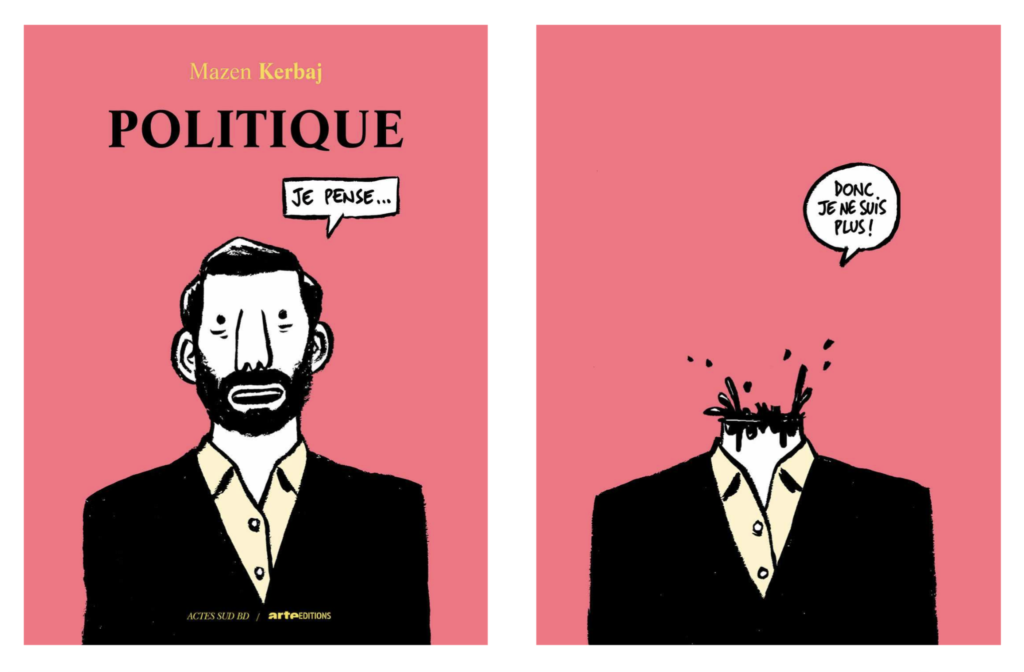
Our featured artist for this issue is Mazen Kerbaj, whose work was also deeply affected by the genocide. In “Mazen Kerbaj’s Record of Time,” our Art Director Nour Annan speaks to the artist on pivoting from humor to seriousness in his latest collection of drawings. Sticking with the visual, Nour Eldin H. analyzes the rich (and vulgar) iconography of Egyptian meme culture in “A7a Neek: A Brief History of Egyptian Shitposting.”
Finally, we have two pieces of humorous writing that play with form to produce something sophisticated and far greater than the sum of their simple parts. In “Dictionary of a Clown Between Two Languages,” Amytis Maleki uses creative dictionary entries to unfold the story of a young girl in (unrequited) love with a boy against the backdrop of a stifling political atmosphere, humorously weaving multiple realities together while also acknowledging how much of humor can be lost in translation. Omar Naim’s “Bibi Netanyahu Arrives in Hell Today! (A Memo to All Departments),” pulls off something so impressive it has to be read to be believed: a deceptively childish, Seussian poem about Netanyahu’s litany of crimes, whose flensing of Bibi—and the larger world order that enables him—is as precise and unrelenting as its rhyming scheme.
And as always, there is our Book List, compiled by our Executive Editor Rana Asfour, with some recommended reading.
We hope you enjoy, share, and most importantly, laugh out loud as you read this issue, which finds much to poke fun at even in this most grief-stricken of timelines. Once again, I return to the prescient Brecht, whose poem “Motto” has often been used to assure us that art persists, that even in the dark times, there will also be singing. We can say the same of comedy, of humor, of laughter, as intrinsic to and defining of what it means to be human as art. For in the dark times—and of the dark times—there is also, always, humor.