Egypt’s meme-makers aren’t out to overthrow the regime. But might their irreverence undermine its façade of total control?
Since I started following it in early 2020, the Egyptian meme page @a7aaneek26 has died and come back to life a dozen times. Operating out of some Instagram backwater, the page was known as @kinky.content12 up until this summer. Before that, it was called @kinky.content11. Before that, @kinky.content10. And after @a7aaneek26, of course, will come @a7aaneek27. To avoid confusing the page’s followers, the account bio explains the name change: “[Still] kinky.content, but in disguise,” and links the official backup page in anticipation of another community guidelines violation and subsequent ban.
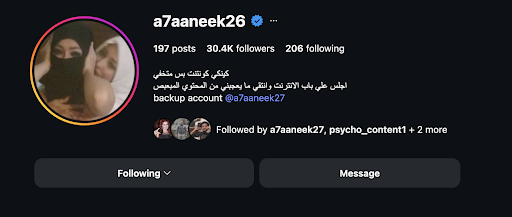
The slang phrase a7a neek has no precise English equivalent. In the Egyptian lexicon, a7a is a vulgar expletive of extreme displeasure, more grunt than definable word; neek literally means “to fuck” but is commonly used as an intensifier, much like the English expression “as fuck.” Put together, it means something like “Fucking shit!”—a common reaction to scrolling through the @a7aaneek26 repository.
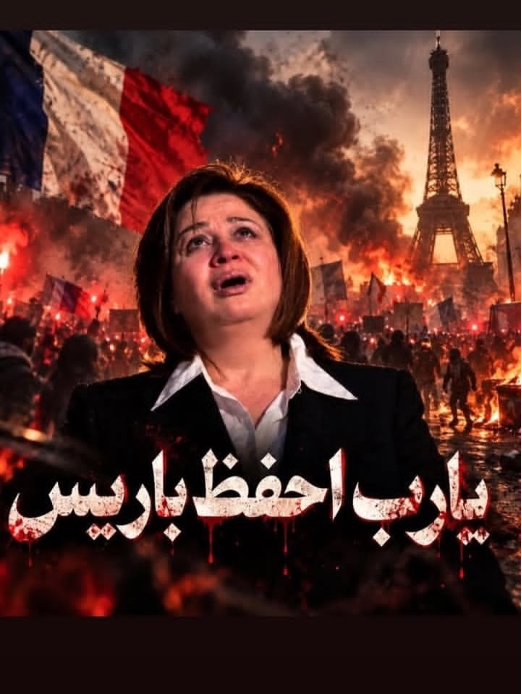
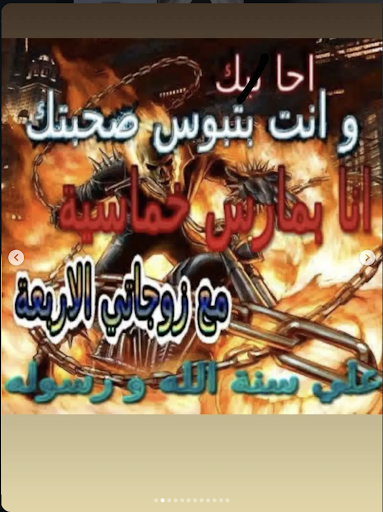
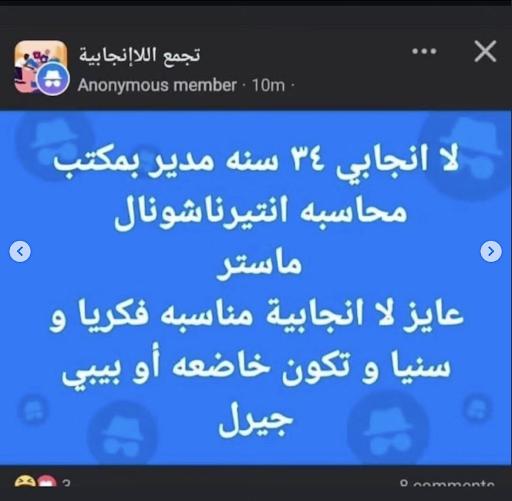
Alongside recognizable memes—reposted from various corners of Reddit, Facebook, TikTok, and Twitter—are screenshots of nasty fights over religion in local Facebook groups; AI manipulations of the Egyptian president’s likeness saying and doing vulgar things; videos of ordinary people in apoplectic rage at the soaring price of chicken; WhatsApp voice notes from thirsty men to disinterested women; viral clips of TikTok livestreamers hurling curses at each other; and many videos of Egyptians dancing: Egyptian tetas dancing to Lil Uzi Vert; working-class Egyptian men in Cairene slums dancing in the sha3by style; and provocatively-dressed belly dancers grinding against each other in underground nightclubs.
But today, Egypt’s digital messiah is the anonymous meme curator.
@a7aaneek26 is by no means the only meme page of its kind, nor is it notable in any particular respect. Popular accounts @badrcontent, @crinjaat, @photohasnovalue, and @skeemoo—to name just a few—are, all things considered, more similar to each other than different, though the trained eye may discern subtle nuances in curatorial philosophies. The users operating these accounts appear to run in the same digital circles, as the same image or clip might grace multiple meme pages simultaneously. And every once in a while, one of them will disappear for days, weeks, or even months, only to re-emerge as @badrcontent3 or @photohasnovalue2 or @crinjaaaaat.
A decade and a half ago, Egypt’s digital vanguard went by different names: activists, bloggers, revolutionaries. They believed the internet could remake the country. But today, Egypt’s digital messiah is the anonymous meme curator.
Egypt’s seasoned digital denizens already know this story, but in the beginning—so it commonly goes—there was the Age of Ignorance: decades and decades of political and social injustice, censorship, oppression, and backwardness. In came the Rightly-Guided Caliphs—the technologist Wael Ghoneim, the Facebook page Kullina Khaled Said (We Are All Khaled Said), the Egyptian blogosphere, and Twitterists like Alaa Abdel Fattah—who, having received divine benediction from demigods in a mythical land called the San Francisco Bay Area, created Facebook groups and hashtags aplenty to unite the masses in a decisive battle between good and evil. The internet, the gleaming fruit of pure human intellect and the crowning achievement of God’s favorite country, was well on its way to liberating humanity, starting with the poorest and most downtrodden. Marx zero; Adam Smith one million.
This lasted all of twenty-four months before the deep state regained its wits and went after the Caliphs one by one, infiltrating their virtual headquarters, exiling and imprisoning them at will, and reinstating the status quo. Since then, the Egyptian internet has been crawling with mukhabarat agents watching every TikTok lip sync and reading every DM. The satirist Mohammed Andeel best captures this reversal of digital fortunes:
Facebook used to be a dark corner where kids met to smoke cigarettes behind our backs; it’s now the glory hole through which we watch what our kids are getting up to […] And just like we babble in real life to fill the empty silence, we babble to fill the digital void with words shortlived and inconsequential. Facebook has become our friend after it used to be our enemy: It plays the role of trend mill, big data broker, and cushion to absorb societal shock after it used to incite them.
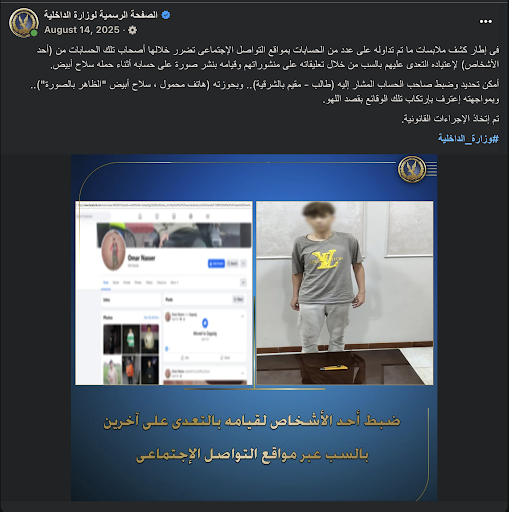
On paper, it seems that the days of the internet in Egypt as an emancipatory, counterhegemonic stronghold are over. Free political expression online is certainly out of the question—Alaa Abdel Fattah, for instance, was imprisoned for the majority of the last decade on charges of terrorism over politically-charged posts online—but the neurosis extends to forms of ostensibly non-political speech as well. As recently as the summer of 2025, internet celebrity titans Mohammed Abdel-Aty, a comedian and podcaster, and Suzy Al-Ordoniya, a TikTok vlogger, joined the long list of those accused, convicted, fined, and imprisoned on charges of “public indecency” as part of a wider crackdown on prohibited forms of cultural expression both offline and online. Ahmed Badawi, Chairman of the Communications Committee in the House of Representatives, indicated that the state is working to extend the crackdown to include not just celebrities, but everyday social media users who use “foul language” online. And that’s only over the last year—rumors have been circulating for more than a decade about shadowy troll farms (ligan iliktroniya, literally “electronic committees”) puppeteered by unknown masters to infiltrate Egyptian virtual space, shape public discourse, and bring the motherland to ruination. The regime insists that the only solution is greater state control over online space. In the eyes of the state, the distance between the real and the virtual is to be collapsed—they are one and the same. Digital presence is to be subject to the same laws as physical presence within Egypt’s borders; the sovereignty of the state and its monopoly on violence are to be applied and enforced the same on Tencent’s and Meta’s servers as they are in Tahrir Square. The Egyptian Ministry of the Interior’s Facebook page looms tall and dark overhead.
The state barks as it pleases—and bark it does—but has no real teeth to back it up.
But as the hordes of gangly Discord-dwelling, Reels-addicted teenage chuds could tell you, Egyptian memes and the connoisseurship of the tastemakers that collect them tell a different story of digital life.
The images and clips posted to meme pages are spores: fungible, flighty, speedy—“poor images,” one scholar calls them—and replicated instantly, reposted with ease, effectively infinite in supply. It’s nearly impossible to trace the source of any individual artifact, let alone of the thousands of images collected on any one account, of the hundreds of accounts that blink in and out of existence while trafficking in these artifacts on Instagram alone, or the massive meme markets of TikTok, Twitter, Facebook, among others. The administrators of these accounts—in all likelihood gangly teens themselves—are hidden by dense layers of pseudonymity or anonymity as standard practice; they can disappear and reappear at will. Bans are easy to circumvent, new accounts free to create. If our new teenage friends trust you enough, they might let you scroll through their camera rolls and their neverending personal collections; if you prove to them that you’re not a cop, they might invite you to their Discord servers, Telegram channels, and WhatsApp groups, each hundreds of members strong, where they dump their collections wholesale and harvest those of others.
The vastness of the mold below, with its many nodes and centipedal arms, is staggering. The state says that actions taken in this space are prosecutable—so be it, but the task is Sisyphean, wack-a-mole-esque. The vastness is itself evidence enough of an overextended prosecutorial apparatus forced to cut its losses somewhere. The practical reality of patrolling virtual space precludes consistent enforcement of state policy beyond the spectacle of the occasional influencer arrested for swearing one too many times on a podcast. Such a system generates digital vulgarity on a scale that dwarfs and outpaces the ability of the state to contain or police it. The state barks as it pleases—and bark it does—but has no real teeth to back it up.
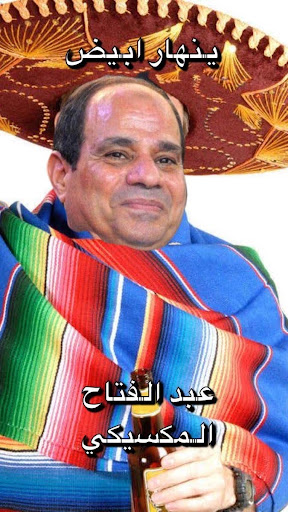
Now the astute reader is, at this point, itching to ask an obvious question: Who cares? It’s just memes—what is there to prosecute anyway? So some kids post funny pictures online. It’s not exactly what one might call high culture, nor are these corpora exactly revolutionary manifestos. Unlike the American tradition of meme-posting—exemplified by Instagram accounts like @the_political_compass, @the_southern_leftist, and @bigdawgsocialism—Egyptian meme aggregator accounts tend to shy away from politicized memetic expression. Of the minority of memes one might consider overtly political, one is hard pressed to extract a coherent ideological leaning or agenda: The same carousel post might feature a sombrero-wearing president Abdel Fattah “al-Maksiki” (the Mexican) alongside an animation of a caricatured Islamic cleric thrown in prison. It must also be said that the content posted to meme aggregator accounts like the aforementioned veer problematic—casually misogynistic or patriarchal, xenophobic, homophobic, colorist or racist. It’s cheap, low-effort, punch-down humor: lowest-common-denominator laughs cobbled together to farm likes, views, or Reddit karma.
This reading, however, misses what makes these pages appealing to their followers. To dismiss Egyptian meme curation as merely another product of algorithmic power or capitulation to state control is to overlook its central appeal: vulgarity.
Vulgarity is funny. For these meme accounts, the more vulgar, taboo, or abjectly outrageous something is, the funnier. Vulgarity in Egypt is especially funny, the joke being that the public veneer of strict social control and conservative Islamic family values is only that—a veneer. In private, Egyptians question the existence of God and curse like sailors and solicit sex and dance provocatively and seek out recreational drugs to party at nightclubs. Despite the regime’s claims of social progress, the vast majority of Egypt’s population is impoverished—and there is a casual vulgarity in that everyday squalor as well. As a matter of course, vulgarity leaks into the everyday realities of online life—in private DMs, in public Facebook groups, and in TikTok livestreams. Given this state of affairs, the tasteful Egyptian meme account selects only the most tasteless instances of online indecency: The truly funny meme betrays deep and nuanced knowledge of what most offends polite Egyptian society’s sensibilities, and deigns, in ever creative ways, to trigger those sensibilities.
Take the following example: a photo of a lone furry tail butt plug lying in the street in the Cairo neighborhood of Zamalek. Here the meme’s humor relies on a simple ironic juxtaposition: Egypt—with its reputed history of conservative religiosity and intense, often violent, repression of perceived sexual deviance or queerness—has a furry community. Egyptian furries exist, and they roam the streets. They are in Zamalek—an affluent neighborhood once home to Um Kulthum. They’re doing god-knows-what with such… devices.
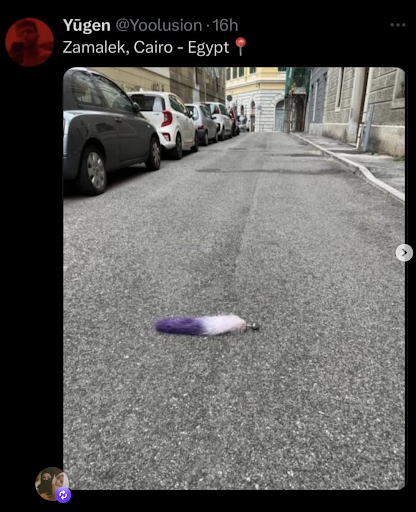
Notice that the meme, in pointing out the vulgarity, does not necessarily align itself with it. For the meme page, displaying the vulgarity is just as much about mocking or making light of those who engage it as it is about mocking or making light of the farcical pretensions of a society that so vehemently disavows such vulgarity. What’s funny is the sheer, brazen fact of the vulgarity, its mere existence. The point is not the politicking, but the brazenness that Egypt’s best and brightest meme-posters prize and covet.
This is the peculiar magic of the meme page: In the pursuit of quick, cheap laughs, curators like @a7aaneek26 construct spaces of exception that are, in a sense, somehow more real than reality itself. As opposed to the regime’s neurotic fixation on controlling, purifying, or otherwise effacing the abject, subaltern, criminal, or deviant elements produced under its watch and as a result of its rule, @a7aaneek26 and friends open an alternate dimension in virtual space where the image of such elements are meticulously recorded, remixed and recombined, and shared widely.
Whether the vulgar display is interpreted as an endorsement or a condemnation of the indecency in question, its very existence exposes the limits of the regime’s power. For all its huffing and puffing, the regime cannot reliably enforce its own moral and social edicts; the totalitarian impulse can never be fulfilled. Judging by the scales of vulgarity on which these meme pages operate, it is hard to believe that the regime’s subjects buy into those edicts. It seems much more likely that these edicts amount to little more than quaint theatrics to appease an increasingly nervous and neurotic hegemon. And isn’t that the funniest joke of all: that Egyptian social reality is just one long skit gone too far?