French stand-up has always been based in social commentary, driven in large part by comics of Arab and African origin.
There’s a phenomenon in France that is very visible, if you’re paying attention, and yet largely unacknowledged, officially at least. The kind of phenomenon that puts people into categories according to their last name or language spoken or the arrondissement in which they grew up. Officially, France doesn’t use check boxes. Ethnicity- and race-based censuses are illegal—a practical demonstration of an abstract concept: French universalism. We are all the same, or rather, we are all French.
And yet, within the reality of living in France as a member of a minority group, it’s difficult to escape or reject such categorization. French literature and art have long been fertile ground for examining and dissecting this dilemma, as well as the accompanying notion of belonging, be it obliquely, literally, or metaphorically. But less noticed, perhaps, is comedy. How do humorists, arguably among a nation’s best satirists, approach such thorny questions?
So I asked them,* albeit not in those exact terms, in large part to ascertain whether the French comedy scene is as gloriously diverse as it appears. Most often, I received a pause in response, followed by a deflection. Little wonder. In France, many Arab-origin comics, like writers and artists and frankly, most anyone else, are sick of being asked to define their “identity” as if it was a fixed object. “I’m French, end of conversation,” was the implied response.
French comedy is diverse, however, though perhaps not gloriously so. Unlike its older counterparts in the United States or Britain, whose comedy scenes have gradually expanded to allow for more diversity, French stand-up was always rooted in historically marginalized populations, notably immigrant Arab communities. The first ripple (soon to be a wave) came in the late 1990s with Jamel Debbouze, French-born to Moroccan parents, who played off the clichés of the “cité,” e.g., low-income neighborhoods populated by supposed bad elements. Debbouze is almost always cited as behind the boom of French stand-up, which split off from the more traditional “café-theatre” (think Coluche in his legendary overalls) and featured many comedians who were the children of Arab or African immigrants. The pivotal year was undoubtedly 2006, when Debbouze launched his now famous “Le Jamel Comedy Club,” a televized comedy show that has birthed numerous success stories. (He went on to launch a now-huge comedy festival in Morocco, “Marrakech du Rire.”)
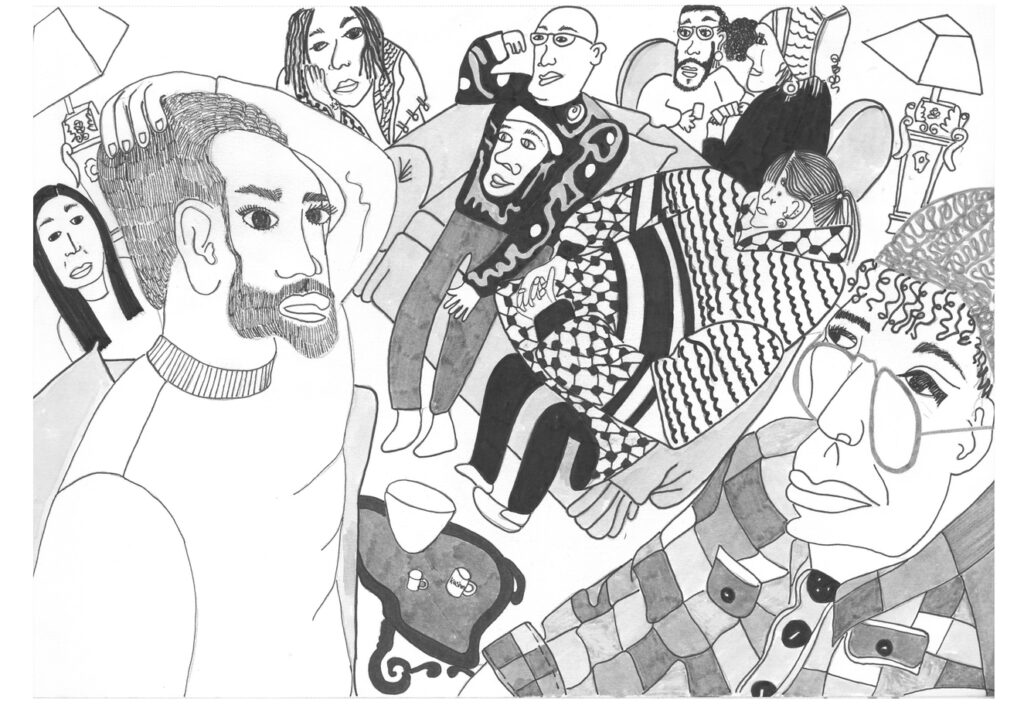
Coluche was a man of the people, and so was the next generation of French comics, in a way. Except that the “people” were France’s large and heterogeneous immigrant communities. Comics like Gad Elmaleh (who is in fact Moroccan Canadian, not French) and Élie Semoun, who has Moroccan and Algerian Jewish origins, became comedic superstars, along with Debbouze, albeit often by exaggerating the very clichés that plagued said communities. The same criticism that was sometimes leveled at similarly hyphenated writers in France in that same era—of playing the clown, or rather, the Arab—was also applicable to some comedians, the line between mocking yourself (and your heritage) for laughs and for societal approval a thin one.
Despite its at times deeply caricatural or reductive nature, French stand-up has had a political undercurrent from inception.
In the years since Debbouze’s Comedy Club launched French stand-up, prompting the establishment of U.S.-inspired comedy clubs throughout Paris and in other large cities, the genre has evolved, arguably in the right direction. Humor has moved away from caricature and toward more nuanced self-representations. Rising comic Meryem Benoua told me, “In the past, we [comics of Arab origin] were constantly labeled. There was a lot of that, but also because comics were working with what they knew. Meaning a community-specific humor. We talked about what we knew best, our cultures, our traditions, and so on.”
Despite its at times deeply caricatural or reductive nature, French stand-up has had a political undercurrent from inception. Arab comics have long highlighted, through humor, the inequalities and discrimination present but oft-denied by some. The fodder was and certainly remains there for the taking—the rise of the Far Right, the machinations and tribulations of Marine Le Pen, Burkini bans, and most recently, a nationwide wave of protests replete with police officers tear-bombing student demonstrators.
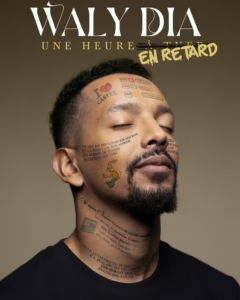
Few contemporary comics are more scathing than Waly Dia, one of the many who got a boost from the Jamel Comedy Club, and whose sketches have evolved, in only a few years, from riffs about a strict Senegalese father to unapologetically critical sets about French politics. (In 2024, a poster advertising his new comedy show was banned on public transport and in train stations for its blatantly “political nature.”)
Houria les Yeux Verts, the stage name of comic Zora Hamiti, is less overtly political, her comedy more centered on daily life. Still, she can and often does wag an admonishing finger. In an interview with TMR, she said, “Humor can wake up people’s minds. From the moment you’re an artist, and that you’re being followed by lots of people, you have a role to play […] We truly have a role in which we must denounce things that aren’t right.” Notably, as Hamiti pointed out, in the form of mockery. In doing so, Arab and African-origin comics are reclaiming the narrative about minorities in France, e.g., we already make fun of ourselves, and better than you can.
In a feature by Hyphen, Tarik Seddak (former artistic director of the Jamel Comedy Club) commented on this evolution: “More and more, Arab comedians are refusing to use the old clichés.” And shouldn’t they be? It’s 2026, more than six decades after the Algerian War of Independence, and presumably France is a more integrated and inclusive society. French-Moroccan novelist Leïla Slimani, for example, was appointed President Emmanuel Macron’s “personal representative” of Francophonie. And in 2024, author Kamel Daoud became the first Algerian writer to receive the prestigious Prix Goncourt, though not without controversy. One could argue that these distinctions are more akin to brightly colored ribbons—Look! Progress!—than valid markers of a truly multicultural society. Nonetheless, Arab comedians are not only clocking these questionable signs of progress, they are organically moving away from the stereotypical self-mockery that characterized much of the early years of French stand-up. (There’s a long though clear through line from Debbouze to Daly).
Another refreshing trend is that many successful stand-ups of Arab origin clearly don’t feel obliged to base their comedy on their last name, so to speak, in the same way as Arab-origin authors certainly can but should not have to limit themselves to “Arab stories.” Benoua, for example, who transformed a viral moment on television into a successful career in stand-up, and who happens to be a multi-hyphenate—French-Russian-Moroccan—builds her shows on observational humor, with a big dose of slapstick, that isn’t necessarily specific to one country or culture. (For example, her sketch about creepy catcallers is universal, sad to say.)
Nonetheless, jokes about the home country—the “bled”—remain the bread and butter of many Arab stand-ups; they work, after all. Sami Ameziane, a.k.a Le Comte de Bouderbala, is a good example, as is Gad Elmaleh, who has the rare distinction of having filmed Netflix specials in both French and English. Watch either and you’ll see that he really is the Jerry Seinfeld of France. Or he was before a plagiarism scandal and a disastrous attempt to replicate his success in the U.S. chipped away at his popularity. Yet even this mild-mannered comic has seemingly become more political in recent years, albeit in a tempered way.
In a sketch titled “Living the American Dream” (which he recently repurposed in French for “Marrakech du Rire”), Elmaleh mocked his would-be adopted country, describing an incident with a customs officer reading his passport:
“Born in Morocco…?”
“Yes.”
“….why?”
Melha Bedia, more of a television and film comedian as of late, also centers her comedy on Arab culture, specifically on growing up in a Muslim Algerian household in her Amazon Prime series Miskina, Poor Thing. The show feels well executed and true to its subject matter—funny, moving, and rarely clichéd.
Stand-up Wary Nichen (featured in “Where’s the Joke?”) appears to mix everything—observational humor, social commentary, and jokes about Arab culture—and rather impressively, does it in four languages: French, Arabic, English, and Spanish.
Others comics come across as more dated. (This writer couldn’t help but cringe at a joke by Ameziane, which began, “When my father bought my mother in the 1960s…”) Which raises the question: The bigger you get, the safer the jokes?
Several up-and-comers certainly feel more current, and more daring, namely Dia. Akim Omiri is another unabashedly political comic. In an interview with TMR, when asked about whether he feels pigeonholed as an Arab comic, he told me it’s not a preoccupation of his, or more precisely, “Yes and no, but that’s not my fight. […] Certain publics see me as [Arab-origin] and perhaps want to find a kinship there, and yes ‘white people’ see me as Arab, though maybe not consciously.” Curious, I asked, “So what is your fight?” Without thinking, he replied, “Injustice.” It didn’t feel like a facetious response, or one designed to earn him Brownie points. Omiri, like Dia, makes a point of calling out the varied disappointments and failings of the French government, notably on a Daily Show-esque radio show called La Riposte, which WordReference translates as “response” or “counterattack”—a comeback, in other words.
Merwane Benlazar is another comic who doesn’t hold back. Last year he faced the wrath of conservative cancel culture, ostensibly for his sartorial choices, after guest-hosting a popular television show wearing a beard and a beanie (a Salafist get-up, according to his critics), which earned him a flood of racist attacks on social media. In the wake of his appearance, France’s then Minister of Culture, Rachida Dati, announced Benlazar would no longer be appearing on public television.
Which brings forward another evolution in French stand-up—growing wariness. Omiri told me that there is a “very small minority” of French comics daring to make pointed political comedy, including among the former heavyweights of the comedy scene. (Other comics I interviewed made similar allusions; keep reading and you’ll understand why they are likely referring to Debbouze.)
There is something sickeningly tragic about the fact that jokes about genocide and systemic racism and modern-day fascism even exist.
The atmosphere is certainly fraught, as notes a recent feature by Le Monde diplomatique, which highlights “a cascade of controversies” in French stand-up. Notably, the outrage sparked by one of the nation’s most popular stand-ups, Blanche Gardin, in 2025, after performing a sketch about the accusations of antisemitism leveled against pro-Palestine activists. It is, depending on your level of cynicism, either very surprising or not surprising at all that one of the most outspoken French comics about Palestine has been one with no Arab origins. Debbouze in particular has drawn ire from much of his fan base for his thundering silence on the genocide in Gaza.
Hamiti, who in contrast has been outspoken for the Palestinian cause, albeit with a smaller following, explained, “Some [comics] don’t say anything because they tell themselves, ‘I have my opinion but I’m not sharing it.’ Those are artists who are really afraid, who are afraid for their careers. But personally, I’m not afraid.”
Though France has not been rocked by a Jimmy Kimmel-esque controversy (or not to that magnitude; several television and radio hosts have been censured or fired but without any presidential intervention as of yet…), the caution is palpable. My consumption of French comedy is far from all-encompassing, but of the many sketches I watched, only a few humorists brought up Gaza, notably Benlazar, Dia, Hamiti, and Nichen.
Another is Omiri, who, when I noted there aren’t many comics talking about Palestine, sighed, before responding, “You’re right, there aren’t many of us…”
There is also Haroun, a successful French comic who rather impressively has refused to identify his origins, but whose name creates confusion, deliberately one would assume. (A feature in MondAfrique noted, “Seeing how he’s no one, he can laugh at anything and anyone!”). A recent sketch entitled “I’m stopping the risky jokes,” which is sure to offend some, has the merit of at least acknowledging the genocide in Palestine, and notably western complicity.
Of course, there is something sickeningly tragic about the fact that jokes about genocide and systemic racism and modern-day fascism even exist. As I watched, I couldn’t help wondering: What does it mean if we laugh at them? Or worse, if we don’t get the joke?
Haroun and his peers are visibly navigating a new age in comedy, which reflects an increasingly bleak global landscape and the rise of conservative dogmatism far and wide. And with it, censorship, both self-imposed and external. And yet, they keep making the jokes.
Perhaps Netflix comedy specials and Amazon Prime series are another kind of shiny ribbon, like literary prizes and token appointments. But surely the best humor is subversive. It is political and canny. Stand-ups in France, Franco-Arab and otherwise, are pointing fingers all while making the objects of their jokes (some at least) laugh. Their continuing success and popularity is yet another manifestation of the j’en ai marre-ism—I’ve had enough-ism— that literally set France ablaze last month, and that is rising worldwide. In a recent set, Omiri quoted comedy giant Coluche (“If voting changed things, it would have been banned a long time ago”) before adding his own spin: “If comedy is getting banned, maybe it’s because it’s changing things.”
Special thanks to the Arabesques Festival of Montpellier for coordinating interviews with Meryem Benoua and Zora Hamiti.
*All quotes translated from French by author.