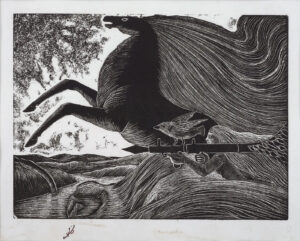
A TMR columnist reflects on the curse—and sobering reality—of "interesting times."
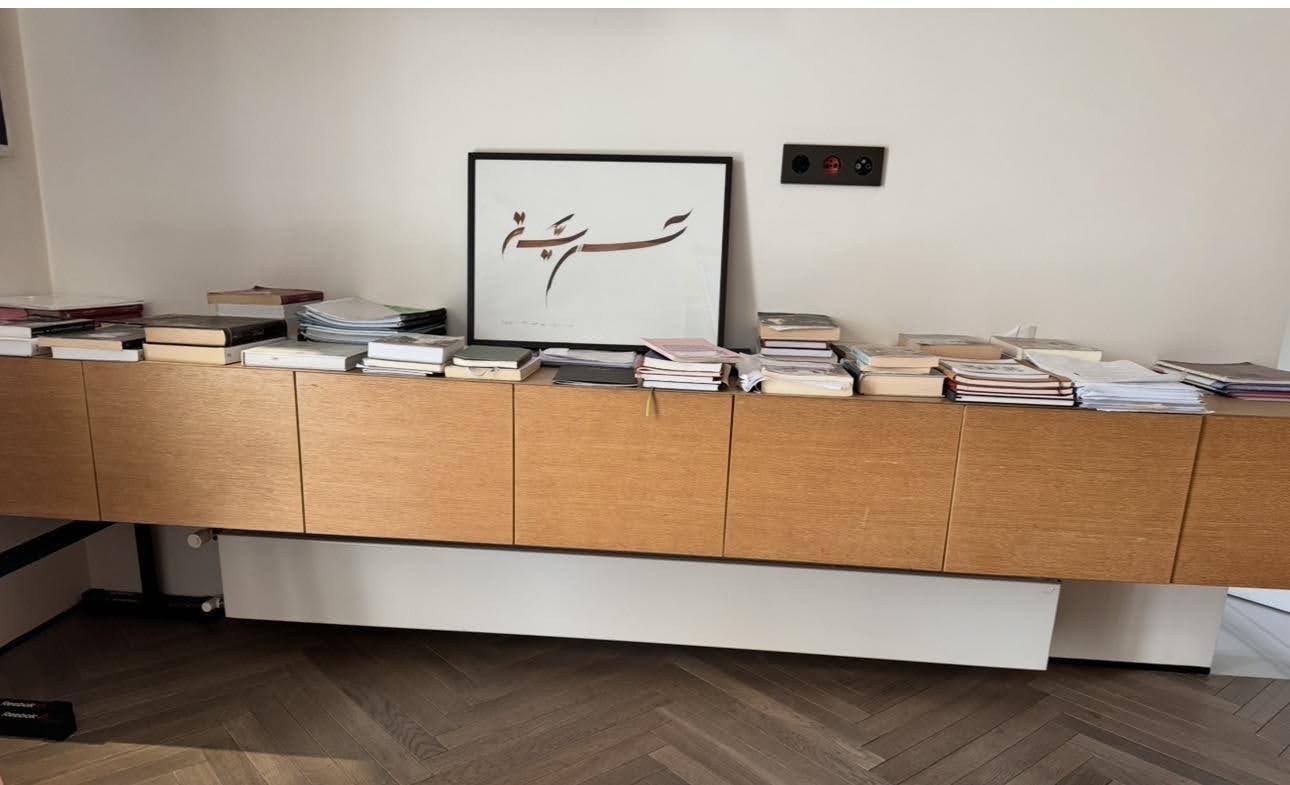
You’re looking at one of Samir Sayegh’s calligraphic creations, Freedom. It sits across from me in my office. The first sight, every morning, gifted by a friend.
A while back, a tired cliché started making the rounds: interesting times. I do not recall ever having had the pleasure of enjoying a single uninteresting day in these Levantine parts, but all the same, we are well beyond interesting now. When I say we, my mind’s eye beholds Earth itself.
This is a time of war and slaughter in two places that “count”: the Middle East and Europe. The epochal nature of the bloodletting in Bilad al-Sham, the Levant, connotes the daunting sweep of societal trauma, the death of innocence in the image of a child, the choking of rebirth in the shape of the future—for those massacred and those doing the massacring. Or to give nuance its rightful turf in the discourse, those doing most of the dying and those doing most of the killing. The conflicts in the Gulf and Europe signal a redrawing of maps and recasting of alliances once deemed timeless.
This is also a time of butchery and pillage in so many places that should count but have somehow faded to black: Sudan, Congo, Nigeria, Mali, Somalia, Ethiopia, Haiti… What the carnage portends there is no less monumental than what it portends closer to these shores.
We fight with little reprieve, we struggle still for aspirations that beckon us like reveries, even as we ponder the imponderable: the twin threats of climate catastrophe and human extinction at the hands of Artificial Intelligence. Neither is a horizon. We grapple with suffering beyond measure while we resist the Epstein classes across countries and oceans indulging in Caligulan excesses and modern-day depravities.
The recent testimony of Kash Patel at a U.S. Senate hearing describes very well the acute dissonance between the specter of Armageddon and the spectacle of tomfoolery at the summit of the world’s most consequential power. At a moment of great peril, the head of the FBI, the agency charged with keeping America safe, was asked to explain why he dropped bestiality as a disqualification for applicants to the bureau. Such imbecility would have been easy to dismiss as an unfortunate aberration had the state of the union been otherwise reassuring. When the historian Timothy Snyder diagnoses U.S. conduct as “superpower suicide,” Patel is one small piece of the evidence. Snyder was just setting the stage with this opener to his May article in Project Syndicate:
The United States is spending billions of dollars to lose a war in Iran that is enriching its oligarchs, impoverishing its citizens, sabotaging its alliances, and strengthening its enemies.
My American best friend, a writer who resides in Washington, D.C., had this to say, as I brooded over our predicament:
There is no you and us anymore. We have radioactive water threatening [the] water supply in Ohio, a measles outbreak that may be the beginning of an epidemic, a $40 trillion debt, machines that may soon overrun us. And a president who wants to build ballrooms and arches, demolish the Kennedy Center if it doesn’t have his name on it, and make a lot of money, while he bullies us and the world. You just can’t make this shit up. There is no you and us.
It may seem strange that I chose to lead with faraway saturnalia, when home is a showcase of scandalous behaviors. I reach for the U.S. for obvious reasons. I worry very much about our wellbeing in the region when America is in full command of its senses and sharp about its intentions; I am terrified when it is clearly unwell. We are, on this non-western side of the world, the empire’s most defenseless subjects. While it may feel comforting that, for example, Canadians, Britons, and Danes now share at least some of our vulnerabilities, the costs we bear for imperial caprice and perversity are staggering.
I need only mention the bizarrely constructed Gaza Board of Peace, which operates at the pleasure, and under the total control, of the person of Donald Trump—in perpetuity. The Palestinians of Gaza, at least two million, are thus forced to live on ever-shrinking land (under 146 km²) in the penumbra of Israel’s genocide and Trump’s phantasmagoric visions of a gold-plated, glassed-in dominion. And while they do so, we learn that the Israeli army has crushed and removed 10 million tonnes of the “war’s” rubble—evidence, human remains, and all. One destination is Israel proper. What it wants to do with the rubble is as yet unknown. At this point, can we be blamed for imagining the unimaginable? Does the Jewish state think it can, in one fell swoop, pulverize the cadavers and the material record of its war crimes, and bake them into the structures of Jared Kushner’s charnel dreamscape?
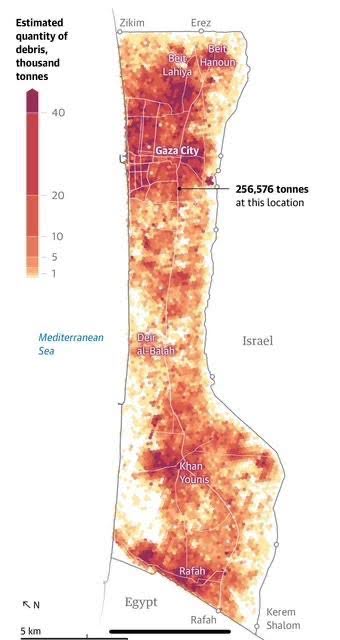
But it isn’t unimaginable, is it? Because in the span of two years, on an enclave as small as 365 km², “more than 200,000 tonnes of explosives were dropped […] the equivalent of the total energy of approximately 13 Hiroshima-type nuclear bombs.” Because new AI-assisted targeting systems have enabled murder on an industrial scale in an age that has dispensed with practically all moral and legal guardrails. Systems with chilling names, like Lavender, the Gospel, and Where’s Daddy?. Systems, as the documentary NAZA has shown, operated by Israel’s elite units, not messianic rogue soldiers. About Israel, nothing beggars belief anymore.
All sorts of tells attend this dystopian composition. We hear that board member Tony Blair, on the instructions of the U.S. Administration, informed Mahmoud Abbas, the so-called president of the Palestinian Authority, that to be taken seriously he must remove Palestine from the curriculum. We see Israeli national security minister Itamar Ben-Gvir put out an animated video of Palestinian prisoners being processed with methods disturbingly similar to those of Nazi Germany’s concentration camps. We watch Bezalel Smotrich, Israel’s minister of finance, share on a podcast his frustrations with the West for not helping with the mass expulsion of Gazans: “If every European country were willing to take in 20,000 to 30,000 Gazans, this whole story would be over.” We listen to MK Hanoch Milwidsky, a leading member of the Likud Party and Chair of the Knesset’s Finance Committee who has been accused of rape, explain why he and many of his countrymen have the right to violate man’s laws: “We are not like everyone else, and that is why all the laws that apply to everyone else do not apply to us… The Jewish people are born a high people.” The mise-en-scène of this ghoulish pageant is two embrittled, tiny fragments of Palestine.
So stands much of Lebanon’s south. It can neither find solace in a hapless state, nor protection from a crippled resistance, nor mercy from a ruthless enemy. We are told that the Americans and Israelis put a gun to our head during the negotiations in Washington: sign on the dotted line of an unforgivably punitive framework agreement or the Gaza doctrine unleashed on the south will extend to Beirut itself. Which of course raises a painful question: does that mean we were confronted with Sophie’s Choice? Between Beirut and the south, we chose Beirut, knowing full well what Sophie knew when she was told on the selection ramp at Auschwitz, in 1943: save one of your children or both go. So she gave up her daughter to save her son.
I cannot pretend to know the true sense of loss southerners feel. My family’s roots in the south have frayed to vestiges of what once was. They survive in weathered photos of youth and laughter and camaraderie on old balconies. They survive in the bygone world my mother revives in her vivid recollections from time to time. They barely survive in my grandparents’ long-abandoned house in Nabatiyeh. We recently heard its walls have yet to fall. But what I do know as a Lebanese is that we are facing a hardship that has all the makings of an existential crisis.
If the government is alert to the grim possibilities, it is remarkably skillful in hiding its vigilance. The power nexus that presides over it has just cooked up a General Amnesty that, as Legal Agenda establishes, would forgive its untold corruptions, much like its predecessor in 1991 wiped clean their war crimes. It is just one of the law’s outlandish achievements. Soon the Constitutional Council will rule on the challenge brought before it.
We are all in this together, indeed. Somewhere in this reality is a message of hope.
On Another Note
A few days ago, my sister sent me Home is so Sad, a poem by Philip Larkin. I need not explain why I felt I needed to share it this week:
Home is so sad. It stays as it was left,
Shaped to the comfort of the last to go
As if to win them back. Instead, bereft
Of anyone to please, it withers so,
Having no heart to put aside the theft
Read the rest of the poem here.
Amal Ghandour’s biweekly column, “This Arab Life,” appears in The Markaz Review every other Friday, as well as in her Substack, and is syndicated in Arabic in Al Quds Al Arabi.
Opinions published in The Markaz Review reflect the perspective of their authors and do not necessarily represent TMR.