A Kuwaiti artist, wary of mainstream definitions of art, produces work that seeks to tell stories about our modern condition.
When Monira Al Qadiri first noticed a puddle of oil spilled along the side of the road in Kuwait, she thought it looked like pearls. A thick liquid shimmering under the desert sun, reflecting the colors of the sky in a dichroic rainbow sheen. The relationship between the two forms did not stop at iridescence. It drew a line from the Gulf of the past to the Gulf of the present; from Al-Qadiri’s grandfather in a pre-oil Kuwait to the Gulf War that defined her childhood. Somewhere in this brief timeline, the discovery of oil and the expanding petrochemical industry upended the natural world in the region. The jewel of the sea, which required the labor of men for extraction, gave way to the extractive machinery that now dug up the most precious and dangerous materials on earth.
Al Qadiri has spent much of her artistic career exploring that trajectory. Her sculptures, films, installations, and performances are built around a fascination with the temporality of the oil industry and the machinery that sustains it. Drills and tankers are removed from their familiar context and displayed as dramatic monuments, to be admired and revered by a society shaped by oil consumption. Brought into the spotlight, these behind-the-scenes tools of invisible extraction become the main character: powerful, masculine, seductive. Beyond the present moment, Al Qadiri imagines the oil drill as a future relic that might one day be excavated in a post-oil world and given an entirely different meaning. To her, oil is both ancient and temporary: a powerful material formed over hundreds of millions of years that humans have extracted and burned though at extraordinary speed. In a Zoom conversation between Beirut and Berlin on a hot summer day, Al Qadiri reflected on the absurdities of our material reality, and her role in bringing it to the fore.
“Oil is like 300 million years old,” she tells me, “and then we dig it out of the earth and we use it on the way to the supermarket.”
Al Qadiri’s interest in the Gulf’s so-called “petro-culture” reflects her early understanding of the world. Growing up in Kuwait, she spent much of her time drawing and painting in the studio of her mother, the artist Thuraya Al-Baqsami. When she was seven years old, the Gulf War overwhelmed the landscape around her. In 1991, as Iraqi forces withdrew from Kuwait, hundreds of oil wells were set on fire. She recalls seeing black rain pour out of a black sky, covering everything it landed on, even the sea. As a child, she found this frightening yet strangely mesmerizing, discovering a sense of magic and wonder in this violent physical transformation of the world. Even then, it was clear to her that the central substance was oil: its discovery, accumulation, and destruction marked a new era in Kuwait’s national history. Suddenly, the obscure substance that turned the wheels of wealth was brought to everyone’s doorstep, burning everything along with it.
As a young adult, Al Qadiri moved to Japan to pursue a higher education and ended up living there for ten years. The comfort she sought in Japanese anime, escaping into fantastical worlds of bright colors and animated shapes, eventually made its way into her work, inspiring a tension between the vibrant visuals and the sadness hidden within these virtual worlds. She returned to Kuwait in 2010, but soon left again, first for Beirut, then Amsterdam, and finally Berlin, where she has lived for the larger part of the last decade. But leaving Kuwait only made its contradictions more visible. For Al Qadiri, this is not the story of one country, but a story about modernity and how humans have distorted the world.
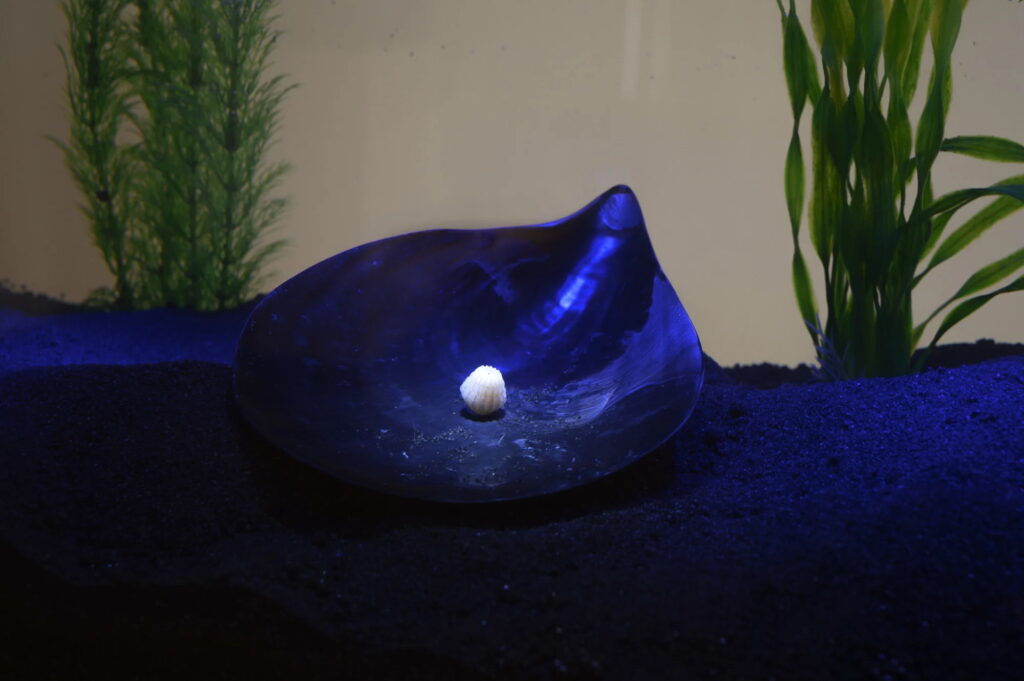
The near past of a pre-oil Kuwait looms over Al Qadiri’s earlier work through a fascination with the pearl diving and trading practices in the Arabian Gulf, a foundational economic pillar for thousands of years, that is, until the commercial discovery of oil and the advent of the oil economy we associate with the Gulf today. Recent efforts to celebrate this ancient practice often fall short; it is frequently presented as a detached history of a more primitive time and a nostalgia for pre-industrial life. Al Qadiri’s grandfather, whom she never got to meet, had been a singer on a pearl-diving boat. He accompanied impoverished men at sea for months at a time, entertaining them as they labored to extract the precious pearls. His personal history came to symbolize a bygone time in Al Qadiri’s work, an era that preceded fossil fuels. In Father of Pearl (2016), Al Qadiri multiplies the only surviving photograph of her grandfather in forty-two silkscreen prints. The pearlescent prints fade into the white background, a disappearing history, at present barely visible. In Wonder (2018), the artist collaborated with a Japanese pearl carver to carve oil drill heads into natural pearls to be displayed in an aquarium. The iridescence of the pearl and the oil itself draws connections between the labor intensive extraction processes of both industries, highlighting the irreversible jump into modernity brought about by the oil era that left the pearlers behind. The collision between pre- and post- comes to a head in Diver (2018), an immersive video installation showing four synchronized swimmers in dark waters, wearing dichroic iridescent bodysuits, performing a choreographed routine to an early recording of a traditional pearl-diving song. The video work alludes to Al Qadiri’s own distorted version of the pre-oil Gulf, complicating it with embellished female bodies and opulent aesthetics that resist the narrow national identity attached to that era. The dancing divers appear to be swimming in oil, temporarily suspended between the traditional song and modern ornamentation.
As the oil industry quickly took off, new machinery came to replace, or support, the bodies of men burdened with the work of extraction. In her most recent solo exhibition at Berlinische Galerie, Hero (2025), Al Qadiri positions the oil tanker as a central character in the story of fossil fuel, in a mural that stretches over twenty-five meters of a gallery wall, unobstructed and impossible to ignore. Even though the oil tanker is rendered at roughly one-tenth of the scale, its overwhelming presence commands the room, sailing between prosperity and pollution, imposing on the present and too stubborn to fade away, despite the emerging shift towards renewable energies. “The character of the oil tanker plays such a central role in our world today, and we don’t directly see it so much, so I really want to confront people with its presence,” Al Qadiri explains. Across from the mural, SS Murex (2023), a lightbox installation named after the world’s first modern oil tanker (which was built by the founder of what is today the notorious petrochemical Shell) displays several illuminated ships’ portholes, offering a material viewpoint of an intentionally obscured process, and highlighting the pollution of these bizarre sea creatures. By playing with viewpoints and scale, Al Qadiri presents the tanker as a foreign invader to the natural world, destroying the seas as it delivers the oil that sustains modern life. “The tanker is now a protagonist of our time. It’s the hero of our time. But it’s also kind of the death of it,” she says. “I really feel like we’re seeing the final phases of this part of human history, which is this oil era.”
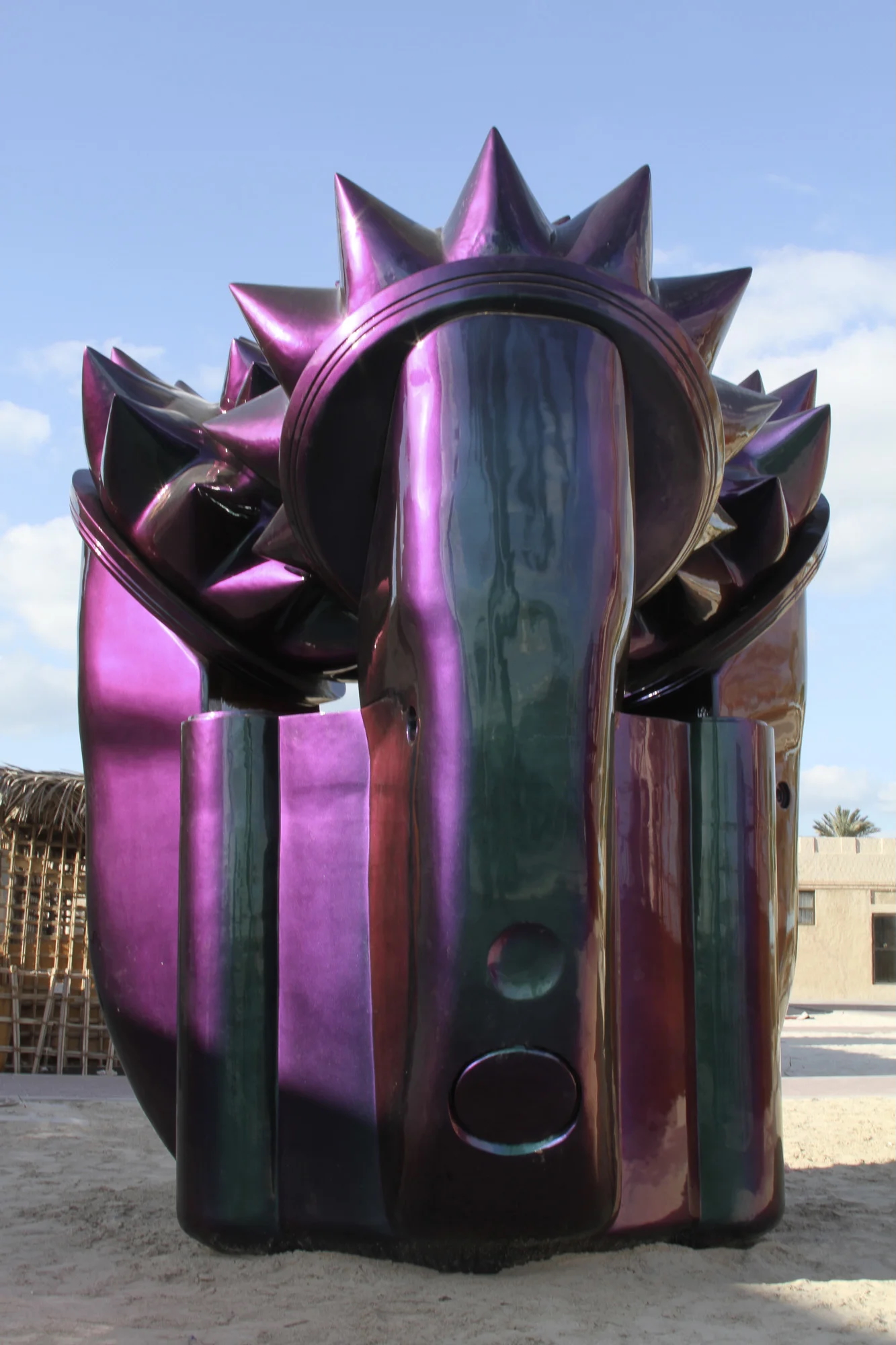
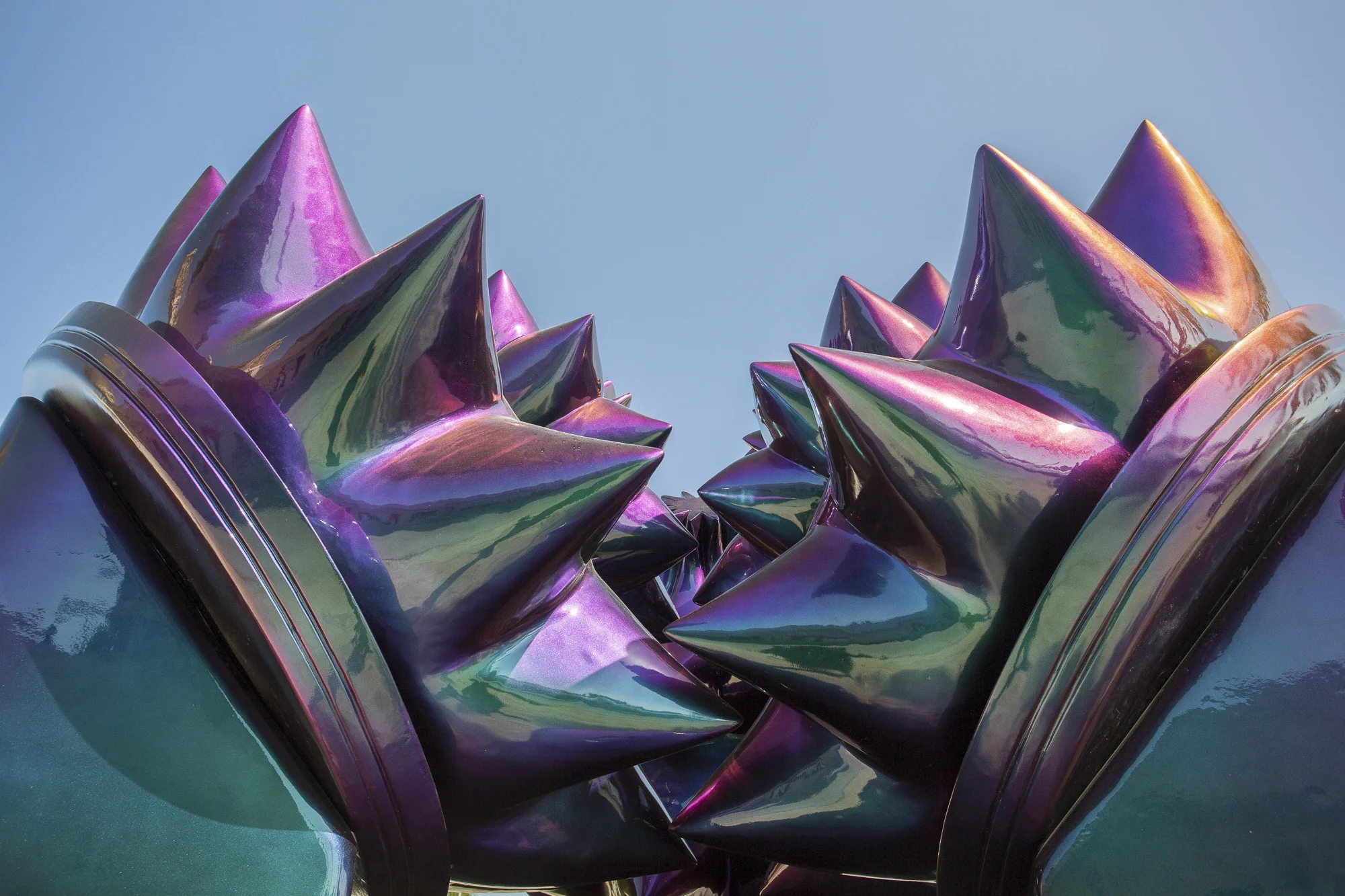
This concept of foreignness is central to Al Qadiri’s work, where extractive machines are often presented as aliens from another dimension. In Alien Technology (2014-2019), she creates large-scale sculptures in the form of industrial oil drill bits. Once enlarged to such a grand scale, the precision of these carefully engineered tools gives way to alien-esque features—creatures that resemble forms of bioluminescent marine life. Forged from fiberglass and coated with automotive paint, Al Qadiri’s sculptures catch the light like an oil spill, or the sheen of a pearl, connecting the machine to the industries that preceded and spawned it. When asked about these recurrent colors, Al Qadiri says, “perhaps this iridescent color is the color of the Gulf.” Despite what they represent, the Alien Technology sculptures insist on being beautiful, alluring, even seductive, just like the wealth and decadence that oil brings to its extractors and consumers. Unlike the overwhelming presence of the oil tanker in Hero (2025), the separation of the oil drill bits from the larger machinery makes them appear fragile, almost harmless. There’s a playful softness to the shapes that gives them a new life outside of their intended function. Here, Al Qadiri’s guiding belief that the oil industry will soon fall from grace shines through, as she presents these powerful machines as disconnected fossils of the past, waiting to be discovered in a post-oil future.
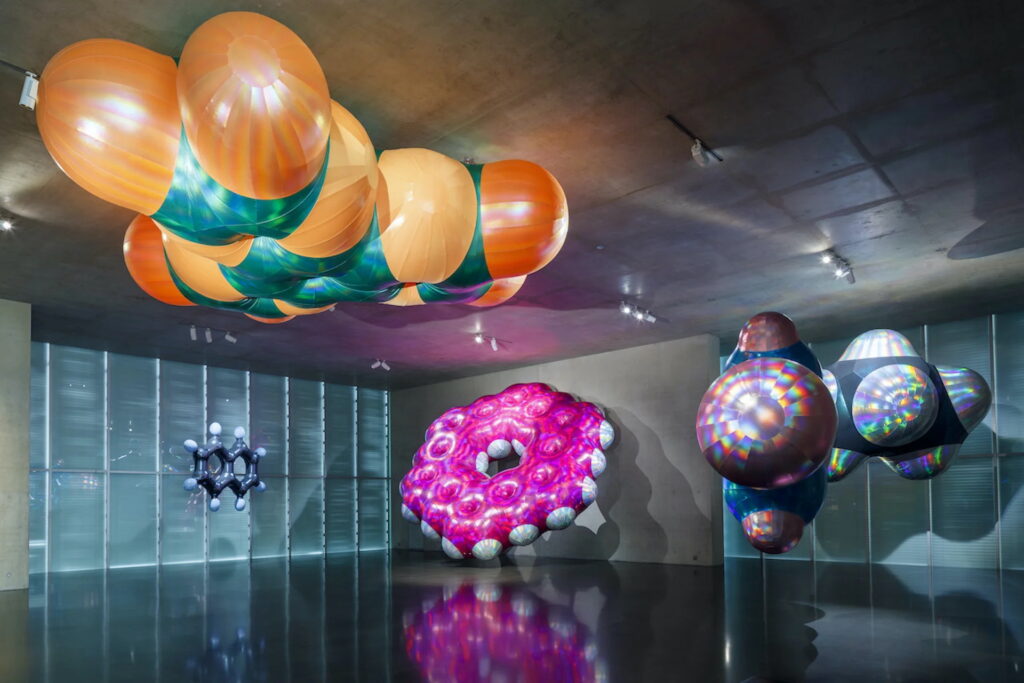
The artist takes this process of abstraction a step further in Benzene (2022) and Benzene Float (2025). These works take one of the elementary petrochemicals, benzene, a clear colorless liquid with an intense aroma, and make it visible in its purest form: a molecular compound. In the earlier iteration, the delicate glass sculptures present a colorful textured breakdown of the components of crude oil, once again magnifying what is unseen and demystifying it to its most powerless form. One gets the feeling that the molecule can be smashed by the slightest movement, alluding to a simple end goal to leave these chemicals behind in human history. In Benzene Float, Al Qadiri enlarges these petrochemical compounds into towering inflatable sculptures that resemble parade floats. The invisible molecules are turned into bombastic, obtrusive floating objects; they interrupt the natural and urban landscapes they are installed in. Once again, Al Qadiri pushes these essential molecules into visibility, this time in an absurd exaggeration of scale that highlights their undeniable influence on our world. In her signature style, the inflatable sculptures are colorful and playful, leaving the political critique open to interpretation.
The artist’s distinct visual world moves between mainstream definitions of research-based art and so-called environmental art, to which she is wary of subscribing. She distances herself from questions that view her work, or art in general, through the lens of activism. For Al Qadiri, the work does not seek to spur people to action but rather to tell stories about our modern condition by creating complex landscapes and analyzing relationships. At the center of her artistic production is a preoccupation with sadness and tragedy, which is concealed and obscured under layers of vibrant colors and seductive designs. When asked to define this genre, she settles on defining herself as “a dystopian artist.”
Al Qadiri approaches her work like a time traveler, making art from a future point of view. In her temporal jumps, she visits a future where petroculture has already passed, working to eulogize the oil era and give it a longer arc in history. She describes her practice as “creating monuments of the future”—objects another civilization may one day misunderstand. The monuments do not celebrate the oil era, but neither do they simply condemn it. Al Qadiri creates an emotional landscape between fascination and mourning, making unfamiliar objects familiar, asking us to look at them from a distance. Her works, like the oil era, move between the ancient and ephemeral. While it took fossil fuels hundreds of millions of years to form, the civilization built around its extraction may occupy only a brief moment in human history.
“After everything that happens in the world, the only thing that remains is art,” she says. “It’s the only thing that we can leave for the future.”