We Call Her Emma is a compelling introduction to a fascinating figure, but neither quite biography nor moral reckoning
My mother is one of several Syrians I know who believe that Asma al-Assad is not actually Sunni: that her family is secretly Alawite, or that she converted to Alawism. I’ve heard versions of this claim from friends and relatives and seen it circulated through social media and word of mouth, though never accompanied by evidence. And yet my mother maintains it and has repeated it to me numerous times. It is her way of rationalizing Asma’s involvement in the regime’s crimes: how could a Sunni woman have become, in the regime’s final years, one of its most influential figures?
The Assad family belongs to Syria’s Alawite minority, whose disproportionate representation in the military and security apparatus increasingly identified the regime with the sect itself, making sectarian identity a potent and common way of accounting for its violence. Of course, my mother may not know—or perhaps not care—that many influential Sunnis were implicated in the regime and its crimes, including its last minister of defense. What matters is that the contradiction can be resolved by uncovering some deeper inscription beneath the label Sunni: Asma is not what she appears to be. It is an almost folkloric method of accounting for evil, illness, and other aberrations by tracing them back to some concealed source or identity. Surprisingly, We Call Her Emma, a six-part investigative podcast of Asma al-Assad from The Observer and Tortoise Investigates, attempts something similar, only from the opposite direction.
Where my mother searches beneath Asma al-Assad for a secret Alawite, We Call Her Emma searches beneath her for Emma al-Akhras—or simply Emma, “the girl from Acton.” Across the series, journalist Chloe Hadjimatheou sets out to reconstruct the life that preceded Asma’s reign as Syria’s First Lady: her childhood in London, her education, her friends, her career in banking, and finally the marriage that carried her from Britain into the Assad dynasty.
For all her international visibility, remarkably little is known about Asma’s life.
The premise is seductive. Somewhere along that trajectory, perhaps, lies an answer to the question that gives my mother’s conspiracy theory its peculiar durability: how does a seemingly ordinary person come to accommodate herself to extraordinary evil? Such a question assumes that something happened to her along the way. We Call Her Emma goes further. Again and again, it seems to ask whether “Emma” survived—as though Emma were the name of Asma’s better nature, and as though the well-educated British woman from Acton were somehow less capable of complicity in the regime’s crimes than the Syrian woman who became First Lady.
The question is not uninteresting. However, its formulation is suspect. As it stands, it repeatedly threatens to displace a more modest, empirical one that the podcast, with its team of investigative journalists, is uniquely equipped to answer: who, exactly, is Asma al-Assad—née al-Akhras, also known as Emma? For all her international visibility, remarkably little is known about Asma’s life: where she went, whom she knew, what she wanted, what she did, and how she accumulated and exercised power.
The outlines of her biography are familiar enough, usually compressed into a succession of images: the computer-science graduate with a promising career in investment banking; the young woman who abruptly leaves London for Damascus and marries Bashar al-Assad in 2000; the glamorous, reform-minded First Lady of the following decade; the dictator’s wife who stands by him after 2011; and, in the regime’s final years, a figure of considerable economic and political influence. It is the life between those images that I wanted the podcast to excavate. Six hours later, much of it remains frustratingly out of view.
This is not for lack of investigative effort. Hadjimatheou travels to Syria after the fall of the regime, tracks down Asma’s childhood friends, relatives, former colleagues, and employees, and speaks to politicians, businessmen, and regime insiders who encountered her at different stages of her ascent. Some speak openly, others appear under pseudonyms, their voices replaced by those of actors—such is the fear of reprisal nearly two years after the fall of the regime. Hadjimatheou visits the orphanages Asma patronized, examines documents left behind after the regime’s collapse, and follows the testimony of people whose lives passed through institutions over which the First Lady exercised influence.
The six episodes proceed roughly chronologically but organize Asma’s life through a succession of investigative problems (from “The Girl from Acton” and “Diana of Damascus” to “Asma’s Deal” and “Asma’s Orphanages”). The structure is lucid and often gripping, and the production has the unobtrusive polish of a very good narrative podcast: archival recordings, interviews, music, and sound design are woven together without calling attention to themselves. Hadjimatheou is a restrained but persistent narrator, often allowing her sources to carry the story before returning to test what they can actually establish. Her tone is skeptical without being prosecutorial, and she is noticeably wary of allowing moral certainty to outrun the evidence. Taken together, these elements produce something less like a continuous biography than a sequence of revealing scenes illuminating Asma’s life and her place within the regime from a range of perspectives, both local and international.
One such glimpse comes from Paul Gibbs, who worked with Asma at J.P. Morgan in the late 1990s. He remembers her as poised, ambitious, and competent, but hardly exceptional among the young bankers around her. Then one day, in the middle of a pharmaceutical deal, she failed to turn up to work. Gibbs eventually learned that she had gone to Libya for several weeks as Muammar Gaddafi’s guest, accompanied by her fiancé, Bashar al-Assad. She returned to London, packed up her desk, and left J.P. Morgan. Dramatic as the episode sounds in retrospect, it was less an inexplicable rupture than a change of course already announced by her family life and relationship with Bashar. The Akhras family had longstanding ties to the Assads: Asma’s father, Fawaz al-Akhras, reportedly helped arrange Bashar’s ophthalmology training in London, while Hafez al-Assad helped Asma’s mother, Sahar, secure work at the Syrian consulate there. A relative interviewed by Hadjimatheou describes Asma’s marriage to Bashar as having been arranged with her knowledge and acquiescence.
Nor did Asma leave her career behind in the City. Finance, microcredit, and development would become important parts of her work in Syria. Asma herself presented her earlier career as preparation for this work, saying, as she is quoted in Episode 1, that her British education and “the rigors of working in the City” had given her skills she could use “today to make a positive impact.” Yet We Call Her Emma reconstructs her banking career almost entirely through the recollections of a single former colleague. Even then, the few minutes devoted to Asma’s years at J.P. Morgan tell us considerably more about how she left banking than about the person she was while working there—what she actually did, what she was good at, what she believed about markets, development, and the uses of capital, or what habits of thought she acquired there. J.P. Morgan, after all, was more than a chapter in Emma’s professional life: it was an institution of capital and power in which, by all accounts, she worked competently. And so the omission matters because her education and banking career do considerable symbolic work in the podcast, furnishing the image of the British, educated, cosmopolitan professional whose eventual place inside a dictatorship requires explanation. But they might also do explanatory work of a different kind. If Asma later concerned herself with microfinance, development initiatives, public-private institutions, and eventually much larger forms of economic power, her years working in the City belong not only to the story of the life she left behind, but potentially to the one she went on to build.
In her early years as First Lady, Asma travelled around Syria, listening to people describe their lives and problems, cultivating an image of herself as an unusually accessible public figure, while cameras, as former employees recall, were rarely far away. Her listening could be both performative and passive. When a former employee tells Asma that a teenage boy has described being sexually tortured by the security services, Asma later reports simply that the commanding officer responsible has been dismissed. While alluding to a veneer of “accountability,” what remains untouched is the system that made such torture possible. The episode took place years before the uprising, during a decade in which Asma established a series of NGOs that eventually came under the umbrella of the Syria Trust for Development in 2007. As Hadjimatheou notes: “Of course, all this would get much worse later after the revolution, but it was definitely there before too.” This tension between localized intervention and systemic violence ran through Asma’s development work. Her projects promoted microfinance, women’s empowerment, and civil society, borrowing heavily from the language and methods of international development, but they operated within a security state fundamentally impervious to reform. Zaki, a former employee of the Syria Trust interviewed for the podcast, eventually came to regard such projects as little more than a plaster on a critical bleed. This complicates the podcast’s search for rupture. The habits associated with Emma’s supposedly abandoned world—professionalized listening, development, empowerment, institutional solutions to social problems—may not have disappeared when she became Asma. They may instead have been among the means through which she inhabited power.
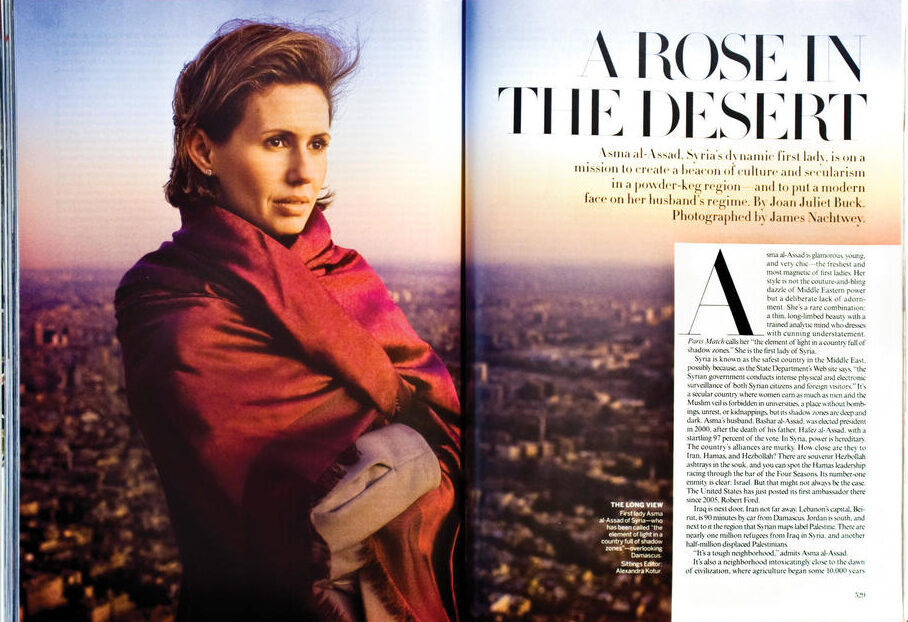
Inhabiting power also meant being photographed inhabiting it. The cameras following Asma on her tours were not incidental to her work. Her usefulness to the regime lay largely in her image: a young, modern, educated, and accessible First Lady listening to ordinary Syrians and trying to improve their lives. Phil Elwood, a former public-relations operative interviewed in the first episode, is unusually candid about the strategy. His firm was hired to promote Asma internationally so that Bashar would look better by association. She was the photogenic one, the glamorous one, the figure onto whom the possibility of a more modern Syria could be projected. The culmination was the notorious 2011 Vogue profile, “A Rose in the Desert,” for which a reporter and photographer were brought to Damascus and presented with an image of an attractive, liberal, “wildly democratic” ruling family. Hadjimatheou calls the result “the apex of image management.” Within days of its publication, however, demonstrations broke out in Syria; Vogue subsequently pulled the issue from U.S. newsstands and scrubbed the profile from its website.
Yet the search for such evidence sometimes creates a distortion of its own.
But the glamour upon which this strategy depended requires some qualification. Asma photographed well, dressed well, spoke English with a British accent, and furnished foreign journalists with an irresistible approximation of a modern Arab First Lady. Yet her glamour was curiously static. My own memory of Asma growing up in Syria is that she was a presence, certainly, but one that felt insubstantial on its own: she helped Bashar appear more modern, while remaining strangely indistinct herself. Even her face remains vague in my mind’s eye. I don’t remember people talking about her clothes or personality, or really about her at all except in reference to her role as the president’s wife. She never circulated through Syrian popular culture in the way comparisons to Princess Diana—made repeatedly in the podcast and during Asma’s years as First Lady—would suggest. Her presence in Syrian public life was largely institutional: through foundations, development initiatives, and carefully staged appearances. Her glamour belonged above all to the image: the photograph, the profile, the reputation passed from one publication to another. To mistake the circulation of that image for cultural reach, however, is to accept a premise of the publicity campaign itself: that because the regime successfully projected Asma as an icon, Syrians necessarily experienced her as one. At moments, the podcast seems to reproduce the scale of that projection rather than interrogate it.
And there is, throughout We Call Her Emma, a curious reach for precisely this kind of recognizable female iconography. Asma is repeatedly compared to Diana; when her hacked emails reveal her shopping for jewelry and furnishings while Syrian cities were being bombed and their inhabitants detained and tortured on a mass scale, Hadjimatheou remembers it as her “Marie Antoinette moment.” I found myself thinking instead of Carmela Soprano from The Sopranos and Skyler White from Breaking Bad. The distinction is not entirely facetious. Both characters emerge from sustained fictional attempts to understand complicity in evil: Carmela’s wealth, family, and status depend on the survival of a violent enterprise of whose particulars she prefers to remain ignorant; Skyler, on the other hand, puts her own professional competence to work managing her husband’s drug profits and maintaining a façade of legitimacy. Both offer more nuanced models for the forms of complicity the podcast itself uncovers in Asma than the image of Marie Antoinette’s insulated luxury. Yet Diana, Marie Antoinette, and finally Emma all perform a similar narrative service: they translate Asma into recognizable western archetypes—the charitable princess, the oblivious queen, the ordinary London girl—even as the investigation is ostensibly trying to discover who she was.
The podcast is at its best when Hadjimatheou resists such ready-made explanations. In Damascus, she worries that Asma has become a “bogeywoman,” a name onto which Syrians project crimes whose precise chains of responsibility remain obscure. It is a necessary journalistic suspicion, and it produces some of the series’ strongest reporting. But what Hadjimatheou seeks instead is something closer to a smoking gun: evidence that can establish not merely that crimes were committed within institutions Asma patronized or influenced, but that Asma herself knew of them, authorized them, or intervened in them directly. As a journalistic standard, the distinction is entirely defensible. Yet the search for such evidence sometimes creates a distortion of its own. Again and again, the investigation reaches for proof of Asma’s personal knowledge or involvement in particular crimes, as though proximity to the criminal act were the principal measure of responsibility.
In the episode titled “Asma’s Orphanages,” Hadjimatheou builds on testimony from orphanage employees and documents showing that intelligence agencies secretly placed detainees’ children in institutions. She keeps looking until she finds Maya, a witness who says she raised the issue of the children directly with Asma—and that Asma herself dismissed them as “the children of terrorists.” The discovery is important, but its implications extend well beyond establishing what Asma personally knew. The Assad regime did not operate through tidy chains of personal culpability, and neither does accountability necessarily require them. Elsewhere, the podcast renders this problem of proximity in an almost unbearably literal image. Asma’s residence overlooked the Mezzeh Military Hospital, where the bodies of detainees tortured to death passed through the regime’s machinery in enormous numbers. Years later, she would be photographed receiving treatment for cancer at the same hospital. Hadjimatheou cannot know whether Asma ever saw the bodies accumulating below her, and she is right not to pretend otherwise. But the question itself reveals the limits of the smoking gun as a moral framework. Responsibility for a criminal system cannot be reduced to whether someone personally witnessed, ordered, or carried out one of its crimes.
Indeed, a broader conception of culpability emerges from the podcast’s own reporting, articulated most clearly by Osama Othman, who helped preserve and smuggle out the photographs taken by his brother-in-law Farid, the military-police photographer known as Caesar. “Bashar al-Assad didn’t kill the detainees in the prisons with his own hands,” Othman says. “There was an entire system, chain of command, that led us to these heinous crimes.” His conception of that system extends beyond the torture chamber. The regime paid the jailers’ salaries; those salaries depended, in turn, on the entities and businessmen that sustained it financially. Othman calls such businessmen “murderers” even when they “didn’t issue the kill order.” And then he makes the connection explicit: “Asma al-Assad is an active part of this.”
But the search for culpability is not the only place where the podcast seems to demand something extraordinary of Asma. What We Call Her Emma rarely confronts is the possibility that there may be less to decipher than its premise assumes. The qualities repeatedly attributed to Asma—beauty, charm, competence, ambition, vindictiveness, an increasing appetite for power—do not amount to much of a character. Even moments the podcast treats as unusually revealing can feel strangely vacant. In one meeting with young Syrians studying abroad, Asma asks what they think of the Hama massacre, a question one of them would later understand as an indirect warning about the consequences of crossing the regime’s red lines. She then tells the same students that Syria is not yet ready for them: “Don’t come back. Go find a job somewhere else. And when Syria’s ready for you, we’ll call for you to come.” The student understood the we to mean Asma and Bashar, deciding as the presidential couple when Syria was ready for their talents. In this encounter, Hadjimatheou hears two versions of the First Lady speaking at once: the authoritarian enforcing the regime’s limits and the benevolent “mother of the nation” acknowledging them. But the remark may reveal something less dramatic and more troubling: a woman capable of inhabiting a contradiction without apparently thinking very hard about it. Syria needs precisely the educated, ambitious young people whom it cannot accommodate; reform is necessary, but the regime that makes it impossible remains the instrument through which reform will somehow arrive.
This is where Mary Midgley’s 1984 philosophical study of wickedness begins to seem more useful than the search for a hidden Emma. “This book is about the problem of evil,” the British moral philosopher writes at the beginning of Wickedness, her 1984 philosophical study, “but not quite in the traditional sense, since I see it as our problem, not God’s.” Midgley relocates the ancient problem of evil from theology to human character. She is not so much interested in why evil exists as in how ordinary human beings become capable of it. She warns against imagining wickedness as the property of a special class of people, villains conveniently identifiable by their metaphorical “black hats.” Instead, she asks us to think of wickedness as “a general kind of failure to live as we are capable of living.” The motives that move exploiters and oppressors, Midgley argues, “may not be bad at all”; they may be perfectly ordinary ones such as “prudence, loyalty, self-fulfillment, and professional conscientiousness.” The appalling element lies, rather, in what is missing: the other motives that ought to balance them, particularly a proper regard for other people. Seen in this light, Asma’s thinness of character may not be incidental to the problem of her culpability but rather part of it. She may have sincerely wanted development, opportunity, and reform while possessing no sufficiently serious account of what those words demanded in a state built on coercion; she may have been intelligent and professionally competent while remaining morally incurious and politically incoherent.
None of this makes the missing biography less important. If anything, it makes it more so. A life need not conceal some extraordinary psychological secret to require explaining, particularly when that life culminates in extraordinary power. Emma’s wickedness, however, becomes the deeper subject of the podcast, and it is resistant to easy answers precisely because it cannot be disentangled from the structures through which Asma’s life unfolded: first the idealized London world of finance and professional ambition, and later the Damascus world of ruthless dictatorship. The question of what happened to her therefore carries another within it: what role did these different environments play in making Asma who she became?
Structural violence need not be violence in the strict sense of the word. It does not simply act upon people from outside. Instead, it holds them captive, prisoner and jailer alike, without making their positions interchangeable. The podcast invests considerable suspense, for instance, in reports that Asma attempted to leave Syria at the beginning of the uprising, and in the unresolved question of whether she did so because she opposed her husband’s response or simply feared for her own survival. The distinction matters to her biography. It does little, however, to settle the moral question. Even in attempting to leave, Asma’s concern appears to have extended no further than her own children, whom she tried to take with her—a grim anticipation of the regime’s final collapse in December 2024, when Bashar al-Assad and his immediate family fled to Moscow.
Even if we are charitable about what we cannot know of Asma’s motives when she attempted to flee, we should be wary of simply relocating wickedness from the individual to her environment, circumstances, or the structures she inhabited, as though moving the black hat around solves the problem. The podcast’s own evidence resists any such localization. In “Asma’s Orphanages,” Hadjimatheou tells the story of Bissan, a former detainee whose two young sons were taken from her in prison and placed in orphanages linked to Asma’s charitable work. After the regime’s fall, Bissan discovers on Facebook that Hala, a prison guard who had tormented her and her son Omar, is now running a hairdressing business nearby. Bissan reports her, and Hala is arrested; when several former detainees are left alone with her, they beat her brutally. Hala, Bissan’s jailer, occupied a comparatively minor place in the regime’s machinery and exercised its cruelty directly. Othman, who helped smuggle out Caesar’s photographs, was, by contrast, close to that machinery but used his proximity to expose its crimes. Meanwhile, the businessmen Othman calls “murderers” could remain far from the torture chamber while materially sustaining the system that made it possible. (Incidentally, Bissan’s and Othman’s stories stayed with me more vividly than almost anything about Asma herself.)
If wickedness has no permanently safe location outside ourselves, the political demand is not purity but vigilance: attention to what our ordinary commitments make possible, the institutions through which they operate, and the point at which participation becomes complicity. That requires attending to differences in knowledge, agency, coercion, and power. It also means distrusting the categories through which innocence becomes self-evident.
The question of Emma al-Akhras and Asma al-Assad therefore persists. My mother searches beneath Asma for a concealed Alawite; We Call Her Emma searches beneath her for a concealed better self: the educated British girl from Acton, bound for a career in the City. Both assume that the contradiction can be resolved by finding another, truer inscription underneath. Midgley suggests a less dramatic and more disturbing possibility: perhaps there is nobody else to find—no secret identity, no pristine Emma, no single moment at which one woman became the other. The question may not be what was added but what was missing—what failed to operate when it mattered. The qualities Emma al-Akhras possessed—education, competence, ambition, perhaps sincere concern for development—were never evidence of moral virtue in themselves. They need not have disappeared when she became Asma al-Assad, any more than they need to have protected her from wickedness. Emma may have survived perfectly well.
We Call Her Emma begins with the promise that the ordinary girl from Acton might explain the woman Asma became. Yet for all that the series reveals about Asma al-Assad, relatively little emerges by way of new biography. As a Syrian listener, I finished the series without feeling that I knew Asma substantially better. Certain images lingered, but they sharpened the darkness around her rather than truly illuminating her. For listeners encountering Asma primarily as the British-born wife of Bashar al-Assad, the podcast is nevertheless an unusually accessible and often compelling introduction, and Hadjimatheou has assembled testimony that any future biographer will have to reckon with. For those already familiar with the broad outlines of her life and place within the regime, there is less here that fundamentally alters the picture. An introduction, in any case, is not quite a biography; We Call Her Emma may be best understood as necessary groundwork for one that has yet to be written.