A writer tries to think through the unthinkable as she considers the mechanics of Israel’s AI-powered assault on Lebanon.
In the spring of 2026, a man and his twelve-year-old daughter were riding on a motorcycle in Nabatiyeh, southern Lebanon. They were on their way to pick up food parcels and aid packages. An Israeli drone appeared in the sky above them. It fired a munition, struck them. They survived the first attack and ran together in search of cover, but the drone followed them and struck again. The second hit killed the father. The daughter, now severely wounded, kept trying to escape. The drone came after her again. Striking for a third time. This one killed her. Where did the father and daughter try to run? Did they have time to call for help? Or try to seek protection behind a makeshift shed, like the journalist Amal Khalil and her photographer colleague Zeinab Farraj?
These two women were also chased down by a combination of aircraft and drones, shooting at them from above. They were sheltering in an abandoned building when a jet launched a third strike against them and leveled it. Trapped for nearly three-and-half hours beneath the rubble, Amal Khalil made repeated calls for help. When the ambulance crew arrived, they rescued Farraj, but the Israeli military forced them to retreat under fire before they could reach Khalil. Though she’d survived the third strike, the Israeli forces continued to prevent aid workers from approaching until Amal Khalil had bled to death.
I keep returning to these horrific scenes. I am nearly the same age as Khalil. I’d spoken to her once, in 2019, when she helped me retrieve a scientific study she’d reported on. The study considered the pollution of the Litani River alongside rising cancer diagnoses in southern Lebanon and the Bekaa. From the comparative safety of my home in Beirut, I think about that father and daughter, too. What did they look like? What names did their loved ones call them? Where was their house? What did the father do for a living? Did she go to school? What was her preferred subject? Favorite pastime? Did she have siblings? A mother? The father, a wife? Where is the rest of the family now; are they still in the land of Jabal Amel, which Israel has turned into an open killing field?
These drone chase scenes are not without witnesses.
To write about what Israel did to them, the implacability with which they were lethally targeted, and how they responded, I would need a language for which I have few suitable words or images. Abhorrent? Morally intolerable? Reprehensible? Inhumane? My lexicon seems to revolve entirely around the idea that the suffering of others can and should prompt an overt political intervention. T, who called me from Greece the other day, asked me about the wanton destruction of villages in the South. When I asked her if these stories had made the Greek news, she matter-of-factly replied that the whole world was watching. The brokenness in her voice was palpable at the other end of the line. Perhaps, unlike T, I am failing to articulate that we should collectively refuse to imagine ourselves outside of this violence. Perhaps I return to the minute details of these murders to avoid confronting the inadequacy of my response.
How do I describe the perverse ways in which certain regions and bodies become bombable while others are spared, if only temporarily? These drone chase scenes are not without witnesses. We have seen them, read about them, met people directly affected by them. The ferocity with which these people fought for their lives—Amal Khalil’s courage, the father and the daughter’s resolve—made the inhumane chase to which they were subjected momentarily more human. Out of respect for their determination, I cannot invoke the unimaginable or the unrepresentable. And it is that determination that allows me, each time, to see more clearly how Israel, even with all its algorithms and its machines, fails to wipe out their humanity. If, as Tina Campt says, we can listen to images, then these chase scenes are clamoring: it is intolerable, but please know that the intolerable does happen, that the unimaginable is happening as we speak.
How exactly did we arrive at a world in which contemporary social, political, and economic life regularizes genocide, spaciocide, urbicide, ecocide, domicide, all the -cides alongside the vertical, horizontal, multidimensional destruction of human and non-human life at any and all scale? Why would a drone relentlessly chase down and kill a little girl? Friends will denounce the planetary double-standards and condemn the unequal measures with which brown and black bodies are treated compared with white ones, while critical political and philosophical scholarship will assert the very serious idea that lives are unequally grievable and that some bodies are worthy of protection while others are simultaneously rendered killable. But my questions are not couched in terms of humanitarian concern. I know Israel has none—it keeps committing war crimes—and that this framework is itself part of the law of the strongest, invoked only when convenient or necessary for the exercise of power. Rather, I am trying to understand how this violence functions according to its own operational logic. I talk to R about the daughter and we have a heated argument. He tells me they strike her because they can. I argue that the drone does not see a twelve-year-old but a trackable signature and I begin describing heat patterns in infrared thermal imaging. R becomes furious and accuses me of rationalizing the atrocious crimes. “This crime is a crime, is a crime, is a crime! It’s pure evil!” he yells. My riposte is to mumble something inchoate about theodicy and the material historical conditions of this war. I lose my mind; I do not even know why we are fighting.
The chilling image of the girl being hunted down throws into question everything I thought I knew about the laws of war. I turn to books to try to arrange the mechanics of this horror into something comprehensible. I find some answers in Grégoire Chamayou’s Les Chasses à l’homme, a philosophical account of manhunts, which he traces as a concrete phenomenon that materializes a longstanding history of violence, its technologies of predation, and the relations of domination that structure it. “Chasser” in French refers both to hunting and the action of forcible expulsion. This is a form of war that entails tracking human beings down as well as chasing them out with the aim of killing them. What strikes me most in Chamayou’s account is that it draws a portrait of the hunter as a figure through which to understand sovereignty and power. I am taken aback by the stark contrast between the archetypes of the hunter and the shepherd, the latter long associated with a form of power that manages life in both religious and secular western political thought. Whereas the shepherd exercises pastoral power, in other words concerns themself with caring for the flock, guiding it, and disciplining its wayward members, the hunter tracks, expels, and kills. Remember when, in October 2023, Yoav Gallant, the former Israeli minister of defense, said: “We are fighting human animals and we will act accordingly?”
Hunter and shepherd have very distinct relationships to community and land, which means they are also powerful in different ways. In life, in movies, in the Bible, in books and articles written by, or about, Michel Foucault, the good shepherd will guide their flock through gentle care, both metaphorically and literally. Only occasionally will they hit an insubordinate sheep with a rod, or, placing the curved end of a long stick around the neck of another that’s been led astray, will they pull it back onto the right path. A hunter, on the other hand, will engage in unremitting pursuits, which will usually entail little risk for them but great danger for their prey. A hunter will hide downwind, spot and stalk, stop and reassess, camouflage, calculate, ambush, soar, before plunging back down, resuming their chase, forcing their prey to run until they’ve captured and killed it. As far as war, drones, and fighter jets are concerned, the hunter’s pursuit transforms what we might understand as the “theater of war” from a well-marked territory upon which battles are waged to an open, almost endless ground.
Countless families, displaced from southern Lebanon, have been refused shelter in other areas of the country. “I understand where you are coming from,” said the landlord to an old woman and her two daughters who had been forcibly expelled not once, not twice, but thrice, from Aitaroun near the border, to Sour on the southern coast, to Jnah in the southern suburbs of Beirut. After the Israeli army issued another one of its ethnic cleansing directives, ordering the residents of Jnah to evacuate “for their own safety,” the mother and her daughters had spent a couple of nights sleeping in their car. “But you should also understand,” the landlord had told her, “I have five kids, aged between two and fourteen. How do I know your male visitors will not bring the drone and the jet into this neighborhood?”
Around the bodies of those who are pursued by the hunting apparatus is constituted what Chamayou calls “an autonomous zone of temporary killing.” What about the man who receives a phone call from the Israeli army? The person (or bot) at the end of the line asked him if he preferred to die with his family or alone. The man calmly hung up the phone, bid farewell to his loved ones, and walked out the front door. He’d only made it a few meters before the drone struck him. There’s also the wounded fighter who left the ambulance on foot and turned himself in to the Israeli military to protect the medics and the residents of the town he had crawled to for treatment. There are the countless families who decided to stay in their villages, rather than face the humiliation of dwelling in a classroom in Beirut or burdening their relatives elsewhere. The couple who stepped out of their car and stood by the side of road, holding hands, before they were struck by the Israeli drone, until death do them part. Wherever the hunted body goes, it carries with it the possibility of a battlefield that will materialize the moment the hunter discovers its location. When they come for you, there will be nowhere to hide.
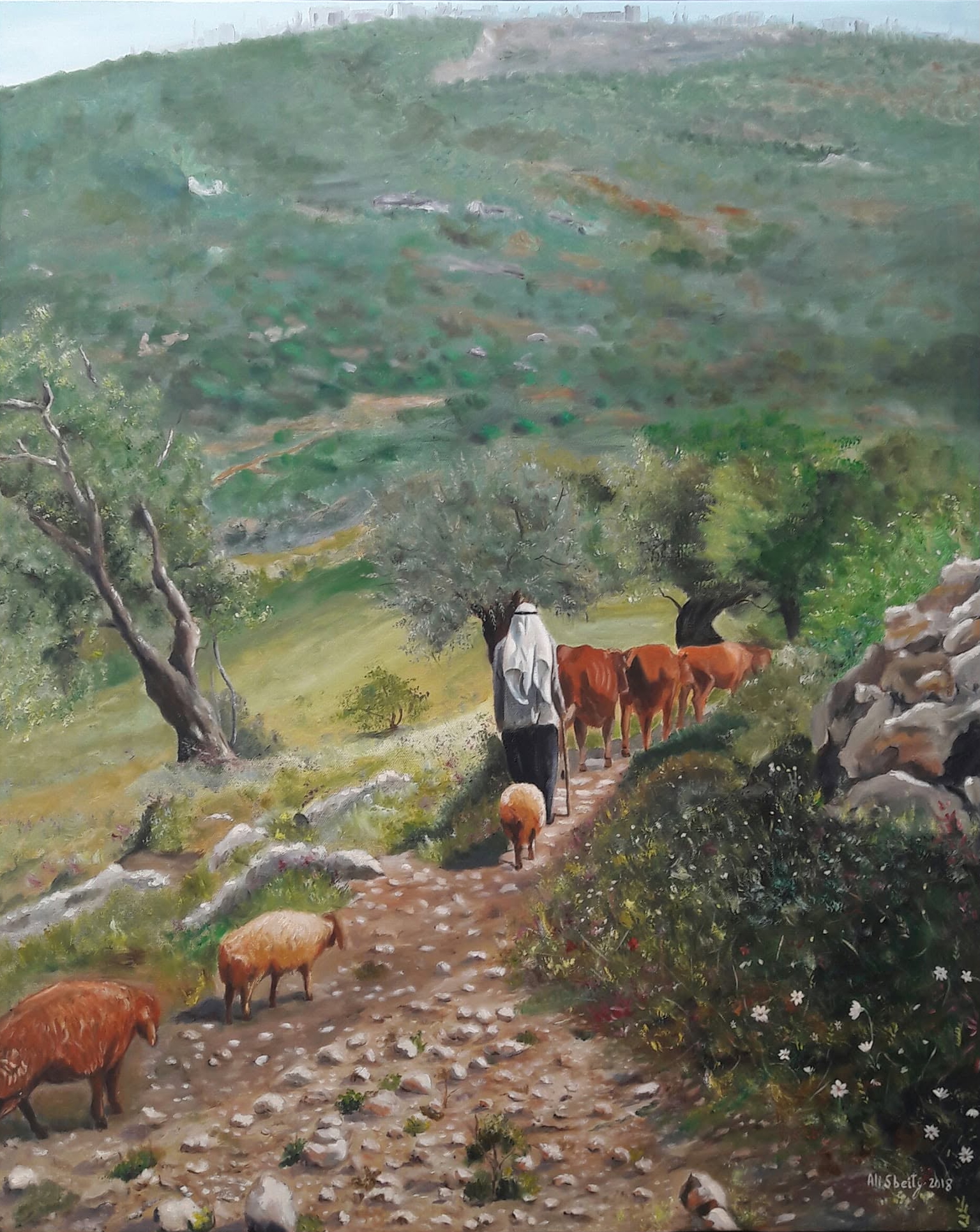
The artist was killed in an Israeli strike on the southern town of Kafra, Lebanon in March 2026.
In the words of geographer Derek Gregory, war literally takes place. It snatches place from those who dwell and labor in it, and from those who love it, and turns landscape into its antithesis, into piles upon piles of rubbish and ruins. War takes place by eating up new spaces in which it is waged. This is why, he says, it makes more sense to speak of battlespaces, rather than neatly delineated battlefields. In this Lebanese battlespace, as in Gaza, war is taking place vertically and not just horizontally. Israel is working to collapse the distinction between ground and air, so that a soldier who is flying a jet and a soldier who is on land can both experience the horizon in the same way, as a highly panoramic and unobstructed field-of-view. What this effectively means is that the Israeli forces are flattening landscape in the South to govern ground space in the same way that they dominate Lebanese and Palestinian airspace. They are also obliterating humans, and the physical, natural, and built environments alike so that their boots on the grounds are no longer envious of their pilots up in the sky. The Vietnam comparison is familiar in this regard. Guerrilla fighters, who are of the land, use its topographical elevations and slopes as part of their strategy, knowing when and where to take cover and how to defend. In the kind of warfare Gregory is describing, the colonial forces also blot out land in a way that not only pre-empts anticolonial tactics, but also robs communities of the mountains and valleys, forests and swamps, rivers and lakes, and plains and ridges and valleys they know and love so much. In southern Lebanon, this comparison still holds, and not only because of military asymmetries, colonial aspirations, and anti-colonial struggles.
The everywhere war becomes diffuse and embedded in everyday life rather than formally declared.
The anthropologist Munira Khayyat has beautifully written about how “tobacco blooms and goats forage and humans flourish” in Jabal Amel through both agricultural seasons and seasons of war. To make even that life an impossibility, Israel will turn valleys and hills, villages and springs, into leveled and abstract surfaces. Kali Rubaïi, another anthropologist, this time writing from Iraq, has shown how these military tactics also include actively destroying people and the land’s very ability to recover. At a recent conference I attended in Beirut, Eveline Hitti, an emergency physician who saw her department flooded with the wounded after the pager attack and the massacres of April 8, 2026, spoke about “hybrid warfare.” Many practices and things come to mind when I think about hybridity—an animal (mule), a fruit (sweet orange), a vegetable (broccolini), even a car (Toyota)—and yet little did I know that it could also refer to ways of killing. But isn’t this what happens when people and places, mixed with things, collide with the machinery of late capitalism?
When place is taken in the sense that I have been describing, as in Vietnam, Palestine, Iraq, or southern Lebanon, the very objectives of war are recast from the imperative to achieve military victory over a territory to the desire to produce a certain kind of sovereignty and the ability to impose total legibility and control. This desire secures authority over space by enforcing a separation between culture and nature, and between what is made visible and what is made to disappear. When the territory becomes flat as the map, or when the map itself becomes the territory, sovereignty is no longer limited to the right to govern it. I find this contemporary vision of power and control particularly monstrous in its hubristic ambition to turn space, nature, and the human itself into three theaters of war, all organized through the creation of fields that are calculable, visible, and controllable.
The night before the massacres of April 8, 2026, I sent my friend F, who lives in Montreal, a silly voice message in which I described, in vivid detail, the coffee place, croissant joint, and grilled sandwich shop along my street—which used to be her street, when she still lived in Beirut. I only recently mustered the courage to relisten to this message, not merely because I dislike hearing my own voice, but because I knew, she had told me, that everything I had wanted to say to her had been overshadowed by the very loud buzz of the hawking drone surveying Beirut at very low altitude that night. Hovering overhead, the drone forces us to reckon with ourselves not as two women talking to each other about the grumpy old men and the taxi drivers who sit in these places but as trackable signals and potential targets. “Where’s Daddy?” a child asks her mother. “He is picking up some sandwiches for dinner and he’ll be here soon.”
From reading Gregory’s work, I learn that this did not begin in Gaza but has been in the making since at least the early 2000s, if not earlier. The first drone strikes in Afghanistan (2001), Yemen (2002), and Pakistan (2004) prompted gradual shifts in the way that war is waged, and began to transmute the loosely defined physical, moral, and political spaces in which, and through which, it is waged. These changes point towards a broader “civilianization of war” and the gradual erasure of the boundary between civilians and combatants in the age of human rights. The everywhere war becomes diffuse and embedded in everyday life rather than formally declared. In “Af-Pak,” an umbrella term coined by the Obama administration to refer to the regions where the United States conducts war against Al-Qaeda and the Taliban, it is the CIA that plans and executes the strikes, further muddling the distinction between intelligence and military operations. In the borderlands between the United States and Mexico, the logics of killing, and the “war on drugs,” are extended to encompass a wide array of people caught up in the drug trade in various ways—in reality, this means not only those directly affected by Mexico’s violent neoliberalization of the economy, like the urban and rural poor, guerrilla groups, and migrants, but also human rights organizers and community leaders. As early as 2011, the cartels were already being compared to terrorists, posing a threat to national security serious enough to require joint security infrastructures stretching from within the U.S. to Mexico. In the midst of mayhem, I remember that this is part of the strategy that the Trump administration later adopts. In the words of the orange man himself, this was “a commitment to using lethal military force to destroy the sinister cartels and terrorist networks once and for all.”
When I first read about the Stuxnet worm, an example Gregory deploys to illustrate how networks themselves form another battlespace, I froze. The highly sophisticated computer worm, which only came into public view in 2010, is often described as the world’s first cyber-physical weapon because it crossed from code into material destruction. Deployed to sabotage Iran’s uranium enrichment program, it forced nuclear centrifuges at the Natanz facility to whirl out of control and caused permanent physical damage. I froze because I found this cyberattack so eerily correspondent to the pager attack in Lebanon. When software, batteries, communication protocols, and supply chains are turned into vectors of incapacitation and harm, the conventional distinction between spaces of battle and background infrastructure collapses, and infrastructure itself becomes weaponized. In the pager attack specifically, the crucial and most evident point is that it also transformed an object people carried in their pockets, held near their faces, gave to their children, or left in their homes, streets, cars, clinics, and shops into a ticking time bomb that could go off whenever. Carrying a tiny bomb on you wherever you go and having it explode against your very body means that the battlefield is as vast as the world, and that war is everywhere. I imagine that in some global arms industry conference, someone is setting up their company’s promotional booth. A banner shows a vast desert in sepia tone, broken into a fine particulate field. Grains of sand are drifting through and inside mundane objects half-submerged in the landscape. Beneath it, a caption that reads: “From putting boots on the ground to sandblasting.”
In many conversations I have had, there is an unspoken sense that Lebanon has entered a condition of prolonged deterritorialization, the feeling that our institutions and our social, cultural, political, and economic practices, and the way these have been historically connected with the country, are all being unmade. This emerges on the heels of recursive cycles of crisis, including, in recent years, the 2019 financial collapse, the pandemic, the Beirut port explosion, more than 700,000 people permanently relocating abroad, and now permanent war. With more than a million people displaced since 2023, many facing the possibility that they may never return due to the continued occupation and devastation of the South, and no clear horizon of repair, the future increasingly appears foreclosed. Hell! Following from several decades of open markets, globalization, time-space compression, and the latest expansion of imperial wars alongside the normalization of compromised sovereignty for the least powerful states on the planet, with little to no deterrent capacity, I ask myself whether it isn’t perhaps the concept of country that has become obsolete? A few scholars have advanced the notion of the archipelago—defined as diverse bodies of land separated by a sea in flux that nonetheless come to form a shared political community—as another way forward. For some, this might be a generative proposition to reimagine territory as well as political sovereignty. But what is the path forward that might help communities protect themselves from this predatory violence?
As of late, we have been made privy to the operational viewpoint of the First-Person View drone (FPV). Like a mosquito—or the tuktuk—unleashed in swarms, this kind of drone builds on a different imagination. Relatively inexpensive and requiring far fewer resources, it raises the possibility of a use of the aerial gaze in a way that can harass more powerful adversaries in at least two distinct ways. For one, it is a more-than-human cyborg assemblage characteristic of our present world. I know that engaging with cybertechnologies in warfare has been compared to gaming, but war has become so permanent and pervasive that I think it more accurate to say that operating an FPV drone belongs in the same category of acts as holding one’s phone or smoking a vape pen. The Ukrainian case stands as an example where the use of FPV drones has fostered greater public engagement in war efforts, for example through heightened tech literacy or with people using their homes to build the different components of these drones. For another, it seems to me, given how stealthy, small, and impoverished it is, the FPV drone is akin to a trickster, like those adept shapeshifters of myth and fairytales, mercurial and unpredictable in their nature, and playful in their modulated relation to rules, following or violating them depending on circumstance and need. Trickster stories—where the downtrodden outwit their masters—often starkly depart from the stoic representations of steadfast freedom fighters. Think Puck from A Midsummer Night’s Dream, or Tinker Bell, the feisty, manipulative, creatively resourceful fairy of the original tale (and not the watered-down Disney version), rather than, say, Hercules or Mulan.
Ursula K. Le Guin once wrote that there is a human culture that derives from, and is built around, making pointy weapons and going out to use them, for bashing, killing, chasing, sticking, and thrusting, and then returning home with meat and a story. “The trouble,” she said, “is we’ve all let ourselves become part of the killer story, and so we may get finished along with it.” What is the nature of the other story, Le Guin asks? What are its words, who are its subjects? Like her, I’ve always preferred gatherers to hunters, because their stories, which are about collecting rather than conquering, are also about tinkering, doing with what is available and expedient, trying things with your hands, for yourself and for others. When Israel resumed its full-on assault on Lebanon in March 2026, I began to keep a list of every activity that entailed some degree of collecting: friends who collected donations of various kinds to support relief initiatives, friends who documented events, violations, histories, photographs, gathered artifacts, and compiled archives, writers who collected stories, foragers who brought spring home, farmers who drove back to the South to harvest their crops, bus drivers who collected passengers and evacuated them to safety each time Israel issued another one of its mass death threats, rescue workers who pulled the wounded on stretchers and transported them in their ambulances, displaced women who gathered the dirty laundry, put it in a basket, washed it, put it in the basket again, hung it to dry, before fetching it again, displaced men who piled up heaps of food, aid packages, and medicines, placed them in their cars, and distributed them to those who needed them, M, the seventeen-year-old who stayed with us with his family when they fled their village near Qasmieh and who walks around all of Ras Beirut twice each day because he wants to “collect memories.” This is not a random list, but a theory of how the relationships between people, nature, technology, and power can be recomposed. This season of war, I am learning that resisting is not so much a matter of doing something exceptional to confront extraordinary circumstances, as it is of doing something ordinary to the very end. And still the story isn’t over.