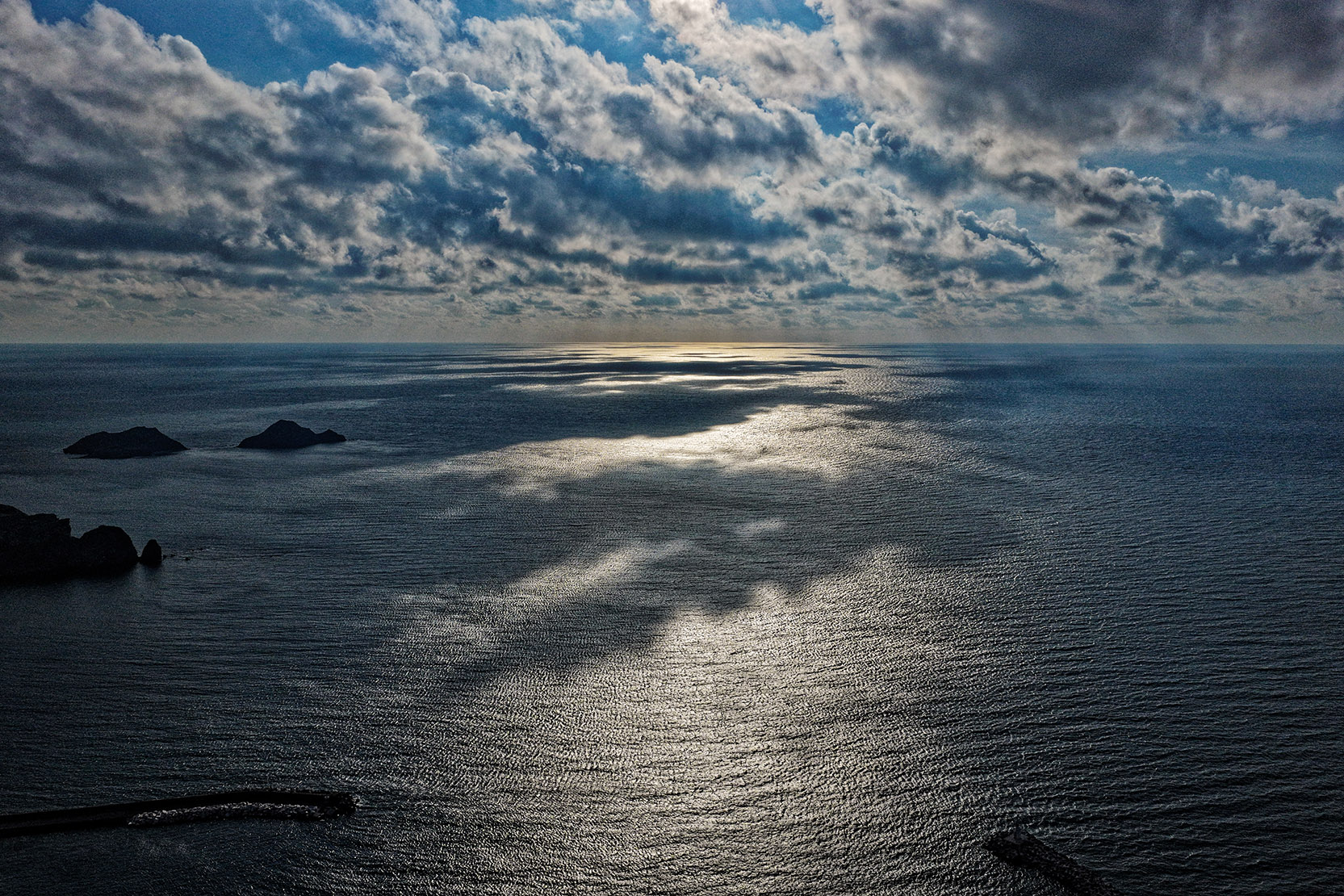
Climate change, geopolitics, and overconsumption are driving the little remarked-upon, accelerating and possibly unsalvageable demise of the world's oldest inhabited seas.
The Mediterranean is suffering, beginning with the northern Aegean, at its eastern flank, between Turkey and Greece.
You can tell from the consistency of its waters, their smell, and contents. The past few years, tepid winters have failed to cool it down significantly, setting the scene for unbearable summer temperatures. Entering it on clammy August days feels like wading into a tureen of tepid soup. And when increased temperatures unite with industrial pollution to produce sheets of sea mucus coating the sea’s surface, the idea of wading through soup feels preferable.
Simultaneously, coastal activity has caught fire, sometimes literally. A season of post-Covid construction in Greece, Turkey, and Egypt is resulting in the concreting-over of much of the urban Mediterranean coastline that escaped the 1970s-era boom. Materials and debris are often tipped into the sea. New cement protuberances (marinas, corniches, even artificial islands) and dammed rivers prompt accelerated land erosion by staunching sediment loads and disrupting water currents. Beaches are strewn with millions of microplastic fragments. And the forests burn in the summers, resulting in the earth held by the trees’ roots washing into the sea with the first rains.
Jacques Cousteau’s 1970s warnings that the Mediterranean is turning into a dead sea were already old news by the time I toddled to the water’s edge in the early 1980s. I just about managed to snatch some memories of a healthier sun illuminating crisp, fish-laden waters, and mornings at the beach followed by lunchtimes in tavernas, scoffing piles of fresh, cheap red mullets. This was before the Chernobyl nuclear disaster and an expanding hole in the ozone layer struck the first notes of doom. Today, the sun is less a source of health than a threat to shield against, and the sea ails from multiple factors. Overfished, overheated, and increasingly the target of petroleum and marine mining speculation, the Mediterranean is approaching saturation point, even while the terra firma bias of ground-dwellers imposes swelling pollution loads on it.
“It’s clear in the data that, from 2000 onwards, fish stocks are waning and that approximately 80% are now overfished,” said Ioannis Giovos, a conservation officer at iSea, referencing declining fish stocks in the Aegean. “Sea-trawlers used subsidies to buy radar, improved nets, larger fridges or upgrade to larger vessels to go out further; and this worked for half a decade before fish stocks out at sea started diminishing, too.”
The Aegean’s low nutrient levels ensured that it was never a particularly fish-rich sea, but better fishing technology and a scattergun approach to fishing has compounded the problem in recent years. A cascading effect was created whereby fish are not given the opportunity to reach reproduction age before being caught, resulting in shrinking biomass within the sea and higher prices at fish markets.
After several years spent reporting around the coastal Mediterranean, I was ashamed to realize how little I knew about the sea itself. Like most Greeks, despite hailing from a maritime nation, the past century of urbanization has alienated several generations of Greeks from the natural world, terrestrial and aquatic. Island-hopping went from a practice our forebears engaged in while evading pirate raids to a form of luxury entertainment. Accustomed to airports, motorway toll booths, and the occasional railway, contemporary Greeks traveled through their landscapes estranged from their connecting seas even though, for millennia, these provided the easiest way of moving from point A to B of this mountainous land.
The landmass was only joined up by twentieth-century modernity, when an extensive tunnel network bored through the land’s massive rocky obstacles. When an old captain described to me, in the taverna of a small port clinging to the steeper side of the Mani peninsula, how his annual summer migrations from the port of Piraeus were noted by locals watching his twin-masted ship nose into the harbor as late as the 1970s, I was surprised at how recently we lived in an era of casual maritime transport, when your personal sailboat was as normal as a private vehicle is today.
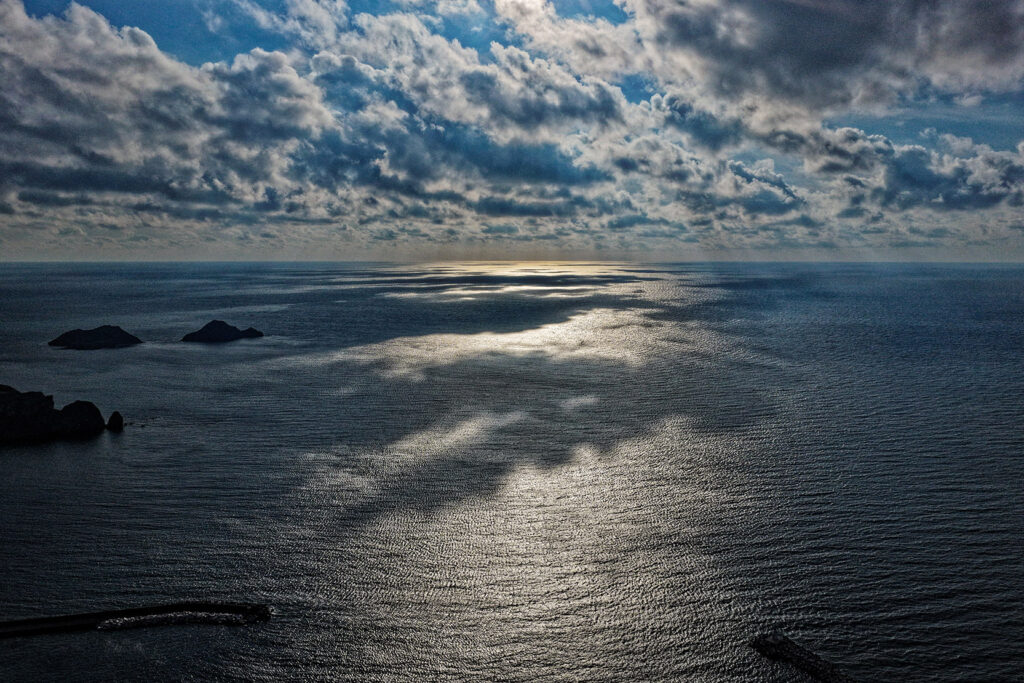
Deciding to pull back the aquatic curtain, I loaded my motorbike one rainy February night onto a passenger boat in Lavrio, Athens’ second port, and headed to the northern Aegean, which provides half of Greece’s total fish catch. Stormy seas had already delayed our 14-hour trip to Kavala, an amphitheatrical port adjacent to the Thracian Sea. Shortly before dawn, I was awoken by the sound of metal and wood straining against heaving seas. It was a watery dawn and, from the drenched deck, I beheld sheets of rain lashing Ay Stratis, a small island and place of internal exile for Greek leftists in the twentieth century. It was carnival season and, gazing at its green winter foliage, I wondered if it had decided to shrug off its arid, year-round, Aegean-rock normality and dress up as a British Channel island for a few weeks.
A whodunnit in Limnos
I got off at the next island. Strategically positioned at the mouth of the Dardanelles and boasting the Aegean’s largest castle, Limnos controls the approach to Istanbul and the entrance to the Black Sea. With some of the largest wetlands in the Mediterranean, its broad plains, frequent rainfall, and proximity to the Balkan Peninsula’s rivers have blessed its seas with the rich sediment runoff that nourishes thriving fish populations.
“These are stormy seas that can’t be fished daily, so the fish have a chance to recover,” said Thodoris Tsimbidis, a sea captain and the founder of the Archipelagos Institute of Marine Conservation, an NGO active in conservation and management of the natural environment.
Nevertheless, the fish of the northern Aegean are not faring well. Despite Limnos being situated in the particularly bountiful Thracian Sea, responsible for producing over a quarter of Greek annual fish production, catches are down a stunning 45% since 2017, compared to a 20% reduction elsewhere in Greece, according to the Greek Fisheries Research Institute. Decades of overfishing have now been compounded by additional stressors including warming waters and pollution, as I discover by the end of my trip.
I was in Limnos to interview a few of the 160-some fishermen still working this ailing sea’s most fertile section. Then onto the land ports of Kavala before wrapping up with a visit to the Axios River estuary, where lightning summer heatwaves have been frying shellfish farms.
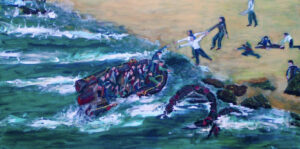
But first, I spoke to painter Katerina Veroutsou, who welcomed me into her atelier in an ancient settlement of the island’s interior surrounded by crumbling towers, where she hides out during Limnos’s over-touristed summer months. “We’d sit on the shore spearing the incredibly abundant fish in the water,” she said, recalling white seabream swimming just two meters from the water-surface when she first moved to Limnos in 1985. “Now, you have to go down to under 20 meters below the surface to stand a chance of finding such fish.”
“Every last year and better,” she says, making a pessimistic word-play on a Greek saying. “The shellfish are gone from the sea, the crabs and shells disappeared from the beaches, the temperatures are so high that we didn’t light the heater this winter, and a type of sea-slime has been coating the sea the past few summers.”
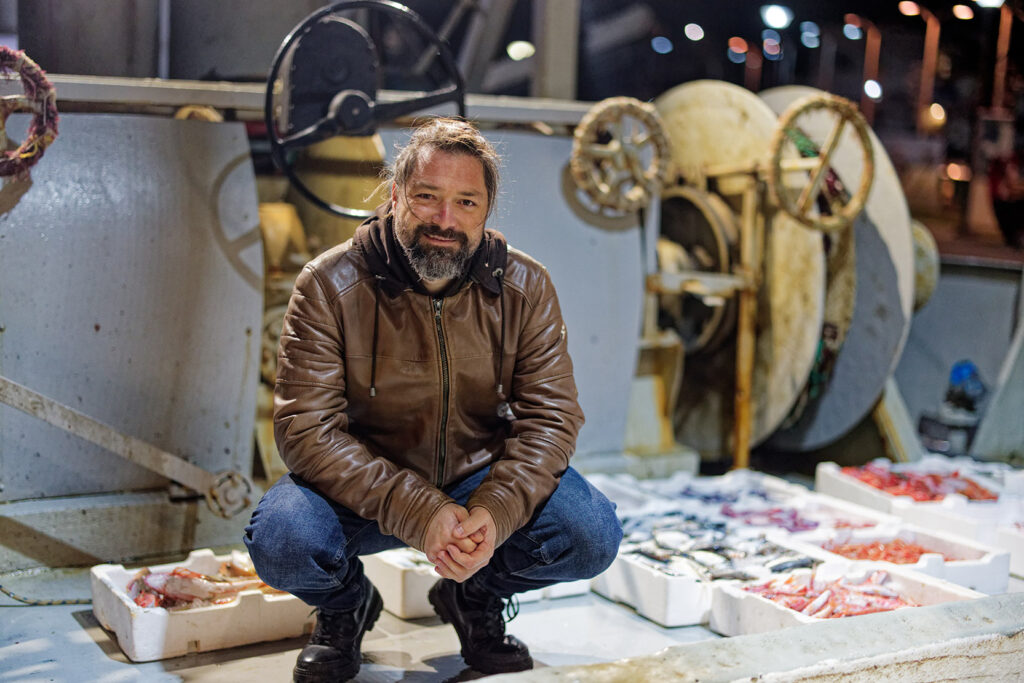
Back at the main port, I met Thanasis Ladopoulos, a trawler captain. Trawlers use gears that scrape essential ecosystems from the sea-bottom, often discarding up to 70% of their catch, according to Thanasis Tsikliras, professor of Ichthyology at Thessaloniki’s Aristotle University. Ladopoulos was introduced to me as an enlightened captain who sells his catch to his local community and mounts underwater cameras on his nets to better understand the behavioral patterns of fish. At 45, he is considered a young fisherman in a largely meat-consuming society that has grown alienated from the sea, even on islands. Two Egyptian fishermen crew his trawler, the Virgin Mary, having moved to Greece from North Africa’s largest fishing port, Ezbet al-Borg. Ladopoulos learned the craft from his fisherman father. When I meet him on the captain’s bridge, he is frustrated at how NGOs love to blame fishermen for any marine-related problems.
“Why do they always strike the small fishermen?” he asks. “However much of an ecologist you might be, you cannot stop oil, bombs, companies, development! And anyway, who knows who’s funding the NGOs’ ecologists’ studies?”
Despite the availability of numerous studies on the destructive impact of unregulated trawling in the Mediterranean since the 1950s, trawler fisherman Ladopoulos is convinced that the erosion of fish stocks has much more to do with pollution than trawler activities, and points as proof to the disappearance of a massive underwater fan mussel valley stretching between Limnos and Ay Stratis. “After years of blaming us trawlers for their disappearance, it turned out they had been infected by a newly appeared microbe that blocked them from closing. As a result, crabs were climbing in and eating them.”
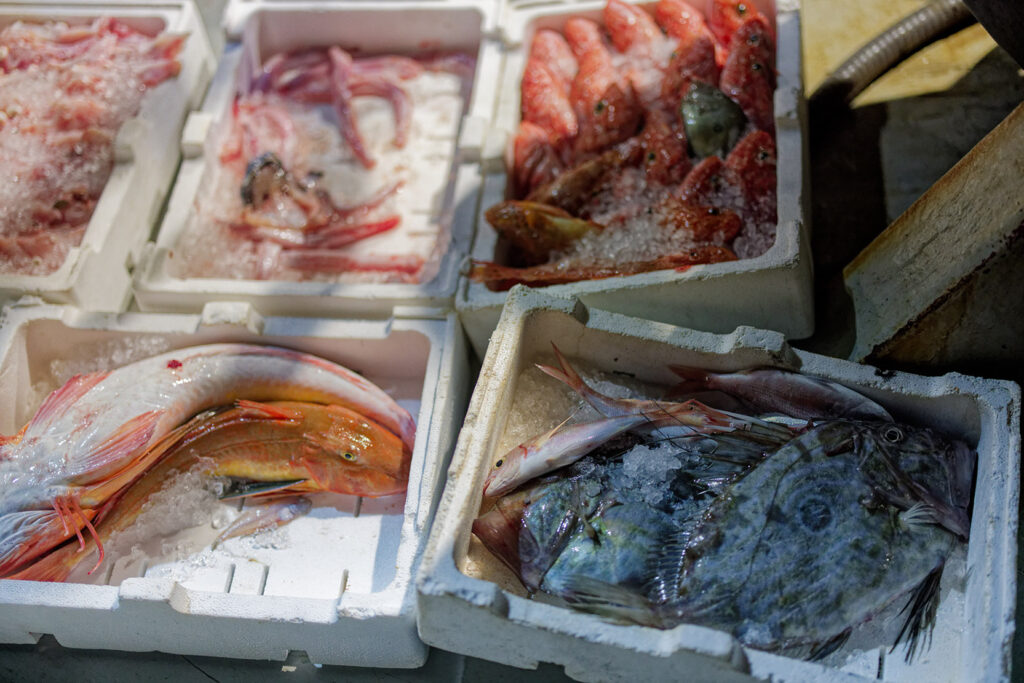
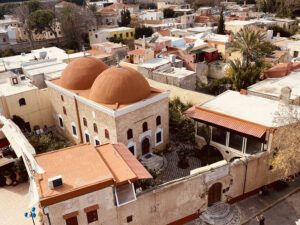
Panayiotis Moschos, a coastal fisherman and former diver disagrees. “Wrong management and extremely technical equipment have resulted in catastrophic overfishing,” he says, sitting in the port’s main café, which exists in the shell of an Ottoman-era mosque, which in turn was a Byzantine church conversion. “Unregulated Turkish purse seiners (a type of trawler using bright lights to attract fish) use lights so strong they burn the larvae from 200 fathoms away.”
Diving in the sea off Limnos in 1986, Moschos recalls being shocked by the discovery that large fields of sponges were shriveling away. It was the summer of the Chernobyl nuclear disaster and he wondered, due to Limnos’s proximity to the outflow from the Dardanelles, whether perhaps it was as a result of the radiation leaking out of the reactor. Experts consulted for this article believe it may have been related to the simultaneous appearance of bacteria that wiped out sponges.
“Most fishing grounds have collapsed,” said the Archipelagos NGO’s Tsimbidis. “River estuaries are the only remaining areas where you can still profitably fish.”
Pollution, pollution, pollution
The Aegean is no stranger to pollution. Starting from the lead effluent of Antique-era mines and Greek and Phoenician ship-building workshops, to the large-scale damage caused by the Industrial era, the sea has suffered enough. Yet never has the damage been as great as at present, whether through the effect of heavy metals and fertilizers corroding through the soil into the water table and the sea, or the environmental fallout of overtourism, untreated waste disposal, oil exploitation, and the ongoing conflicts in the Levant.
“Every time it rains, heavy metals from northern Greece’s reactivated mines sluice into the sea,” said Anastasia Haritou, education program manager for iSea, a Thessaloniki-based NGO that seeks to remove litter and microplastics from the sea. “The higher up in the food chain a fish is, the heavier concentration of metals it contains.”
The Mediterranean is the Earth’s fastest-warming region by a margin of 20%. This increasingly manifests in the appearance of unprecedented phenomena: the now-annual return of the noxious Marmara mucus, a layer of slime created by the combination of higher temperatures with industrial waste, creating a lack of oxygen that asphyxiates sealife, and great belts of Mediterranean sargassum, a massive bloom of brown seaweed driven by nutrient runoff, deforestation, and changing ocean temperatures that asphyxiate marine life. Water temperatures have risen so much as to push certain types of marine life to below 40 meters’ depth.
“Lying in the depths of the Thracian Gulf are hundreds of kilometers of ropes tied to cement weights, and some up to 800,000 plastic octopus traps cast into the sea,” said Manos Koutrakis, the director of research at the Fisheries Research Institute. “Microplastics are also a massive problem and all research shows that its effect on humans is far graver than we thought.”
Microplastics are so dangerous because new research shows that minuscule shards infiltrate our bodies, accumulating in the placenta or the brain. “Our body tries to defuse them by dispatching T lymphocytes to surround and neutralize them,” Koutrakis told me in his book-stuffed seaside office just outside Kavala, “but microplastics can’t be dissolved, leading to the T-cells being exhausted, which is a major contributing cause of cancer.”
The microplastics found in the bodies of persons deceased in 2024 already register a massive increase compared to those who had died by 2018, which appears to confirm that our expanded use of single-use plastic has accelerated within only a few years a disastrously lethal trend. That we are simply ignoring it only serves to more vividly illustrate how our alienation from the sea is actively harming us. Not only do we carelessly dump dangerous waste, but our ignorance contributes to disregarding the harm we are inflicting on ourselves by consuming the same fish that our polluting lifestyle initially poisoned.
“People are exhibiting health problems, like an autoimmune epidemic, that didn’t exist in the past and which is connected to a modern way of life,” said Giovos. “But you can’t isolate it down to one factor because the rise in microplastics also coincides with other factors, such as the increase in processed meat consumption.”
Aside from containing disturbing amounts of heavy metals and microplastics within them, there is so much plastic in the sea that fish are often literally trapped in it. Ladopoulos often catches fish whose heads are wedged in plastic rings.
“We actually know very little about what’s happening below the surface,” Koutrakis warns. “We don’t have data about sea-temperature rise aside from what the Copernicus satellite sees, and that is only up to half a meter of depth, whereas we need to assess the whole water column.”
His disturbing words are ringing in my ears as I get on my motorbike to head west towards Thessaloniki. His parting shot was, “What’s worse is that we mistakenly conflate a relatively unimportant 1-2 degree land temperature raise with its consequences at sea, which are massive and lethal.” Fish time their reproduction with winter’s cooler waters, so that their spawn will benefit from spring’s ample feeding matter. But climate change-related temperature fluctuations can trick them into giving birth too early, and condemn a whole season’s reproduction.
“Fish stocks are so reduced that some nets may be pulled out of the water after two hours and still only contain five kilos of fish,” said Giovos. “The situation is so bad that fish traders often advance fuel money to trawler captains so they can afford to go out to sea.”
Fried mussels on the Axios Delta
But the situation is not only grim at sea. On a chill February day with northern winds whipping down from the Balkans, I ride my motorbike through the plain extending west of Thessaloniki, past tall reeds bent double by up-to-9-Beaufort-scale winds that resemble hideously cackling hags. I’m headed to the point where the wide Vardar River, having crossed Bulgaria and North Macedonia’s industrial wastelands, dumps increasing quantities of chemical effluent into the northern Aegean. I’m reminded of Thanasis’ words that the main reason for the reduction in fish is not so much industrial-scale fishing as the rising pollution infiltrating the waters.
“The causal relationship between fishing pressure and fish biomass has been scientifically proven since 1897 when the first relevant article was published,” said Tsikliras, the ichthyology professor at Aristotle University. “Climatic and other conditions affect the stocks, biologically and in terms of their spread, but this doesn’t mean that overfishing doesn’t remain the most defining pressure on them.”
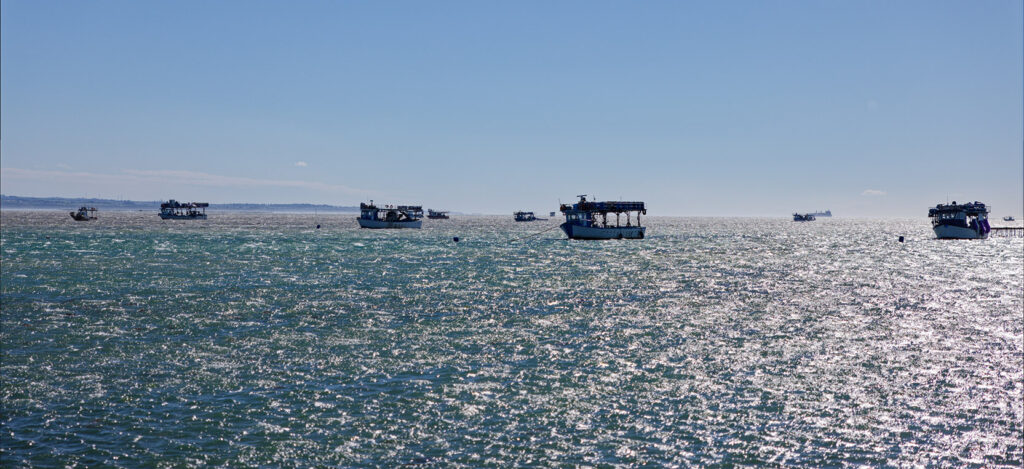
Reaching the shore of the Thermaic Gulf, I behold a cluster of dozens of squat, wide boats rocking in the waters’ sparkling turbulence. Hugging the shoreline is a necklace of two-story wooden cabins built on stilts, each equipped with a sharp-prowed boat known as a plava that fishermen and revolutionaries alike have used to negotiate or hide in lagoons.
When he opens the door to his hut, mussel-cultivator Stavros Yayas seems troubled. “The shallow waters here make it ideal for cultivating mussels, as well as the mild weather and gentle currents that bring nutritious elements down three rivers,” he says.
But things are far from ideal, as betrayed by the ramshackle, deserted-looking shacks. The cultivation of mussels that developed in the area since the 1980s was already steadily diminishing when, in the summers of 2021 and 2024, massive and extended heatwaves raised surface water temperatures 32°C.
“These were tropical temperatures the likes of which we’d never encountered,” Yayas told me, sipping the coffee he made us. “After a month and a half of continuous heatwaves, the first gust of breeze took all this boiling water from the shoreline out into the Gulf and — wherever it passed — it flambéed the mussels.”
With his harvests almost totally destroyed, Yayas redoubled his efforts in fishing tourism, but local clients are few because, he believes, Greeks have become alienated from the sea surrounding them. Gone are the days when the Thermaic Gulf was studded with dozens of caiques pulling 50-100 kilos of its famous red-striped shrimp out of its waters. These days, the few caiques that survived the EU-sponsored cull of traditional vessels struggle to find either fish or shellfish.
“We don’t know exactly why all the shellfish vanished but the oysters were beset by an illness in the 1990s, clams disappeared in recent years, and scallops just emigrated away as temperatures rose,” Yayas told me. “The only ones still remaining are mussels and conches, but studies show they’re infected with heavy metals and lead.”
“Our seas are changing but the transition period is extremely long (by human years),” said Constantinos Koukaras, a scientist tracking how climate change affects seas at the Greek National Center of Technology and Development, “We’re in a transitional phase and it’s unknown whether the new balance will be in favor of humanity or against it.”
All the effluent released by metropolitan Thessaloniki’s million inhabitants swills alongside the pollution washed into the Thermaic Gulf by the Vardar River.
“The situation is tragic and within a few years we’ll find ourselves crying over a dead sea,” Yayas told me as we stood on the wooden quay looking out at the wind-whipped waters. “If we don’t apply the brakes, as humanity, the descent will be rapid.”
I leave Yayas glowering at the stormy waters. As I drive back to Thessaloniki, it occurs to me that, even more disturbing than the initially slow, then faster descent, is that, for an alienated generation with no connection to the sea, the loss of its vitality will not even register as an information point. Can we miss what we are too ignorant to realize is gone?
This story was produced in collaboration with Med Mosaic.