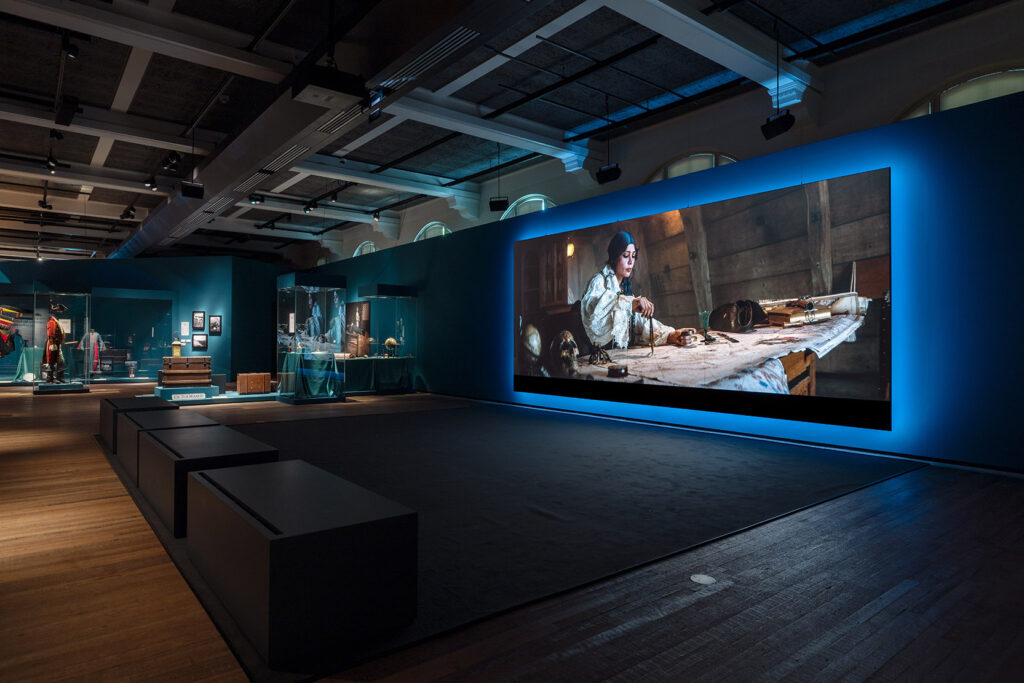
Visitors to Amsterdam's Wereldmuseum are treated to an installation of the British Palestinian filmmaker's A Sunken Tale of Losses Delayed, along with projections of two of Sansour’s earlier films — In the Future They Ate from the Finest Porcelain and Familiar Phantoms.
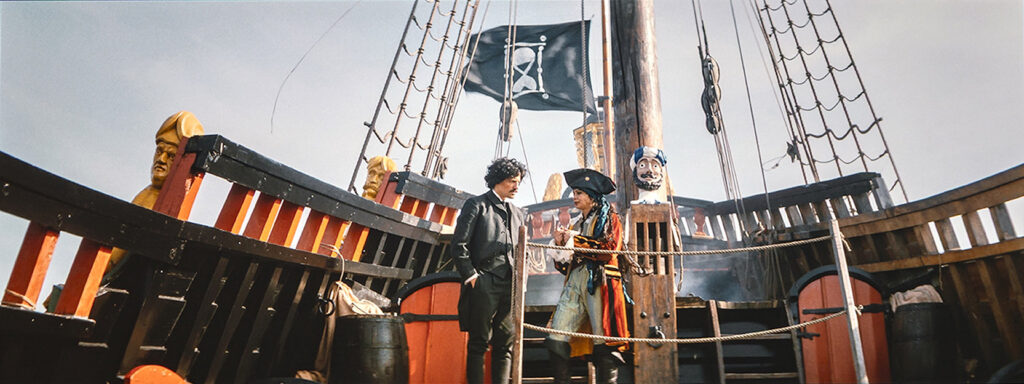
BEIRUT — A wide-angle drone shot slowly closes on a three-masted merchant warship of 17th-century design, coursing across the open sea. In lieu of national colors, the mainmast flies a flag with a white hourglass upon a black background.
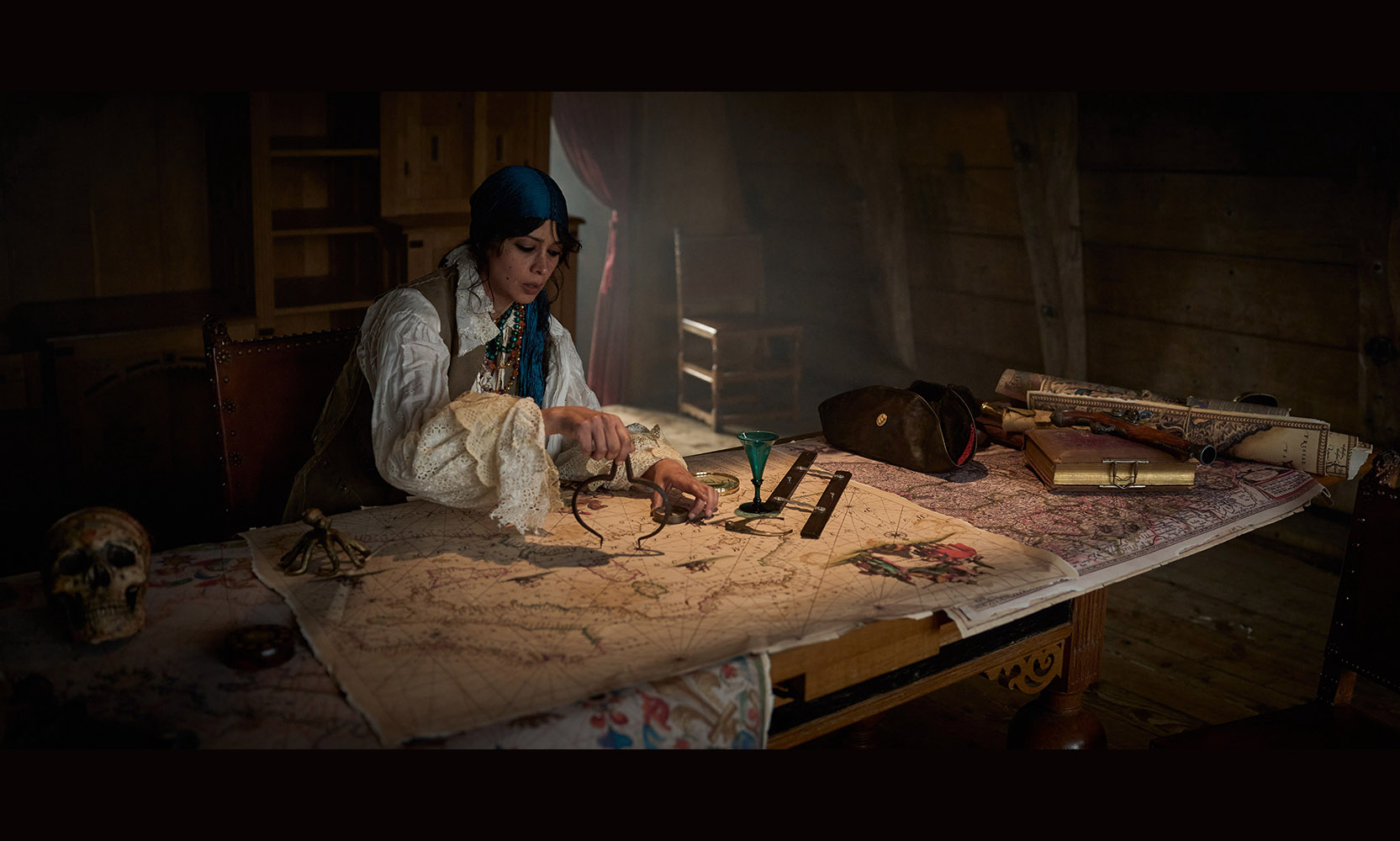
On deck stands a solitary figure, the ship’s captain (Maisa Abd Elhadi), in a costume reminiscent of Pirates of the Caribbean. Gazing out to sea, she spots a lifeboat carrying a chest and a body lying face down.
These shots set the scene for A Sunken Tale of Losses Delayed, the new film by Jerusalem-born, London-based artist Larissa Sansour.
When the disoriented fellow (Fadi Abdel Shafi) comes to, he has a few questions. The captain’s responses are playfully evasive, as though she’s accustomed to these inquiries.
Asking how long he’s been out, she replies that it’s difficult to say. When he wonders where he is, she tells him they’re in the Mediterranean. “Not far from home,” she adds, alluding to their shared Palestinian heritage.
He explains that he was en route to the Paris World’s Fair and asks about her ship’s destination. She asks if he’d take the train from Marseille to Paris, which he accepts as a response.
“If it’s on your way,” he says, “I’d appreciate it.”
She asks the traveler when he set out from Jaffa.
“21st of March,” he replies.
“What year?” she adds, “if I may ask?”
He blinks at her for a second or two before responding. “1900.”
“Time is different at sea,” she says, as if in explanation. “There’s very little to hold onto.”
A Sunken Tale of Losses Delayed is steeped in the past. Its production shots were filmed in historic locations and are interspersed among archival clips from the turn of the 20th century, donated by the British War Museum and UNRWA archives, and more recent footage of submerged shipwrecks, shot by National Geographic.
The work was commissioned by Amsterdam’s Wereldmuseum and debuted on April 24 as the centerpiece of the exhibition Rogue Agents of History, Sansour’s first solo in the Netherlands. Curated by Nat Muller, the show assembles three bodies of work that share a preoccupation with narratives of the past.
A Sunken Tale is being projected with two of Sansour’s earlier films — the 2016 short fiction In the Future They Ate from the Finest Porcelain, and the mid-length nonfiction Familiar Phantoms, 2022. In all three works, either archival footage or restaged historic photographs supplement the production photography.
The exhibition is also showing objects referenced in individual films — museum pieces, personal mementos, and fictive artifacts — each occupying various locations on the spectrum of fiction, fact, and historical worth.
Touring the Wereldmuseum’s holdings, Sansour says she was overwhelmed by “what damage colonialism has done, by [the sheer] number of artifacts that Europe looted from the rest of the world.”
Faced with the thorny issue of how to rewrite the history of colonial theft, she decided “to subvert the terms conventionally used to talk about the serious business of restitution. So the film’s heroine is a 300-year-old pirate queen.”
Six stories awaiting a resolution
A Sunken Tale of Losses Delayed begins as the story of a specter that thinks it is still alive. Sansour appropriates this ghost story conceit, so effective in films like Amenébar’s The Others and Shyamalan’s The Sixth Sense, and hitches it to her own interests. While commercial pictures use disclosure as a punchline, Sansour refines the trope into a tool to explore facets of dislocation — whether imperialist pillage, the power of narrative, or the temporal stasis of exile.
The rescued traveler is a Bethlehem antiquities collector who makes a living flogging Holy Land souvenirs to naïve foreigners. From his trunk of artifacts, he produces a small wooden box from the 17th century. Latin labels locate and date each of its minute compartments, which contain soil taken from twenty-one Christian pilgrimage sites in Palestine.
He explains that he’s thus far refused to sell the box to an English collector, though he has gotten rich selling the foreigner dirt from his back yard. He plans to one day sell him a cheap knockoff of the box for an extortionate price.
“You’re proud of your dishonesty?” the captain asks.
“The collectors have deluded themselves,” he avers. “It’s because of these stories that Palestine has been repeatedly conquered. Now we’ve turned them into a profitable business. Bethlehem’s palaces are now more grand than those in Jerusalem, Jaffa, and Beirut.”
“It’s an era of opportunity,” he smiles. “How can this new century not belong to us?”
Later, the captain suggests he reconsider marketing Palestine as “Holy Land.” “It’s risky,” she suggests, “identifying with the fictions that keep you hostage.”
When the merchant retorts that people have always been at the mercy of the blinding fictions of mythology, the captain remarks that there is always “a new story, no less valid than the one before.”
There are other passengers aboard whose stories have taken them far from home. Like the merchant, most carry a memento of their past lives. These figures seem a bit catatonic, and the captain never explains their condition. “It’s important to keep yourself busy if you’re at sea” for a long time, she points out. Otherwise, you can lose track of things.
A lady (Leila Sansour) sits on deck sewing an elaborately embroidered dress and announces that she must finish the garment before her niece’s wedding. When the merchant later walks into the seamstress’ gloomy cabin, he finds her still sewing. Again, she tells him that she needs to finish the dress before her niece’s marriage.
“I know,” he assures her. Then, glancing up, he sees a dozen or more embroidered dresses, many years of labor, suspended about the cabin.
Another traveler (Maxim Sansour), clutching a squat cylindrical box in his hands, recalls leaving home in the middle of the night, kissing his wife and kids goodbye as they slept. He reiterates this line the next time the merchant encounters him. Examining the man’s container, the merchant notes that it should be part of a matching set, and the traveler confirms that his wife has the other box.
He fled his home, he says, because he didn’t want to fight in the Ottomans’ war.
“The Crimean War?” the merchant asks.
“The First World War,” he replies.
“The first?” says the confused merchant. “How many were there?”
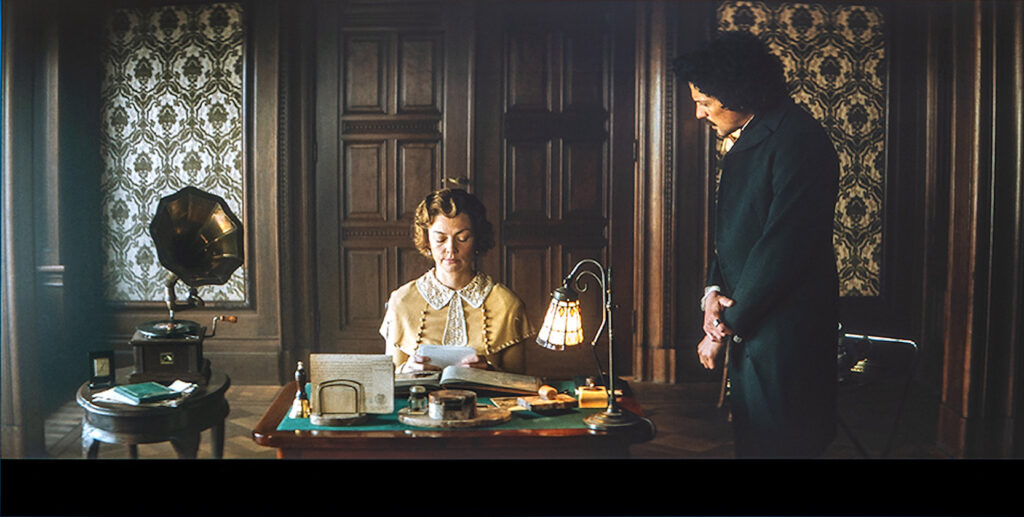
The film’s only non-Palestinian character is a woman sitting at a desk with her photo collection. She and her husband were great travelers, she tells the merchant as she flips through an album. He was a passionate amateur photographer.
“My husband was the U.S. ambassador in Beirut,” she says impassively, “dealing with the French.”
“Why the French?” he asks.
“Who else would he deal with?”
“The Ottomans.”
“No,” she demurs, eyes returning to her album. “No more.”
The merchant also stumbles upon a young woman sitting alongside a little boy, who lies unmoving, eyes closed, throughout. When he approaches, she looks up from the child and raises a finger to her lips to shush him. Merchant and observer alike are left to speculate about her untold story and the most-cherished possession that embodies it.
In the feature film version of A Sunken Tale of Losses Delayed, which has yet to premiere, the story of the young woman and child is related more explicitly. Here, her silence lingers as a compelling metaphor.
An art of narrative appropriation
Sansour has long used the cinema genre to make visual art and film that scrutinizes dispossession, in a language that speaks both to the contemporary art cognoscenti and a wider public.
Some of the artist’s early no-budget pieces are ironically light-hearted, addressing life under occupation through the lens of kitsch. In her 2004 Bethlehem Bandolero, for instance, Sansour dons the garb of a Mexican bandit, toy six-guns and all, for a showdown with the Israeli separation barrier.
Later, the artist incorporated elements of science fiction into her shorts, winking at the idea of the post-Oslo Palestinian state (A Space Exodus, 2009) and the state that might be erected for displaced people on the enclosed remains of their ancestral land (Nation Estate, 2012).
More recently, Sansour and her creative partner Søren Lind have applied genre conventions to ambitious, sometimes dialogue-centered, projects.
Hinging on a psychiatrist’s conversation with a woman who says she’s part of a “narrative resistance” organization, the sci-fi premise of In the Future They Ate from the Finest Porcelain is provoked by Zionism’s use of archaeology to justify its brutal settler-colonial regime.
In Vitro, 2019, is premised on a future in which the people of Bethlehem have been driven underground by global political and environmental collapse. The depleted community has resorted to exporting individuals’ memories into clones. The film comprises a sparring session between a cloned young woman (Maisa Abd Elhadi) and her ailing adoptive mother (Hiam Abbass).
While nodding to Ridley Scott’s Blade Runner, this intergenerational exchange also captures the burden of memory that has been passed on to Palestinians of every generation since the Nakba. An inheritor of nostalgia for a land she’s never known, imbued with longing for a life that is not her own, the young woman feels imprisoned by history.
This discussion is echoed in the repartee of A Sunken Tale, when the captain warns her guest of the dangers of adopting fictions that hold you hostage.
“We’re always interested in how memory works,” Sansour says when we converse, speaking from London, fresh from a shoot in Andalusia. “Be it personal or collective memory, national history or colonial history, it keeps coming up in our work.”
Whether they are set within a sci-fi-inflected plot or a ghost story, the arguments in these films are never resolved.
“It never really occurs to me that my films have a message,” Sansour reflects. “All these ideas and associations are just floating around. The films talk about things that are worth considering, rather than having one disprove the other.”
Historic objects, scars of time
Early in the film, the captain cheerfully confesses that she faces a death sentence in multiple jurisdictions. “I took some cargo that some saw as their own,” she explains, but “piracy is in the eye of the beholder.”
Objects confirm stories, the captain tells the merchant, then takes him on a tour of her own collection. “The artifacts aren’t mine,” she says. “I’m just their guardian, until they can be returned.”
“But the artifacts are not the stories,” he notes.
“Maybe not,” she admits, “but if we leave them to the looters, they get to spin their own tales and rewrite history.”
This exchange takes place while the camera lingers over historic pieces — a shipboard pendulum clock, say, or a mechanical timepiece with a maritime diorama — and through more or less realistic locations. Many are shot in the Museum Batavialand. A memento of European imperialism, it is a reconstruction of the merchant warship Batavia, originally built for the Dutch East India Company.
Others, like the captain’s grand memorial hall (shot in an ornate interior space of Amsterdam’s Royal Institute for the Tropics) could only exist on a ghost ship. A candlelit sequence in the ship’s hold, showing antiquities looted from Southeast Asia, was shot in the depository of the Wereldmuseum.
A skeptic might remark that placing the commissioner’s holdings in the frame smacks of product placement, but objects’ symbiotic relationship to narrative is a significant part of Sansour’s recent work.
A reflection upon the unreliability of memory, Familiar Phantoms draws upon family photos, home movies, and reenactment. It also references Sansour’s childhood possessions from before she was forced to leave Palestine in the 1980s. The film’s voiceover likens these pre-exilic objects to the artifacts of the ad hoc archaeology of memory.
“We wanted to complicate how museums archive and categorize objects,” Sansour says of exhibiting memorabilia of her youth — a pair of plastic eggcups or a statue of Misha, the mascot of the 1980 Moscow Olympics — alongside museum pieces like a reliquary of Palestinian soil from 1672.
“It was really funny when I handed my bag of childhood objects to the museum,” she smiles. “The care with which they handle every object feels exaggerated when it’s your own things.”
When placed in a museum context, the artist’s ceramics — the fictional artifacts of In the Future They Ate from the Finest Porcelain — provoked different feelings. “The idea was, how do you animate these objects as though they are museum artifacts? [But in a vitrine, museum pieces] are just dead. They are given life by making them political objects, using them to weaponize your narrative — as Israel uses archaeology to justify taking more land.”
Sansour and Lind are interested in how trauma is inscribed. In Familiar Phantoms, the narrator muses that “Biology keeps its own records.” Trauma is evident not merely in individuals’ lacerations and broken bones but in their genes, so that pain is handed on to ensuing generations.
In A Sunken Tale the captain remarks, “The sea keeps its own records. Gradually those records merge to form a much bigger story.” It’s tempting to read Sansour’s sea as a metaphor for exile.
“In part,” Sansour says, “[we wanted] to cement Palestine’s identity as a Mediterranean seafaring nation. That’s always taken away from Palestinians because, obviously, Israel wants to take the sea, as it’s doing right now in Gaza, Palestine’s last seafront …”
“I find things have many readings,” she adds later. “For me, mostly, it’s the fact that with the formation of the state of Israel, the Jewish people suddenly rejoined the historical narrative. Palestinians were ejected from history. They are sailing in a parallel realm, just trying to get to their destination.”
Larissa Sansour’s Rogue Agents of History, curated by Nat Muller, is up at Amsterdam’s Wereldmuseum through September 27, 2026.