Youssef Rakha searches for a Muslim modernity beyond Islamism and liberalism—but can he escape the latter’s terms?
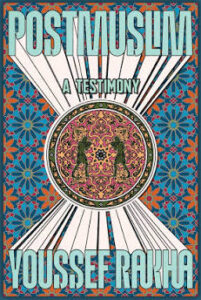
Postmuslim: A Testimony, by Youssef Rakha
Graywolf Press, September 2026
ISBN 9781644454152

In Postmuslim, Youssef Rakha poses a deceptively simple question: What should contemporary Islam look like, and more specifically, how to “assert Muslim identity without accepting the standard interpretation, which they [Islam’s orthodox ideologues on one hand, and Islam’s detractors in the West on the other] represent?”
That line of inquiry is peppered with ideological trapdoors. One relevant if historical example is the exchange between the French orientalist Ernst Renan and Sayyid Jamal al-Din al-Afghani in the spring of 1883. In a lecture at the Sorbonne, Renan lambasted Islam as the chief impediment to scientific and civilizational progress in the East. He argued that Islam produced intellectual sterility even while conceding that “for around five hundred years, there had been scholars in Muslim countries, very distinguished thinkers. One can even say that, during this time, the Muslim world had been superior in terms of intellectual culture to Christendom.” For Renan, there is no contradiction. It is simply the case that the “brilliant caliphs” of Islam, those who promoted reason, science, and innovation, “were barely Muslims. They practiced externally the religion of which they are the leaders […] but their mind [was] elsewhere.” Even Renan’s admiration for the Persian Empire as an example of civilizational “genius” was qualified by the claim that Persians were “basically more Shiite than Muslim.”1
A translation of the lecture reached al-Afghani, a modernist Muslim thinker who sought to rehabilitate Islam and science. But in his response—a letter addressed to Renan directly—Al-Afghani is diffident and fawning. He addresses Renan as a “great thinker of our time” who “applied himself to discovering historical truth and making it known to those who do not know it.” Al-Afghani offers only “some observations,” but not before “hasten[ing] to recognize that Monsieur Renan has acquitted himself marvelously of this very difficult task […] I find in his talk remarkable observations, new perceptions, and an indescribable charm.” Al-Afghani largely accepts Renan’s premises. He admits that Islam has indeed “tried to stifle science and stop its progress […]”; his only protest is to wonder whether the “obstacles” preventing the full uptake of the ideals of science “come uniquely from the Muslim religion itself or from the manner in which it was propagated in the world; from the character, manners, and aptitudes of the peoples who adopted this religion.”2
The significance of the exchange lies in the terms of the encounter itself. In the process of defending Islam against western modernity, Al-Afghani is forced to argue on premises that already concede western modernity’s authority to define progress. It is this dynamic—though neither Renan nor Al-Afghani is invoked by Rakha—that illuminates the central problem of Youssef Rakha’s Postmuslim.
Following The Dissenters (2025, Graywolf Press), Postmuslim is Rakha’s second book in English. It is about being Muslim in the liberal West and being liberal in Islam, about Rakha’s crisis of faith in both as each betrays their purported value systems, and about the political disillusionment and spiritual homelessness that follows from that crisis. The book is also a memoir, a philosophical coming-of-age set against the background of a contemporary Egypt still torn between fidelity to its Islamicate, Kemetist, and postcolonial inheritances, and the temptations of an increasingly unipolar global system amid civil and political unrest. Rakha spends much of the book tracing the intellectual and spiritual journey from naive and overzealous rebellion against his inherited Egyptian intellectual traditions to gradual disaffection with the liberal alternatives on offer. He finally arrives at a bespoke Arab-Muslimhood that attempts to reconcile the eclectic range of influences, ideologies, and doctrines at work in his formation as a global citizen: “…the wannabe mystic in me meets the rationalist. The secularist meets the Muslim. The liberal pays obeisance to the decolonial theorist.” In doing so, he attempts to avoid the same traps that ensnared Al-Afghani over a century earlier.

Rakha is not particularly generous in his description of contemporary Sunni Islam. Born in the late 1970s, Rakha came of age as a hardened brand of religious conservatism, bolstered by Iran’s Islamic Revolution, took root in Islamic societies. In Egypt, Gamal Abdel Nasser’s socialist nationalism gave way to Anwar Sadat, dubbed the “pious president.” Nasser had come down hard on Islamism in his own time and imprisoned members of the Muslim Brotherhood. In a speech to the Egyptian public, he openly mocked the Brotherhood’s leadership for suggesting the idea of an obligatory hijab.3 Sadat, on the other hand, sought to appeal to the religious right. He patched things up with the Brotherhood, freeing members imprisoned by Nasser. By the 1990s, the Muslim Brotherhood and its particular brand of conservative Islam held considerable sway over the domestic culture of Egypt, if not necessarily its politics. Conservative preachers, notably Sheikh Al-Sha’rawy, came to prominence and attracted immense followings. Naguib Mahfouz, one of Egypt’s two Nobel laureates, had his religiously allegorical novel Children of the Alley banned by the state for blasphemy and an attempt was made on his life. Indeed, at this time, Egypt saw a spate of religiously motivated assassinations as well as terrorist attacks across the country’s major urban centers, a number of which Rakha details throughout Postmuslim.
Growing up, Rakha’s experience of the development of religious conservatism in Egypt oscillates between disappointment and resentment. He details the hypocrisies and contradictions that abound in orthodox Islamic society: “Egyptians embrace the technology, the consumerism, even the political rhetoric of the West, but not the intellectual and moral freedoms that made them possible. Wi-Fi is okay, but not civil marriage.” He is similarly irked by the way certain religious obligations reinforce inconsistent social mores that stunt his personal growth—how Ramadan, for example, becomes “just an excuse for people to be obnoxious during the day, only to gorge themselves on the pleasures they pretend to be renouncing as soon as the sun goes down.” More significantly, Rakha finds himself ashamed and angry at events like the 1997 Luxor massacre and 9/11. For him, it is not enough to recognize the “movement of history” that created the conditions for Islamic extremism; Rakha insists on the agency and culpability of orthodox Muslim society itself, on the “Muslims who let that happen.” Political Islam in general is a nonstarter—the prospect of Islamist rule, for Rakha, can only result in “the persecution of difference, vigilante violence and the policing of personal [life].” Sunni orthodoxy in Egypt simply lacked “something essential to [Rakha’s] humanity.”
Postmuslim does not embrace western secular liberalism as the inevitable corrective to that orthodoxy. Whatever that missing essential aspect is, Rakha does not find it at his British university where he’s shunned and alienated by his peers for his religious and cultural background—a “tormented impurity in the quarts of Middle England.” Nor does he find it in liberalism’s historically dubious moral track record since its conception, and certainly not after the most recent genocidal atrocities committed in Gaza since 2023. Citing Gamal Abdel Nasser’s failed secular nationalism in the 1950s and ’60s, the “stillborn” leftism of the Student Movement in the ’70s, and the decidedly authoritarian outcomes of Egypt’s Arab Spring experiment, Rakha remains unconvinced of western liberalism’s hallmark claims to universality and of its utility or relevance as a framework for enacting political change in Egypt.
Against both the mainstream Islamist and secular liberal dispositions on offer, Rakha proposes the titular “postmuslim” orientation. The idea emerges piecemeal throughout the book, constructed from the remnants of Rakha’s disaffection with the two poles of Islam and liberalism: the Abrahamic “willingness to relinquish control of the world to an unseen greater power” and the necessity of “[c]laiming full citizenship in the modern world.” The book rejects the idea of Islam as the barbaric foil to enlightened secular civilization while acknowledging the historical breadth of Islamic doctrines that hegemonic orthodoxy came to flatten and supplant. It is an orientation that integrates and legitimates Rakha’s alternative spiritual experiences with hashish and psychedelics, his visions of patron saints, and his moral reckonings with political Islam as a historical reaction to western modernity’s ills.
But Rakha has not been addressing conservative Muslims. He, in fact, does not appear to address Muslims of any persuasion. His diagnoses of Islam’s ails and his prescriptions for them are not directed towards those for whom such prescriptions would perhaps be most relevant. He translates verses from the Quran and lines from Arabic poetry into English before citing them. He is careful and quite meticulous in contextualizing and explaining Islam’s basic precepts and dictates, as he is with the detours he makes to Islamic history and his references to Egyptian politics and pop culture. As a published writer, Rakha’s career for the past two decades has been firmly planted in the Arabic literary tradition, but Postmuslim, by contrast, is written entirely in English. It bears asking: Who is Rakha writing for? To whom is Postmuslim addressed?
Like Al-Afghani before him, Rakha writes with a liberal, western interlocutor in mind—a neo-Renan. Though not as conspicuously deferential as his predecessor, Rakha’s Postmuslim is not simply a manifesto of the author’s personal convictions, but a response to a discourse.
It is a timely intervention. Unlike Al-Afghani’s, Rakha directly challenges liberal discourse about Islam—it is a “perversion of the world [he] inhabit[s].” He addresses this neo-Renan to challenge a liberalism all too eager to accept at face value the claims to religious hegemony made by a reactionary mainstream Islam and treats Islam as its diametrically opposed Other. Postmuslim reiterates the common, if often-ignored, point that the reactionary character of mainstream Islam is not inherent to Islam but conditioned by liberal modernity. Consequently, liberal modernity is certainly not to be trusted to provide an escape from reactionary Islam. As aggressively assimilatory as it might be, the West has failed to account for Muslim subjects in their full complexity or produce them as coherent liberal subjects in its own image.
But, as with Al-Afghani’s encounter with Renan, the endeavor of making Postmuslim legible primarily to the West introduces a fundamental ambiguity into Rakha’s project. We find, for instance, that in order to make the point that liberalism has failed to take root in Egypt, Rakha goes to great lengths to demonstrate the illiberalism of Egyptian society; at the same time, Rakha is found to complain of that very same illiberalism—indeed, it is that illiberalism that lacks “something essential to [his] humanity.” This indeterminism is present in Rakha’s views on the liberal ideals of the 2011 revolution. He lays blame at the feet of the revolutionary activist class for imposing a liberal vision of sociopolitical order onto Egyptian affairs, only to then accuse those same revolutionaries of being “just as dogmatic, just as illiberal as their Student Movement predecessors.” It is unclear whether Rakha takes the liberalism of the revolution as merely a projection of a West-dominated globalist agenda designed from the start to “promote low-grade civil war” and only “piety or patriotism” can reliably buffer against it, or whether it is the Muslim Brotherhood who “allied… with the generals in charge” to hijack the “billion hues of subversive creativity… vying for energy.” Rakha calls for an “alternative,” authentically Muslim modernity “without the shadow of the West weighing us down,” while insisting elsewhere that “we can only revive in communion with the dominant civilization.” Rakha hails the Ottoman Empire as the chief exemplar of his preferred model of an alternative, postmuslim society. He praises the ideologically decentralized, supposedly heterodox nature of the Empire—“unity in multiplicity”—as evidence of the capacity of a Muslim world, “informed not just by secularism but by enlightened values in general,” to participate in and even rule over a modern global system.
Though Rakha denigrates it by name, liberalism remains the mold shaping Postmuslim: it underlies the interpretations of Muslim history; it is in the rehabilitative impulse; it is in the identitarian approach to resolving a structural tension. The ambiguity, in precise terms, is whether Rakha’s Postmuslim rejects secular liberal modernity as such, or, echoing Al-Afghani, merely rejects the obstacles preventing the authentic uptake of secular liberal modernity. It is similarly unclear whether Rakha vies to oust liberalism’s hegemony or is simply outraged by unfaithful and opportunistic adherents. Indeed, is it possible for a book to fully reject the object to which it is explicitly addressed? Is it so easy to simply “[birth] an English-speaking version of myself that—disabused of liberalism—would exist seamlessly alongside its Arabic counterpart”? Postmuslim concludes and the deceptively simple question posited at the beginning lingers in the air, unanswered for all but Rakha himself.
1Ernst Renan, “Islam and Science: A Lecture,” trans. Sally P. Rabep, 2011.
2Sayyid Jamal Al-Din Al-Afghani, “Lecture on Teaching and Learning and Answer to Renan,” in Modernist Islam, 1840-1940: A Sourcebook, ed. Charles Kurzman (Oxford University Press, 2002).
3hossam hassan, جمال عبد الناصر يتحدث عن حواره مع الاخوان عن الحجاب, 2011, 2:10, https://www.youtube.com/watch?v=OWCJnFu9gF0.