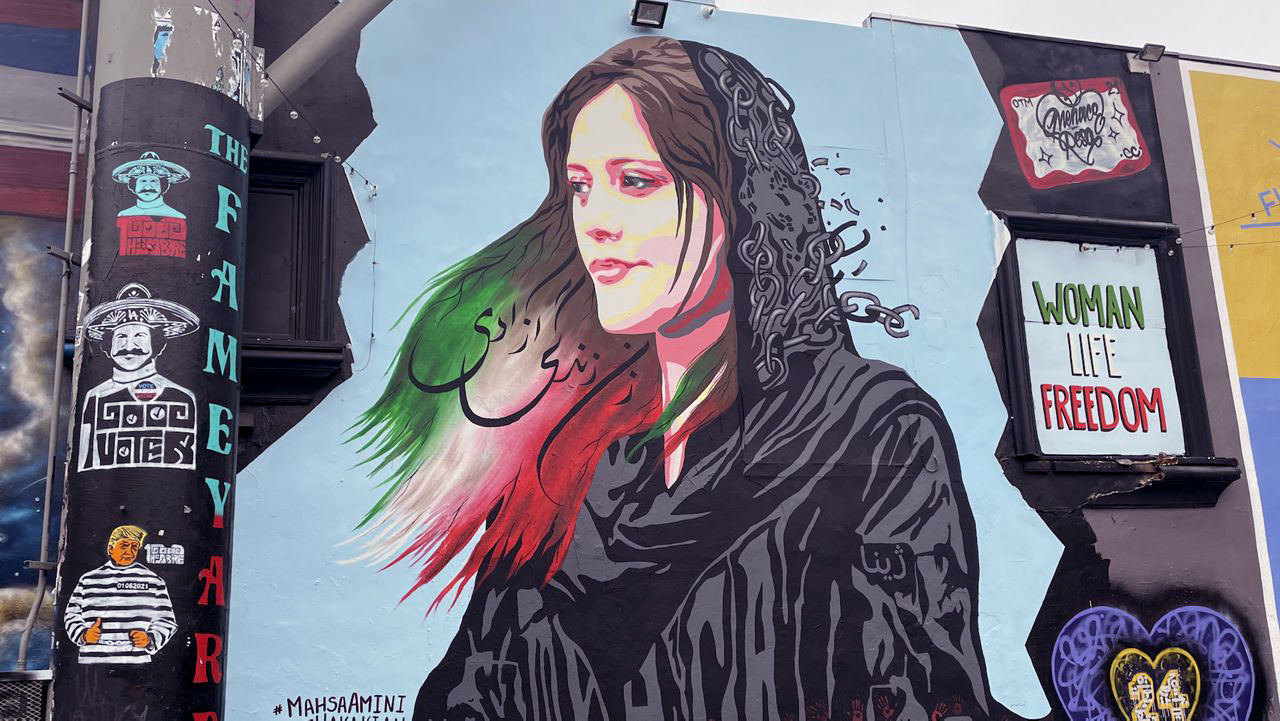
A small town couple have a brutally honest conversation about marriage in light of the “Woman Life Freedom” protests.
We were sitting on the balcony watching videos of the demonstrations in Tehran on our cellphones.
I told her, “This is the big one. This time they can’t just roll things up like all the times before.”
She was resting her head on my chest, watching the screen. “Is it really possible? Talk to me, Asghar. Tell me we’ll be free. We could go to concerts from now on. Go to the beach — and I could wear a bikini! Tell me it’s not all a dream.”
“It’s not a dream, my love. It’s real. We’ve turned into a nation of lions.”
“But the other afternoon when you were away, it got pretty rough around here. They hurt a lot of people.”
“I know. But it’s different this time. Don’t look at this nowhere town we live in. In the big cities, and not just in Tehran, no one’s backing down.”
She did not skip a beat: “Then I’m not wearing a hijab either, from now on. I’m going to the salon to bleach my hair. Afterwards, I’m going to the city.”
“City? What city?”
“You just called this a ‘nowhere town.’ And I agree. I want to go where the action is. Tehran, Mashhad, Tabriz, Esfahan … wherever.”
“What about me?”
“You can get yourself a new wife, darling.”
“I don’t want a new wife.”
“But ours was an arranged marriage.”
“Of course it was. Every marriage is arranged in this town. And what’s wrong with that?”
“Everything’s wrong with it. My youth was wasted on us, my dear. I like you, but I don’t love you. This town has slim pickings, and you and I got paired. Now I want out.” She pulled herself upright, put the cellphone away, and stared into my eyes. “If women are going to get their freedom, why should I spend the rest of my life with you? I don’t even like a man with blue eyes.”
“You don’t like my blue eyes?”
“I don’t trust them.”
“Then you’re going to find someone with brown eyes?”
“What I mean is, I’m not staying in this backwater anymore.”
“Fine. We’ll go to Rasht. Maybe even Shiraz. But, let’s admit, Tehran’s a bit expensive.”
She rolled her eyes. “If this government goes, you’ll have an army of women who’ll love your light hair and blue eyes. Come, let’s agree to get a divorce. Don’t waste yourself on me, dearest.”
“You’re being serious? If this regime falls, you want a divorce?”
“Yes.”
“Not on my life.”
“I am being honest with you, Asghar. How can you say you love me if you don’t appreciate my honesty?”
“I actually never said I loved you.”
“See? If you don’t love me, so much the more reason we should go our separate ways.”
“Are you insane? I’m out there every day, working myself stiff for a piece of bread and a roof over our heads, and you’re talking about divorce?”
“Asghar, whether you like it or not, I want a divorce.”
“But why?”
“Why? Because this life we live is empty. Empty! You think anyone will ever again want to watch a film with a woman wearing hijab once we’re free? Our lives are a lie, my precious. A woman in her own kitchen wearing hijab because she in a movie or a TV series. Do I wear a hijab in my kitchen?”
I shook my head.
“Exactly. It’s all a big lie. Admit it. And now the big lie is ending. Get used to it.”
She got up and left without another word. Went to her mother’s house, like all the other times we’d had a falling out. Two days later, when she returned, I’d been thinking.
I said, “I’ll give you back your dowry. Go do whatever the hell you want with it.”
“And what do you want?” she asked.
“A Peugeot. I’ve always wanted to drive a Peugeot. Without both of us to support, I can buy myself one of those beauties and move to Tehran and take my blue eyes with me.”
“So all that talk of ‘you are my one and only’ was just for show?”
“I swear, the thought of freedom got me truly thinking.”
“You’re not man enough yet for freedom. I was testing you to see what you’d do. You want a damn Peugeot out of all this. That’s all you care about.”
“But —”
“No but. Let’s watch some ‘Woman, Life, Freedom’ videos tonight. What do you say?”
“… I say whatever you say, my one and only.”
Salar Abdoh translated Danial Haghighi’s stories for the anthology Tehran Noir and the magazine N+1.