Seven Questions is a new series of conversations with writers about the questions that surround the making of fiction. Rather than focusing on a single book or the craft of writing, we’re interested in the messier territory of practice: the doubts, obsessions, routines, and uncertainties that shape a writer’s work, and the uneasy question of what purpose fiction serves in the world.
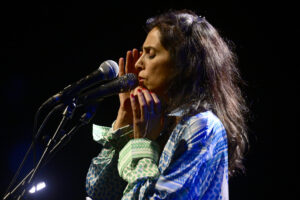
In this installment, Laleh Khadivi—author of the just-released Female Life on Planet Earth (Ecco/ Oneworld, 2026)—reflects on the strange elasticity of time, books as communal wonder, and maintaining faith in art as a form of human connection.
– Saleem Haddad, Fiction Editor.
What problem are you currently trying to solve in your writing?
Time. A book does not have to adhere to any of the laws of physics and so a single moment can last twenty pages while whole centuries can pass in a block of white space. This is not so much of a problem for me as an excitement for all the freedom, but then the freedom itself can become problematic as I try to figure out how much the reader will tolerate. I have read the metaphysicists who talk about parallel time and wormholes and the warp and weave of time in space, but I want all of that to appear in the story organically, believably, and pleasurably. I read Borges, Solvej Balle, and Duras for inspiration and permission.
What’s something readers often misunderstand about your work?
I don’t think there is such a thing as misunderstanding when it comes to a reader’s experience. Once a reader is reading the book it belongs to them, and their responses and thoughts might be different than mine when I wrote them, but I don’t create books to elicit particular reactions. My only intention is to get my idea on the page. I can’t really control what happens after that. Ideally, books are instigators of communal wonder. Misunderstandings can be a conversation starter.
What’s the hardest thing to write honestly?
Joy.
Which writer do you think deserves to be read more widely, and why?
Annie Ernaux, Mary Ruefle, Yusunari Kawabata, W.G. Sebald, Wanda Coleman, Nawal El Saadawi, Ovid, Sei Shonagon.
What does it mean to write fiction at this particular moment?
That you have faith in art as a bedrock of human communication. That human communication via art is urgent and necessary and part of our sustenance as a species. That you are ready to speak your mind and engage with the minds that receive it and, in this way, create a more communal human gathering in this particular moment.
What are you becoming less certain about as a writer?
Individuality. Originality. Uniqueness.
What is your current writing routine?
Defunct. My kids have been at home all summer. I have read in snippets, written in snippets, thought and wondered in snippets, and enjoyed my family in great waves of time. This, I believe, is necessary. Routines can lead to idea stasis.