Author Karim Kattan weaves Palestinian folklore, mythology, and queer desire into a powerful reimagining of love and liberation.

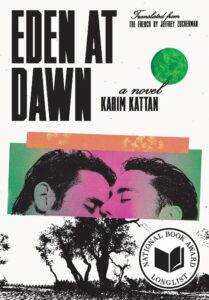
I briefly set aside Karim Kattan’s exquisite novel, Eden at Dawn, translated from the French by Jeffrey Zuckerman and recently longlisted for the National Book Award for Translated Literature, to scroll through a 1984 United Nations document outlining dozens of human rights violations Israeli forces had committed against Palestinians over the previous calendar year. Amid the chronological litany of atrocities—prison torture, bombs lobbed at newspaper offices, arrests of schoolchildren—I discovered that the September 10 birthdate of Isaac, one of the book’s two protagonists, would have coincided with Israeli forces seizing nearly 150 hectares of Palestinian land in preparation for an illegal settlement. The birthday of the novel’s other protagonist, Gabriel, Isaac’s beloved, fell as the Kahan Commission was preparing to release its findings that Israeli officials bore responsibility for the Sabra and Shatila massacre, where an Israeli-backed proxy militia slaughtered thousands of Palestinian refugees in Beirut.
Neither this particular expropriation of land nor the commission’s findings are explicitly invoked in the fictive realm of Kattan’s novel. Few legible horrors, uprisings, or milestones in contemporary Palestinian history are. In fact, Eden at Dawn’s godlike narrator asserts this of the protagonists’ births:
Like their names, this date carries no meaning. It merely conveys further information about the nature of their world. It informs you of how their body originally saw the world. What horizons arose for them, what boundaries.
There is a potent kind of tension here: on one hand, Kattan’s narrator often eschews historical specificity and asserts meaninglessness in its sparing employment, yet, on the other, insists on certain dates and names (as with “Isaac” and “Gabriel,” a foundational patriarch and the angel who heralds his birth across all three Abrahamic faiths, respectively) and ascribes to them the very “nature of their world.” Which of the forces that exert themselves upon people—upon a people, even—are wielded, acknowledged, and entered into official narratives? I asked myself this as I set the novel aside and sought out the UN communique, imagining these two queer men tumbling out of the narrative and into our real world: one born amid a violent rending of homeland and the other in the wake of an official report on the slaughter of refugees who thought they’d escaped harm.
Perhaps the real power in this tension is the impossibility of incorporating any date in contemporary Palestinian history into a work of fiction without invoking atrocity—and even as one specific heinous act comes to light, another is likely taking place, unacknowledged, unknown, in the darkness. Is escape ever possible? And how might a life, a love, an escape be narrated in a manner that might overcome subjugation, suppression, extermination? These are some of the urgent questions animating Eden at Dawn, a novel both muscular and ethereal, where parables collide with folklore, mythology, and queerness amid two Palestinian lovers’ quest for a refuge seemingly just on the horizon, just beyond daybreak.
Is escape ever possible? And how might a life, a love, an escape be narrated in a manner that might overcome subjugation, suppression, extermination?
What are these characters escaping from exactly? Before we even meet Isaac and Gabriel, we learn that their entire country is contending with a merciless sandstorm, the notorious khamsin, which has arrived out of season and refuses to abate. The novel is set in a place suffering from a literal “scrim of sand” where “nobody could breathe,” but we also come to sense that this atmospheric condition and its accompanying claustrophobia are both allegorical and foreshadowing. Even the employment of the word “khamsin” recalls the parting of the Red Sea in the Book of Exodus, and as we move into a grand, epic mode of storytelling that feels scriptural, the contemporary begins to peel away— “drones and watchtowers were now useless” —and the country itself falls “back to the Stone Age.” And yet, crucially, Palestine is still there, named—the narrator conscious not to reduce it to mere symbol: “The name has to be anchored in this reality, or otherwise it would fly off, would become air, nothing, immaterial.” Amidst the storm, Palestine has only “seemingly slipped away” (emphasis mine); its “geolocation systems” have not disappeared but are merely “disrupted,” suggesting a country which is not lost but only obscured from a particular line of sight, a particular kind of consciousness all too willing to turn away from humanitarian crisis, if not Palestinian humanity altogether.
Pointedly, our protagonists are introduced only after their setting is, and these two men are depicted in a similar hybridity of modern specificity and mythology. We learn that Isaac is aesthetically unremarkable (the narrator offers the deliciously sardonic “thin but not ugly”) yet with feet like “that of a Grecian statue.” Gabriel is more remarkable and striking—“an angel,” even—yet is burdened with a lisp, the “one shortcoming of his physical being which made him seem human.” The aperture on Isaac and Gabriel continually shifts, widening and tightening to offer both contemporary exactitude and an air of the prophetic: Isaac with his American pen pal and curious childhood desire to become a saint, Gabriel marked by an early tragedy involving his childhood dog and a military jeep as well as his nightmares of an amorphous darkness.
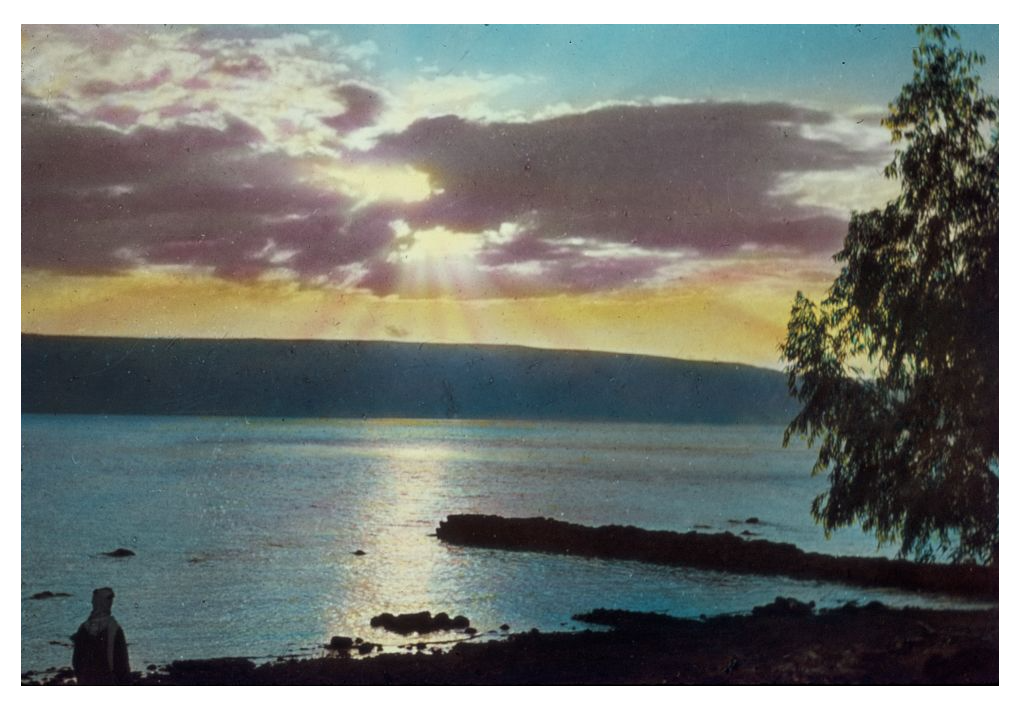
This all might seem like too much preamble, but the early narrative takes the shape of canonical gospel and marks Isaac and Gabriel as fated yet bearing a stark, tangible difference inexorably linked to setting and place: as they enter adulthood, Isaac’s freedom of movement through his cherished Jerusalem is restricted as a new West Bank ID cardholder while Gabriel has a measure of refuge in Birzeit. The depiction of Gabriel’s secluded town is especially crucial, illustrated as almost mythologically sheltered by blizzards and broken municipal clocks. Though Birzeit in reality experiences occasional snow, this hyperbolic description of an isolated place “lost more and more in the mists of time” evokes a landscape before Israel’s deadly crackdowns on the First Intifada, with “no separation barriers, no checkpoints, no soldiers.”
Isaac experiences the most immediate precarity, not just in his literal movement through Jerusalem but also in his compelling psychosexual navigation, pining to enter the city to “watch the boys’ asses and arms and elbows.” When he is granted a contingent permit to work in Jerusalem as a young night shift receptionist at the Garden Tomb guesthouse, a name rife with symbolism, Isaac is soon confronted with Gabriel, a man who recently enchanted him during a chance encounter over a card game. But we learn that Gabriel has also been held in thrall by this enigma who he regards less like a fellow young man and more in the supernatural terms of an “apparition” or a “jinni that he hardly dared to picture.”
Here, Isaac takes his paradoxically clearest form not as human but as storyteller. Amid the peril of the khamsin, Gabriel returns again and again to the guesthouse to hear Isaac spin increasingly elaborate yarns that weave Abrahamic eschatology—figures like Gog and Magog—with rich Islamic and Palestinian folkloric symbols like the bulbul, an enduring messenger of love and unity. There is a captivating metatextual element to Isaac as storyteller—we remain cognizant of how Isaac shares his name with the Abrahamic prophet while also registering his young dreams of prophethood in another form, hoping one day to “emerge like Al-Khader,” the Islamic figure of divine wisdom.
By wielding these tools of mythic narration and language, Kattan returns their power to Palestinians, redressing lost history and humanity.
Gabriel is depicted as a man who has been searching for wisdom: we’ve seen him since youth sketching voraciously, “filling his coloring books with black,” as though capable but perhaps lacking vision. Working now in architecture and with a penchant for gardening—here is a man with desires to cultivate, to nurture and build—Gabriel regards maps as talismans and even drew “a veritable spatial, temporal, and emotional map” of Jerusalem while searching the Old City for Isaac after their first meeting. We can feel him trying, if not quite succeeding, to illustrate the material and geographic reality of Palestinian dispossession. Ultimately, it is Isaac who provides this “languid” man with the inspiration to make a wild, even absurd, proposition that might become the simple, tangible evidence he desires: a vacation, a road trip together, a prospect so infrequently afforded to Palestinians in the contemporary imagination.
So what wisdom might Isaac be sharing with Gabriel and, by extension, the reader? Through his mythological and scriptural mashups, which Gabriel begins to sketch, perhaps it’s another way to see, another way to live. A more oblique and incendiary reading could suggest that queerness itself serves as both inspiration and wisdom. It’s Isaac who inspires Gabriel to recall an idyllic West Bank town he dimly remembers from boyhood—a place where he met another boy like him “singular, one, lone, alone”—and offer it as their literal and metaphorical way forward.
When they arrive at their destination after convoluted and dystopian Israeli blockades, both the setting—“a kind of Arcadia”—and prose open into something altogether more ethereal, complete with residents who “forget to die.” It’s here that Gabriel is finally inspired to reverse their roles of storyteller and listener, conveying a tale of people who “returned healed and beatific as if they had discovered… some splendor, the magic of alif, laam, meem” (a divine Islamic mystery known only to God). We sense that Gabriel hopes to glimpse his future in this story, particularly as we learn that he views this holiday neither as permanent escape nor as symbolic ceding of the self—indeed, he declares that “Jerusalem is where he wants to live out this love.” Here, we might note echoes of queer theorist José Esteban Muñoz in his Cruising Utopia: “The future is queerness’s domain. Queerness is a structuring and educating mode of desiring that allows us to see and feel beyond the quagmire of the present. The here and now is a prison house.” In both Gabriel and Muñoz’s utterances, a direct line between queer and Palestinian liberation comes into view.
The impediments to this liberation, we are reminded throughout Kattan’s deft and elegant novel, are at once literal and metaphorical. It’s the Israeli infrastructure of both transportation and apartheid, captured in the abusive checkpoint soldier. It’s the Israeli violence that is inflicted upon both Palestinian bodies and Palestinian land, as with Isaac’s caustic figurative assessment that it “wouldn’t be the first time that there’d been a man who wanted to set his hands on him.” And it’s the western diplomat, the aptly named Mr. Wargrave, whose exploitive assistance is contingent on Isaac offering him gratification both sexual and moral. (Wargrave is an especially finely rendered symbol of the colonial pharisee, down to his egregious mispronunciation of Isaac’s name and his insistence that uncovering whether Isaac is circumcised will also reveal his worldview. A particularly acerbic late scene of Wargrave traveling to Tel Aviv sharply parodies the western gay man seduced by the easy rhetoric of pinkwashing where, only here, as opposed to in Palestine, was he “among his people.”)
We especially ought to reckon with the device of the godlike narrator who insists, through the biting indictment of direct address, that you—yes, you—might be part of the structure of these impediments toward Palestinian liberation, calling out “your silence,” lambasting “how you all count the dead because you are cruel,” insisting that it is “counting on you.” This narrator—“every sky through every bedroom window”—is authoritative, asserting that it sees what you are choosing to witness or ignore. But it’s also kaleidoscopic and divine in its beauty—“everywhere the same, and everywhere a different sky… I, elusive, am what they share in their sleep.” By wielding these tools of mythic narration and language, Kattan returns their power to Palestinians, redressing lost history and humanity. He also reveals a bitter irony in the ostensibly sacred values embedded in parable and religious scripture—empathy, solidarity, compassion—not being afforded to contemporary Palestinian lives.
Kattan dares to imagine and reify a queerer, more prosperous future for himself and his people
When this narrator reveals the bed in which Isaac and Gabriel spend their holiday, we see it “open to the elements,” sitting in direct opposition to an earlier scene with Isaac “exposed to the elements” in Jerusalem. The khamsin—the material reality of occupation—seems briefly distant, but there will be no staid narrative of escape via domesticity alone. We recognize this Eden-like mythological place as a temporary suspension—two men laying together in an embodied queerness demonstrating ways of living beyond the present. Kattan’s fictional world is a bold image of Palestinians rising above the historical and political narratives imposed upon them without Palestine itself being disappeared. Here, we might all set the novel down briefly, as I did in search of the UN report, to come to terms with the tension between myth and reality, considering the early symbolism of Isaac’s young, blonde American pen pal suggesting he “take up as little space as possible. Hold back so steadfastly, curl up so tightly as to vanish from the world.” It seems to be the only fate afforded to Palestinians geographically and psychically—even in literature. Instead, Kattan dares to imagine and reify a queerer, more prosperous future for himself and his people: “working miracles” so “then it will be the world that curls up tightly to make way for us.” To this, Kattan’s transcendent narrator might add the oft-repeated scriptural refrain: “And it was so.”