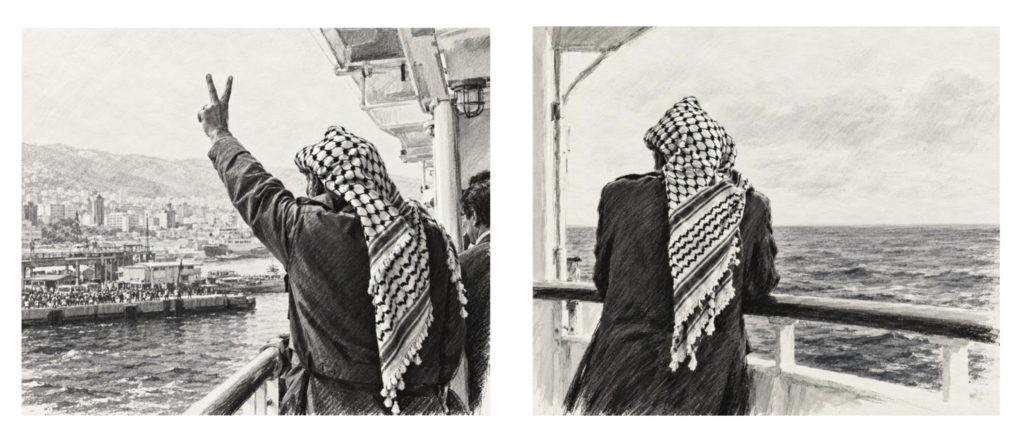
You’re looking at visual renderings of two iconic photos of the Palestinian leader Yasser Arafat (aka Abu Ammar). They were taken in 1982 by Fouad Elkhoury, aboard Atlantis, the boat that took Arafat from Beirut’s shores to those of Athens. He landed in Tunis 24 hours later, where he would spend twelve years in exile. In one, he is flashing his trademark victory sign; in the other, he is staring out to sea.
When it came to distilling sublime victories from glaring defeats, Arafat was known not to mince words. As the Israeli army began to lay siege to Lebanon’s capital in June 1982, Arafat predicted that “Beirut will be the graveyard of the invader and the Stalingrad of the Arabs.” On the eve of his departure in August, he proclaimed the PLO’s defense of the besieged city “a symbol of heroic victories.” So would argue many of his advisers in the ensuing months. In the lexicon of liberation movements, survival to fight another day can be a form of triumph, but the claim has to resonate. In 1982, it no longer did, even within Arafat’s circle. The crescendo of triumphalism that bounced off the walls of the Palestine National Council meeting in Algiers in 1983 prompted Issam Sartawi, one of Arafat’s more sober advisers, to deadpan that “one more victory like Beirut, and we’ll hold our next Palestine National Council meeting in Fiji.”
But there was more to Sartawi’s biting sarcasm. It was actually to Oslo that Arafat began to march––a destination the PLO’s 1982 rout had effectively set for its leader. He and his movement had become powerful emblems of the yawning void between the yearnings of a dispossessed people and the meager accomplishment of their liberators. An elaborate narrative of Palestinian struggle and liberation had, finally, collapsed into that widening chasm in 1982 and its aftermath. Not known for studied introspection, Arafat drew all the wrong lessons from the crushing setback. He had hoped that the 1993 Oslo Accords would reclaim for him his liberationist bona fides. Instead, they very quickly turned out to be, as Edward Said famously termed them, “an instrument of Palestinian surrender, a Palestinian Versailles.”
Had, say, the PLO been capable of the hard task of self-reflection, might the historical record have been kinder to it––and the Palestinians?
If Arafat has the dubious distinction of having shepherded the Palestinian people to the vast desolate expanse between bravado and brute fact only to leave them stranded there, Egypt’s Gamal Abdul Nasser bears the burden of consigning an entire would-be Arab nation to the same fate. His bane was the 1967 debacle. What brought low Nasser had ironically propelled Arafat to the helm of the PLO in 1969. Incidentally, these two men were not brothers-in-arms exactly. Eric Rouleau described their relationship well: “A stormy love affair—a mixture of attraction and aversion, respect and suspicion, quarrels and reconciliations.” Neither man stumbled into his towering stature, nor were they singularly responsible for their tragic inheritance. Certainly in Nasser’s case, there is considerable weight to the historical argument that the transnational appeal he built through impressive early feats marked him out for a catastrophic defeat. His mistake was walking into it. It wasn’t his first but it was the gravest.
Arafat had the stronger heart. He survived to compound, by multiples, his mistakes. Nasser died in 1970 very well aware of the magnitude of the loss, however quickly his regime spun the calamity into a glorious escape: Israel and the U.S. wanted to bring the Egyptian regime down, it survived, they lost. That claim, in full view of the catastrophe, didn’t have much purchase either. But the man was Nasser and the country was Egypt. It held well enough for the titan. In the three years between the war and his death, there were signs that Nasser saw the rot but hesitated before the cure. His passing rendered the possibilities moot.
Had, say, the PLO been capable of the hard task of self-reflection, might the historical record have been kinder to it––and the Palestinians? Counterfactuals are the work of the devil. Besides, it seems simplistic to ask this question about systems whose longevity relies on instruments that smother precisely such thoughtful processes. And not through sheer oppression alone, but through well-fed climates of stigma and taboos and traitor-baiting.
It is against this backdrop that Hezbollah, very capably, has authored its own story since its emergence on the scene in the early 1980s. For decades, the resistance prided itself on a singular achievement in the Arab world: it delivered for its people the tangible rewards of sacrifice. In the south, it liberated the land from an Israeli enemy notorious for holding on very tightly to its conquests in the Mashreq. In Lebanon, along with Nabih Berri’s Amal Movement, it monopolized Shiite representation, marshaled state resources, spent generously on its communities, and dominated politics. In the region, it became a main player in Iran’s rejectionist front. But it was the very narrow gulf between claim and performance, first and foremost against Israel, that spoke to many an Arab’s aspiration.
Inevitably, Hezbollah’s many successes grew its list of enemies and made it a much pursued target. They also camouflaged its weaknesses and the accumulating tarnish from its misadventures and overreach. Its fabled leader, Hassan Nasrallah, like Nasser before him, acquired the qualities of a mythical hero worthy of worship. In 2023, such was his eminence when he entered a war with Israel whose tempo he thought he could control. The traces of 1967 in the sketch I draw, however faint, are not accidental.
Nasrallah was killed by an Israeli strike on September 27, 2024. I don’t know if Israel meant to keep him alive long enough to have him witness the devastating body blows to Hezbollah, from the death of Fouad Shukr, the resistance’s chief military commander, to the pager attacks, to the elimination of the senior command of the elite Radwan unit. But there can be no doubt that, much like Nasser, he went knowing full well the enormity of the failure. So do his isolated heirs, who contend today with unprecedented destruction and suffering in the south. But as whole swathes of it disappear into ash and are devoured by Israel, they scream survival as triumph into the silence. They have opted to abandon their people in that vast, desolate expanse of empty bluster and victory signs. And for those who dissent, the proverbial lash. 
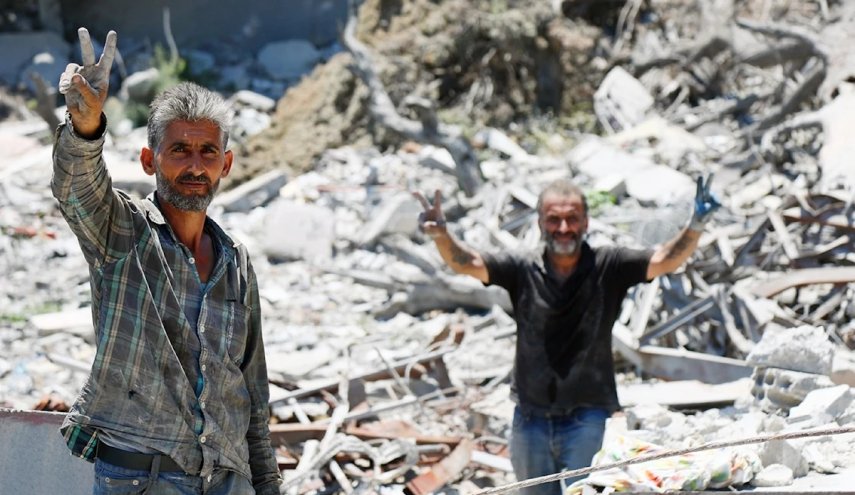
Whether Iran, where essentially all power lies, is abetting this drift or is frustrated by it is hard to tell. Suffice it to say that for the first time in decades, the Shiite duo, now a beleaguered resistance and a much aged and hollowed Amal, are confronting their hardest challenge yet. How they fare is potentially seismic for the Shiite sect and for Lebanon.
On Another Note
I leave you with a wonderful short film on Beirut’s Le Grand Théâtre, part of the Beirut Stories series. It’s the production of a dear friend, Karim Mrowa, and Tarek Kawwa.
Amal Ghandour’s biweekly column, “This Arab Life,” appears in The Markaz Review every other Friday, as well as in her Substack, and is syndicated in Arabic in Al Quds Al Arabi.
Opinions published in The Markaz Review reflect the perspective of their authors and do not necessarily represent TMR.