 Seven Questions is a new series of conversations with writers about the questions that surround the making of fiction. Rather than focusing on a single book or the craft of writing, we’re interested in the messier territory of practice: the doubts, obsessions, routines, and uncertainties that shape a writer’s work, and the uneasy question of what purpose fiction serves in the world.
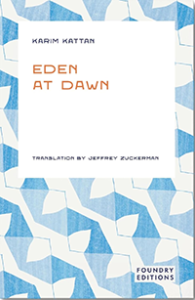
In our first installment, Karim Kattan—author of Eden at Dawn (Foundry Editions (UK)/ Restless Books (US), 2026), which was just longlisted for the 2026 National Book Award for Translated Literature—reflects on dead ends, the limits placed on Palestinian imagination, the strange workings of literary attention, and learning to relinquish control.
– Saleem Haddad, Fiction Editor
What problem are you currently trying to solve in your writing?
Right now, I’m working on a book that’s very, very dear to my heart and that I’ve been trying to approach in various ways for the past decade. Every book I wrote started by being an attempt at this one, then grew into something else. Sometimes books feel better as projects or dreams rather than something you’re actually writing.
My current project is closer to nonfiction, a genre I’m not very comfortable with, so I’m taking it one day at a time. The problem I’m facing is how to enter this text. I keep trying various ways, but they’re all dead-ends.
I generally like dead-ends. I don’t have many beliefs about how one should write or what writing is, but I do think that writing yourself into corners—getting lost, wandering, until you find your way, or deciding you’re not looking for a way in or out of a book—is often a good way to approach the craft. But in this case, I keep getting stuck in ways that don’t feel generative. Just stuck. I haven’t found the compass in this text yet.
What’s something readers often misunderstand about your work?
Palestine. I can write science-fiction on nonexistent planets, or poems about a temple in Kyoto or an obscure Arthurian legend, or fantasy short stories with goddesses and sentient rainbows, and readers will still try to find Palestine there. As if I were unable to invent anything else. As if Palestine is the only thing I can write about. The thing is, writing and reading are, for me, very concrete and sensuous experiences. Words and images are like sounds and rhythms and colors that I assemble. This is what I enjoy doing. Each word is a world in itself and you see what happens when you weave them. I don’t start a fiction book saying: “oh, this is what my statement about this issue is going to be.”
Not to say that books aren’t political, nor that they don’t address the circumstances of their production. They do, and they should; we are where we come from; we are what material realities fashioned us. And of course, when you are Palestinian, there is a particular, inescapable way you are shaped by your history—especially since the genocide, but even before. I don’t mean to say that we are magically absolved from all political responsibility.
But I think there’s a racist, sometimes orientalist, sometimes self-orientalizing, or at least a very condescending assumption that we, Palestinians or Arabs, can only write what we know because we have no access to imagination. So readers go looking for Palestine (it’s there in my books, naturally), but don’t see anything else. When this happens, I feel that there is a fundamental misunderstanding about what writing is and how expansive our worlds can be.
Eden at Dawn, a book that does indeed take place in Palestine, opens with two quotations from Colette and Jean Cocteau that address the main aspect of the book for me: metamorphosis. I chose them because Colette was a very important, liberatory, writer for me in my teenage years, and Cocteau’s play speaks perfectly to the themes of Eden. When the novel came out in the French original, I kept being asked about Palestinian writers who had influenced me. Now, sure, there are many. But why don’t they ask me about Jean Cocteau? Why don’t they ask me about Colette? They’re right there on the first page. Do they not think that a Palestinian writer can have something relevant to say about Cocteau or Colette’s work? You don’t ask a French writer which French writers influenced them: you just ask which writers influenced them. This is changing for me, now, and I am supposed to take this as a sign that I am being taken seriously as a writer. That I am being accepted into “general literature” rather than what, in France, is often called “l’ailleurs.” But the very fact that this threshold exists can sometimes be insulting.
I generally like dead-ends. Writing yourself into corners–getting lost, wandering, until you find your way, or deciding you’re not looking for a way in or out of a book–is often a good way to approach the craft.
What’s the hardest thing to write honestly?
Anything autobiographical. The project I mentioned earlier requires me to use an “I,” which would be me for all intents and purposes. I don’t like this, nor do I know how to do it. I wrote some very personal, intimate poetry, for example, but I only wrote it because I was convinced no one would ever read it. I eventually decided to publish a poetry collection, but I never would have been able to write [the poems] if I had known it would be public one day.
Which writer do you think deserves to be read more widely, and why?
Everyone! We should all be paying more attention to less visible books. Publishing is an industry, and it produces an ocean of books and texts every single day. And publishers—especially those with proximity to money, power, or influence, and especially those operating in the English-speaking world, which remains hegemonic in this regard—are machines that produce moments of interest around books. (This is descriptive, by the way, not a moral judgement. This machine brings us a lot of bad novels but also a lot of superb ones.) Many books get lost in this ocean of text, and the struggle is how to keep a book visible, noticeable, for long enough.
One thing I think about often is the process by which books enter into a canon. Contemporary books have an extremely short shelf life. In the francophone world, for instance, they are “new” for approximately three months (and that’s when we’re lucky!), then they disappear from bookshops because other books come out and you have to keep up.
So, to sort of respond to this question: I try to change my reading habits. I pick a random year, say 2006 or 1992, and look up a few books. Any books that strike my fancy and that I’ve never heard of? They’re probably worth reading. At least it’ll be a good time. Likewise, I pay attention to books that came out with independent publishers based in smaller cities, for example, or in countries less likely to be at the center of literary cultural production. It doesn’t mean they’ll be good, necessarily, but they’ll be interesting, surprising, new.
What does it mean to write fiction at this particular moment?
I don’t know. I have a different response to this every day. It can feel complacent: what does fiction accomplish during a genocide? But also, what does nonfiction accomplish? Neither is particularly efficient, clearly, at influencing the world in the face of multi-billion dollar killing machines and colonial projects. I feel very uncomfortable writing fiction, but it is also the only thing I know how to do. Perhaps fiction is really bad at addressing urgency but really good at changing things in the long run. That’s the best we can hope for.
What are you becoming less certain about as a writer?
I don’t think I was ever certain about anything as a writer. But I did imagine myself to be much more in control of my writing than I am. I realize now that some things slip through: ways of writing, motifs and themes, some colors and ideas and verbs. Sometimes I feel like, unbeknownst to myself, I’m just writing the same thing, over and over and over again.
I guess this is what we sometimes mean by a writer’s “style”: all the things they don’t control but that recur in their writing. Everything that slips my very controlling grasp is, perhaps, what would be my “style.”
I think there’s a racist, sometimes orientalist, sometimes self-orientalizing, or at least a very condescending assumption that we, Palestinians or Arabs, can only write what we know because we have no access to imagination.
What is your current writing routine?
Chaos. Unfortunately. I fantasize about a routine, but I never found one that sticks. When I have the leisure for it, I love writing late at night, after midnight and before dawn. But that requires a type of availability that is hard to come by. I write when I can.
There’s also the problem of having to balance the writing you want to do with the writing you need to do to make a living. There are the books, which take time, and then there’s the writing you actually get paid for. These are usually shorter pieces, but they can take up a lot of time and encroach on longer projects. This isn’t to say they aren’t valuable or enjoyable, but I would love to be able to fully focus on a long project: no touring, no writing anything else. The dream!
However: writing happens when you’re not writing. It sounds a bit self-satisfied, but I think it’s a kind of discipline to learn to accept this. Texts can’t be forced into being through routines, methods, and productivity. I’m not going to Pomodoro and Scrivener my way into my next book. There’s an incompressible time in which things need to become what they are. It’s very frustrating when you’re anxious and a control freak like me, or when you’re inundated with nightmarish stuff like articles about “writers’ advice on writing.” Because you always feel you should be doing more and doing it better. Yet sometimes things just need to happen on their own terms. I’m learning. I play video games: I know writing happens while I play. I listen to music: writing happens while I listen. I do my errands and take care of what needs to be taken care of: writing happens there. Writing happens when you let go.