A new poetry collection turns the archive from a repository of Palestinian loss into a site of intimacy, memory, and unfinished futures.
Exhibit G: Poems, Essays, and Photographs of Gaza, by Fady Joudah
Milkweed Editions 2026
ISBN 9781639551989

i.
The museum is a site of care and conservation. A space of enlightenment. The museum is built on colonial plunder. The museum is built on human remains. The violence of the museum is not incidental. The object on display is detached from its original world, stripped of ritual and communal meaning, reframed as “heritage” under western epistemologies. The museum has great lighting.
The archive fantasizes comprehensiveness. The archive is an active system of selection and exclusion. The archive decides what counts as a document, who is audible, which lives leave a trace. The archive is not memory. The archive is governance through memory.
The state dominates through force and law; through systems of documentation, classification, and record-keeping that make populations legible and, therefore, governable. Empires are archival machines.
“There is no document of civilization which is not at the same time a document of barbarism,” writes Walter Benjamin. “And just as such a document is not free of barbarism, barbarism taints also the manner in which it was transmitted from one owner to another.”
History is a continuous catastrophe that must be actively redeemed by the present.
ii.
“And a world we want to begin begins:”
– from Exhibit G, “[And a world we want to begin begins]”
Fady Joudah’s Exhibit G: Poems, Essays, and Photographs of Gaza employs the exhibit as its organizing metaphor. That framing inevitably raises the usual ethical questions in art which, given the subject matter (a reductive term here, I acknowledge), take on higher stakes: who are the curators, and what is their relationship to whom or what is being exhibited? Who is the viewer, and what obligations (if any) come with the looking and not looking? What is the aftermath to viewing?

But Exhibit G, itself, is not particularly interested in these as primary questions. In fact, Exhibit G is past these questions. These questions are meta—an intellectual luxury—when set against the complex urgency of the work.
So what is the argument of Exhibit G if not to interrogate the ever-important ethics of witnessing? I am wary of this question the way I am wary of artist statements. It risks circumscribing the work too narrowly. It risks predetermining the encounter with the work. It might make more sense to think of Exhibit G as a field of attention that, because of its exceptionally wide emotional, spiritual, intellectual, and artistic apertures, attends to how a people choose to live, love, create, and withstand under a violence intended to obliterate.
Where does an exhibition begin, and where does it end? Where does the eye first land? What is the last thing you take in before moving on? Exhibit G’s seven-line opening poem, short as it is, gives us both a point of departure and a strong sense of the subjectivity that runs through the collection:
And a world we want to begin begins:
The opening line centers a collectivity (“we”) and signals toward invocation and an imminent world in which life transcends political contingency. The poem continues:
I turned my love for you into art
that I may triumph over death.
There is a two-fold transfiguration here—love-to-art and death-to-life—both of which aspire to honor and immortalize the “you,” metonym for Palestine and its people.
I kiss your hand,
palm and back,
palm more than back,
to send my soul though.
This is a poem of tenderness. It also establishes the centrality of both presence and relation to Exhibit G’s curatorial perspective, poetic sensibility, and artistic ethos. It’s telling that the opening gesture of this work is, in essence, a reverential love song.
Exhibit G, however, reveals a wide range of tones, rhetorical modes, and intended audiences. A reader might come to the collection loaded with expectations about what the poetry, prose, and images will do and how. A collection “about Palestine” will no doubt have its fair share of manifesto and tirade, bitter indictments against the criminally ignorant and complacent, tender appeals to the indifferent, rage, or so one might presume. Exhibit G, however, does not fall into this predictability, and that is one of the aspects that makes this collection so remarkable.
It refuses that Palestinians (or any subjugated people for that matter) need to audition for a part in humanity at all.
It is true there are moments of searing condemnation. “Truth Is Never Finished,” for example, riffs on Martin Niemöller’s “First They Came,” drawing the link from inaction to inevitability as it relates to genocides of the modern age, carried out by power in service of corporate interests and with the consent-by-indifference of the governed. In this and other poems and essays, the media, judiciary, schools and universities, medical establishment, and other institutions of civil society are called out for their complicity in crimes against humanity as they are corrupted by the very powers they are supposed to keep checked.
These moments, however, are just that. They are moments, never centerpieces, in complicated relationship with joy, lamentation, provocation, witness, and celebration as exemplified by poems of great intensity and nuance such as “Dear […].” These are not flashes of unrestrained belligerence. They are moments of friction against which the large presences of life-under-assault can be made more visible, forces like grief (“I am a grief capitalist, I claim them all”) and proximity (“The siege said it’s ill-advised / for my heart to get too close to those / the siege will kill”).
The other way Exhibit G might surprise readers is that it does not seek to “humanize” Palestinians, at least not in the ways that have been historically typical. Dehumanized people often try to become legible as fully human within a social order that has reduced them to a type, threat, statistic, or abstraction. (Re)humanization strategies are fraught. They might emphasize “respectability” (the victim was educated, a professional, a good parent, a child, a doctor, articulate, etc.). They might appeal to “similarity” (these people are just like us; they want what we want). On the one hand, these approaches can be rhetorically powerful. On the other, they are dangerous. They inadvertently concede that humanity must be demonstrated through innocence, achievement, domesticity, western familiarity, and so forth. The implication is that there are still those—the different, the angry, the somehow imperfect—that are less entitled to recognition as human beings.
Exhibit G offers a more radical mode. It refuses that Palestinians (or any subjugated people for that matter) need to audition for a part in humanity at all. Instead of saying look how much like you we are, it says our humanity is not contingent on your recognition. At the level of individual poems and prose pieces, as well as the project overall, this position appears sometimes as defiance, sometimes as opacity or refusal to translate, as cultural particularity, sometimes as humor, but always as a full insistence on dignified human life.

Exhibit G is a masterclass on the many strategies that can be brought to bear to render a people fully on their own terms, without defaulting to seeking recognition. Joudah particularizes, for example, insisting on the irreducible individual through naming and biography as he does in the prose of “Exhibit G: Surviving Image,” “Late Hussein, Late Ali,” “Salaam Ya Salaam,” and “Wallah,” among others—or through the particularity of a person’s face as is the case with many of the photographs of people. Joudah also narrates ordinary life, foregrounding eating, parenting, joking, working, all the activities of daily living that counter representations of Palestinians only as victims, refugees, militants, casualties, and corpses. In works like “Notes for a Life In-Between,” “It’s Coming Back to Me,” and “Habibi Yamma,” Joudah claims familial relationality, activating the idea that a person exists within a network of intimate attachments rather than as an isolated political object.
In the other denotation of “exhibit,” Exhibit G does not make its primary objective to amass evidence that these people qualify as human. It creates a world in which their consciousness, relationships, pleasures, contradictions, and agency as human beings are already assumed. Throughout Exhibit G, Joudah names the living and the dead (both in text and through photographs), deposing the abstractions that make wars of annihilation possible. He also testifies and self-narrates, never allowing the state, media, perpetrators of violence, or western archive to be either the voices of or epistemic authorities on Palestinian life. Among the most powerful ways Joudah depicts this life are his capacious displays of interiority—with all of its imagination, uncertainty, fears, hopes, and contradictions—and the way Exhibit G reclaims the Palestinian body as capable of touch, desire, giving birth, aging, labor, rest, and play, rather than predominantly as a site of violence.
iii.
“What is clear is that in those days no one was thinking ‘watermelon.’”
– from Exhibit G, “Another Palestine in Arabic”
Diverse artistic approaches across Palestinian literature, film, and photography have sought to reveal and challenge the visual regimes through which occupation is understood. Sight and visibility are political constructs. Exhibit G understands this. It understands that as a political construct, seeing is suspect insofar as it substantiates a violent status quo. Photographs become interventions against dominant visual narratives that either demonize the subjugated, portray them solely as victims, or deny their very existence. In that light, the photographs in Exhibit G are political interventions.
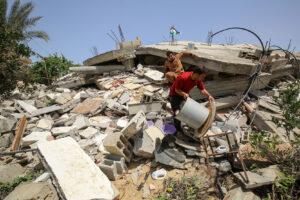
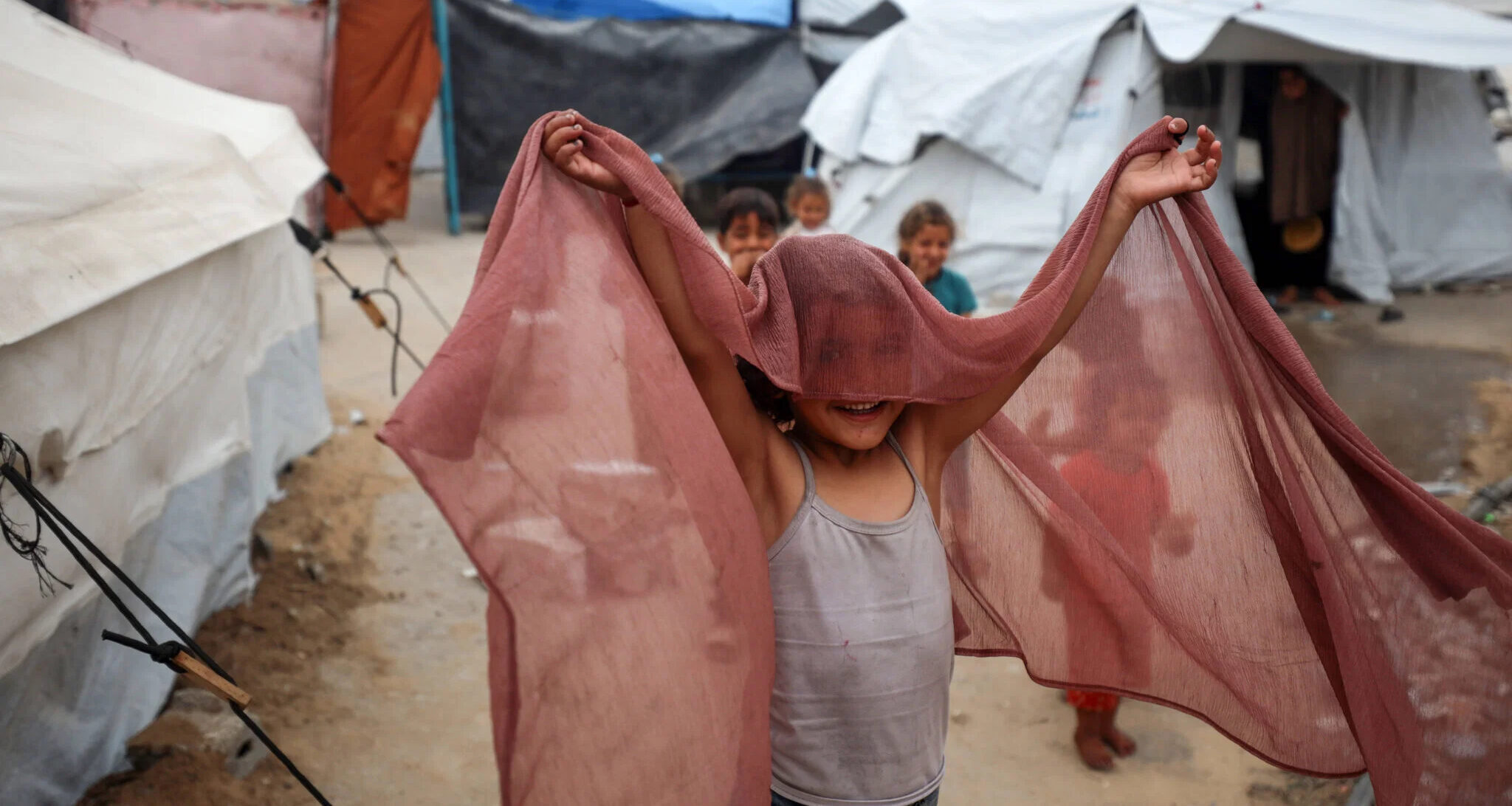
These photographs might very well be the first thing that draws the reader in. They will see dozens of photographs, mostly of people, mostly of children, all taken in the bright light of day and in living color. I can only imagine what difficult aesthetic and ethical choices had to be made in terms of both the overall visual stance of the project and which individual images to include toward that end. As Van Jones once glibly said, dismissing the carnage in Gaza as an Iranian-Qatari misinformation campaign: “…you open up your phone and all you see is dead Gaza baby, dead Gaza baby, dead Gaza baby… dead Gaza baby, dead Gaza baby, dead Gaza baby. That’s basically all you’re seeing.”
Joudah completely avoids spectacle in his curation of images, which come to the project courtesy of the Gaza Soup Kitchen, a Palestinian-led humanitarian effort established in 2024 to counter famine. That is not to say we do not encounter images of suffering. We see people on the perennial hunt for food and water, for example, and are made to understand, through these photographs, the existential precarity Palestinians in Gaza face. But we also see the joyful and the triumphant in the form of family and play. We see exhibits of resilience and community through cooking, art, and craft. There is ingenuity and merriment, love for animals and leisure. Palestinians love their cats. There are Black Palestinians. There are blonde-haired, blue eyed-Palestinians. There’s a little kid wearing a Nirvana tee, another in fake Prada. There are schoolkids registering their happiness and sadness for the day on an emoji-Likert scale. Joudah’s visual curatorial philosophy in Exhibit G finds its articulation in one of the collection’s most weighty mediations, “Exhibit G: Baby Moses & Khalas or Notes on Palestinian Interiority”:
There is no spectacle in redemption. And no redemption in spectacle.
Aside from the image as political intervention, the juxtaposition of text and image in Exhibit G creates a dynamism as each image revises the text that precedes it, and each poem or essay contextualizes and recontextualizes the image field. The hybridity of Exhibit G will undoubtedly shape the reader-visitor’s encounter in different ways as they notice whatever analogies, echoes, ironies, continuities, and causalities are most resonant for them. It is the spatiality and adjacency that seem the larger points.
iv.
“Did you know this about the way you love?”
– from Exhibit G, “Inimitable, I Repeat”
Exhibit G enacts its sociality in many ways. There is, most obviously, community as subject matter. There is also the creation of space for the inclusion of the photographs, which are the works of many on-the-ground photographers and videographers (and which were co-curated with Ladan Osman—an act of collaboration).
Another mode of sociality is worth mentioning: translation. Joudah translates several texts by Rawan Hussien and Nima Hasan, two Palestinian writers from Gaza. These texts are described in the acknowledgments as “texts they were not interested in ‘finishing.’” The work consists of five poems and three poem fragments. Another poem (“The Swing”) is co-written with Nima Hasan. In “Poem #4 of 5” by Hasan, we find what could be an operating principle for this co-completion/translation effort:
Don’t go alone to your sadness.
Take me along as an idea,
a witness,
or evidence,
and with two open arms,
an embrace,
shut the wound’s door.
In “Poem #5 of 5,” Hussien writes:
Disorientation, the head and I think
we’re lost at midnight
or my exhausted hands failed
my cartography.
I previously mentioned that Joudah doesn’t make indictments of complicit institutions the main feature of Exhibit G. I would wager he thinks that is an exercise in futility. What he does do without question, however, is call out the erosion, manipulation, and abuse of language in service of state biopower and necropolitics.
Because Hussien and Hasan could not or would not finish these texts, Joudah becomes a custodian of interrupted authorship.
“And prepositions are where languages live and die in translation,” Joudah writes in “Another Palestine in Arabic”—an essay that, among other things, recounts the history behind the criminalization of the Palestinian watermelon. “During the Palestinian genocide, Palestinian literature in English, translation included, is permitted rapid entry into the imperial glory of mediocre letters that democratize the world through its witness protection art and culture programs,” he writes in “Exhibit G: Baby Moses & Khalas or Notes on Palestinian Interiority,” and “Nothing was lost in translation except the simple truth.”
Translation does triple duty in Exhibit G. It is a stand against assault by the language of subjugating forces. It also does the social work that all literary translation presumably does: extends the writing from one linguistic and cultural-political world to another (Arabic to English; Palestine to the Anglosphere; etc.).
There is a much more charged version of sociality, though, that becomes the third function of translation. Because Hussien and Hasan could not or would not finish these texts, Joudah becomes a custodian of interrupted authorship, someone preserving the possibility that the poets’ speech can continue across a break (to put it mildly) imposed by the violence outside. This is an act of solidarity. Joudah as translator refuses to let siege sever the poets’ connection to readers. This is also an act of care as the translator assumes responsibility for unfinished work that may be exceedingly fragile. There is also, subtly but importantly, an element of witness. We are never told why Hussien and Hasan do not finish the original texts. We can speculate though, and that speculation allows us to imagine the conditions likely to have prevented the works’ completion.
v.
“The tussle will enrich the archive.”
– from Exhibit G, “Baby Moses & Khalas or Notes on Palestinian Interiority”
I started this writing with one formulation of the archive. After inhabiting Exhibit G, I find that formulation incomplete and unsatisfactory. It is still accurate when the archive is set as an imperialist frame, but the work of excavation and illumination from within that archive is exhausting and arguably futile. While critically important against erasure, that kind of evidentiary work rarely changes the political status quo. Examination of the archive as a warehouse of the past seldom reveals anything those marginalized by the archive didn’t already know and haven’t already tried to tell us.
Exhibit G argues for a different kind of archival imagination. It is not interested in proving the historical facts of catastrophe. “They say the killers are unconcerned / with your forensic evidence / since they made partner in the archive,” writes Joudah in “How’s Your Devastation Today?” The kind of imagination Exhibit G displays and asks of us requires a new temporal relationship to the archive. Redemption has less to do with a restoration of things as they were—an idealistic impossibility in most cases—but rather a recognition of the archive-in-present as important substrate for imaginative futures not trapped or predetermined by state narratives or debilitating nostalgia.
Such an imagination understands that, yes, the archive is a repository of evidence and counter-memory. But it further understands the archive as a reservoir of possibility. In this sense, the archive preserves (sometimes explicitly and sometimes paradoxically through its notable omissions) forms of inhabitation, relation, and collective life whose futures were interrupted but not destroyed. Photographs, oral histories, artifacts, and ruins thus become more than remnants of a foreclosed world: they hold arrangements of life that can be activated, recombined, and carried forward. Such an archive is, therefore, neither purely restorative nor nostalgic. It does not seek to reconstruct an intact past so much as to ask what possibilities stored within that past remain available in the present.
This is perhaps Exhibit G’s greatest gift. It is one such living archive for the future. While it does not abandon history, it does not trade in historically conditioned hopes. It reveals the present for the simultaneity it is. It celebrates, even in mourning, the unalienable is-ness of the Palestinian spirit in the now. In its sweeping intellectualism and compassion, in its refusal to seek permission to narrate, in the beauty of its truth-telling, it does what a radical imagination should do for us: point us toward the possibility of what might yet come.