An exhibition featuring Palestinian artists reimagining weeds highlights the problematic symbolism of resilience in times of genocide.
Weeds are often thought of as resilient plants that thrive in landscapes damaged by human activity. For some, they embody the possibility of unexpected flourishing amid immense catastrophe. Framed within in the Anthropocene, for example, weeds might be imagined as proliferating in the ashes of destroyed worlds. However, these imaginings can obscure the historical responsibilities that have led to the genocide of indigenous populations and the alteration of their ecosystems.
These enduring forms of violence are not committed equally by all of humankind, of course. And so, when we imagine weeds thriving in post-apocalyptic worlds, whose imagined futures are we conjuring up?
In 2020, the A.M. Qattan Foundation, a leading Palestinian cultural institution, organized an exhibition in Ramallah titled Weed Control. This exhibition, curated by Yazid Anani and featuring thirty-three Palestinian artists, re-imagined the lives and stories of some of the wild plants targeted for eradication by British and Zionist agricultural organizations between the 1920s and 1940s. It was inspired by a striking illustration from the colonial archives (Figure 1) that detailed the features and contours of thirty-three “seeds and fruits of weeds found in crops,” which was enclosed in a letter dated January 16, 1940. The letter was addressed to the Department of Agriculture and Fisheries of the British Mandate and signed by a representative of the Organization of Field Crop Growers in Palestine from the Kibbutz Ramat Yohanan located in the Haifa district.
Weed Control explores how the concept of “weed” was deeply embedded in colonial environmental imaginaries in Palestine. During the British mandate, for example, colonial officers and members of Zionist agricultural organizations exchanged letters about the urgent need for the control and eradication of harmful weeds. From the European botanical perspective, pesticides were the medicine that could heal the land. Conversely, weeds represented that which needed to be destroyed for a superior civilization to flourish. The goal, in the colonial mind, was to “redeem” the land and tame wilderness through progress and technological superiority.
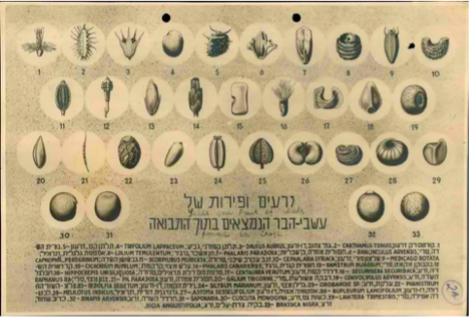
When I first saw the illustration in the exhibition catalogue, I felt as though I had been let in on a secret. The seeds were depicted in great detail, with their ridges, hairs, hooks, and shells carefully drawn. They were rendered so beautifully that it is hard to believe whoever produced the drawings wanted to get rid of them. Each seed was assigned a number, and each number corresponded to a Latin and Hebrew name. The colonial archive does not tell us who produced the illustration or why these particular thirty-three seeds were chosen. However, it is known that the illustration was part of a letter promoting a travelling exhibition in 1940, which aimed to raise awareness of methods to contain the spread of weeds across Jewish settlements.
Eighty years later, thirty-three Palestinian artists reimagined the lives, voices, and experiences of those seeds. In response to the travelling exhibition of 1940, each artist was assigned one of the seeds illustrated in the drawing. In the resulting exhibition, the seeds are brought to life through the artists’ eyes, offering an alternative narrative, from multiple Palestinian perspectives, to colonial accounts of weed control. The artists each offer their interpretation of the deep transformations that result in the toxic aftermath of war, which can linger for generations. Their approach combines original botanical and historical research with emotional, intimate, and subjective engagement with colonial archival documents.
The commissioned artists included renowned Palestinian artists such as Vera Tamari, Sliman Mansour, who sadly passed away this August, Tayseer Barakat, and Nabil Anani, all of whom founded the influential New Visions movement in 1989. However, there is also an intergenerational dialogue between these artists and those born between the late 1970s and early 1990s who are becoming increasingly established on the international contemporary art scene. Weed Control does not articulate a single perspective but many, challenging notions of essentialism and fixity in the process. The artists’ creative journeys bring together different geographies, imagining weeds as being both rooted in the soil and forever moving and changing. They imagine survival in various ways, from affirmative dreams of rebirth from the ashes of the colonial state’s apparatus, to contemplative expressions of woundedness and solitude.
Together, their works speak of the consequences of taking colonial logic to its extreme: the extermination of all life deemed to stand in the way of a specific political project. The weeds speak of how the land is destroyed so that those responsible can claim to restore it.
Although the exhibition was held in 2020 during the Covid-19 pandemic, its themes resonate deeply with today’s genocidal violence and continuing destruction in Gaza, Palestine, and Lebanon. It highlights how the political category of “weed” is used to sustain the project of territorial control and land appropriation, while also articulating the embodied and sensory experiences of dislocation and loss. Engaging with the exhibition now, still, requires us to consider the depoliticizing effects of praising resilience when it is used as a normalizing tool by those who benefit from structures of oppression. Rather than celebrating weeds as symbols of resilience in harsh conditions, the exhibition brings the environmental and ecological dimensions of the mechanisms deliberately targeting the ecological and bodily foundations of Palestinian life into sharp focus.
When we think of weeds, we may consider how Palestinians must confront ecologies of siege and famine by creating rooftop gardens, engaging in small-scale agriculture, setting up improvised water filtration systems, and establishing community kitchens in order to survive. If there is any comfort to be found in looking at weeds growing between the tiles of a building, for me it lies in the reminder that even the biggest structures are temporary and that there is more happening at their edges than what we can see from a distance.
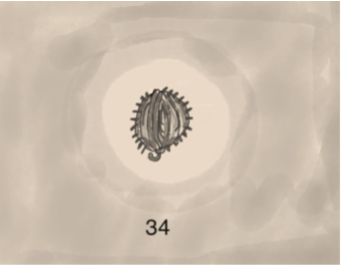
And what about all the seeds of weeds that escaped the listing and compiling of the illustration? What might the thirty-fourth seed look like? How did it escape before the illustration was completed? Perhaps a draft from an open window carried the seed away before the ink could fix its shape on the illustration. Or maybe a tired botanist forgot to add it to the list. An omission in the colonial archive. Its DNA surely carries traces of the pesticides that entered through the pores of its leaves and travelled down its stem. I find some comfort in imagining that the thirty-fourth seed has travelled unnoticed, in a sack of grain or a small pocket of mud, trapped beneath a shoe. Perhaps it was carried in water running from one terrace to the next, resting beside trees older than the institutions seeking to classify them. Perhaps it has withdrawn deep into the soil, waiting to return (Figure 2).