Belal Fadl transforms the lives of Cairo's urban poor into an irreverent picaresque that tests the limits of literary translation.
The Completely True Tales of Um Mimi and Sharawi the Adulterer, by Belal Fadl, translated by Osama Hammad
DarArab, 2025
ISBN 9781788711142
All characters, events, places, and language in this novel do not exist in our reality. Our reality is—as you know—too lofty, pure, and beautiful to have such characters, events, places, and language. Just saying.
—Belal Fadl, The Completely True Tales of Um Mimi and Sharawi the Adulterer
From the opening page of The Completely True Tales of Um Mimi and Sharawi the Adulterer, Egyptian novelist and screenwriter Belal Fadl signals his intentions with a tongue-in-cheek disclaimer: this debut novel is bound to provoke domestic backlash for its portrayal of Cairo’s gritty underbelly. The early-1990s capital city he evokes is a world away from the historicized and romanticized metropolis often exported to Anglophone readers through translated fiction. Rejecting the comforting backdrops of Pharaonic nostalgia or middle-class existentialism, Fadl plunges into Cairo’s backstreets to craft an irreverent picaresque, refracting the profanity, sickly bodies, and everyday violence of the margins into a microcosm of black comedy.
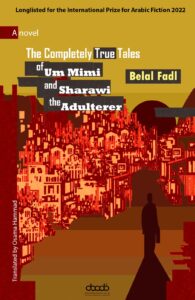
Originally conceived in 1998 and written over a prolonged period beginning in 2004, Um Mimi marks the first instalment of Fadl’s in-progress Cairo Trilogy. While this opening volume wades into the Cairene slums at basement level, the subsequent books promise to move upward to scruffy rooftop flats and outward to the margins of Giza. Longlisted for the 2022 International Prize for Arabic Fiction (IPAF) and now available in English via Osama Hammad’s translation (DarArab, 2025), the novel showcases the qualities that have made Fadl one of Egypt’s most influential contemporary satirists: an acerbic voice, a gift for witty dialogue, and an ability to locate humor amid despair. The result is an absurdist comedy of errors that subverts the traditional bildungsroman, transforming a young student’s moral education into a chaotic trial by fire.
The narrative follows an unnamed seventeen-year-old protagonist who, desperate to escape the control of his abusive father, flees Alexandria for the capital to pursue the Egyptian middle-class dream of studying media at Cairo University. His clash with reality is swift and comically unceremonious: rather than entering the glamorous, cosmopolitan world he envisioned, he finds himself “down one of the roughest and smelliest paths [he has] ever walked,” and ends up renting a room in a crumbling basement flat behind a dodgy cabaret. His landlords are the chain-smoking, mercurial Um Mimi and her erratic, drug-addicted son Mimi.
The novel pulls the reader into the volatile lives of this decidedly dishonorable family and their shady neighbors, including Abu Samia, who forces his daughters into the local sex trade. What emerges is a stark portrait of survival ethics. In this subterranean space, where the rules of middle-class respectability simply do not apply, every facet of existence is as thoroughly broken as Um Mimi herself:
[…] whose every inch had a scar—either from a kettle of tea thrown at her by her ex-husband Sharawi the Adulterer, or from falling out of the Haram buses that failed to stop completely, or from Mimi’s bite during their frequent fights that only Freud could explain, or from the shackles that came out during the police raids back in the old days.
The story ignites with Um Mimi’s death. Tasked with arranging her burial, the young protagonist finds himself navigating a maze of bureaucratic absurdity and familial dysfunction. Her passing summons a procession of estranged relatives: a transactional daughter, an eccentric son-in-law, and the titular Sharawi the Adulterer—Mimi’s father—who had long been barred from visiting the family by court order.
Sharawi’s arrival opens a Pandora’s box of competing narratives, confronting the protagonist with conflicting versions of the family history. In one of the novel’s most absurd twists, Sharawi decides to “adopt” the protagonist to compensate for his own disappointing bloodline. At the same time, the protagonist uncovers a conspiracy by a young woman he mistakenly believed loved him, but who turns out to be using him to escape her family’s social shame. By the time he extricates himself from this web of manipulation, his academic ambitions have been eclipsed by a harsher education in human nature, poverty, and survival that no lecture hall could provide.
Appreciating the world of Um Mimi requires attention to the socio-historical landscape of early-1990s Cairo, a city under immense demographic expansion and infrastructural strain. This period marked a critical stage in the expansion of Cairo’s ‘ashwa’iyyat (informal settlements): haphazard, dense neighborhoods that rapidly spread along agricultural fringes and desert outskirts to accommodate millions of rural migrants.
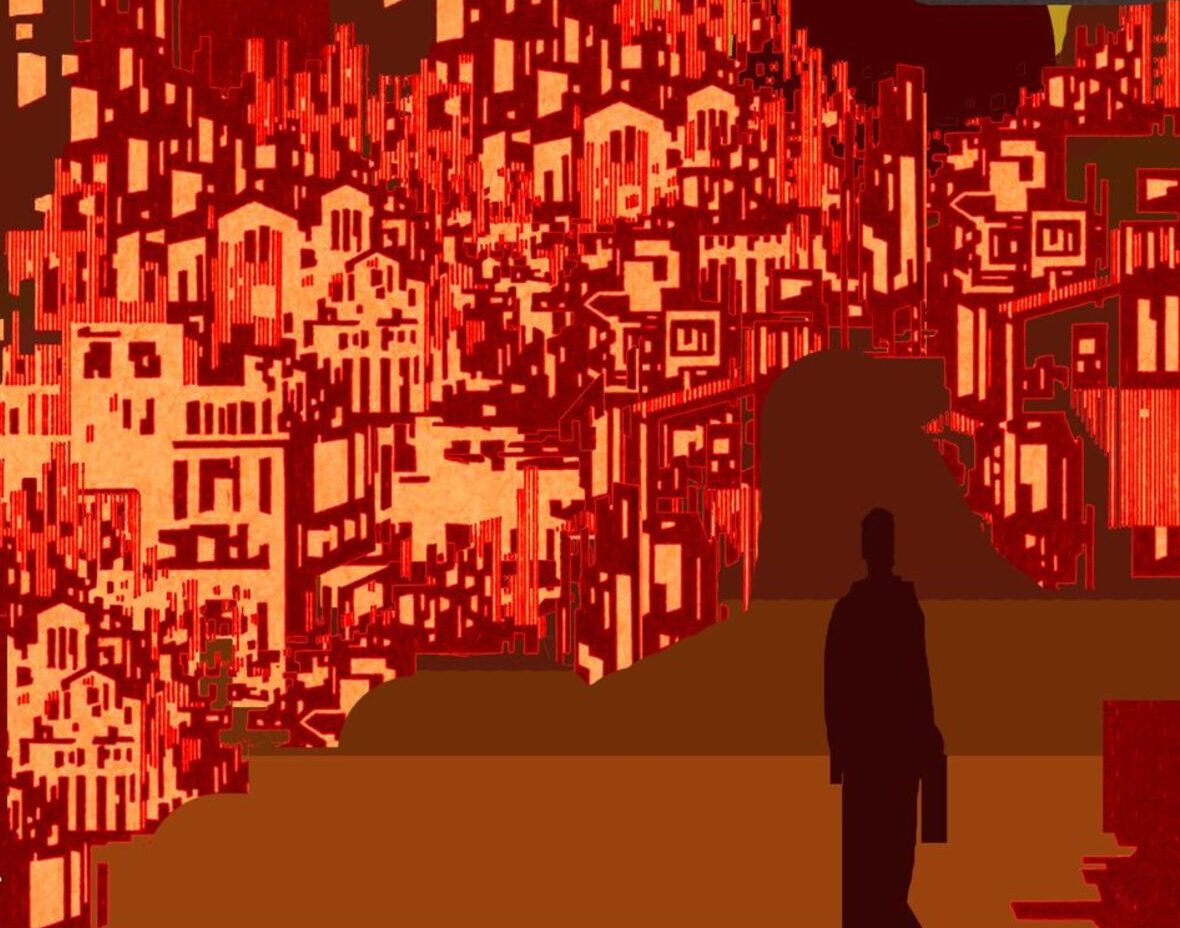
Unlike the low-rise, horizontally sprawling settlements that often dominate western representations of urban poverty, Cairo’s ‘ashwa’iyyat are dense vertical neighborhoods of unpainted red brick and concrete. Built outside formal state planning and without municipal oversight, they feature multi-story tenements separated by alleyways so narrow that sunlight rarely reached the lower floors. The result is an environment of intense, inescapable intimacy and shared precarity.
Throughout the 1990s, the Egyptian state largely denied public services to these areas to avoid legitimizing illegal construction. Residents were therefore forced to devise their own survival mechanisms, from illegally tapping electricity lines to navigating streets flooded with raw sewage. This systemic state abandonment fostered forms of self-reliance and informal social organization that developed beyond official institutions and legal structures. On the margins of society, traditional middle-class codes of respectability lose their authority, and survival dictates its own rules.
This environment is what makes the novel’s picaresque narrative so effective. By situating Um Mimi within the 1990s, Fadl captures a moment of infrastructural neglect and mounting social tension, giving its dark humor a deeper significance. The sarcasm and absurdity that animate the narrative thus transcend comic devices to serve as psychological armor. More than a backdrop, Cairo’s ‘ashwa’iyyat act as the crucible in which a forgotten underclass forged its survival strategies amid chronic neglect.
Fadl’s novel belongs to a rich tradition of Arabic urban realism concerned with the precariousness of the provincial outsider in the capital. The unnamed Alexandrian protagonist’s misadventures in Cairo recall other Egyptian novels such as Abd al-Hakim Qasim’s The Destiny of Stifling Rooms (Qadar al-Ghuraf al-Muqbida, 1982) and Khairy Shalaby’s The Ballad of Lodging and Sleep (Mawwal al-Biyat wa-l-Nawum, 1991), in which survival depends on the unstable generosity of strangers and the fragile social networks of the urban poor. Like his predecessors, Fadl explores the city not as a site of opportunity but as a space of negotiation, where shelter, employment, and belonging remain perpetually uncertain.
Um Mimi also evokes Naguib Mahfouz’s works, especially Midaq Alley (Zuqaq al-Madaq, 1947) and The Cairo Trilogy (Thulathiyyat al-Qahira, 1956-57), through their depictions of Cairo’s backstreets as self-contained moral universes governed by their own rules of survival. Yet where Mahfouz often approaches social decline through tragedy, Fadl turns to farce: dead-body theft, sex work, family feuds, police raids, and neighborhood gossip accumulate into a chaotic comic universe in which laughter becomes inseparable from desperation.
This refusal to moralize gives Um Mimi much of its force. By avoiding the twin literary traps of middle-class judgment and patronizing pity, Fadl demonstrates that some of the funniest stories emerge from the harshest realities. The novel neither romanticizes poverty nor reduces its characters to helpless victims. Instead, it presents them as flawed, resourceful, and frequently ridiculous characters whose humor functions as a survival mechanism.
This grit is anchored by the author’s own history. Drawing heavily on his experiences as a provincial student arriving in Cairo in the early 1990s, Fadl uses this personal proximity to construct a world that feels intensely lived in. The resulting observational precision grounds the narrative, preventing even its most eccentric episodes from slipping into caricature.
This unvarnished depiction of the urban poor is precisely what makes Fadl’s voice both distinctive and provocative within contemporary Egyptian literature. Um Mimi confronts subjects that mainstream Egyptian fiction typically sanitizes: sexual exploitation, domestic violence, corruption, addiction, and the raw vulgarities of life on society’s margins. By coupling an unpolished, explicitly crude street register with graphic sexual references, Fadl enters precarious aesthetic territory—crossing the same line that led Egyptian novelist Ahmed Naji to a two-year prison sentence for “violating public modesty” in The Use of Life (Istikhdam al-Haya, 2014). Yet while Naji suffered state persecution in Egypt, Fadl writes from self-imposed exile in the United States, leveraging geographical distance to push these boundaries without constraint. Read alongside Naji, Fadl’s uninhibited prose reveals itself as far more than stylistic bravado; it is a high-stakes refusal to bowdlerize either the language or the bodily realities of Cairo’s marginalized communities, exposing what societal decorum insists on concealing.
Beyond its immediate disruption of Egyptian literary norms, this commitment to unvarnished realism places Fadl within a broader transnational tradition of working-class fiction, offering English-language readers a literary voice that feels at once familiar and distinct. His raw, profane, and uncompromising realism especially invites comparison with Irvine Welsh’s Trainspotting (1993), as both authors weaponize the rhythms of street language to expose communities structurally abandoned by the state and forced to operate by their own informal moral codes. Yet, where Welsh often drifts toward post-industrial nihilism, Fadl remains invested in the possibility of human connection, however compromised or dysfunctional that connection may be.
This commitment to capturing street-level vitality is fueled by Fadl’s background as a journalist, satirist, and screenwriter, which infuses his prose with a distinctive cinematic momentum. Having co-founded the influential independent newspaper Al-Dustur in 1995 and written acclaimed satirical TV dramas such as People of Cairo (Ahl Kairo, 2010), he possesses an instinctive sense of pacing. In Um Mimi, a brisk narrative tempo and a chain of absurd misadventures sustain the reader’s engagement, as each encounter propels the next to create an incisive and entertaining work of black comedy.
Translating Um Mimi’s gristly world into English, however, immediately confronts the translator with a fundamental paradox: there is no such thing as a “universal English low-class slang.” As Michael Cooperson demonstrated in his translation of Al-Hariri’s Impostures, where he matched twelfth century Arabic slang with fifty distinct English vernaculars, including Cockney rhyming slang and thieves’ cant, the possibilities for translating non-standard language are endless. Yet every solution comes with its own risks. Lean too heavily into any local English sociolect, and the text risks cultural displacement; avoid colloquiality altogether, and the characters lose the social texture that defines them.
In bringing Fadl’s distinctly Cairene world into English, translator Osama Hammad opted for a restrained, text-centered middle path. Rather than attempting to map Egyptian colloquial Arabic onto a particular British or American sociolect, he preserves the novel’s social atmosphere through rhythm, tone, and comic timing. This proves especially important as Um Mimi derives much of its energy from squabbling skirmishes, hyper-local idioms, and raw, survivalist wit. It is therefore a remarkable achievement that Hammad’s full-length translation debut reads with such vibrant, rhythmic urgency.
Hammad’s affinity for the text is also deeply personal. Reflecting on his motivation in a conversation with Tugrul Mende, he noted:
It was also relatable, since I too was a student who wasn’t originally from Cairo. When moved to Cairo to study, I lived in a flat with ten other people, and at some point, I lived around characters who used similar language to Um Mimi’s . . . This was part of the reason I wanted to translate it, the relatability.
This lived familiarity with the novel’s social world informs many of the translation’s strengths. Hammad demonstrates a sensitivity to the shifting registers of the original Arabic, moving fluidly between the relatively formal narrative voice in Modern Standard Arabic (MSA) and the colloquial speech that animates the dialogue in Egyptian Colloquial Arabic (ECA). After all, one of the Arabic text’s defining qualities is its remarkable oral immediacy, as Jordanian critic Maen al-Bayari says, where “you do not feel, while reading, that [Fadl] wrote it, but rather that he is narrating it right in front of you . . . your senses fully captivated by the story and its succession of events and surprises.” Hammad preserves this sensory experience, allowing the reader to feel the city’s textures and scents, where the stenches of raw sewage and death mix intimately with incense and frying garlic.
Yet, translating the language of the urban underclass remains a precarious task. While Hammad captures the overall momentum of the prose with skill, there are occasions where his translation choices suffer from a subtle inflation of register, drifting from organic street slang into something too literary or archaic. This tension becomes noticeable during moments of heightened tension, where rough-edged vernacular occasionally gives way to unexpectedly formal phrasing.
One example occurs during a body-washing scene in which a working-class, supposedly illiterate undertaker berates the young men assisting him: “I said get me some real men to wash the body, not green boys who can’t hold themselves up. Get this sissy boy outside. . . Let’s get this fucking bleak day over with, shall we?” Although the character’s frustration is unmistakable, several expressions sit somewhat awkwardly in English. “Green boys” feels archaic and poetic rather than colloquial, while “sissy boy” carries a dated, schoolyard quality. More noticeably, the adjective “bleak” introduces a literary register that sounds unusually elevated for an angry outburst, and ending a profanity-laced tirade with the polite rhetorical tag “shall we?” inadvertently produces a tone closer to ironic politeness than abrasive street sarcasm.
These moments, however, are exceptions rather than the rule, and don’t fundamentally diminish the translation’s success or disrupt the reader’s immersion. Ultimately, Hammad’s translation succeeds because it preserves what matters most: the novel’s unruly energy. Fadl’s gritty urban realism, colorful wordplay, and satirical exuberance remain vividly intact. Hammad resourcefully tackles the structural and linguistic limits of humor and slang, reminding us that the triumph of translation is not achieving a flawless linguistic mirror, but keeping the original text’s chaotic energy alive in foreign air.
Belal Fadl’s The Completely True Tales of Um Mimi and Sharawi the Adulterer is a vital addition to translated Arabic fiction. It offers a rare and unapologetic portrait of Cairo’s working-class survival mechanisms without resorting to melodrama or poverty voyeurism. While laughing in the face of misery, Fadl illuminates lives that respectable society overlooks. Beneath the novel’s eccentric characters and comic misadventures lies a serious, empathetic inquiry into class, aspiration, family, and the fragile stories people tell themselves in order to endure. By preserving this raw aesthetic, Osama Hammad’s translation does not simply duplicate the source text but allows Fadl’s forgotten Cairo an afterlife in English—a space where the original lives on, transformed yet true to its nature: harsh, grotesque, hilarious, and above all, profoundly alive.