At the Venice Biennale, the issue of Palestine reconfigures the entire festival for the first time in its 131 year history.
Over the course of my life, I’ve seen art that has upset, revolted, and disturbed me, but the closest I have ever come to getting into a fight over artwork was at this year’s Venice Biennale. For those who are unfamiliar with it, the Biennale dates back to 1895 and is the world’s oldest — and arguably most high-profile — art event in the world, running every other year, alternating with an architectural Biennale.
The two main locations are in the Giardini (garden), where the permanent national pavilions are housed (Tsarist Russia, Art Nouveau Hungary, Classical Britain, etc.) as well as the main exhibition space. Then there is the Arsenale (from the Arabic “ard,” land, and “sinaa,” place of manufacture), a warren of old shipyards and armories in the Castello area, where in the twelfth century up to 30 ships were produced a month by 16,000 men working on the world’s first production lines. The Arsenale’s complex hosts yet more pavilions, albeit not owned by the nations they represent. There may be a bit of a hierarchy between the two, the permanent and the temporary, but this does not necessarily reflect on the quality of the exhibitions, nor the importance of the country, given that the pavilion of the host nation itself — Italy — is located in the Arsenale, as are China’s and India’s. Beyond these locations, much of Venice itself is transformed into an exhibition space, with palazzos, homes, and various institutions opened up to the public, where contemporary art is exhibited under Murano chandeliers, in front of ten-metre-high antique bookshelves, baroque mirrors, and frescoed walls. The Biennale, then, is a spectacle on the grandest of scales.
It is also a competition. Since its inception, an international curator has been chosen to oversee each edition, and an independent jury appointed by the Board of Directors to judge the various works. As the Biennale became more international, so did the jury’s composition. Koyo Kouoh, a Cameroonian Swiss curator, and one of the art world’s most important visionaries, was named as the curator for this years’ art exhibition, the 61st. Kouoh’s inspirations always drew widely on art and literature, and she has spoken specifically of the influence of collections of writings by African women, such as Margaret’s Busby’s Daughters of Africa (1992). While she set the themes and tone for the 2026 Biennale, she died tragically and unexpectedly in 2025, without a chance to see her work come to fruition. And yet her ethical vision is set out clearly in her introductory statement to this year’s theme, In Minor Keys:
[Take a deep breath]
[Exhale]
[Drop your shoulders]
[Close your eyes]
The music continues.
The songs of those producing beauty in spite of tragedy.
The tunes of the fugitives recovering from the ruins.
The harmonies of those repairing wounds and worlds.
The introduction to the exhibition guide, penned by “La Squadra di Koyo,” a group of artists and curators composed of Gabe Beckhurst Feijoo, Siddhartha Mitter, Marie Helene Pereira, Rasha Salti, and Rory Tsapayi, tells us that for Kouah, “music came before the keys, and before music came poetry.” Poets, according to her, “see beyond eyesight and measure time beyond calendar conventions; they chiefly consider deeds, forgive failures and believe in repair.” The curatorial team refers to two novels as touchstones: Toni Morrison’s Beloved and Gabriel Garcia Márquez’s One Hundred Years of Solitude. The literary arts are front and center on the ground as well; right at the threshold of the Arsenale, stretching all the way to the roof is a banner printed with the poem written by Refaat Alareer about a decade before he was assassinated by Israel in December 2023:
If I must die
You must live
to tell my story
The story — Alareer’s story and that of the destruction of Palestine itself — threads throughout the various exhibitions of the Biennale, articulated in a multiplicity of ways by engaged artists both Palestinian and otherwise.
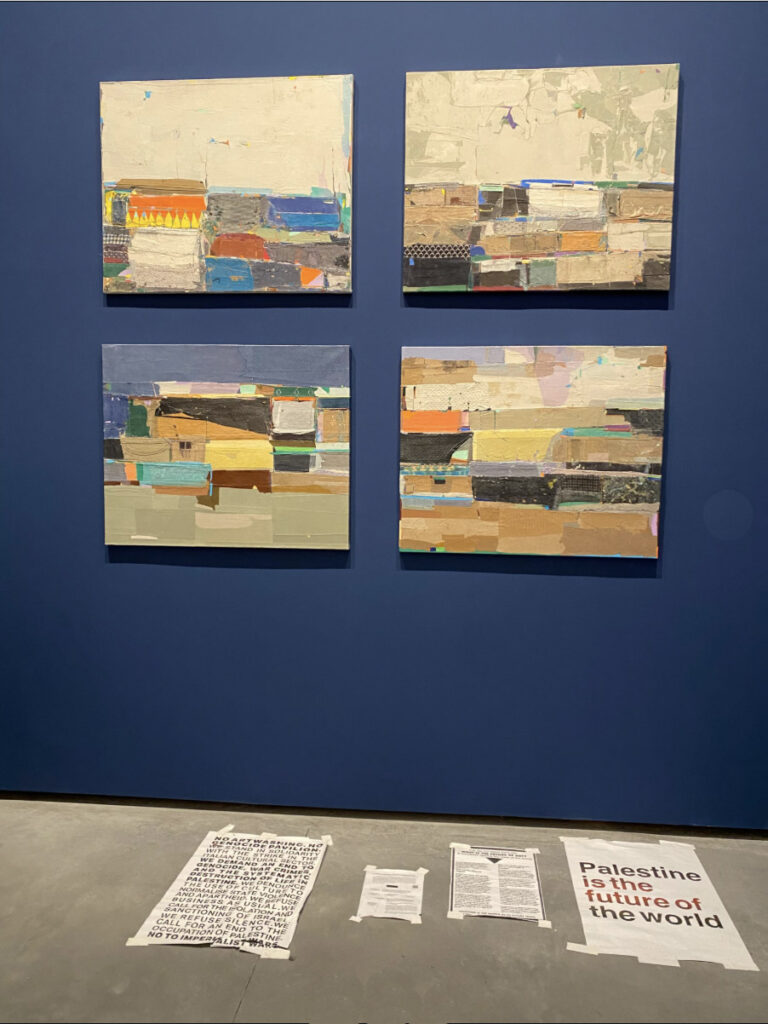
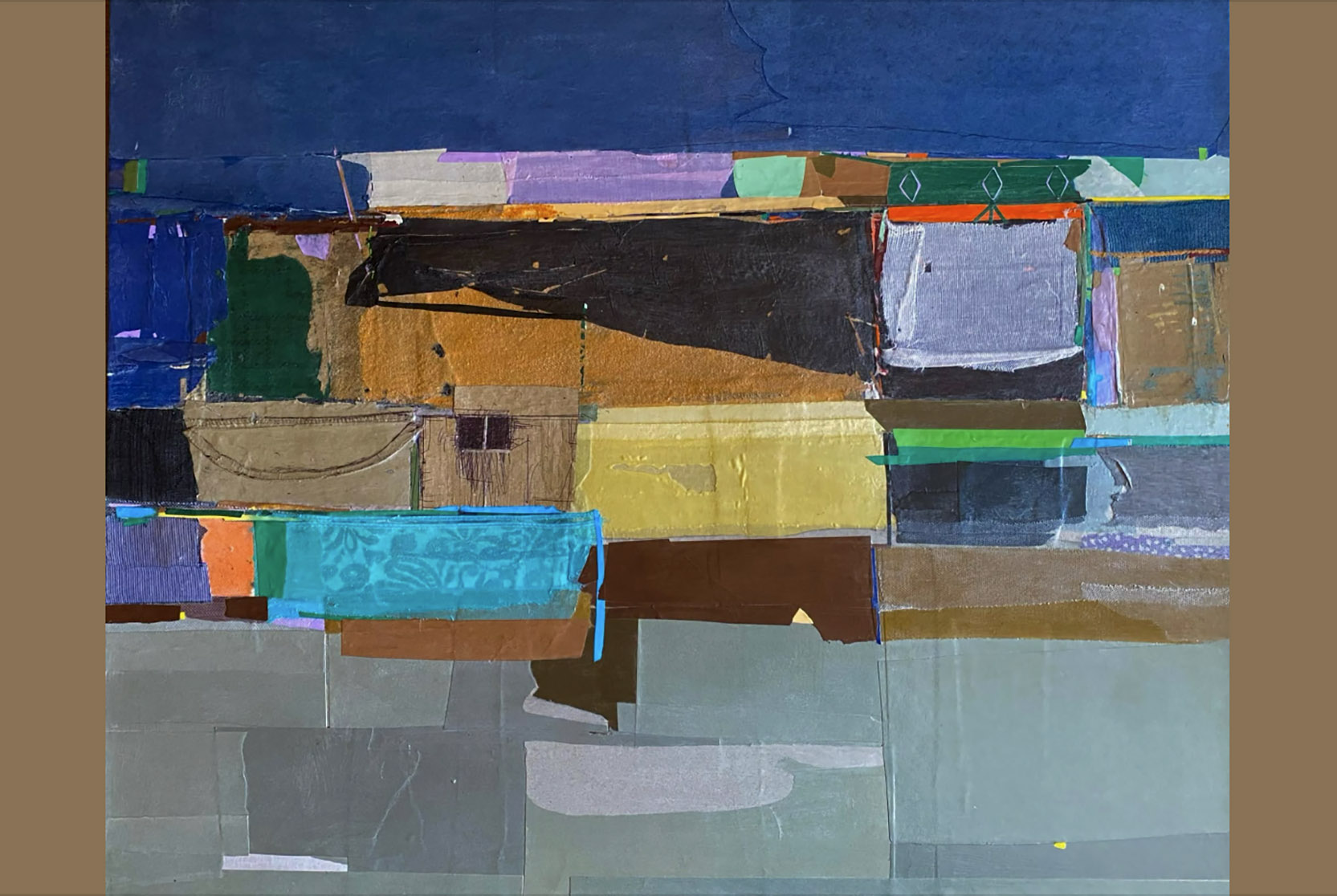
Gazan artist Mohammed Joha’s series No Shelter, made as he witnessed the near-total annihilation of Gaza on his screen, utilizes a collaging technique that combines discarded materials such as cardboard and fabric onto canvas that “takes its cue from the practices of Gazans caught in ceaseless cycles of destruction and rebuilding,” according to the signage.
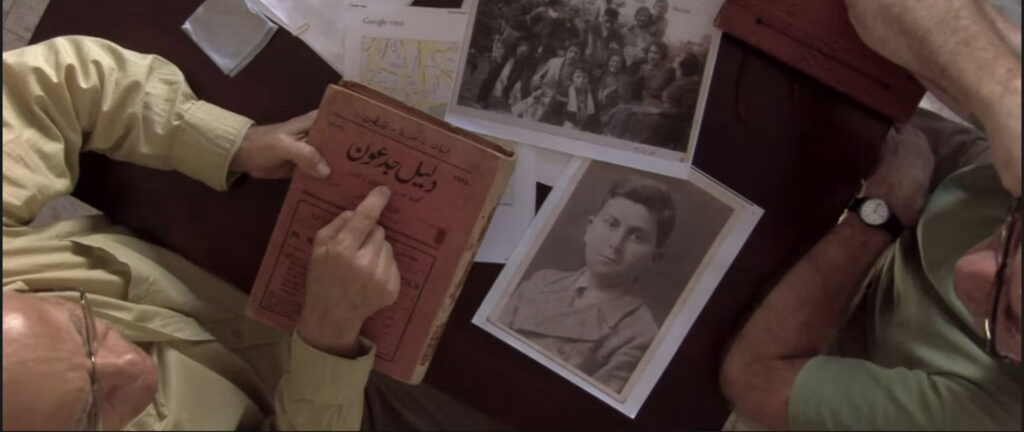
Avi Moghrabi’s work Between a River and a Sea was particularly important to me: it displays two business directories, one for Lebanon, Palestine, and Syria from 1938, and the other from Gaza from 2023. I spent my time trying to spot my grandfather’s Jaffa factory in the listings, captivated by the melange and the order. Moghrabi’s work was shown in the Arsenale, where, in another nod to literature, Etel Adnan’s poems hung from the ceiling. The Saudi pavilion featured the subtle tile work of a Palestinian-Saudi artist, Dana Awartani; Palestine also featured in the collateral events, ranging from Gaza, No Words ‘——’ in Palazzo Moro to the intricate decorative work of the young fashion designer Ayham Hassan in the Palazzo Pisana Moretti.
But, as ever, while Palestine was being asserted by the people, it was also being removed by the authorities.
Palestine was present in the streets as well. I encountered activist interventions throughout my wanderings, both placed before the various exhibitions — as in the posters taped to the ground before Mohammad Joha’s work, or at the Korean and Turkish pavilions — and in the city itself. One read, in bold: No Artwashing. No Genocide Pavillion. Another: We stand with Palestine because by now we know that the destruction of Palestine is the destruction of the world. Some signs were defaced. Others seemed just freshly put up. Soon enough I would witness the battle over the posters myself.
But, as ever, while Palestine was being asserted by the people, it was also being removed by the authorities. South African artist Gabrielle Goliath had her commission withdrawn by her government as her work, Elegy, was too focused on Gaza.
“It’s a mark of how unserious most politicians’ attitude to culture is,” South African novelist and playwright Gilian Slovo told me, “that the South African Minister of arts, sports, and culture, whose right wing Patriotic Alliance is in coalition with the ANC, was able to stop Elegy — a work of mourning for the killing of women and children in, amongst other places, Gaza — from being South Africa’s official entry to the Biennale.” Slovo viewed this as an anomalous position given the breadth of popular solidarity with the Palestinians. “They do this despite the fact that the majority partner in the government, the ANC, took Israel to the International Criminal Court for the crime of genocide,” she said. The Minister’s decision was challenged, but he refused to back down. Elegy is showing in the Chiesa San’Antonin instead and will be exhibited at Ibraaz in London in September.
Perhaps the South African politician decommissioned Elegy precisely because he understands art’s direct relationship to protest. In 1968, at the Venice Biennale, the outcry against South Africa’s system of apartheid forced their national exhibition to close. This, according to Matthew Holman of Frieze Magazine, presaged the wider, UN-backed cultural boycott initiated in late 1968. South Africa only returned to the Biennale in 1993.
In fact, since its inception, the festival has mobilized in response to the wars, crimes, and concerns of the day. In 1974, the Biennale went as far as to transform the entire Giardini pavilion into a protest against Chile’s Augusto Pinochet, a dictator who’d come to power in a US-backed military coup the previous year. In the last five years, Russia and Israel, for obvious reasons, are the states that have engendered the most controversy at the Biennale. Both states have permanent pavilions in the Giardini, but the question of whether or not they’re participating in the 2026 Biennale elicits a response both qualified and murky. For Russia, the ambiguity is also visual. The doors to their pavilion are closed, but four screened windows are open with a techno montage playing on a screen behind them. In 2024, the Israeli pavilion, whose modernist structure creeps up behind the dominant American one, was also closed. A printed piece of paper on the door explained that restoration works were taking place (none were visible) and that Israel’s exhibition was being shown in the Arsenale instead. “They want to make everyone feel sorry for them,” a national curator commented to me. “They want to make it look as though they have been closed out, but they shut it themselves.” Protests over Russia’s involvement have not been nearly as controversial as those over Israel’s participation, despite threats from EU donor bodies to pull funding if Russia was included, pointing to the sanctions. Pressure to include Israel was less public.
On May 8, 2026, one day before the 61st Biennale was set to open, artists and workers associated with the festival declared a one-day strike — the first strike in the Biennale’s 131-year history — and, alongside ordinary citizens, took to the streets in protest, responding to a call from ANGA, the Art Not Genocide Alliance. A collective of artists, curators, and art workers that has been growing for several years, AGNA, in its own words, answers to the calls by Palestinian civil society to challenge the normalization of Israeli apartheid and occupation within international cultural platforms.
In a letter delivered to the Directors of the Venice Biennale on April 29, it declared its position as follows:
As we reach an appalling anniversary — two and a half years of open genocide against Palestine — and 77 years after the Nakba, the Israeli state once again seeks the legitimation of the Biennale to masquerade as a creator instead of a destroyer of life and culture.
The letter goes on to state (in bold letters):
Genocide cannot be tolerated by an institution that aims to investigate and celebrate the human values embodied by art.
The list of signatories is significant: a total of 238 artists, curators, and art workers. Some chose to remain anonymous “in fear of possible physical, political or legal harms from signing publicly.” (At the time of this writing, no response to the letter has been received by the coalition).
By the time the letter had been delivered, the international jury of the 61st Biennale had already issued its own statement on April 22, which deferred to Koyo Kouoh’s aspirations and philosophies: to refuse the spectacle of horror and to safeguard the dignity of all living beings. Thus, the jury would refrain from considering those countries whose leaders were currently charged with crimes against humanity by the International Criminal Court. To my knowledge, this criterion was as novel as it was clear. It was not about prejudice, but about actions; not focused on slogans, but arrest warrants for war crimes. Bravo. I thought. I was not alone. British Lebanese artist Amale Khlat spoke of the importance of the Biennale to artists as one of the key global settings where art can engage with the political and social challenges of our time, commending the judge’s principled stance as an act of integrity, during years of wars and genocide. In an email reply to me, she praised them “for refusing to be silent in the face of deep ethical and moral issues.”
Most of the media reporting surrounding 2026 Biennale focused on whether Russia was in or out, ignoring the militarized elephant of a state — Israel — that was very much in the room.
And yet, within a week, the entire jury had resigned, with the briefest of exit notes. The Biennale scrambled, announcing that the competition awards’ ceremony would take place at the end of the exhibition, instead of the beginning, and also that the traditional awards would be replaced by an unprecedented “peoples’ vote,” (which there are calls to boycott). The question is: what happened during that week between the resolve of the jury’s statement and cursory resignation note? It may take a long time before anyone close enough to the jury is able to go on record, but more than one person told me that the threats of possible litigation, on the basis of discrimination, were impressed upon the individual jury members by agents of the Israeli state.
Thus, the weaknesses of the Biennale as a stage for real protest were revealed. The team that runs it is only able to withstand state power so long before pressure from some of the world’s most powerful — and criminal — nations forces it to give in. It is also structured around a complex web of laws that allow for powerful interests to exercise their will without risk of sanction. There’s now a long precedent establishing that those who speak out against the genocide can be individually threatened and sanctioned. As many readers will be aware, in recent months, the UN Special Rapporteur for the Occupied Territories, Francesca Albanese has received direct threats against her and her family, and has had sanctions placed upon her by the United States government, which have had wide ranging implications, including blocking the use of her bank cards.
Most of the media reporting surrounding 2026 Biennale focused on whether Russia was in or out, ignoring the militarized elephant of a state — Israel — that was very much in the room. But once again, the media proves itself thoroughly out of step with the reality on the ground when it comes to Israel.
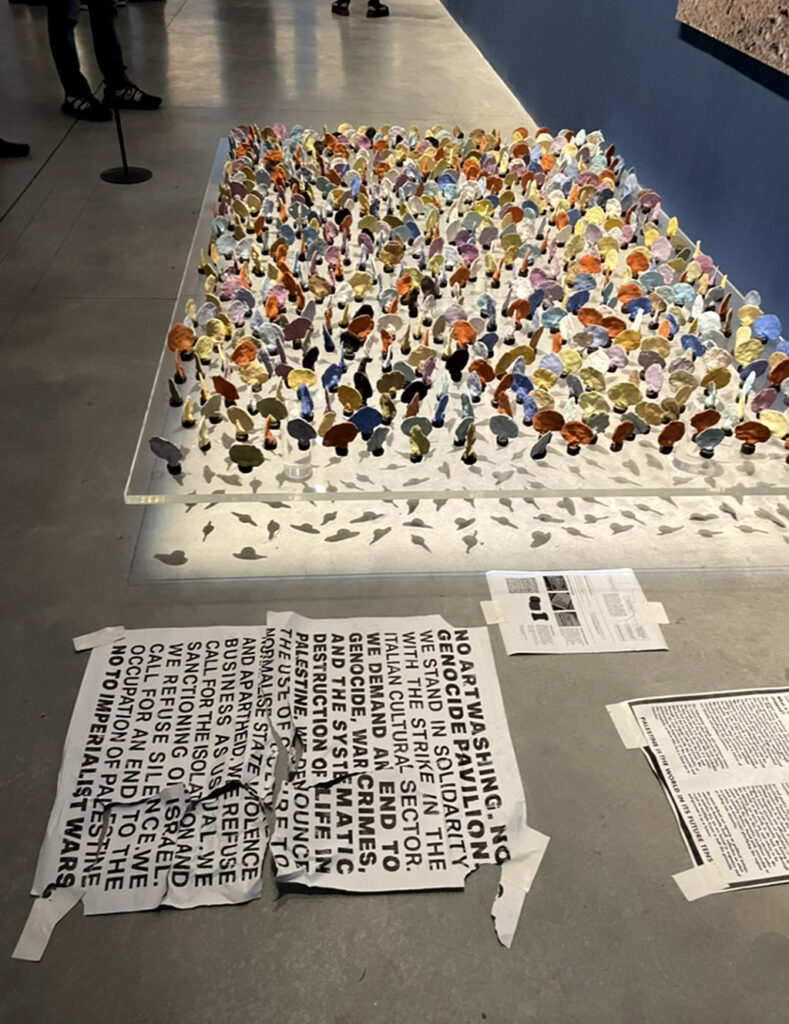
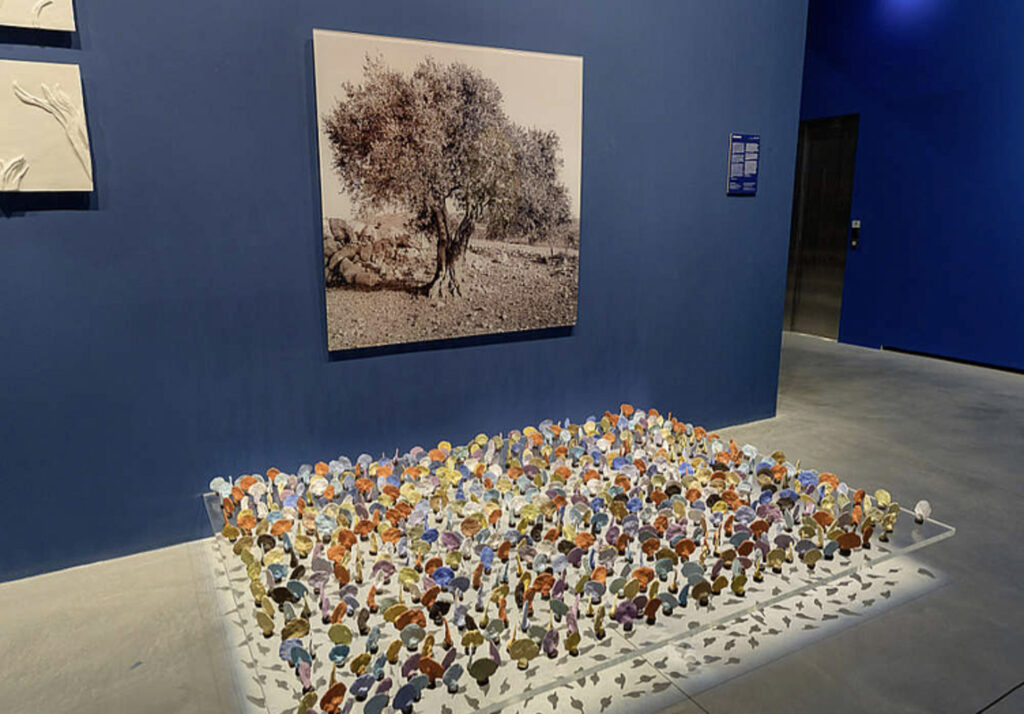
I experienced the protests — and the violent backlash to them— personally during my visit to the Biennale. As I was looking at two art works by Vera Tamari Tale of a Tree (2002) and Mantra (2019), a woman came up to tear away the ANGA protest posters that were taped to the floor.
“If they protest, I protest,” the woman said as she ripped at the posters.
She declared that she was an Israeli and that this was her right. Her aggressive body language was at odds with her diminutive stature. She gave off the energy of an aging hooligan, empowered by zealous conviction. Though her tirade lasted only a few seconds, I am ashamed to say that we just watched her bending down and ripping at the posters for what felt like hours, doing nothing. My fury was muted by shock, dulled by the long years of discipline I’ve learned to impose on myself after a lifetime of having to ensure that I don’t express my fury at injustice in a way that alienates others. But in this moment, I also felt curiosity, and a sense of something close to pity; her actions were so undignified. Who was this person, who thought that despite everything her country had done, that she was so right, so wronged, and so entitled to express both sentiments?
She was intercepted by a soft-spoken Biennale assistant, who told her that the artist had asked for the posters to be part of her show and that she should leave them alone. She moved back, muttering all the while. A young man moved in to fix the posters back in place and I joined him. Seeing us reignited her fury and she came back to rip at the posters again. I repeated what the attendant had said, that the posters were part of the exhibition.
“I’m Palestinian,” I added unnecessarily.
“You’re a Palestinian? You’re a Palestinian?” With this she ripped into the posters more violently than ever.
“Leave the posters. This is a Palestinian artist and she wants these posters as part of her show,” I objected.
“She’s not Palestinian. Tamari. She’s Israeli,” the woman replied. “I looked her up.”
“No, she’s Vera Tamari and she’s Palestinian,” I said. “I know her nephew. Look at the sign.” I was pointing now. If I hadn’t known the artists’ family, I would have doubted myself, such was the force of this woman’s assertions, her lies. It made me shaky. She stomped off.
Increasingly, the Gaza genocide has been laying bare the limitations of state-sanctioned cultural expression.
In a restaurant the next day, while sheltering with some friends under umbrellas during a thunderstorm, I met a woman who told me she was with ANGA and that someone had taken a video of my interaction with the poster-ripping woman and that it had circulated in their groups. These poster ripper-uppers, she told me, were a regular feature of the Biennale, and more would come after these ones left. She also told me that when the ANGA supporters protested, the other side would film their faces, say that they had them on record, would make life difficult for them. For some of the protestors, there is a real possibility of retribution upon return to their home countries. And yet despite all of this, at the time of this writing, 25 national pavilions are reported to have temporarily shut their doors in protest of Israel’s participation, including France, Belgium, Austria, and Italy: an unprecedented revolt. The Director of London’s Mosaic Rooms, Pip Day, pointed out that the Biennale’s claims of “openness” and “artistic freedom” were being used to justify Israel being granted a pavilion space in in the Arsenale, “but in the face of genocide there is no neutral ground, this becomes complicity.”
The furor continues to rage, and the Biennale still has some months to go until it closes, at the end of November. It remains to be seen how this will play out. Increasingly, the Gaza genocide has been laying bare the limitations of state-sanctioned cultural expression. Cultural institutions cannot claim to champion open spaces of creativity, critique, beauty, or courage while refusing to take a stand on one of the worst crimes of our era. They cannot ignore what the courts of international law have already established. For art to continue to be meaningful, state power will have to be challenged again and again. Cultural institutions that try to claim political neutrality under these circumstances will crack under the strain of their own hypocrisy and complicity, running the risk of becoming irrelevant. In response, we need to become more socially and politically engaged, not less. As the posters in Venice read: “We stand with Palestine because by now we know that the destruction of Palestine is the destruction of the world.” Indeed, the stakes are no less than this.