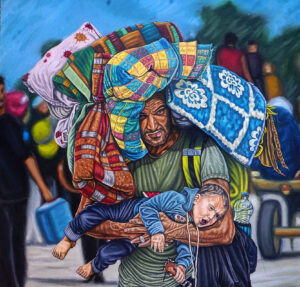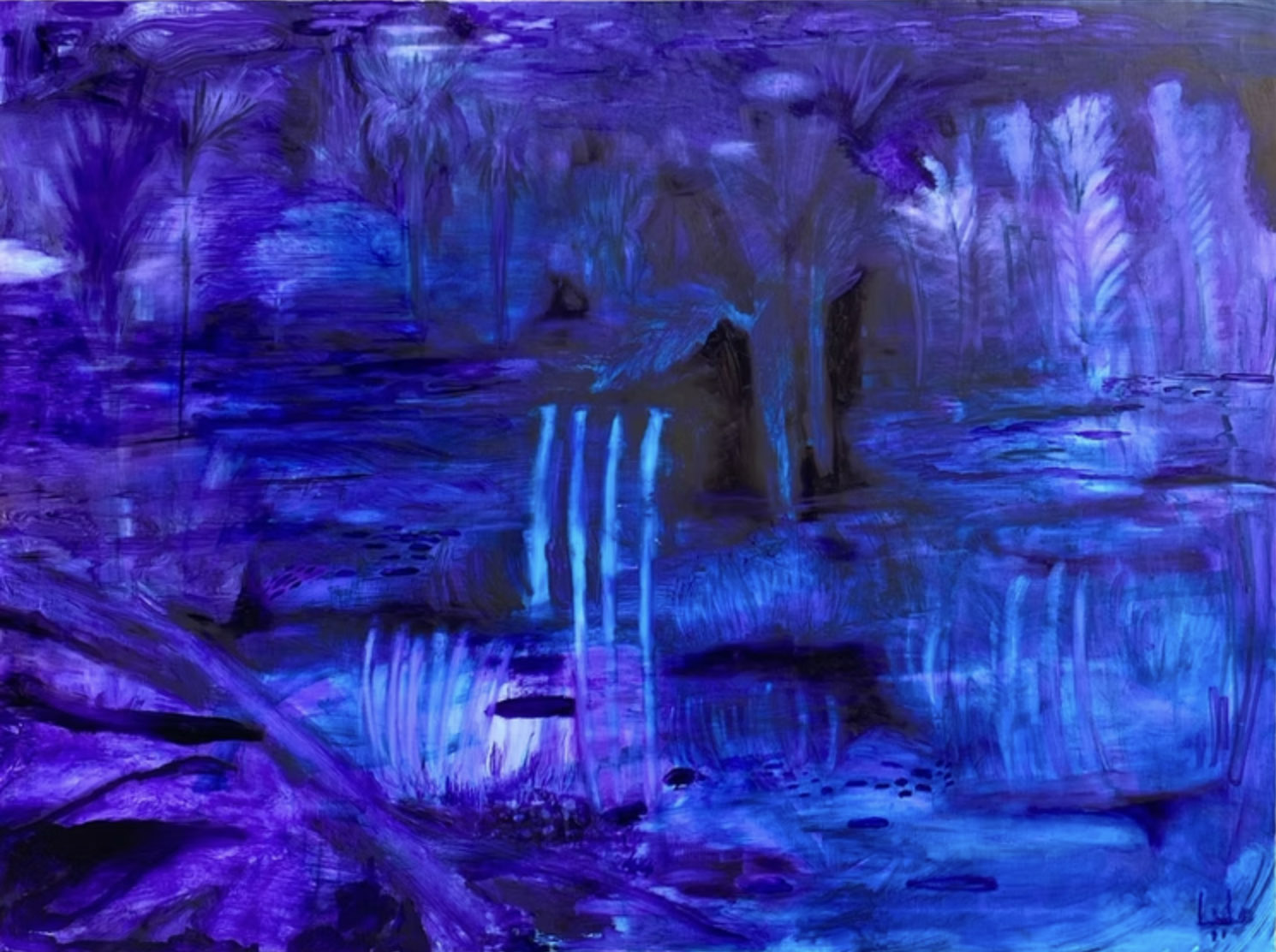
For some, the Mediterranean is a site that sparks artistic contemplation, for others, it offers a bridge of hope beset with treachery.
With deliberate care, Anis retrieved an old clipping inscribed with the name “Marco” from behind a family photograph on the living room wall. He coaxed it free from the center of the frame, whose edges were worn by years of humidity. He slipped the folded paper into his pocket as though it were a precious amulet. In Marco, Anis saw a savior — someone whose gaze could cut through the dense harbor fog.
Standing on the cement sidewalk, peeling strips of dry salt from his fingers as though shedding a former life, Anis dreamed of one thing: to escape the stench of diesel and the heavy weight of poverty, to stand beside Marco, and to learn from him the secret to capturing a fleeting moment, of distilling the whole world into a single, perfect shot.
Two hours before departure, Anis sat in a basement thick with the smell of damp walls, facing a screen in a dilapidated Internet café to send a final email. Addressing it to Marco, he wrote haltingly: I am Anis, from the shore that lingers, forgotten, in the periphery of your photographs. I am coming not only to escape, but to learn from you how to render ugliness into beauty. Your work has made me believe the sea holds a purpose — one beyond drowning.
He attached a photo that captured the length of his lean frame as he stood by the beach, and ended the email with a tiny confession: For the longest time, I trawled through thrift markets looking for shoes like those you wear in your photographs. Now, when I slip them on, each step feels as though it draws me nearer to you. He pressed “send” with the conviction of someone casting himself a lifeline before tackling the waters.
•
Anis stands on the pier, watching the wooden fishing boats rock upon the murky water like bodies shivering with perpetual fever. He reaches into his pocket to touch the folded paper bearing a solitary number — his only tether to the promises of crossing at midnight. He makes his way towards the house. The further he moves from the port, the narrower the alleys become; their walls, long sated with salt, have exhaled it in flecks of green dots like scattered points on a mislaid map.
When he enters the room, he finds his father, Rayyes Saleh, sitting in the corner. His eyes stare into the distance, clouded white as if lost in fog. He clutches an old radio, flipping through the static for scraps of reassuring news. “Anis?” his father asks, his voice worn thin. “The sea is roaring. I can hear its rumble from here.” Anis approaches and lays a hand on his father’s shoulder, frail as a withered branch, but offers no reply. Instead, he packs a shirt and a half-empty bottle of pills into a bag. He hurries down the stairs toward the beach where a black rubber boat waits, never once looking back.
On the opposite shore, in the heart of Nice, under a light designed to lend tragedy a certain heft, a velvety dimension, Marco strides across marble floors with measured confidence. Here, calamity is transfigured into art, and death, sealed behind glass, becomes a masterpiece that enchants the affluent as they contemplate the blueness of the waves while they sip their wine and trade “cool” remarks on the aesthetics of composition.
Marco pauses before one of his photographs. The glass covering it is less a shield for protection than an insulating wall — a safety valve to keep the smell of death and salt from seeping into the hall and spoiling air heavy with luxurious perfumes. In his photographs, Marco refines the sea, tames it, cleanses it of death and human debris, offering the elite a silent landscape, stripped of any offense that might grate against their consciences.
Amid all this, his phone screen flickers to life. Anis’s email arrives in his inbox like a smear of mud on white carpet; words from a boy at the margins who believed art was a lifeline, a photograph of a brown face alight with naive hope. Marco regards the email with professional detachment. He sees not a cry for help, but a potential project, or perhaps just an unwelcome interruption from his doting audience. He closes the screen and steps out onto the balcony to face the true sea. There, where the wind is fierce and the horizon dissolves into impossibility, a blade cleaves the world in two: on one side, those afforded the luxury to pause and contemplate, on the other, those who drown in the struggle to stay afloat.
•
The stench of gasoline claws at the senses, mingling with the sweat of bodies huddled tightly against one another. Anis is a silent mound amid a trembling mass riding atop rubber ready to burst its guts. Waves batter the prow, as saltwater drenches every thread of clothing, biting into skin like icy nails. Anis glances back at his city, its lights slowly devoured, fading and dissolving like an oil slick adrift on the sea.
•
The captain’s cry, heads down, would be the final word. Anis closes his eyes and summons Marco’s face, the man he once believed would be his safe harbor. The engine coughs once, then dies mid-splutter. A sudden, eerie emptiness settles in, preceding the grand finale. Language falls silent, words vanish. Only the howling of the wind and the crash of water against the boat resound. In his delirium, Anis thinks he can glimpse Marco standing on the distant shore, observing him through the chill of a glass lens. In that moment, he realizes a single truth: he had never been a student, nor would he ever become one, only a marginal narrative in someone else’s latest artistic composition. “We are merely photographs,” he whispers, lips tinged blue, before the spray claims his final breath, and the sea closes the curtain on this scene.
•
Night recedes from Nice with exhausting slowness. Without his camera, Marco stands on the rocky shore, his eyes weary and his stomach churning. Today, the sea offers no inspiration; instead, it hurls its filth at his face: parasitic weeds, shattered glass, and peculiar debris that does not belong in these waters.
Marco bends to retrieve a canvas shoe, sodden and shrunken, like a tiny corpse. His gaze lingers on its rough texture; it is the same shoe, that humble relic Anis scavenged from the flea market in a desperate attempt to bring him closer to his inspiration. In that moment, the email, the lenses that prettify ugliness, and the glass barriers shielding against the stench of death, all fall away.
An orange life jacket glimmers among the rocks, a vivid protest against the dull pallor of dawn. Marco takes out his phone, not to capture an image, but to pen a confession: “The Mediterranean is not a sea; it is a cemetery, and we sell its tickets as we do to a resort.” He notices a scrap of paper clinging to a splinter of driftwood, its ink bled into blue halos; a message surrendering itself to the sea instead of reaching its destination. In that instant, the illusion of distance shatters. Marco understands that the gulf between himself and the drowned is not measured in kilometers, but in the false survival he bought with the neutrality of his lens.
•
In Nice, the hall lights flicker out. The glass box is hoisted onto the truck — a prized artifact bound to its destination.
Marco stands in his room, slipping off his shirt before the window. His hands are spotless, so pale they make him nauseous. He recognizes that the rugs beneath his feet and the haven he resides in are not luxuries but debts owed for lost lives.
He sits at his desk, dragging his pen across the sales check. The ink dries quickly, sealing the transaction. At that moment, he turns to his phone. Reopening the email, he glances at Anis’s name and gazes at the photograph he received at the party. I am coming to you to learn… — words he had read indifferently at the time, now a muted scream ricocheting off the walls. His gaze shifts between the screen and the shoe. With professional detachment, he places it inside the glass coffin and tilts his head, checking how the light falls on the wet fabric. At last, he has found the missing ingredient that will make his next exhibition the talk of elite salons. Anis’s cry, sealed within the shoe, has failed to reach him; the item a commodity to raise the auction price — a paltry death, reduced even further to a decorative piece coveted by the wealthy. Marco deletes the message, his trembling hand betraying his indifference, and slips the phone into his pocket.
•
On the opposite shore, Rayyes Saleh ends his vigil. He turns off the radio, silencing the empty static, and walks towards the rusty nail in the wall. There, Anis’s clothes hang where he left them; rough, desiccated fabric that still holds the scent of old sweat. Saleh does not cry; tears are an alien luxury in salt houses.
He heads into the alley and finds the young men perched in their usual spots, idle skeletons hollowed by waiting, their eyes fixed on the horizon that steals children and returns only flotsam. The sun rises indifferently over both shores, at once illuminating the place where bones are ground to dust and glinting off the polished lenses that feed on agony, their images destined for showrooms. The alley swells with crowds waiting for those who will never return. Eyes hopelessly addicted to searching the horizon, which have long since dried of hope.
•
The sea offers no apologies, and the wind carries no farewells. Water pursues its age-old ritual of erasure, licking truths from the sand and tirelessly grinding the remnants of stories in its darkest depths. And all that remains are lifeless shoes locked away in boxes, and souls left to dangle forever on the nails of oblivion.