A novelist transforms Fanon’s theories of violence and liberation into a world of satire, ambiguity, and fractured agency.
Rebel English Academy, a novel by Mohammed Hanif
Grove Atlantic 2026
ISBN 9780802165985
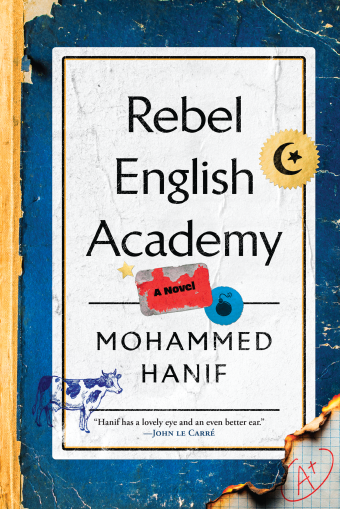
Several books are mentioned in Mohammed Hanif’s novel Rebel English Academy, most notably Frantz Fanon’s The Wretched of the Earth (1961). In one scene, Sabiha Bano, a young woman on the run determined to find her incarcerated parents, throws Fanon’s book at the failed revolutionary and English teacher, Sir Baghi. This moment invites the question of whether her gesture carries a deeper symbolic significance. A closer reading demonstrates that Fanon’s theoretical concerns are not merely referenced but actively dramatized through the novel’s character and narrative structure.
In The Wretched of the Earth, Fanon explores the psychological and societal impacts of colonialism, including violence as a means of decolonization, the formation of national identity, the role of intellectuals in revolutionary struggle, and a critique of post-independence politics, racism, and entrenched hierarchies. As he writes, “colonialism is not a thinking machine, nor a body endowed with reasoning faculties. It is violence in its natural state.” He examines the psychology of the colonized, arguing that internalized inferiority often develops into a desire for rebellion, noting that “the colonized man finds his freedom in and through violence.” Crucially, he identifies three groups within colonized societies: native workers, colonized intellectuals, and the lumpenproletariat, suggesting that the last group, being least influenced by colonial ideology, holds the greatest revolutionary potential. At the same time, he critiques how newly independent nations frequently replicate systems of oppression by replacing colonial elites with native ones, warning that “the national bourgeoisie… steps into the shoes of the former European settlement.”
Mohammed Hanif’s unique un-literary trajectory informs his writing and allows him to navigate satire, political, and social critique with a grounded perspective that sets him apart from other novelists. A former Pakistan Air Force trainee turned journalist and satirist, Hanif brings to his fiction an insider’s eye for the absurdities of military and bureaucratic power and its effects on everyday people.
Unlike Fanon’s more positive revolutionary horizon, Hanif’s novel offers little liberation.
It also positions him as a “thuggish sort of writer,” unafraid to critique established “holy cows” (the military and mullahs), lending his writing a satirical and rebellious edge.
Read through a Fanonian lens, Rebel English Academy reflects these ideas at multiple levels. In Hanif’s fictional world, the army has become the new colonial power and “no one is getting any relief from the duffers running this country.” Violence functions as a tool of control, while the insecurities of ordinary people are transformed into a desire for revolution, yet “there is no hope.” However, unlike Fanon’s more positive revolutionary horizon, Hanif’s novel offers little liberation. Instead, it dwells on ambiguity and disillusionment.
In the novel, Fanon’s ideas most clearly shine through in Hanif’s unusual and well-rounded female protagonists. Sabiha, Noor, Bano’s mother, and even minor figures such as sex workers are rendered with depth and complexity. Each grapples with conflicting desires shaped by religion, politics, and personal circumstance. Alongside them, the male characters, Sir Baghi, Captain Gul, Molly, and Inspector Malang are in equal measure both loathsome and compelling, embodying the moral contradictions and entanglements with power that structure the novel’s world. Hanif often channels philosophical reflection through dialogue, as in the line: “Do small things, kind things, maybe even small acts of defiance, but never destroy the order that He has created.” Yet the instability of what constitutes that “order” produces chaos, as characters interpret divine intention in contradictory ways.

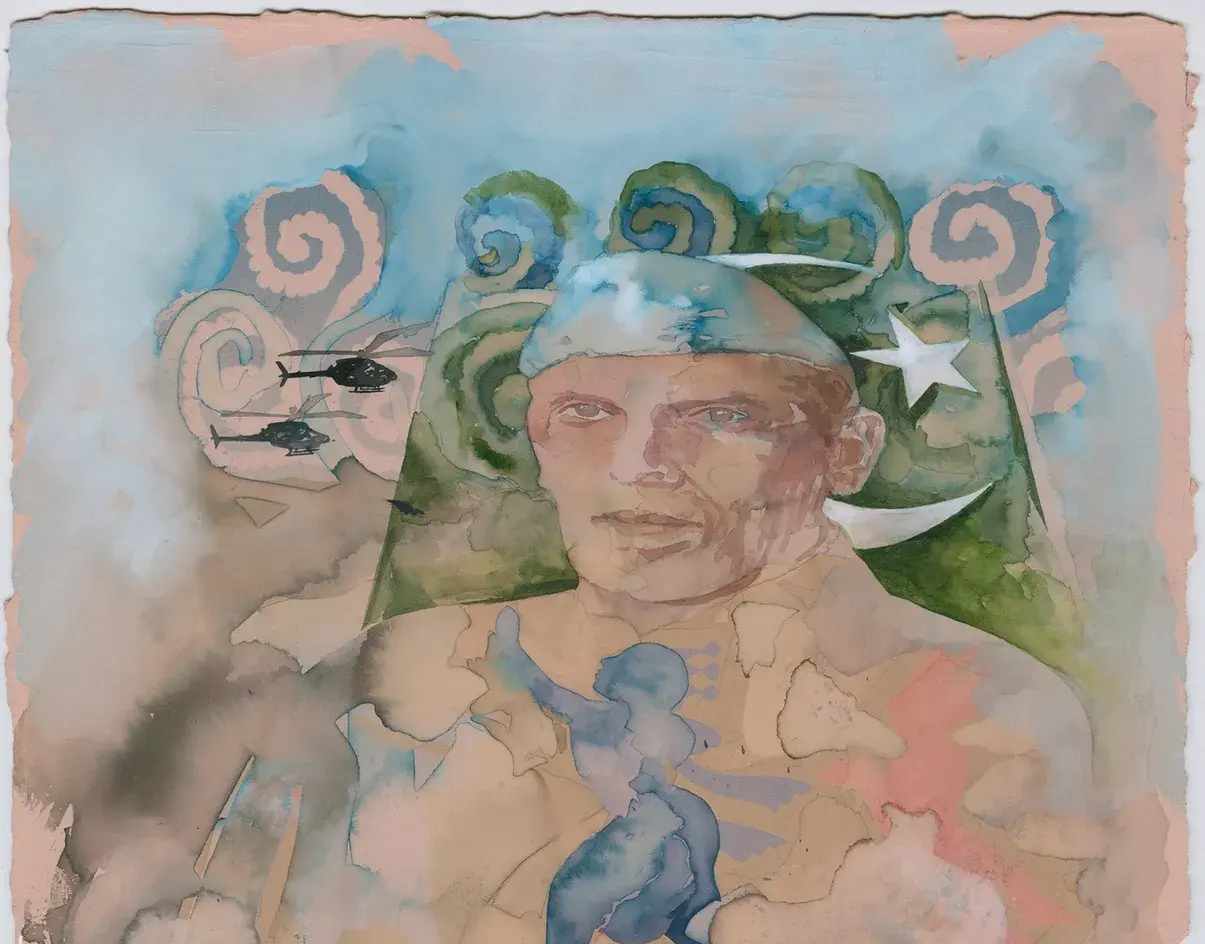
(courtesy Pilar Corrias).
This emphasis on ambiguity also distinguishes Hanif from his contemporaries. While some contemporary Anglophone Pakistani fiction tends to foreground identity, migration, and global interconnections, Hanif’s work leans toward dark political satire, directly confronting authoritarianism, religion, and social hypocrisy. His novels tend to share a suspicion of grand narratives, focusing instead on individuals navigating chaotic political realities. Rebel English Academy continues this trajectory but shifts its attention to micro-politics, examining how power operates within a school, a mosque, and other intimate spaces of everyday life.
The novel re-examines a specific moment of Pakistani historical trauma, specifically, the disbelief around the execution of the deposed leader, “Prime Minister Bhutto.” The focus is on a tuition center in a fictional cantonment named OK Town. The novel opens with a hanging scene characterized by grotesque absurdity, highlighting execution not as solemn justice but as an “administrative farce.” Here, even death is subject to bureaucratic logic. The opening scene establishes a political climate in which characters are obsessed with symbols of purity and loyalty, “lacking dignity, and perpetually suspicious of each other,” and where the teaching of English takes on political and social significance.
The academy is founded by Sir Baghi, a failed revolutionary who teaches grammar to shopkeepers’ children and tries to instill in them a love for English. His institution is described as a “modest” center where the future is parsed into manageable clauses.” In Fanonian terms, Baghi resembles the colonized intellectual, whose awareness of oppression does not translate into effective resistance, leaving him suspended between critique and complicity. However, when Sabiha Bano arrives at the academy to seek refuge, the fragile equilibrium that Baghi has established in the classroom collapses, and the academy becomes both a “sanctuary and a battleground.”
This transformation highlights the symbolic function of language in the novel. Through Baghi’s teaching methods, particularly his emphasis on isolating single words, Hanif suggests that language offers a way to process and contain chaos. The idea that “to name ruin is to anticipate it; to teach a child the conditional tense is to insinuate the possibility of an alternative history” imbues grammar with political resonance. Yet the limits of this approach are equally clear: while Baghi can teach grammar, he “cannot guarantee safety,” revealing language as a shield but not a fortress, able to stop the arrows but not the army. Thus, his quiet rebellion remains ethically meaningful but practically insufficient.
When asked about learning English, Hanif spoke of the low levels of literacy in Pakistan, the fact that only some would make it to college and those who spoke English tended to do better. “I have always been struck with this notion of social mobility and the role of language to make yourself better,” he explained. “I was also fascinated with that notion that how language does work as a tool of power. I was trying to look at that through this ‘English academy.’” For him, English, the language of the former colonizer, was not divisive as he believed everybody in Pakistan wanted their children to learn English.
In contrast, the character of Sabiha Bano embodies a more direct engagement with violence and resistance. She is neither idealized nor victimized; rather, she is shaped by a past that includes political activism and personal trauma. She is introduced as being “on the run… with a pistol,” pursued by both her past and the town’s appetite for scandal. This aligns her closer to Fanon’s idea of those positioned outside elite structures, whose marginality enables a more radical, if precarious, form of agency. The novel’s repeated references to gendered violence underscore its pervasiveness, suggesting a society in which such experiences are normalized. Sabiha’s silence about her assault reflects this reality: she “runs home” to hide her shame. Speaking out risks blame, disbelief, or social ostracism. While some narrative developments in the novel may strain plausibility, they reinforce the broader point that silence often becomes a survival strategy.
Indeed, when commenting on his female characters, Hanif noted: “I don’t think writing novels is about sympathizing with people or liking or disliking them. They are my characters and creation. I have one responsibility to them that I should be true to them, not somebody’s idea of how a man, woman or socialist should be.”
At the same time, Hanif complicates any straightforward reading of resistance by juxtaposing Sabiha with characters such as Noor Nabi. In a palm-reading scene set within a mosque compound, satire and tension intersect. Noor Nabi’s profession, part lawyer, part fortune-teller, embodies the blurred boundaries between legality, spirituality, and opportunism. Her philosophy, “your fate is in your hands,” contrasts sharply with her dependence on systems of power she cannot control. The scene is rendered with dark humor: “Ya Ali madad… a murder is about to happen… it’s written on her hand.” Meanwhile, Sabiha dismisses her as “a Bonafide fraud, a godless mosque lawyer, a fortune teller and a lackey.” The chapter closes with Noor Nabi’s biting sarcasm about a new army officer: “Who knows, he might help us sort out our fate, just like they have sorted out our country’s fate.”
Hanif’s female protagonists illustrate Fanon’s warning that postcolonial elites may reproduce the violence of colonial rule. Figures such as Sabiha Bano and Noor Nabi are rendered not as passive subjects but as agents navigating, and sometimes perpetuating institutional power structures. Their decisions drive the narrative, and their ambitions exist independently of male characters, even as figures like Captain Gul and Molly exert pressure on their choices and trajectories. Sabiha’s “Homework” entries, written in a distinctive and archaic English, further emphasize her agency, revealing her aspirations “of being a champion runner,” and of “fighting a final battle for the rights of the workers,” as well as her reflections on those she has encountered, including her parents and fellow “comrades.”
Hanif shifts the focus from abstract revolution to lived struggle.
Another way that Sabiha’s agency comes through is in her relationship with her mother. Though shaped by cultural and political expectations, the relationship reflects both empowerment and constraint. As she recalls: “Mother Bano always advised me not to run because she opined that when a woman walks, how far can she go, but if a woman runs, first she runs from her home, then she runs away from her husband and beautiful children and sometimes she can run so far that she forgets how to navigate her back home.” This tension becomes a metaphor for female autonomy within a restrictive society.
Looking through a Fanonian lens illuminates the symbolic weight of Sabiha’s gesture when she throws Fanon’s book at Sir Baghi. It is not simply an act of frustration but a confrontation between theory and lived reality, between intellectualized revolution and its messy, often disillusioning practice. Fanon’s ideas, embodied in the text, are literally hurled at a figure who represents their failed implementation. The gesture encapsulates the novel’s central tension: the gap between revolutionary ideals and the compromised, ambiguous world in which they must operate.
Ultimately, Rebel English Academy suggests that while grand theories of liberation may illuminate structures of power, they cannot fully account for the contradictions of everyday life. By grounding Fanon’s ideas in the experiences of complex female characters, Hanif shifts the focus from abstract revolution to lived struggle. The result is a novel that resists easy optimism, offering instead a nuanced exploration of power, agency, and the limits of resistance in a fractured political landscape. By doing so, we are left with the unsettling recognition that understanding power is not the same as escaping it, and that whatever hope remains lies in the fragile persistence of human agency.