An artist in Aix-en-Provence with roots in Tunisia and Corsica, Dalel Ouasli recounts the mythistorema of the Mediterranean, from its ancient origins to contemporary narratives. In her painting, human figures emerge in chiaroscuro, evoking strength, simplicity, and vulnerability.
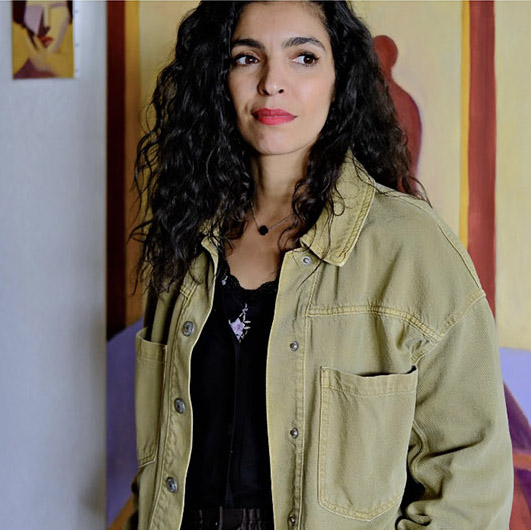
Growing up in France, the child of a Tunisian father who had spent years in Corsica, and a Tunisian mother, the identity of painter Dalel Ouasli was leavened with Tunisian Arabic and French, as well as the long, hot, fragrant summers of Provence, and family visits to Tunisia, where she was marked by the blue sea of Tunis and the chaos of its medina. “The Mediterranean is central to my work,” she avers, as she shows a visitor her artist’s studio in Aix-en-Provence. “It isn’t just a sea or a geographical area, but a space of exchange, of cultures and different civilizations that have intersected.”
Although she now paints full-time, Ouasli’s story is perhaps atypical, as she first obtained a master’s degree in finance and worked for nearly fifteen years in business banking, before returning to her first love, taking up art studies in Paris at the École des Arts de la Sorbonne, the École du Louvre, and the Atelier des Beaux Arts de Paris Jean-François Courteaux. Not that art-making has been a path paved in gold — in fact, as curator and art critic Anne Bourrassé explains in a new book published earlier this year, entitled Les Refusées, despite the fact that 70% of art school students these days are women, their work is represented only 23% of the time in galleries, and just 6% of the time in museums (down to just 1% in the Louvre’s collection). Bourrassé’s research found that 85% of the highest contemporary art revenues derive from work by male artists.
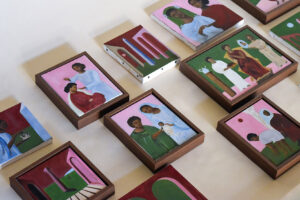
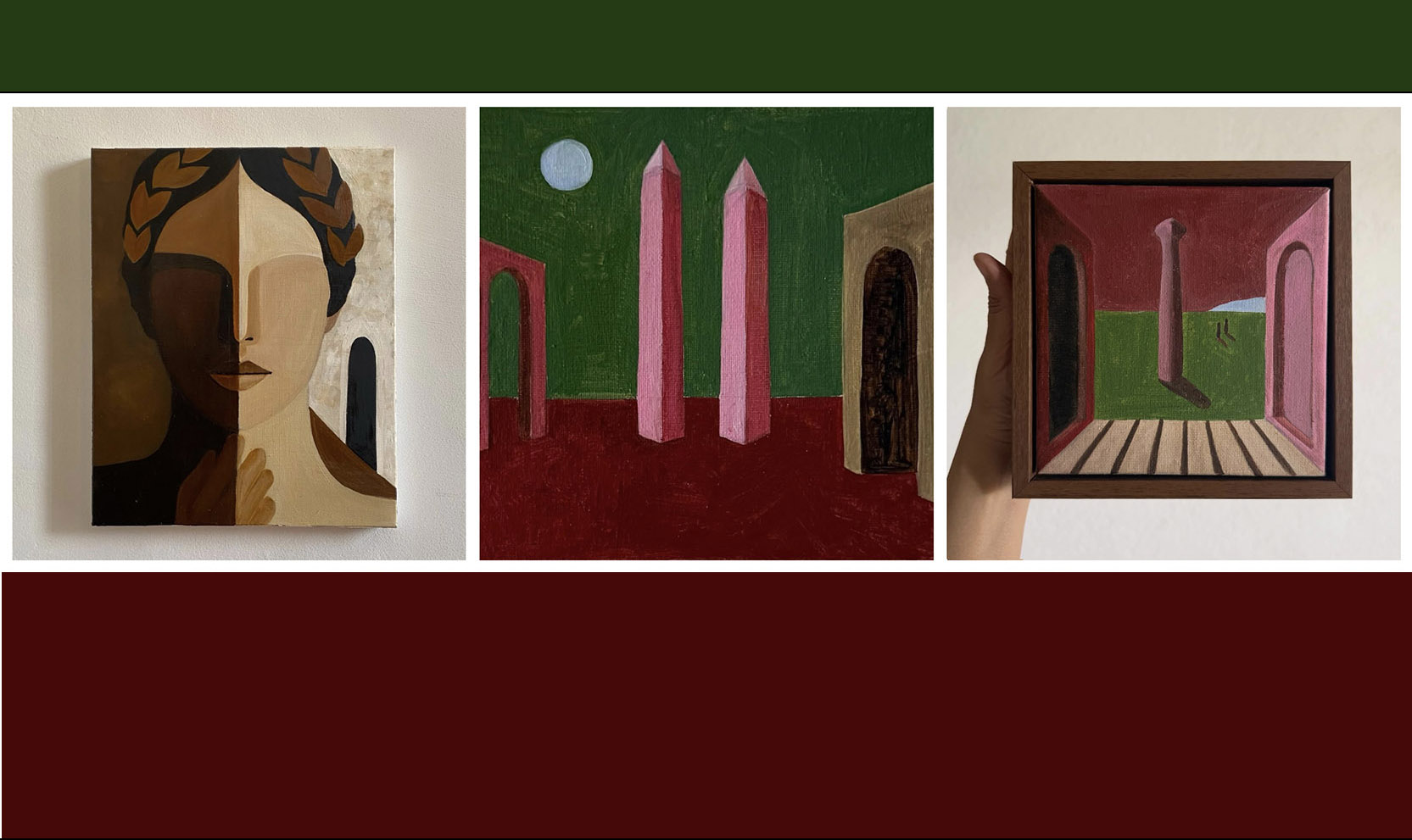
This is the context in which Franco-Tunisian painter Dalel Ouasli has devoted her creative talents. Mixing her own pigments, painting both on large canvases and miniatures, Ouasli explains that she is fascinated by ancient imagery, icons, relics, mystical Sufi texts, Greek and Roman mythology, and architectural forms, such as arches and towers. She often paints in earth tones, particularly shades of green, which for her represent peace and hope, and shades of red, for earth, blood, pain, and suffering. In addition, she works from personal memories, influenced by fragments of family stories. “Oil painting, through its slowness, depth, and material qualities, is central to my work. I feel as if I’m in a kind of historical continuity, from Renaissance painting forward, and painting becomes the space where the visible and the invisible, present and past, meet and influence each other.”
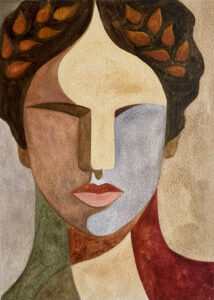
Ouasli feels that she’s working between the spiritual and the theoretical, an invisible dimension and a visible one. She explains: “The invisible is connected to what we don’t see, but what we feel. And the theoretical is what’s connected to the Earth, to reality, to what we experience. There are many things that are invisible. For example, energies — when you meet someone, something invisible happens that you can’t explain. Sometimes there’s a connection, at other times the opposite — you want to distance yourself from that person.”
Asked how one captures energy in a painting, she says, “That’s the whole challenge. I work with oil painting because for one thing, it’s a slow process, and there’s something meditative about oil painting. It takes time to create… a certain depth.”
Then there is the matter of the past, and how her memories of Tunisia come into play, as well as the mystical texts and myths she talks about. “I have these lived memories,” she says. “For example, visiting a saint’s mausoleum, preparing a meal that we’re all going to eat together, walking around the old medina — everyday experiences, but also spiritual ones, because there were a lot of beliefs. Beyond religious relief, beyond Islam, there were beliefs like invoking a certain saint to receive his blessing, so that the wedding would go well for the young woman getting married. There were other beliefs, such as using salt, and reciting incantations to ward off the evil eye. I remember that when there were periods of drought for farmers, when crops were threatened and agriculture was in bad shape, they would make invocations. My mother and aunt did this; they would take pieces of wood, hang cloths on them, and recite a spell to make it rain. And there was something magical about it, because rain would fall.”
Asked about her own beliefs, Dalel Ouasli stops for a moment, surrounded by dozens of oil paintings of varying dimensions. After some reflection, she replies, “I believe in a form of universality. I see the umma as representing and bringing together Muslims, Christians, and Jews. I don’t know if you know René Guénon. He’s a metaphysician who believes in a primordial tradition — a tradition that is the source and origin of all others and that, in fact, connects all the beliefs across the entire Earth into a single tradition that bonds us all together.”
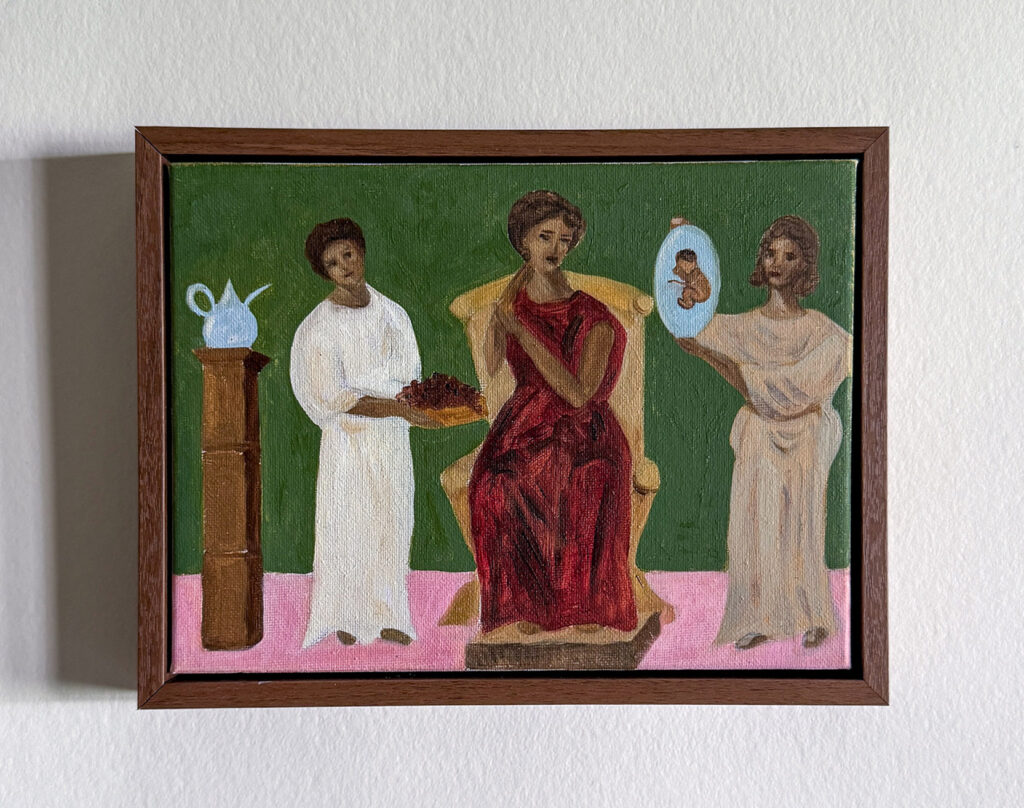
What of Sufism, what are the connections Ouasli makes in her work? “I became interested in Sufism when I started my studies because I needed to understand my cultural background and my origins — where I come from. I found answers in Sufism. I thought it was a beautiful way of looking at things. For example, Rumi’s The Book of the Inner Self. Sufism is pretty complex, it’s about inner life, about encountering oneself, so there’s a bit of an initiatory quest involved. I became interested in medieval texts from the twelfth and thirteenth centuries. Rumi in particular, as well as Ibn Arabi, and Al-Sulami.”
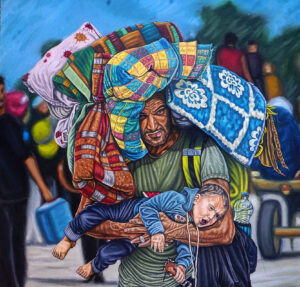
There is a contemplative quality to much of Ouasli’s work, in her scenes and figures, but rarely do her paintings conjure death. While she thinks of herself as a Mediterranean-inspired artist, the Mediterranean Sea has become a kind of coffin, because so many refugees have died attempting to cross the sea to Europe, and safety. “It’s true,” Ouasli says, “that I celebrate life [in my work] and yet death is part of life too — isn’t celebrating life also a way of accepting death? Of telling ourselves, well, from the moment we’re born, in fact, we know we’re going to die, that we’re not eternal. Philosophy and mystical texts help us accept death. By reading and engaging with these texts, can’t we come to accept death better? And yes, I think the Mediterranean has become a graveyard, where thousands of migrants have drowned. While it’s true that I haven’t yet addressed death in my work, I am thinking about it. I’d like to explore that territory one day because I think a lot happens in life. There are births, there are weddings, there are breakups, there is illness. There are broken hearts, and there is death, too.”
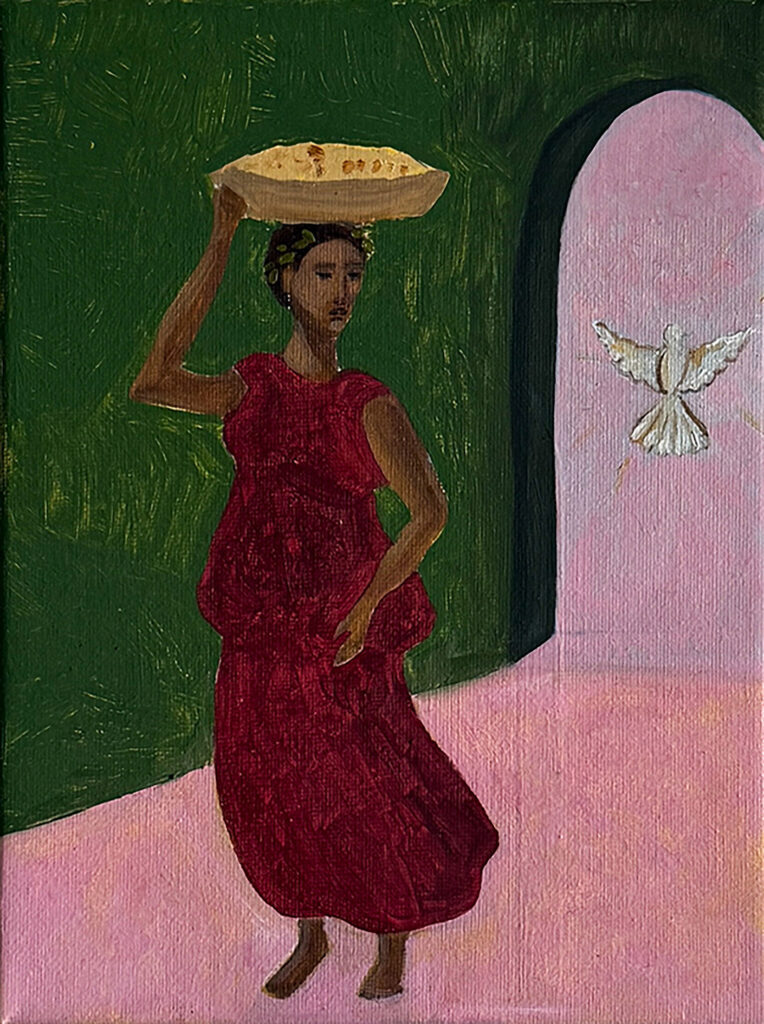
As a return to origins and sources, the artist says that she is presently developing a project around ancient rituals, feminism, and the figure of Tanit. A chief deity of ancient Carthage, which was founded in the ninth century BC on the Gulf of Tunis, Tanit was revered as the goddess of wisdom, civilization, and the crafts. Still today, Tanit is invoked in Tunisia during times of drought, and as a symbol of fertility. An ancient figure who has inspired such novelists as Flaubert and Margaret Atwood, perhaps Dalel Ouasli will find both the sacred and the universal with Tanit as her muse.