A Moroccan artist and "artivist" reflects on the inspiration and political realities behind his work.
Expulsion from the Riviera
Oil on canvas, 58x45cm, 2025.
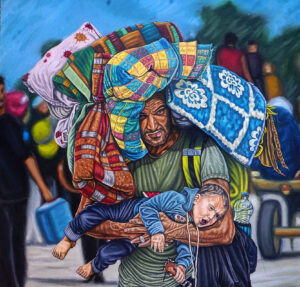
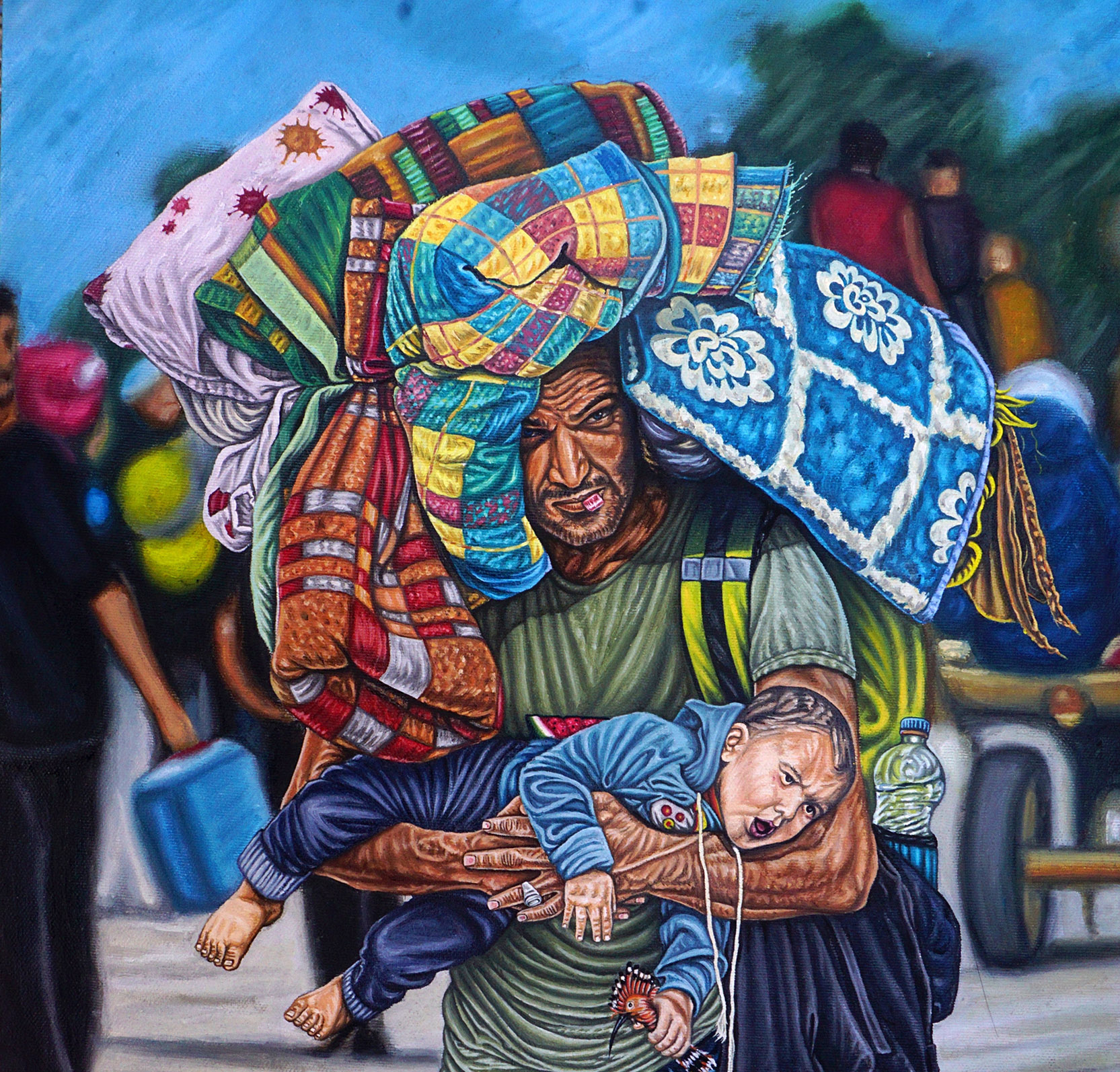
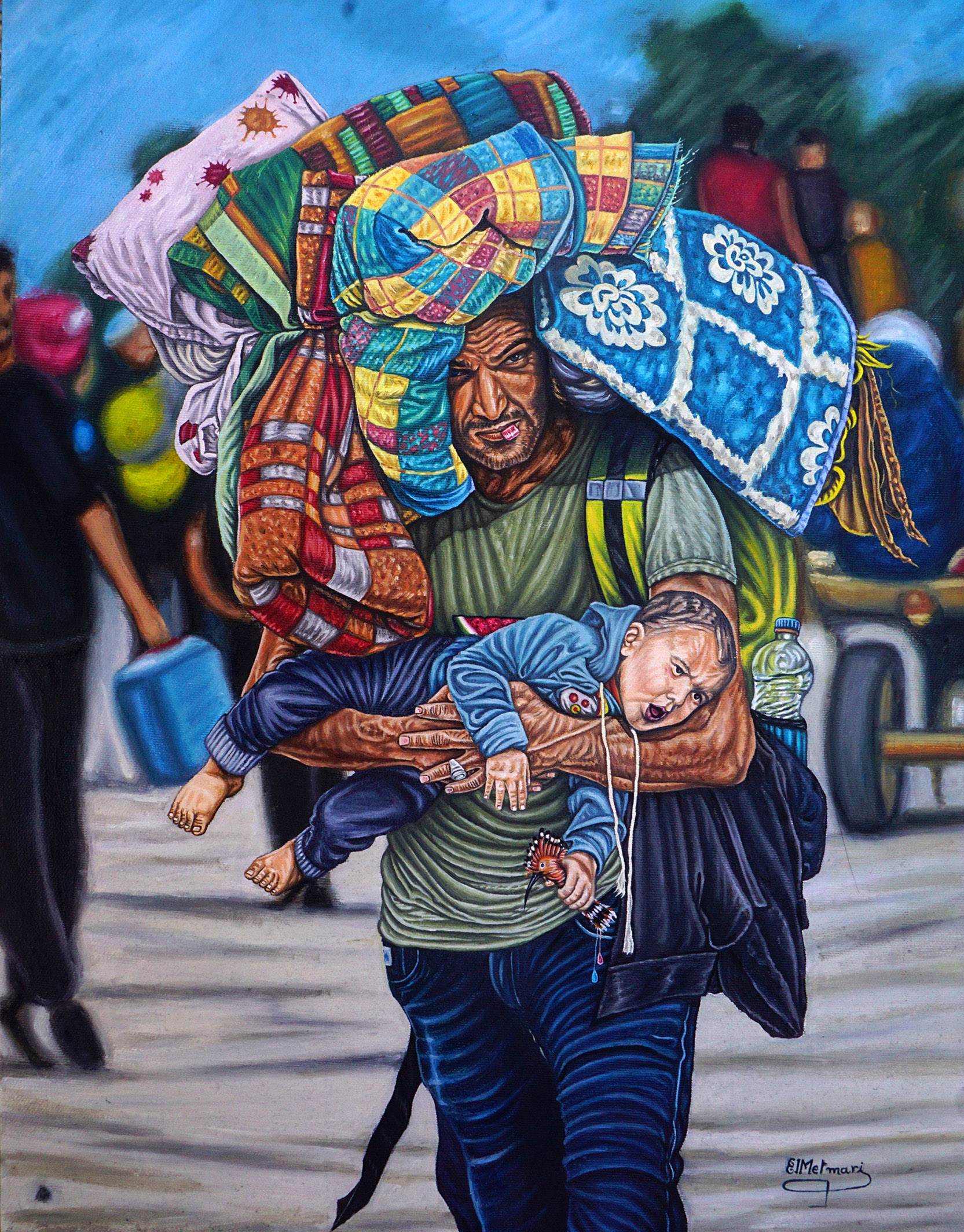 “Expulsion from the Riviera” is an allegory for how people become victims of borders and wars, especially in the Middle East, one of my main sources of inspiration and interest. It is a region where territorial changes have not ceased since the fall of the Ottoman Empire. With these constant changes to the map driven by power struggles, people of all ages and backgrounds continue to become victims.
Painted in oil on stretched canvas, this work is part of a series exploring forced migration, displacement, and land dispossession — situations in which people are denied the luxury of forming memories and bonds with places due to constant evacuations and the compulsory movement imposed by trauma-inducing conflict zones.
It is titled “Expulsion from the Riviera” because many people who are dispossessed, unhoused, or forcibly evacuated live on lands rich in minerals and natural resources. In such cases, capitalistic greed — often allied with despotic political power — becomes a totalitarian force that reshapes territories and disrupts people’s relationship with their spatial surroundings, all for the sake of gaining full access to the riches beneath their feet.
It is, of course, evident that the title is a direct reference to Gaza, whose coastline is rich in oil. In the midst of an American-funded genocide, the Trump administration promoted the idea of creating a riviera and tourist resorts on the rubble of dead Palestinian children and Gazans, while proposing the evacuation of the survivors — without consulting them or involving them in this vision. This is the tragedy of conflict: the wretched and powerless are left only with suffering between borders and checkpoints, their fate reduced to a security clearance or a stamp that determines their transfer to the next refugee camp.
Moreover, at the moment of evictions, dispossession, or expulsion, we tend to think only of packing the most important or essential items to keep a belly full and a body warm. For adults, this may include warm blankets, water, canned food, or a family photo album; for children, it is often their cherished toys. In this painting, the father appears weighed down by the load of necessities, highlighting the struggle of men during conflicts, as they are both targets and central to the survival of those who depend on their suffering, sacrifice, and strength for a chance at life.
For the child in the painting, although he appears unhappy with the situation, he chooses to carry, not his shoes, but a toy bird: the hoopoe. This particular bird carries significant symbolism in religious texts, representing truth — a quality often blurred in conflict zones, much like the suffering of the people living there. Therefore, this painting not only advocates for the right to life and housing for the victims of the many “rivieras” around the world, but it also serves as a call to speak truth to the powers that perpetuate their suffering.
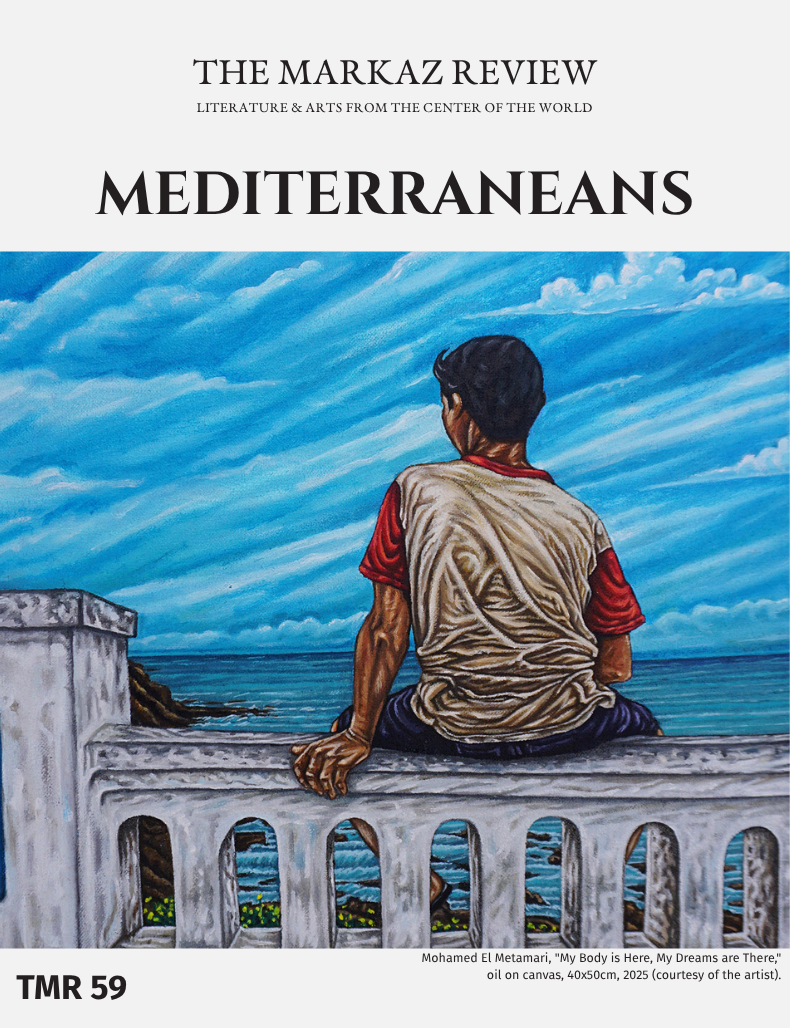
My Body is Here, My Dreams are There
Oil on canvas, 40x50cm, 2025.
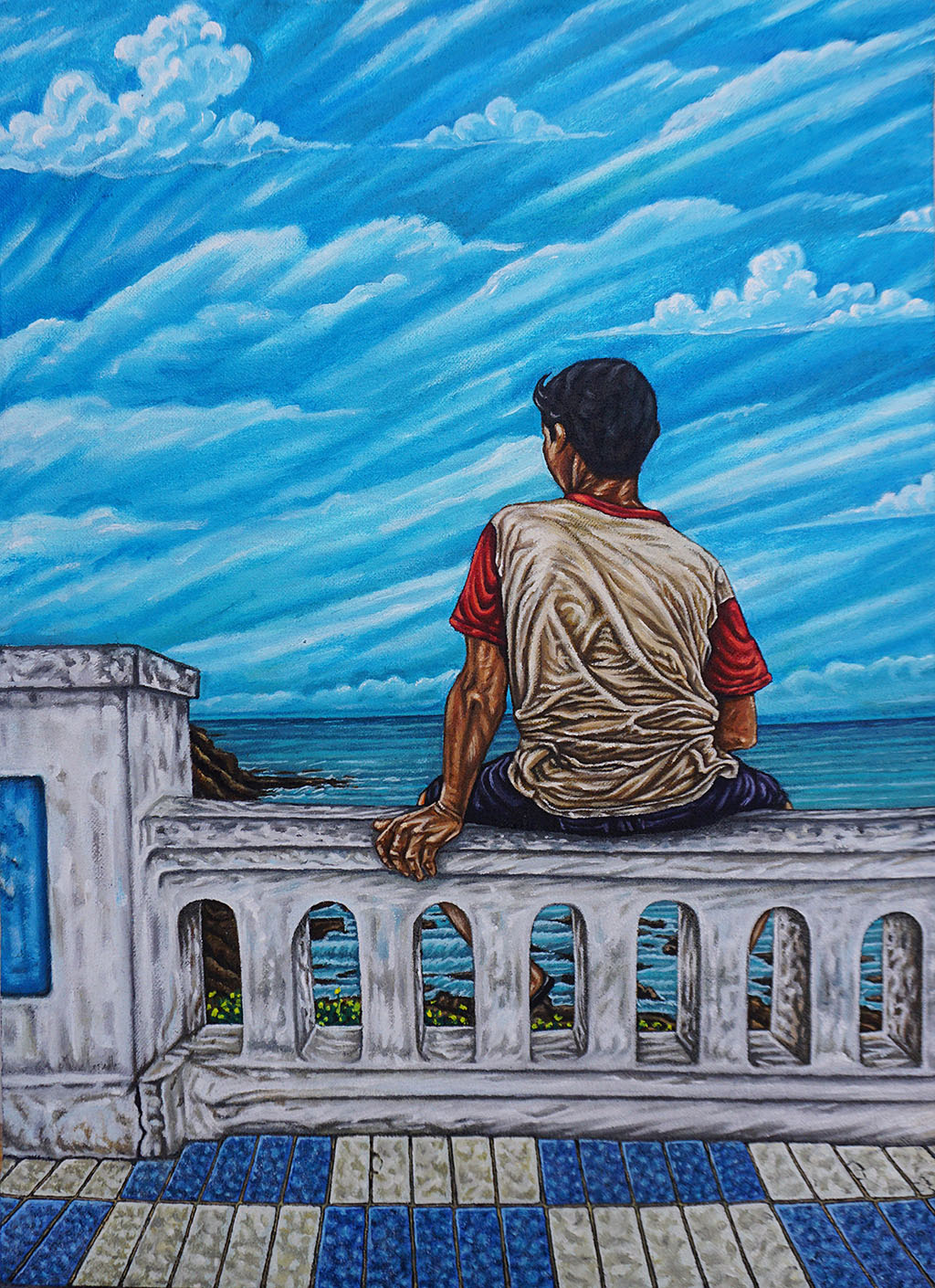 This painting is part of a series I am currently working on. This series’s subject matter is migration and people as victims of borders. These people could be “irregular” migrants, refugees, or dispossessed and displaced individuals.The painting appears simple, showing a young boy sitting on a terrace enjoying the view of the sea. Yet it conveys the profound tragedy experienced by Moroccan youth.
To offer some context, I live in the north of Morocco. This region — especially the cities of Larache, Tangier, and Fnideq — is known as a crossing point for many undocumented sub-Saharan migrants heading to Europe. For many of them, Morocco represents the final hurdle before reaching the European “paradise” lying on the other side of the Mediterranean.
However, the majority fail to reach their intended destination, as Morocco maintains strict control over its borders. As a direct consequence, they often end up stranded in Moroccan cities, waiting for another opportunity to attempt the crossing.
However, the reality of migration has never been, and is no longer, exclusive to sub-Saharan migrants. In fact, ever since the Arab Spring failed to achieve its core demands, many Moroccan youth have lost hope of transforming the country into a just, democratic, and inclusive state. As a result, instead of taking to the streets to demand their rights, they now turn to the sea in search of escape.
Many dream of crossing the border in search of better living conditions, greater freedoms, and rights that are denied to them in their home countries. However, strict border control often leaves them stranded, stuck with their bodies in their homeland while their dreams, aspirations, and ambitions lie abroad.
Official Moroccan reports reveal that 25 percent of Moroccan youth aged 15 to 24 — approximately 1.5 million — are neither employed nor enrolled in education. It is important to highlight that many drop out of school before completing high school, as they see no value in continuing their education. In a country where power and wealth are centralized due to corruption and authoritarianism, many minors seek to escape the reality their parents and grandparents have endured for decades. They aspire to break the cycle, no longer willing to live in a country where their basic rights are not guaranteed.
Last summer, the region witnessed an exceptional wave of Moroccan youth — particularly minors — heading north, taking advantage of the fog and poor weather conditions to make their way to the Spanish-occupied city of Ceuta. Reports estimate that the number of those attempting the crossing ranged between 4,000 and 5,000. Nevertheless, many were sent back to Morocco, causing their dreams to be postponed — or, for many, shattered.
Here, we can also reflect on the European policy of externalizing borders to third-world countries. As a result, these buffer states, like Morocco, are tasked with guarding European borders in exchange for aid. Consequently, the borders become an arena of human rights violations, where people’s right to move and, at times, their right to live are jeopardized. Given that these states, responsible for managing the borders, have poor records of human rights, they treat migrants with utter disregard for their basic rights.