A young man in Gaza moves between rubble, work, and the sea, holding onto fleeting moments of dignity and fragile illusions of normal life.
Moaz wakes to a strange taste, chalky and metallic. His mouth fills with dust, and he wonders whether it is coming from inside or outside of him. In a panic, he reaches for the glass of water next to his mattress and knocks it over.
“Shit,” he says, sitting up.
“Haram, ya Moaz,” his mother calls from the next room. She can hear him. They can all hear each other, all the time. Fourteen of them piled into his uncle’s two-bedroom apartment. He dabs at the water with a corner of his sheet. He shouldn’t waste it.
He looks around the room. Every centimeter of the floor is covered in mattresses, cushions, and blankets. The children, all nine, sleep in this room. Moaz, twenty-two yet unmarried, still counts as one of them. His parents, his uncle and aunt, and his older sister, recently widowed, sleep in the other bedroom. Across the room, his nine-year-old cousin, Yunis, sleeps on a heap of blankets. His marmalade-colored cat, Mishmish, is curled on his belly, rising and falling with Yunis’ breaths. Beside Moaz is his younger brother, Ahmed. In the small gulf between their mattresses, the puddle of spilled water.
Ahmed snores softly, his face turned into the crook of his arm. Ahmed can sleep through anything: honking cars, screeching alley cats, or bombs falling just a few kilometers away, as they had last night. The whole apartment had shaken, frames rattling on the walls, a deep, subterranean rumbling. The other children had woken up, terrified and in tears, tearing across the mattresses. As the eldest, he opened his arms and gathered them to him, hugging them tight as he told a story about a friendly giant who was so clumsy that he kept tripping and knocking over buildings. The bombs lasted for hours — it was methodical, moving block by block, inching closer and closer. Ahmed tossed and turned but never woke up, not even when Moaz jumped to close the windows as the air outside turned to ash. The other children whimpered and begged him to come back. “It’s just the giant sneezing,” he said, pinching his nose.
He can hear the other children in the kitchen now, squabbling over the last of the bread. He is in the room with Yunis and Ahmed, both fast asleep. This is the closest he has come in weeks to being alone. Moaz bends over, his lips hovering over the puddle of water. He slurps it up, sucking as much of it as he can without his lips touching the floor. His father spent three hours and half a week’s wages to buy this water.
At the sound of Moaz’s slurping, Ahmed’s left eye flickers open, his right eye still buried in his elbow.
“Why are you lapping water off the floor like a cat?” Ahmed asks, his voice thick with sleep.
“This is what wakes you?” Moaz says, wiping his mouth on his sleeve.
“Why? What happened?” Ahmed sits up quickly, his eyes darting around the room.
“Nothing. Look at Mishmish. He’s got the best bed in the house.”
As if on cue, Mishmish stands, turns around, then plops back down on Yunis’ stomach. Ahmed laughs.
Moaz gets up, wobbling on the mattress, and offers his hand to Ahmed.
“Let’s get some breakfast, if those other monsters haven’t eaten it all yet.”
*
Moaz is the last one to the bathroom. By this time, the sink is covered in globs of toothpaste. Every towel on the rack is damp. In the wastebasket, a sanitary pad folded up inside some toilet paper. Worst of all, the room stinks of Ahmed’s hair gel. Moaz has long given up on grooming; weeks earlier, he had taken his father’s shaver to his head and buzzed his thick curls to the scalp. But Ahmed, only sixteen and dangerously aware of how handsome he is, rations his hair gel like it’s the most precious commodity in the world.
Stories about giants won’t put food on the table or stop the shelling.
Moaz picks up his razor, then thinks better of it. Who cares about a few days’ worth of stubble? Why waste the water? He rubs his palm up and down his cheek. He may be sharing a room with eight children, but at least he can walk around looking like a man. He swipes on some deodorant and brushes his teeth, rinsing the sink out well when he is done.
At the front door, he endures his mother’s nagging about his beard, kisses her hands, and waits patiently as she prays for his safe return. Then out of the apartment at last, he releases a long sigh. He resists breaking out into a run before anyone can call him back.
Ahmed is sitting on an overturned paint can a few meters from the building’s entrance, his head gleaming, not a hair out of place.
“Our clothes are clean!” Ahmed sings. “The cleanest clothes in town! Come and see a demonstration!”
He has a new side hustle. Ever since the war started, Ahmed has brought home more money than anyone else in the family. He is good at inventing things, at taking the detritus of other people’s lives and seeing its potential for reincarnation. Every few days, Ahmed comes home with a new collection of discarded items. Recently, he’s collected a bike pedal, the blades from inside a fan, a hub cap, and a dented plastic basin. Where people see junk, Ahmed sees opportunity: a washing machine.
As he sings and calls out to passersby, a crowd gathers to watch him operate his new invention.
“No electricity? No problem!”
He’s filled the old plastic basin with water and some clothes. He hunches over the basin and sprinkles some powdered soap over the top with a magician’s flourish. Then he cranks the bike pedal, affixed to the hubcap, which is itself attached to the fan blades. As the pedal turns, the hubcap and blades spin, rotating the clothes in the basin.
“Give me five minutes and your clothes will be as clean as mine! Watch!”
Moaz looks at the time. He is late to meet Malik. As he walks away, he can hear the negotiations begin.
“By God, pay me what you think is right,” Ahmed says.
Moaz smiles and shakes his head. It sometimes bothers him how indispensable his little brother has made himself in this new world. Meanwhile, Moaz feels useless, a glorified babysitter. Stories about giants won’t put food on the table or stop the shelling. Today will be different, because he’s finally found some work. It will be hard. He will return home filthy and exhausted. But for the first time in weeks, he feels almost excited.
They are all lost, in the city they were born in, the only city most of them have ever known.
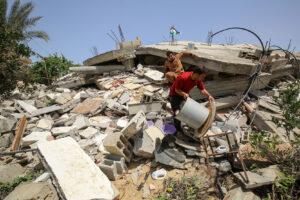
In their old lives, it would have taken Moaz ten minutes to get from his uncle’s apartment to Malik’s father’s shop. But in this new world, the landscape of the city changes every night. As he walks, the road suddenly ends at a mountain of debris. Moaz scrambles up and down enormous shards of concrete to continue. The obliteration is disorienting.
“Do you know where the corner of Al-Jala and Al-Sabah is?” he asks a man sitting in a plastic chair beside a building that has been blasted open like a dollhouse. As the man gives him directions, a woman pokes her head out of one of the apartments. She holds onto some steel beams for balance as she calls down to the man below and asks if he wants any tea.
Moaz continues, and the road reassembles into something he can recognize. Up ahead, Malik is waving his arms. Moaz grins and wipes the dust from his face.
“You made it,” Malik calls.
“Sorry I’m late. Would you believe I got lost?”
“Habibi, look around. Everyone is lost!” Malik laughs like it’s the funniest thing in the world. They are all lost, in the city they were born in, the only city most of them have ever known.
“I have a gift for you,” Malik reaches into a backpack at his feet and pulls out a small object, which he hides between his hands. He lifts his top hand like a magician pulling a rabbit from a hat. “Mabrouk!”
In his hand is a tiny graduation cap, intricately folded out of white paper. Moaz stares at the paper hat then back up to Malik’s face, confused.
“I couldn’t sleep last night, it was either the air strikes or indigestion, anyway, I realized: today would have been our graduation.” Malik thrusts the hat into Moaz’s hand. “My sister made them for us. I have one too. Yalla, let’s take a picture.”
Malik reaches into the backpack and pulls out an identical paper cap. He puts it on his head and waits for Moaz to do the same.
Moaz counts back the days in his mind. Sometimes he feels like he’s living in a video game, multiple Moazes on a split screen, converging and diverging but never touching. Like if he turns his head, he might see his old life running like a hologram alongside him. On another screen, Malik has just graduated with a degree in computer science, Moaz with a degree in architecture. There is cake and a party by the sea. But on this screen, in this life, there is no university. A diploma here is as worthless as the paper hats on their heads.
Malik elbows him in the side and tells him to smile for the selfie. “Look alive, ya Moaz. This is the happiest day of our lives!” He flashes a peace sign and Moaz sticks his tongue out. Malik plucks the hats off both their heads and places them back into the bag. If Moaz can’t be like Ahmed — useful, good in a crisis — he can at least try to be more like Malik, who shrugs off despair like an unneeded jacket.
“Let’s get started,” Moaz says, throwing his arm around his friend’s neck.
Outside the shop, a few other young men are gathered. Malik’s father, Yassine, is paying them to clear the rubble blocking the entrance. A strike leveled the building next door, sending massive pieces of shrapnel flying. The front door is buried behind a pile of debris.
“Yalla, ya shabab,” Yassine says to the group. “Whoever makes their way inside first gets to take home the cash register.” He laughs and claps his hands, and the men get started.
Moaz thinks it will take them an hour, maybe two, to carve a path to the entrance. As soon as they begin, he realizes how wrong he is. The work is agonizingly slow. It takes all seven of them to lift some of the larger pieces of concrete. Sweat pours down Moaz’s face within minutes. As the others grunt and swear, Malik and Yassine sing a Fairuz song. We’re coming back, oh love, we’re coming back.
Cradling a block of concrete, Moaz trips and almost drops the block on his toes. Malik leaps to steady him.
“Oh, flower of the poor,” Malik croons as he helps carry the block.
“Your voice is truly one of the worst things I’ve ever heard.”
“You’re welcome, habibi,” Malik says, slapping Moaz’s cheek lightly with a gloved hand.
Sometimes he feels like he’s living in a video game, multiple Moazes on a split screen, converging and diverging but never touching. Like if he turns his head, he might see his old life running like a hologram alongside him.
Moaz takes off his own gloves and uses them to wipe the sweat off his face and neck. They’ve been working for two hours and have hardly made a dent. There’s no way they’re getting into the shop today. But if it means another day of work, he is grateful for it. He wants to return home with arms full of bread. He wants to buy Ahmed a fresh tube of hair gel, and his father a jar of olives.
At lunchtime, Malik’s mother and sister arrive with cheese sandwiches.
“Break time, ya shabab,” Yassine calls out.
The swearing and grunting stop as the men find perches to sit on to eat. Moaz stretches out on a large slab of concrete and closes his eyes. There is silence as the men devour their sandwiches. All Moaz can hear is his own shallow breath and the buzzing of the drones overhead. Moaz cracks open an eye and watches the black machines swarm in the sky. He pictures another Moaz stretched out across a screen just a few kilometers away, his digital body a riot of neon. With his heart beating so fast, his skin hot and sweaty, he might draw the drones’ thermal imaging right to him. They’re just surveillance drones, he tells himself. Until, of course, one of them pauses, looks at him, and takes aim.
The wind shifts, and the drones zip higher. But the wind brings something else, an odor that comes to them in waves, getting stronger and thicker. At first, the smell is like flowers decaying in a vase of murky water. The next gust brings a whiff of moldy apricots, of meat left out in the sun.
He feels someone sit next to him and knows it is Malik. “If we ever get into the shop, let’s get you some deodorant,” he says. “Please, ya Moaz. You stink.”
Moaz laughs, silently at first, his body shaking gently. But the worse the smell gets, the harder he laughs. Malik joins in, until both of them are clutching their bellies, writhing on the concrete, trying to stop. An image of the other Moaz flashes in his mind — the neon colors pulsing hysterically, in sync with his laughter.
“I saw this video once,” Malik says, “of this man telling people that the whole city smells of musk.”
“Musk?”
“Yeah, like from the bodies of the martyrs. This guy is grinning into the camera, telling people that martyrs don’t smell like corpses but like musk, the scent of heaven.”
“You’re kidding me,” Moaz says. The smell is unbearable now. He pulls his shirt over his nose. Malik is lying flat on his back, his hands behind his head.
“The video got, like, a million views. The man quotes this hadith where the prophet, sallallahu alayhi wa salaam, said something about how when the martyrs reach heaven, their blood looks like blood but smells like musk.”
“Huh,” Moaz says, pulling his shirt down again. The worst of the smell has passed over them. The sky pulses with a high-pitched vibration, a frequency he feels in his bones rather than sees with his eyes.
“I looked it up. There are dozens of hadith about how sinners will smell the stench of rotting corpses when they approach hell and how we will smell musk when we enter paradise.”
Malik starts quoting the hadith, and Moaz realizes he’s memorized them.
“Paradise is built from bricks of silver and gold, its mortar is musk of strong fragrance, its pebbles are pearls and rubies, and its soil saffron. Whoever enters it will enjoy bliss without despair and eternity without death. Their clothes will not fade, nor will their youth expire.”
“So, all these Muslims out there watching us die? They think our whole city reeks of perfume?”
Malik shrugs.
“Does that make this heaven?” Moaz asks.
Malik makes a sound between a snort and a cough. He reaches to the ground beneath their slab of concrete and scoops up a handful of dirt. “Saffron,” he says, letting the dirt slowly trickle out between his fingers. “Gold,” he says, patting the concrete bed beneath them. Then he takes a deep breath. “Can you smell it? We’re here. We’ve already made it.”
∼
They work until they’ve carved out a hole big enough to look through. They can see shapes in the dark that might be cans, bags of rice, bottles of water. Even if the building collapses on them while they are inside, at least they will be buried with their arms full of Kit Kats and Pepsi, Royal cigarettes and chewing gum. Moaz has the beard of a man but the cravings of a child. What he wouldn’t do for a Fanta! They want to keep going, to make it all the way inside. But Yassine orders them to stop.
“That’s enough for tonight,” he yells when the boys start to squabble over who gets to look inside. They are getting tired and sloppy, he says. Malik’s cousin has already busted his big toe trying to kick a cinderblock out of the way; the bloody toe swells under his shoe. “Tomorrow Moaz will examine the structure to see if it’s safe.”
Moaz looks up at the sound of his name. He had been imagining the sound of opening that Fanta, the hiss and sigh of it.
“Me, ya Amo?” he asks.
“Yes, of course! As of today, aren’t you officially mister architect?”
Moaz starts to object, to explain that an architect is different from a structural engineer. What if he tells everyone the building is safe, and it collapses on top of them? Will their corpses still smell like musk if their bodies are crushed not by bombs but by Moaz’s own stupidity? He thinks of his younger brother — what would Ahmed do?
“Moaz Ibrahim Abu Zuhair, certified architect, at your service, sir,” he says, giving a little bow. The boys roar in approval and Yassine claps his hands.
“Until tomorrow then, inshallah,” Yassine says.
Malik invites Moaz to come back home with them. But Malik has his grandparents and two aunts and their families staying with him. His apartment is even more crowded than Moaz’s. Malik told him that once, when he couldn’t take the sound of eighteen people snoring, he took his pillow and blanket and slept in the bathtub.
“It wasn’t that bad,” he had said. “Until you wake up to your grandpa pissing two feet from your head.”
All Moaz wants is a little quiet. But quiet is elusive in this city, even in good times. They were packed into a pen and locked in. “Moo moo,” Malik would say. Moaz is tired of trying to be like Malik and Ahmed. He is tired of laughing at their humiliation, of remaking their lives from trash, of eating expired food and drinking filthy water, of recycling ruins. He doesn’t want to be positive. He doesn’t want to make the best of any of it.
There are still a couple hours before sunset. He knows that if he doesn’t get home before dusk, his mother will start to panic. But he can’t go back just yet.
He says goodbye to Malik and heads west. He passes a boy selling biscuits, a girl selling hair scrunchies, a boy selling tissues. He has a little money in his pocket from the day’s work. The children call out to him, but he keeps walking. The wind slaps his cheeks like it is trying to knock some sense into him.
And then, the sea.
If he only looks straight ahead, at the white sand disappearing under the blue tongue of water, there is absolutely nothing wrong.
He strips down to his boxers, tosses his clothes on the sand, and runs towards the water, splashing thigh-deep into the surf. He lets the waves knock him around, flip him over and flood his nose. He is limp and compliant until, finally, the sea spits him out and he lays, panting, by the shoreline, splayed out on his back like a starfish. He turns his head, cheek to the sand, toward the horizon — no clouds, no planes, no drones. Only a blue line where sky meets sea, the first gate to heaven. His mother will start to worry soon, and doesn’t paradise also lie beneath her feet? He closes his eyes and listens. Whatever is happening back there is drowned out by the sound of the water. He can’t hear a thing beyond the crashing of the waves and the suck of the sea.
He turns his head, cheek to the sand, toward the horizon — no clouds, no planes, no drones. Only a blue line where sky meets sea, the first gate to heaven.
He thinks of a beach in the north that he and his family used to go to on summer evenings. His mother would pack a picnic and his father would buy them ice cream. One night last summer, they saw a man swimming in the sea with what first appeared to be an enormous dog. As the man came closer, they realized it was not a dog but a horse, frolicking and jumping alongside its owner, rearing her head back as if to catch the ocean spray in her mouth. If the waves moved the man the wrong way, he would drift right under the path of her hooves. But the man trusted her. Moaz’s family laughed and shook their heads as the man finally emerged from the surf, climbed onto the horse’s back, and rode off down the beach like some mythical hero.
“What is it about our people and their pets?” Moaz had asked as they watched the man disappear.
“It’s something we can control,” his father said. He had a small dab of vanilla ice cream in his mustache. “We can control whether the animal has a good life, a life of dignity. Even when we can’t give that to ourselves, we can give it to our pets. Take him,” his father pointed at the spot in the distance where the man had disappeared from view. “Who knows what his life is like? But have you ever seen a happier horse?”
As Moaz lays in the surf, he recalls the stories they had exchanged that night. The story of the woman who broke her fast with beans during Ramadan but insisted on giving her dog lamb. The man who slept on the couch and ceded his bed to his cat because she didn’t like to share. Someone who sang Um Kulthoum songs to his pigeons each night.
And what of the man and the horse? What has become of them now?
He stands and dunks his head into the water. He rubs his scalp and scrubs his face with a handful of sand until his skin feels raw. He rinses. The sky is a pale purple. If he doesn’t hurry, his mother will begin to imagine all the ways he could be returned to her. He takes one last look at the glimmering sea and forces himself to turn towards the city, the skyline now bathed in shadow.
As he trudges up the beach, he sees a boy rifling through his clothes.
“Hey,” he yells. “Hey, ya walad!” He runs, his muscles screaming, his feet sinking in the sand. He has no doubt the boy could outrun him, and then he would return home not only late, but with nothing to show for his work.
“Thief!”
The boy freezes, wide-eyed, with his hand in the pocket of Moaz’s jeans. Moaz skids to a halt in front of the boy and reaches down to snatch the jeans from his hands. The boy has dark brown skin and strange copper-colored hair. His eyes are green, enormous and unblinking. Crouched there in the sand, his hand still cupped in an invisible pocket, the boy looks terrified. Of him, Moaz realizes. Six foot four, haggard, nearly naked. He is about to reach out his hand to help him up, when the boy springs to life as if someone has put a coin in him.
“I’m no thief, you son of a dog!” the boy yells, before unleashing a string of the foulest insults Moaz has ever heard. His grandfather is a donkey-fucker and his grandmother is a whore. On and on he goes as Moaz looks around, trying to find someone the kid belongs to. There is no one around to claim him.
“Ok, enough, please!” Moaz yells, hurrying to put his clothes on. “If you’re not a thief, why were you going through my pockets?”
“I thought you were dead.”
Moaz pats himself up and down, then puts two fingers to his pulse. “You thought I was dead?”
“Well, obviously now I can see that you’re not dead, you idiot. But you looked pretty dead when you were laying on the sand.”
“Do you make a habit of robbing the dead then?”
The boy shrugs. “It’s not like they need it where they’re going.”
Moaz thinks of the hadith: Paradise is built from bricks of silver and gold… “No, I guess they don’t.”
Moaz reaches his hand down to help him up. The boy flinches. Moaz extends his hand again. This time, the boy puts his bony little hand in his and Moaz pulls him up to standing.
“Yalla,” he says. “You better get inside. It’s getting dark. Where do you stay?”
People had taken to asking each other this question instead of “Where do you live?” That question had become difficult to answer — too many variables, too many ways to interpret. “Where do you stay?” was better, more precise.
“I’m sorry I thought you were dead,” the boy grumbles, ignoring the question.
“I’m sorry I wasn’t dead.” Moaz means this as a joke, but something in the way the boy looks at him makes him feel embarrassed, like he has confessed a secret.
The planes are upon them without warning. Moaz grabs the boy by the wrist and starts running. He spots a metal dumpster, tipped on its side, and pulls the boy to it.
“Can you fit underneath?” he screams over the roar of the planes—four of them, massive and flying low.
The boy doesn’t wait to reply. He gets down on his belly and slides under the dumpster. Moaz is too big, so he crouches beside it, his hands pressed to the rusted metal. He feels something grab him and he almost screams, but it’s only the boy’s fingers clenched around his ankle. He wills himself to look up. One of those giant gray beasts is right above them. A hatch in its belly opens. He reaches down and puts one hand on top of the boy’s.
“Ma’lesh,” he screams, but he doesn’t know if the boy can hear him. He starts to recite the Shahada. Something slides out of the plane’s belly. A flash of white, a cloud torn to a million pieces. The planes continue south down the coast, thousands of pieces of paper fluttering down in their wake. The wind blows the paper inland in great swirls. Moaz watches the planes go, opening their hatches and releasing more paper.
“It’s ok,” he says, patting the boy’s hand. “They’re gone.”
The boy’s head appears. He scans the area, and then shimmies out. They sit with their backs against the dumpster, catching their breath as the sheets swirl above them in slow, gentle arcs. It’s like they’ve won the World Cup, the confetti raining down.
“What do you think they’ll say?” the boy asks.
“What they always say probably.”
“Maybe the war’s over.”
Moaz snorts and the boy scowls at him.
“You don’t know,” he says. “All those other wars had to end sometime. Why can’t this one end today?”
Moaz rests his head against the dumpster and closes his eyes. The sheets of paper flap around them like a swarm of locusts. Maybe the boy is right. The war has to end sometime.
He feels the boy jump up. He opens his eyes and watches the boy hop, arms flailing, trying to snatch a leaflet. He imagines the boy somewhere else, trying to catch a firefly or candy from a piñata. The boy stands very still, his eyes tracking the falling leaflets, until finally he leaps and plucks one from the sky. He grins at Moaz victoriously, then smooths the paper out and starts to read.
“What does it say?” Moaz asks.
The boy says nothing. Instead, he shouts in frustration and crumples the paper in his fist. He spikes it to the ground. Tears well in his eyes. He rushes towards the rest of the leaflets fluttering down from the sky, grabbing them, stomping on them and ripping them to shreds, cursing them like he had cursed Moaz on the beach.
“Son of a whore!”
Moaz does nothing to stop or comfort him. He waits until the kid has exhausted himself, standing there limply, shuffling the leaflets around with the toe of his sneaker.
“What will you do?” Moaz asks.
The boy shrugs.
Moaz hoists himself up. The muscles in his legs feel gelatinous, like he can’t rely on them not to collapse. It will be a long walk home. No, not home. Back. It will be a long walk back.
“Where are you staying?” he tries again.
The boy ignores him.
Moaz reaches into his pocket, feels for the five shekels from Yassine. He grabs one and hands it to the boy, who snatches it and stuffs it into his pocket as if Moaz might change his mind.
“I really did think you were dead, you know.”
“I know.”
Before turning left on Tariq Ibn Ziyad Street, Moaz pauses to send a message to his mother. He opens his phone and sees a message from Malik’s cousin, the one who kicked the cinder block. The message was sent to all the guys who were helping clear the shop. A picture of his swollen toe, the nail black and cracked. There is a speech bubble coming from the bloody nail. “See you studs tomorrow.”
The message must have been sent before the leaflets fell. He doesn’t suppose any of them will be back tomorrow. He turns to take one last glance at the sea. There is no sign of the boy, not even a speck in the distance. Ahead of him, a road littered in leaflets that will stick to the bottoms of his shoes as he walks, carrying their orders with him through the city.