Amid a tense cultural and political climate, a palpable wariness hovered over Istanbul’s art programme this autumn.
On the upper floor of a nineteenth-century building in the Passage Petits-Champs, in Istanbul’s Pera neighborhood, a DJ is playing Turkish dance classics. One floor down, I’m seated in a quiet room with frescoed walls, sharing a sofa with a few artists and journalists. Istanbul-based artist Hera Büyüktaşcıyan is speaking: “In general, as Turks, our identity is very difficult to pin down, and definitely impossible to reduce to a single national image.”
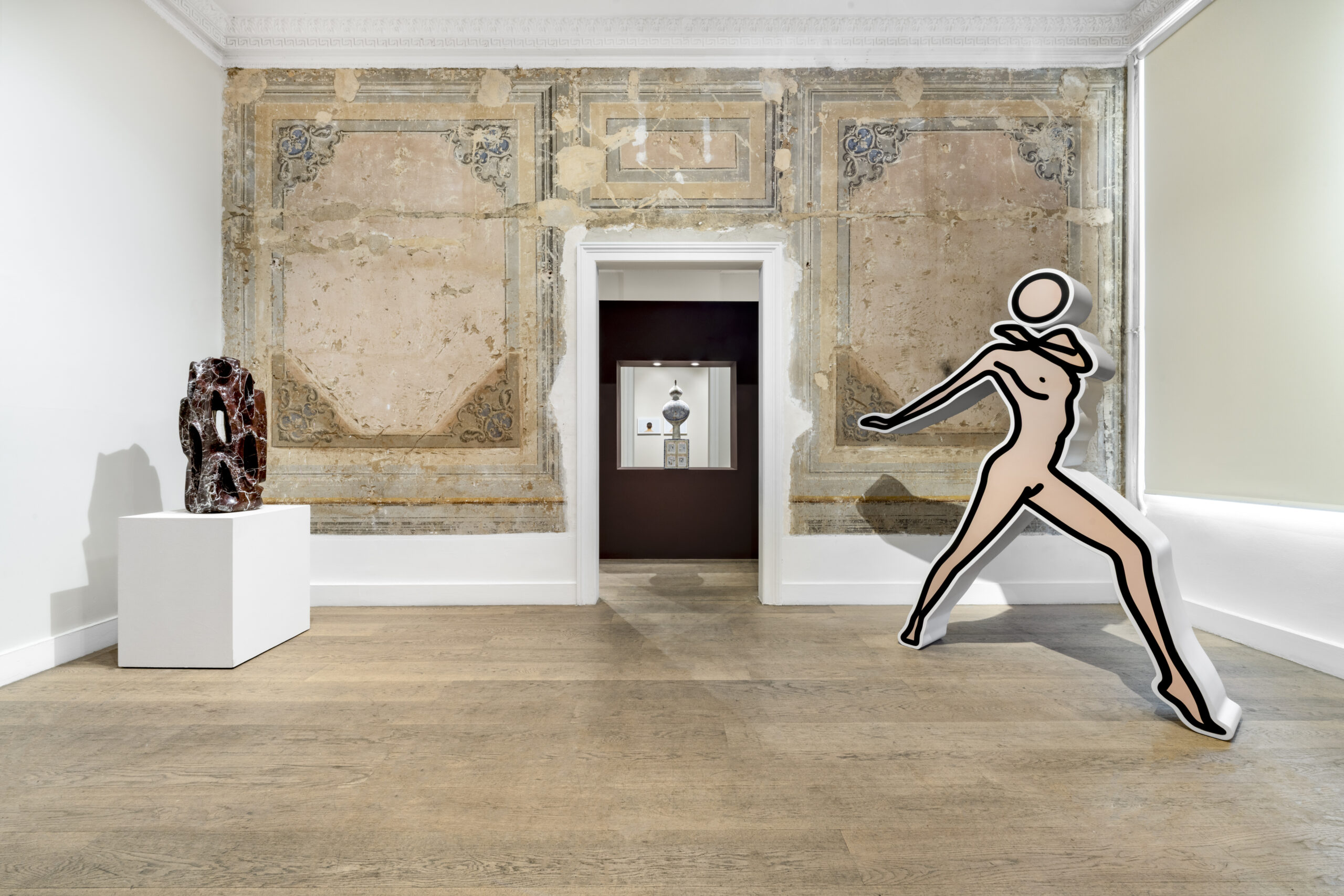
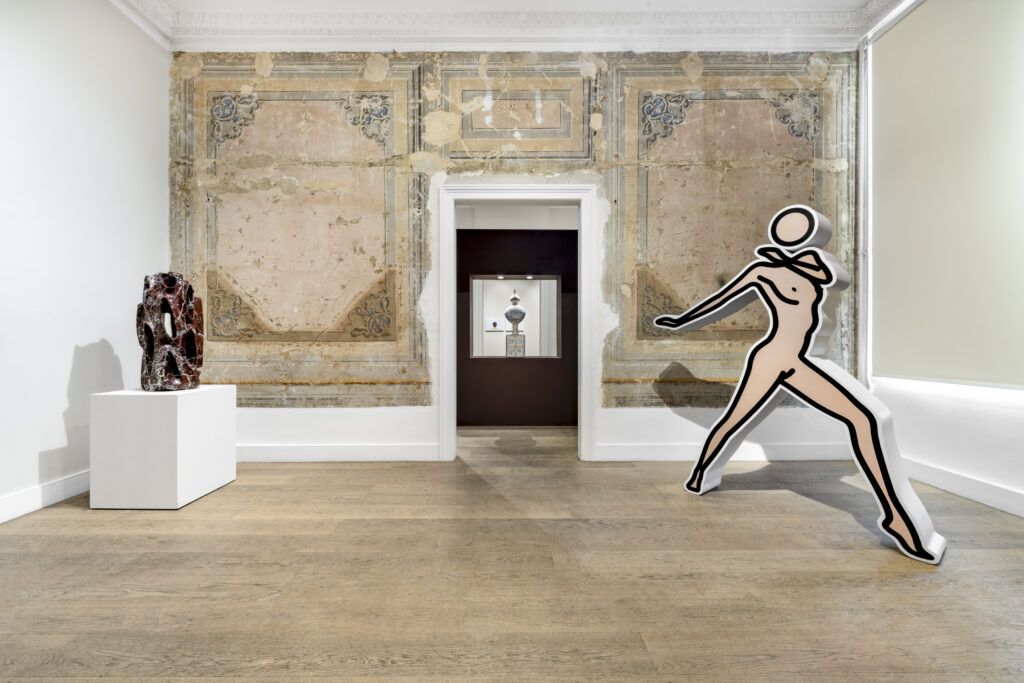
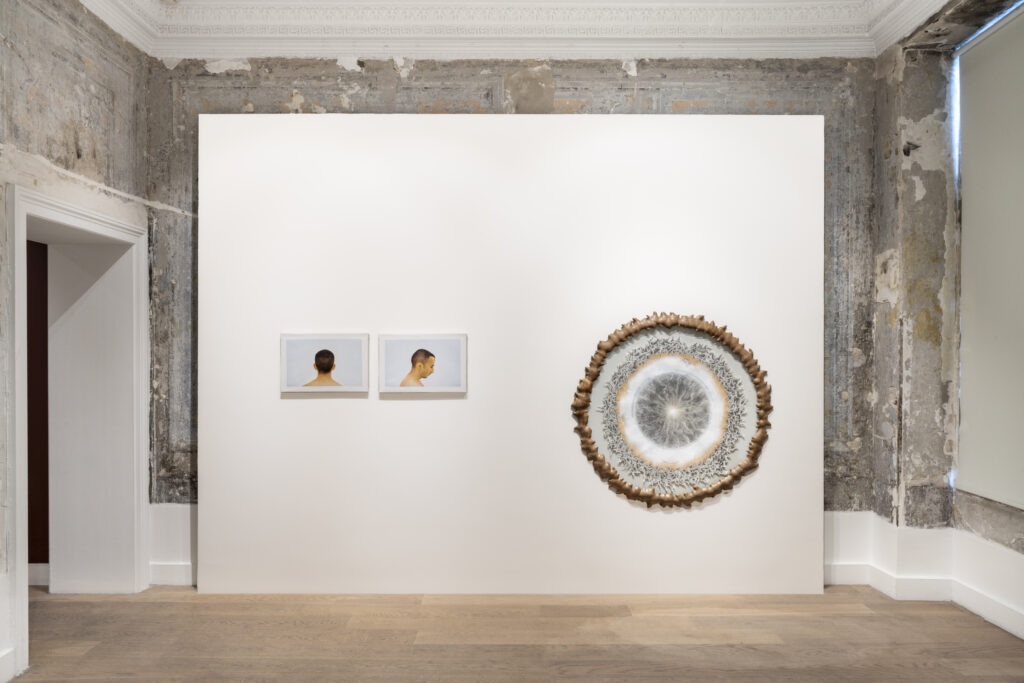
Büyüktaşcıyan is participating in a show staged another few floors down, in the Galerist gallery space, titled Labour of Love. Her contribution is “Meadow”: an installation made of architectural fragments that resemble petrified plants, with ceramic shards embedded in them. She picked the shards up in Kütahya, a town in western Anatolia famous for its painted tiles, where Armenian potters worked for centuries. The town’s roughly 4,000 Armenians escaped deportation in 1915, thanks to a governor who refused the order, but by 1931 only sixty-five remained, and their old neighborhood has been crumbling ever since. Büyüktaşcıyan found the shards in front of one of Kütahya’s ruined houses, where they lay piled in the street. “I have been collecting the tiles with plant patterns,” she tells me. “Plants always find this way of reappearing, trying to find existence in between all the rubbish.”
Labour of Love is one of several shows that make up Istanbul’s autumn programme, overlapping this year with Contemporary Istanbul, an art fair now in its twenty-first edition. The show opened the week before the fair, marking Galerist’s 25th anniversary and bringing together nearly fifty artists selected by the gallery’s director, Müge Çubukçu, and her team. The theme was the self-portrait, but the artists interpreted it so loosely that the show became a collective portrait of the gallery, and, in the histories some of the works carry, of the city around it.
Rather than a chronological archive, Çubukçu wanted what she calls a “living portrait” of Galerist, built “through the connections and affinities between the artists who have shaped its identity from the beginning.” The title came from an old interview with co-owner Melkan Gürsel; the show, she says, acknowledges “the many people who have contributed to Galerist over the years, often through work that goes unseen.”
Elif Uras took that brief literally. “My work often includes narratives of labor,” says the artist, who opened her first solo show at Galerist in 2004. “I immediately thought of making a collective portrait of the art gallery, capturing the teamwork, passion, inspiration, hard labor, and dedication involved in mounting exhibitions and everything else that artist representation entails.” Her contribution depicts the open office where the whole team works, and pays homage to the nineteenth-century building itself and its old Istanbul-style apartment interiors. “In the end, it became a self-portrait too,” she says, “reflecting the collaboration and ongoing, complex dance involved in sharing an artist’s work with an audience.”
Longevity is part of the subject: Uras has had solo shows at other international galleries since, “and it’s worth noting that none of those galleries are still around today.”
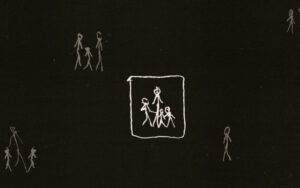
Because it mixes works from the gallery’s early years with new ones, the show also traces how the conditions for making art in Turkey have changed over the past twenty-five years. Particularly telling in this sense is the work of one of the pioneers of contemporary art in Turkey, İpek Duben, born in 1941. The work she is exhibiting in Labour of Love belongs to her series “Manuscript 1994,” which comprises an “artist’s book”: a box containing silkscreen photographs of self-nudes, and whose lids open outward on all four sides. The nude images, painted with layers of paint and molding paste, appear veiled. These “plates,” as Duben calls them, in reference to medieval and Islamic manuscripts, are hung at specific intervals, forming a text that creates a visual rhythm that the eye of the viewer can follow.
The installation also includes a poem, which borrows another historical form: the “ferman,” the sultan’s edict in Ottoman times, meant to be unrolled from ceiling to floor. “In this work I created my own commandments, and they’re sacred,” she says. “So there is this irony and this opposition with Islamic codes for women’s representation, which I reference in this work.”
When Duben first showed the work in 1994, Istanbul had just passed from the center-left Social Democratic Populist Party (SHP) to the Islamist Welfare Party, whose new mayor was a forty-year-old Recep Tayyip Erdoğan, and nobody yet knew what the new administration would allow on the level of artistic expression.
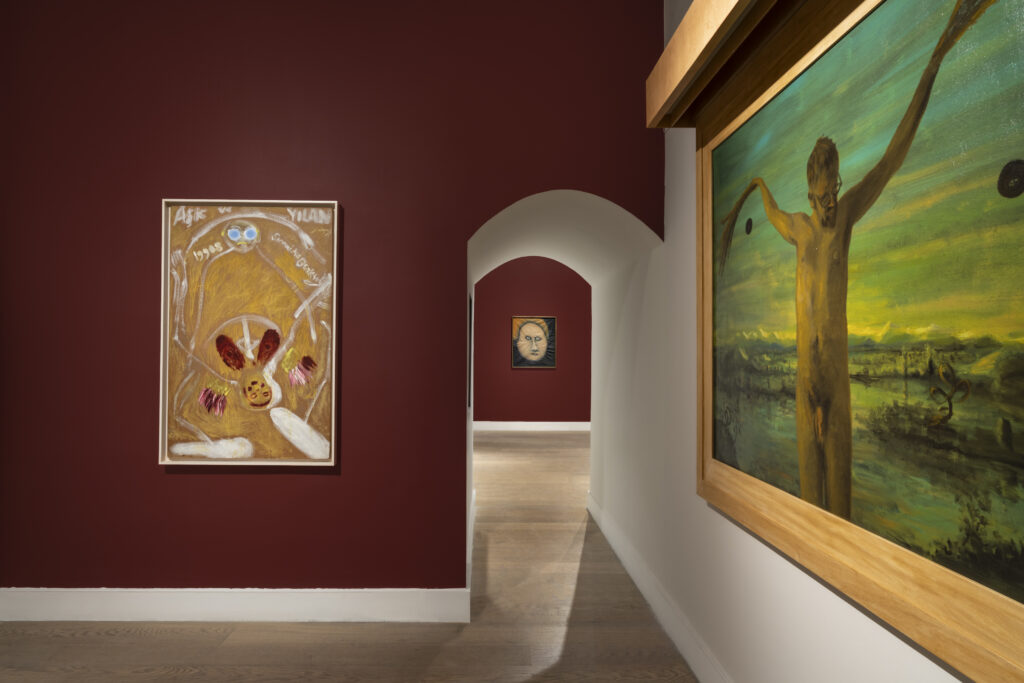
Duben was taken to the head of the cultural department and introduced, she remembers with amusement, as “a decent woman and a real artist.” Her work went up at Taksim Art Gallery, on the main road İstiklal Avenue, just off Taksim Square. “Hundreds of people came in, all kinds of people,” she says, and despite the nude image, “there was no negative reaction, really.”
I asked her if she could show that work today, and she said yes. Censorship, or self-censorship, is not really about nudity per se today in Turkey. The pressure falls instead on whatever strays from the official image of the nation and the family, above all on LGBTQ+ people. Istanbul Pride has been banned since 2015, and on September 13, days before the galleries opened their autumn shows, police raided LGBTQ+ and HIV support associations, bars, and activists’ homes in several cities, in an operation called “My Family is Safe,” carried out in the name of the government’s “Decade of Family and Population.”
Duben noted this would not be the case for another work, “They,” shown in 2015 at SALT Galata, which consisted of a video installation of twenty-five people talking about their identities and their experiences of discrimination: Armenians, Greeks, Jews, Kurds, Alevis, LGBTQi individuals, and women survivors of domestic violence. “That was a very courageous exhibition,” she says. “To get these people to talk to me about their stories took a lot of work, to build confidence. I couldn’t do that work today.” She says that this is not due to direct censorship, but because people like those she filmed wouldn’t feel comfortable sharing their stories so openly anymore, given the flattening of national narratives that represents the prevalent political discourse today in Turkey. Instead, Turkish authorities emphasize a single story of Turkish identity, built around the nation and the family; all other stories are viewed as risks. There is no need for an explicit ban of alternative narratives for this to work. People see what happens to those who step outside the official narrative, and they begin to censor themselves. This applies on both the individual and institutional level,
“They” closed on June 28, 2015, the day police broke up Istanbul Pride with water cannons for the first time. Weeks later, peace talks between the state and the Kurdish militant group PKK collapsed. That summer is widely seen as the end of a period of relative cultural openness within Turkey.
Nobody I met in the city used the word censorship; what they describe is more of a change in the weather, so to speak. Istanbul’s elected mayor, Ekrem İmamoğlu, President Erdoğan’s main rival, has been in prison since March 2025 and on trial since March of this year, alongside some 400 co-defendants, on corruption charges his supporters call politically-motivated. In this climate, the obstacle artists describe is less a list of forbidden subjects than the silent injunction to produce work that fits the state-endorsed single narrative of Turkish identity. This awareness, and resulting wariness, hovered over the exhibition program this autumn in Istanbul.
Çubukçu, who has been at Galerist for fifteen years, remembers the early 2010s, when “Istanbul was really a hype city,” and the city’s art scene was attracting a great deal of international attention. Looking back, she reflects on how much the art world has evolved. “Things are constantly shifting, and we have to adapt to these changes,” she says.
Indeed, since a 2017 referendum gave the presidency sweeping powers, the space for dissent has steadily narrowed. Elected Kurdish mayors have repeatedly been removed and replaced with government-appointed trustees, journalists are prosecuted under terrorism and disinformation laws, and provincial governors regularly cancel concerts by Kurdish musicians. Culture is not spared.
Landscapes of Erasure
In the process of rescuing and reviving narratives that risk erasure, artists are becoming increasingly subtle. One notable example is Landscapes of Erasure, on view until November 21 in an old tobacco warehouse in the neighborhood of Tophane, which houses the art and cultural space Depo. The show gathers seven artists working on the cultural, ecological, and social destruction produced by late-Ottoman modernization and centralization, and continued methodically by the Turkish Republic. (Founded in 1923, the Republic had a familiar program of singular national identity: for decades, Kurdish and other minority languages were restricted, thousands of villages had their Armenian, Greek, or Kurdish names replaced with Turkish ones, and non-Muslim communities saw their property confiscated.) The press text for Landscapes of Erasure notes that this is the first time these artists, the majority of whom live in the diaspora, have shared a space, despite “the increasingly repressive conditions of our present moment.”
It is closer to a séance, summoning people, places, and beliefs that have been made to disappear, and making their absence felt in the room.
Depo is run by Anadolu Kültür, a non-profit cultural institution based in Istanbul that uses arts and culture to foster social dialogue, mutual understanding, and democratic values. Its founder, the philanthropist Osman Kavala, has been in prison since 2017 and was sentenced in 2022 to aggravated life imprisonment over the 2013 Gezi Park protests; in August, the European Court of Human Rights ordered his immediate release.
The tone of Landscapes of Erasure however, is not meant to be controversial. It is closer to a séance, summoning people, places, and beliefs that have been made to disappear, and making their absence felt in the room.
One of the most striking works is “The Land of the Disappeared” by Zilan İmşik, a Kurdish artist born in Istanbul and trained in London, on the forced disappearances that followed the 1980 military coup: some 650,000 people were detained and hundreds died in custody; disappearances continued into the 1990s, mostly in the Kurdish-majority east. In İmşik’s installation, you walk behind a curtain and are immediately blinded by a pair of car headlights. Then a vintage white telephone rings; when you lift the receiver, there is only white noise on the line. As your eyes adjust to the glare, a haunted landscape slowly surfaces behind the headlights, like a watermark, on a white cloth hanging from the ceiling.
Elsewhere in the show, Istanbul-born artist Marina Papazyan’s two-channel video “The Blood of the Mosquito” creates a dystopia, turning Anopheles superpictus, one of the main malaria vectors of West Asia and the Mediterranean, into a monster hunting German officers in 1910s Cilicia. In the film, the mosquito represents both the instrument of imperial exploitation and the revenge fantasy of the colonized.
The show also includes “After Anahit” by Turkish artist Ece Gökalp, who developed it with the writer Hiwazerê: photographs, some printed as cyanotypes or Polaroid emulsion lifts, are set alongside archival material and short poetic texts. Together they track the erasure of a landscape in northeastern Turkey: Dipsiz Göl, a 12,000-year-old glacial lake in Gümüşhane province, drained in 2019 by treasure hunters with official permission; the goddess Anahit, whose bronze head was dug up in the same province in 1872 and now sits in the British Museum labeled as Aphrodite; and the Armenians, for whom she remains a symbol of a lost heritage.
A symbolic retelling
Another show digs further into the city’s past, quite literally, reading the present through archetypes and symbols rather than current events. It is held in the Byzantine cistern beneath the Zeyrek Çinili Hamam, a 16th-century bathhouse designed by Mimar Sinan for Barbarossa, the admiral of the Ottoman fleet. Curator Anlam de Coster calls the cistern the “subconscious of the bathhouse,” and invites international artists to create site-specific works which engage the site “materially, mythologically, or symbolically.”
“Historically, the Hamam was a very important social place; a third space that allowed people to co-exist despite their cultural, ethnic, religious differences,” de Coster says. “A place where we can just be our bodies. I feel like we’ve lost that kind of space in today’s culture.”
This season’s guest is the Brazilian artist Alex Červený, whose “Atlas of Encounters” is on view until January 31, 2027. “Červený first came to Istanbul in 2009, kept a hammam towel and found, in a second-hand bookshop, loose pages from anonymous Ottoman astronomical treatises,” explains the curator. “He drew on them for years without showing them. He does not read the script and treats it as a visual sign, adding hands that point at a passage, as in medieval manuscripts, and a small man carrying a flame.”
The artist also drew human figures on new towels, embroidered by a women’s association, and painted Bosphorus scenes in which, as de Coster puts it, you cannot tell whether there has been a flood, whether the figures in the water are calling for help or enjoying themselves.
The title of the show, “Atlas of Encounters,” comes from her long-standing suspicion of maps. “Historically, maps were used as a tool to dominate, to control,” she says, “but they also correspond to a very primal need to understand where we stand in this humongous universe. Maps have always been political, and maps never really represented the territory. Alex’s are not maps of control or domination. They are maps of encounters.”
The cyclical nature of crisis
Hidden in a street close to Galata Port, where the shops all sell pipes and electrical parts, the gallery Sanatorium showcases Austrian artist Christiane Peschek, whose exhibition “Phoenix Castle” changes every week for six weeks, as new paintings replace the old ones. To enter the space, I left my shoes at the door and purified my hands with scented ash, a gesture the artist borrowed from rituals she learned during her residency in Japan.
The ground floor is dark, arranged like a fireplace where people can sit on the ground, while in a shallow pit, incense slowly burns the word “HUMAN” into the ash. Sound comes from stone-shaped speakers hanging from a spiky chain. It is built on the Schumann resonance, the electromagnetic frequency of the earth, too low to hear, transposed into a range you feel in the body.
Upstairs, four paintings face the cardinal directions; over the six weeks, the series follows a cycle of twenty-four earth conditions, among them sedimentation, compression, crystallization, rooting, erosion, smoke, ash, purification.
It doesn’t take a seismologist to see how in Istanbul, shaky footing is both a geological and a political condition.
“The series is meant to show this exhaustion that we are currently facing as humans,” she says. “Everyone is just so overloaded and tired of everything happening simultaneously.”
The word “HUMAN” burns down and is traced again every week, “like a phoenix that has to burn to arise anew.” Apocalyptic thinking, Peschek adds, returns in cycles of twenty to twenty-five years, and she prefers to read the apocalypse not as the end of it all, but simply as the end of a cycle. “Especially now, in these days where everything is so uncertain, with the global political situation.”
Peschek conceived the work during a three-month research trip in Japan, out of a fascination with earthquakes, and it closes a cycle of four installations on the elements; the water one was shown at Sanatorium a few years ago. She wanted to premiere it here. “There is a lot of similarity between Japan and Turkey, which both share this history of earthquakes,” she says hinting at the famous North Anatolian Fault, which runs beneath the Sea of Marmara, just off the Istanbul’s southern shore, and caused deadly earthquakes in 1999 and 2023. It doesn’t take a seismologist to see how in Istanbul, shaky footing is both a geological and a political condition. The shows in the city this autumn suggest an art scene that has somehow learned to adapt.
“The question I wanted to ask with my work,” notes Peschek, is “what does it mean to build a culture on unsolid ground?”