A new novel explores the hidden currents of power, loyalty, and class divides that aim to keep women's experiences invisible.
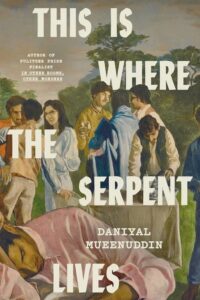
This is Where the Serpent Lives, by Daniyal Mueenuddin
Knopf 2026
ISBN 9780525655152

In the 1940s, when charged with obscenity, Pakistani writer Saadat Hasan Manto famously declared, “If you think my writing is dirty, it is because society is dirty.” This potent statement can be interpreted as art’s profound ability to reflect and expose the uncomfortable realities of its time, including the often-concealed “dirt” within patriarchal structures that marginalize women. When art dares to unveil these hidden truths, it compels a confrontation and challenges the systems and biases that aim to keep women’s experiences invisible.
Following this tradition, the revered Pakistani poet Faiz Ahmad Faiz penned the evocative line, “Bol, ke lab āzād haiñ tere”—Speak, for your lips are free. This was more than just a poetic utterance; it was a clarion call for artists to harness their creative liberty to make art that challenged norms. Inherently, this plea carries significant social responsibility, especially regarding female representation. Art that depicts female characters without internal lives, complex motivations, or significant agency implies that their experiences are less profound or important than those of men, thereby perpetuating rather than questioning the systems that exclude them.
In Daniyal Mueenuddin’s This is Where the Serpent Lives, hailed as “the greatest fiction written in English to come out of Pakistan,” a pervasive, ill-defined serpent winds through a landscape of interlinked novellas, yet the very fabric of its acclaimed storytelling, from character development to narrative plausibility and, most notably, its portrayal of women, raises critical questions about the nature of literary excellence and societal representation.
However, this review argues that despite Mueenuddin’s stated intentions of realism and Chekhovian depth, the novel falls short in its portrayal of believable characters, relies on improbable plot devices, and perpetuates a patriarchal narrative through its one-dimensional representation of women. While the book succeeds in crafting an atmospheric and geographically rich depiction of Pakistan, these narrative and representational inadequacies, particularly the novel’s failure to pass the Bechdel Test, undermine its claim to greatness and invite a broader discussion on the criteria by which contemporary literature, especially from male authors, is judged. The true “serpent” in this context might not only be the societal ills Mueenuddin describes but also the unexamined biases that allow such works to be lauded despite their critical flaws in character and representation.
The Allure of the Serpent
The title, This is Where the Serpent Lives, derived from Wallace Stevens’ poem “The Auroras of Autumn,” immediately suggests concealed malevolence.
This is where the serpent lives, the bodiless.
His head is air. Beneath his tip at night
Eyes open and fix on us in every sky.
In an interview, Mueenuddin said he intentionally left the title ambiguous, allowing for multiple interpretations of the serpent. As a symbolic entity, it might embody societal maladies such as corruption, villainy, thuggery, infidelity, or extortion. The text also probes whether the serpent is a singular force, like Pakistan’s feudal system, or a multifaceted evil manifesting through characters such as Nisa’s “tiny scarlet forked tongue,” Saqib’s cunning, or Hisham’s decadence. This deliberate obscurity serves as a central thematic element, encouraging readers to ponder the origins of the darkness portrayed.
Although marketed as a debut novel, Mueenuddin clarifies that the book is an “interlinked novella collection,” a format he views as “breaking form,” reflecting his high esteem for poetry, prose poetry, and short stories. This is his second book, following the acclaimed short-story collection In Other Rooms, Other Wonders, published 17 years earlier. The current work, penned over five years, is divided into four distinct parts. Each section functions as a novella, characterized by a tight structure, focused characters, and an economical use of words that conveys a specific atmosphere through detailed observations. The novellas are set across diverse Pakistani locales: Rawalpindi, South Punjab, and Lahore, featuring different protagonists and timelines. While this approach offers varied perspectives, it also dilutes the tension between stories.
Mueenuddin’s narratives are rooted in his personal experiences; his elite lifestyle, farming background, and the individuals he has encountered. In an interview with Varun Gauri, at Washington D.C.’s Politics and Prose, Mueenuddin said he always meticulously studied the people he interacted with, and based on these he created extensive “biographies” for both his major and minor characters to craft “fact-based and reality-based” stories.
Narrative Progression
The first story introduces Yazid, an abandoned young boy discovered in a Rawalpindi bazaar by a tea kiosk owner. Set in post-Partition Pakistan, this narrative follows Yazid’s friendships with boys who frequent the tea stall. They encourage him to read and write, and through them, he encounters his first love. His exposure to an upper-middle-class household through Zain steers his life in an unforeseen direction, eventually leading him to become a chauffeur for a wealthy businessman after an ill-fated attempt at smuggling in Kashmir.
Following Yazid’s narrative, the book shifts its focus to Rustom, an American-educated Pakistani residing in Dunyapur, a rural area of Punjab. Much like the author himself, Rustom is compelled to navigate pervasive corruption to reclaim his estate. He proves ill-equipped to handle the coarse humor and vulgarity of the local police or “thugs,” with whom his own employees are colluding. When these “goondas” escalate their activities to an “encounter,” no one is held responsible. Rustom then travels to Lahore, seeking assistance from his American-educated cousin Hisham and Hisham’s glamorous wife, Shahnaz. This couple exerts a significant, almost paternal, influence over Rustom and arranges his marriage to Nisa.
The third novella delves into the backstory of Hisham and Shahnaz, revealing the connection with Yazid. As Hisham’s chauffeur, Yazid is portrayed as a loyal employee and a silent observer, uttering fewer than ten lines in total. He dutifully drives, serves, and occasionally cracks a joke. After becoming invested in Yazid’s character in the initial story, the reader is left to question whether his reappearance is merely a connecting thread between the narratives, since he contributes little of substance to this part of the story.
The final section weaves together the four narratives and concludes by focusing on Saqib. Mentored by Yazid, Saqib rises through the ranks to manage a cucumber farm for Hisham, while Shahnaz is drawn to his charm, intelligence, and eagerness to please. He reciprocates their affection and financial protection in the only way he knows how.
Mueenuddin’s female characters are predominantly portrayed as stereotypes. They exist primarily in relation to the male protagonists.
In an interview, Mueenuddin admitted, “I am never not reading Chekhov.” His admiration for this author’s capacity to delve into the “soul of a character” is evident in his concise writing, emotionally resonant characters, and nuanced observations of Pakistan’s decaying feudal structures. However, although critics have dubbed him “the Pakistani Chekhov”—a comparison to Saadat Hasan Manto, renowned for his stark portrayals of post-Partition Pakistan’s struggles and their psychological toll—there is a notable divergence: Manto’s characters, though flawed, were profoundly human and evoked deep empathy from readers.
In contrast, Mueenuddin’s protagonists, particularly in the initial three stories, remain distant. Despite the rich descriptions of setting and atmosphere, the shifting, omniscient point of view throughout the narrative hinders a true connection with the characters’ internal struggles. For instance, Yazid’s emotions are frequently described rather than demonstrated, leading to a lesser understanding of his loneliness or motivations. When he sees Yasmin, his best friend’s sister for the first time, he is instantly attracted to her. Despite how he “thought of her often, dreamed of her … desperate, and happy, and shy, a tiny shivering piercing emotion inside him all the time,” we are never shown Yazid actually dreaming of her, and we therefore never experience the depths of his isolation.
Toni Morrison’s powerful assertion, “Don’t tell us what to believe, what to fear. Show us belief’s wide skirt and the stitch that unravels fear’s caul,” underscores this deficiency. Mueenuddin’s characters, while intriguing, lack the deep emotional resonance that enables readers to genuinely grasp their choices and experiences. Saqib, in the final novella, is arguably the most fully realized character. He is attractive, ambitious, and wily. The reader is shown his personality at home, on the farm, in love, and in business. As Saqib never once demonstrates any act of kindness, is rotten to the core, and has no friends, his ultimate downfall is predictable.
Authorial Perspective and the Bechdel Test
The reader consistently sees the world through Mueenuddin’s upper-middle-class perspective, which becomes more obvious when the author depicts characters from less privileged backgrounds. This occasionally manifests as an underlying disdain, such as highlighting the accents of native Urdu or Punjabi speakers when using English words, e.g., “dishturb’” for disturb or “bij ness” for business or “tan shun” for tension. This biased observation, likely the author’s own, leaves the reader with the impression that less-educated characters are judged more harshly just because of their imperfect English pronunciation.
Another significant critique of This is Where the Serpent Lives is its portrayal of female characters, which largely fails the Bechdel Test.
Rebecca Solnit and Virginia Woolf’s observations on the one-dimensional depiction of women in literature resonate here. In a Lit Hub Essay, Solnit noted: “I just think some books are instructions on why women are dirt or hardly exist at all except as accessories or are inherently evil and empty.” Much earlier, in A Room of One’s Own, Woolf wrote about the one-dimensional portrayal of women in contemporary fiction: “… It was strange to think that all the great women of fiction were … not only seen by the other sex, but seen only in relation to the other sex. And how small a part of a woman’s life is that …”
Mueenuddin’s female characters are predominantly portrayed as stereotypes. They exist primarily in relation to the male protagonists. They appear as archetypes such as the patient, sacrificing mother; the alluring young woman; the glamorous, ambitious, hardened upper-middle-class wife; the loyal, elderly servant; the clear-sighted, sophisticated potential wife; and the enduring, tolerant village wife. Depicted as such, women in the book hearken to Solnit’s words, as “inherently evil and empty” and seemingly content in their perpetual service to men as mere “accessories.”
In the initial story, several female characters emerge, primarily defined by their relationships with men. Among them are Zain’s sacrificing mother, the alluring Yasmin, and the “crone” maidservant Mai Viro. Zain’s mother, who remains unnamed and is the first female character to appear, twenty pages into the narrative, is depicted as caring and attentive to the boys, yet she never utters a single word. The reader never hears her voice. She is described as “small, with a very fair face, like a girl from the north, and a single dark mole above her lip, adoring toward Zain and … familiar with Yazid, calling him a ‘child.’” Her role is confined to serving food and urging them to eat more; “watching the boys after she brought each dish to see what they took, then retiring to the kitchen for refills.” The diligent maidservant, Mai Viro, characterized by “a bead of sweat perpetually on her upper lip,” rules the household from the kitchen. She is later given a voice, but only to express anger towards Yazid, portraying her as a formulaic “evil, mad, protective witchlike woman” loyal to her employers. Yasmin, Zain’s sister, primarily exists in Yazid’s imagination after his first sighting of her. She appears only to tend to men’s injuries, and the reader does not get to know her. Her ultimate fate remains largely obscure, leaving the reader with little reason to empathize with her.
In Mueenuddin’s book, female characters are consistently represented as having roles that revolve around men, whether by offering commentary, providing entertainment or food, or supporting them through opinions, distractions, or connections. While the author has described himself as an “incorrigible realist” who aims to present the “reality” and lived experiences of his characters and claims to have given “intense intentionality equally” to all, this focused attention appears not to extend to his female characters. Instead, they are typecast and lack humanity beyond their functions in men’s lives. When questioned in an interview about the book’s male-centric nature, the author responded that it was not the one to pick up if you wanted to read a happy book.
The portrayal of female characters in Mueenuddin’s work might arguably be seen by some readers as a true reflection of Pakistan’s patriarchal society. Nonetheless, it prompts a critical examination of what constitutes great fiction, particularly when it marginalizes the agency of women. Women in Pakistan, both within and outside their homes, have lives that extend beyond their relationships with men and their roles in fulfilling male needs. But in Mueenuddin’s book, there is a continual pattern of female characters serving and prioritizing male protagonists’ objectives. For instance, within minutes of their first meeting, Nisa offers Rustom “a wheel of brie … smeared a dab onto a cracker.” It prompts him to realize he “needed a useful marriage” to someone with connections. There are also illustrations of female characters encouraging other female characters to be compliant. To help his foreign fiancée adjust, Nisa tells Rustom she will “doll up Klara and take her around.” Even characters with some independence, such as Shahnaz, described as a “suave woman,” and Gazala, a teacher, ultimately exist to assist male characters, their narrative reduced to saving Saqib and his son.
While Mueenuddin claims his work is intended to reflect societal realities, his narrative choices perpetuate existing stereotypes. Overlooking women’s independent existence, even in the context of a patriarchal society such as Pakistan, limits the depth and impact of his storytelling. Great fiction should strive to explore the full spectrum of human experience, which includes the independent lives and motivations of female characters.
The potential for This is Where the Serpent Lives to receive literary accolades despite its identified shortcomings necessitates a critical examination of how contemporary literature, especially that by male authors, is evaluated and what values are implicitly endorsed. In this light, the pervasive biases that allow women to be overlooked in acclaimed works are the true “serpent.”