The writer of the International Booker Prize long-listed The Book of Disappearance returns with a surrealist dream-like novel that explores the reality-altering effects of everyday life as a Palestinian in Israel.

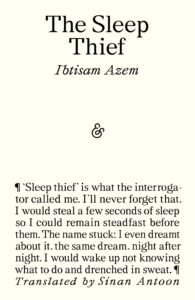
The Sleep Thief, by Ibtisam Azem, translated by Sinan Antoon
And Other Stories August 2026
ISBN 9781916751538
Throughout her career, Ibtisam Azem’s novels have pushed the boundaries of realism to expose the profound derangement of Israel’s settler colonialism in historic Palestine. Her work has explored themes of identity, power dynamics, estrangement, and erasure, using non-mimetic modes of writing like the speculative and absurd. In her new novel, The Sleep Thief (And Other Stories, 2026), estrangement traverses the political and psychological to alter the texture of reality itself, and the absurd becomes less an escape from reality than the form best equipped to survive it.
Though translated to English later, The Sleep Thief, Azem’s Arabic debut, was written before her International Booker Prize long-listed The Book of Disappearance. This order adds significance to the reading experience: Disappearance, a story of the overnight disappearance of Palestinians from the historic borders of Palestine, is a manifestation of the biggest anxiety expressed in Sleep Thief: existential erasure.
The Sleep Thief follows Gharib, a ‘48 Palestinian (“Forty-Eighter”) with an Israeli passport. As an “Israeli Arab,” Gharib is part of the Zionist nation but not quite, treated conditionally, routinely distrusted, and forced to navigate the mind-bending condition of living side-by-side with the people who displaced and killed his people. Born during the 1967 Six-Day War, a war the novel describes as “short and strange,” Gharib’s name is an allusion to his condition. Derived from the Arabic root غرب, which conveys the idea of something distant from familiarity, words derived from this root can mean strange or foreign. Growing up in West Jerusalem, Gharib is a man accustomed to having his reality questioned. A Palestinian citizen of Israel, he inhabits a world in which streets carry competing names, familiar landscapes conceal dark histories, and even the most mundane encounters can produce moments of vertiginous estrangement.
Then again there is a sense of freedom in being orphaned. There are no guardians.
He is, like other “Palestinians inside,” also isolated from the rest of the Arab world. His Israeli passport allows him freedom of movement outside of the region, it bars him from entering most Arab countries, while Ramallah is closed off to people like him by military order.
In the novel, Gharib reminisces on his uneasy childhood and adolescent years, the different formative encounters and lovers he meets along the way, and the burden of being Arab in Israel. He dabbles in resistance and pays the price with torture and imprisonment; he is nicknamed “Sleep Thief” by an interrogator for stealing brief moments of slumber in between interrogations.
Every interaction confronts Gharib with both the minor and major acts of colonial violence: the creation of the Zionist state, the treatment of Palestinians, and the daily racism and bigotry. Even mundane objects, like oranges and street names, become anxiety-inducing symbols of living on ethnically cleansed land. Everything is a reminder and a constant battle in Gharib’s head, a fight for survival:
I don’t like remembering street names, because each street has two: the one that is written, and the one warring with memory. Their names and ours. Even when one of ours and one of theirs are the same, the names still have a stolen taste.
When he moves to Tel Aviv from West Jerusalem, Gharib is haunted by the ruins on which the city is built. Azem’s imagery is visceral: Tel Aviv is violently personified as an animal devouring the Palestinian city of Jaffa. Rather than lengthy descriptions or context, she uses the accumulation of short, charged phrases, without the need for softening language:
The way it lives on Jaffa’s remains. It gobbled up Jaffa and left it to die. […] Because it had a history which it destroyed, claiming modernism and a zero-hour birth. There is no zero hour in this country. Every grain of sand has gallows.
Gharib grows up with the paranoia of being watched, with an eye following him everywhere and judging him. As an adult it turns into the eye of the state, which he experiences as a horror planted inside him, watching his every move and eavesdropping on his thoughts. State surveillance is omnipresent: Gharib lives with a fear that preys on him and eats him from within.
When treated without suspicion, Gharib is caught off guard. In one passage he goes through airport security with a foreign airline company and is surprised not to be searched and humiliated. He demands to be searched, is denied, and, in an absurd turn of events, decides to cancel his flight.
It was like my identity was a coat they had stripped off on a cold day.
Gharib briefly joins a clandestine resistance cell, only to be arrested years later and imprisoned. The consequences are catastrophic: he experiences the violence of Israeli interrogation and imprisonment, and paired with the everyday psychological warfare of being othered on his own land, he teeters on the edge of sanity in a series of hallucinations, mental breakdowns, and recurring dreams.
He is not unlike Saeed the Pessoptimist, the protagonist of Emile Habibi’s 1974 post-realist satirical novel. In The Pessoptimist, Saeed is a Palestinian who lives through the Nakba, the establishment of the state of Israel, and the disappointment of the 1967 Naksa. He recounts his life in the new state as an informant for Israeli intelligence, but despite his cooperation is sent to prison several times and beaten up. Habibi’s message is clear: a Palestinian in Israel is a second-class citizen, perpetually mistrusted and othered.
Habibi was among the key literary chroniclers of the Forty-Eighters when the state of Israel was still in its foundational years, a time of existential instability for Palestinians. In Sleep Thief, Azem advances this portrayal, showing the absurdity of Palestinian life “inside” in a rapidly developing Israeli society. The concerns are different but the aesthetics are similar: characters subjected to psychological and physical violence losing grip on reality.
This sense of instability is reflected in the narrative style: the novel opens in the first person, from the perspective of Gharib, followed by a short chapter narrated by an omniscient narrator introducing the reader to Gharib and framing the story. The narration then returns to Gharib for the bulk of the story. The omniscient narrator has an ambivalent attitude towards Gharib; he doesn’t quite trust the veracity of Gharib’s story and openly admits to tampering with the final rendition of his words. He tells the reader:
I will not deny that I have used my authority as a narrator and interfered, here and there, in those matters that Gharib did not wish to, or could not, describe.
While Gharib insists on telling his story the way he remembers it, we have a patronising narrator who, while pointing out that “Gharib doesn’t like others to speak for him,” goes ahead and controls the narrative, evoking the desire to censor the Palestinian. This does more than just signal the presence of an unreliable narrator: it stages tension over who gets to tell Gharib’s story, and removes the reader’s direct access to an authentic narrative, effectively reenacting Gharib’s estrangement. Azem is careful to show this intrusion only once at the beginning of the story, to create just enough narrative instability.
There is also an omniscient narrator in The Pessoptimist, who similarly warns the reader against the truthfulness of Saeed’s story, written in the form of letters from a mental asylum.
Like Habibi, Azem embraces surrealism in The Sleep Thief. Gharib’s perception of reality falters when he is confronted with the Zionist project’s epistemic violence. In one defining passage, he visits an Israeli friend’s house for a party and his mind races in agony; he can only think of the original Palestinian owners of the house who were ethnically cleansed from the neighborhood. He has a vision of an Arab-looking woman weeding mint in the garden and he spirals into a mental breakdown:
I called to her. She didn’t turn round and I didn’t know if she heard me. She was weeding hurriedly. I reached down to tap her shoulder but couldn’t touch anything. I tried again, like I wanted to grab her body, but my nails scratched the palm of my own hand instead. I couldn’t believe what was happening. I grabbed her shoulder more forcefully, but my fingers slipped through her and again scored my palm. Yet I could still see her there, weeding. I kept trying. I thought I heard a voice singing, but it vanished.
The surrealism is controlled, the episodes grotesque, but the choice of words is meticulous. Azem’s style, compressed and controlled, is masterfully preserved by the translator Sinan Antoon, who maintains the stylistic features of the original Arabic: the short sentences, repetitions, and lyrical tone. There is little dialogue, and interiority makes up the majority of the text.
Every grain of bulgur felt like a shard of glass in my stomach. I rushed to the bathroom and washed my face with cold water. I was afraid if I opened my mouth I would spit out my own blood. I closed my eyes and drank some water, then left. Everyone was jovial. The place itself was the angel of death clutching my neck, but he would neither take me with him nor let me go.
The result is a strong sense of suffocation and claustrophobia that closely matches Gharib’s inner world. The treatment of time adds to this instability: flashbacks interrupt the present and dreams rupture reality.
In another scene, the fear of erasure haunts Gharib in a recurring dream: he visits a museum exhibiting Palestinian culture and Palestinians on the brink of extinction. Palestinian tradition is morbidly displayed as a mother with lifeless eyes, baking taboon bread in front of a crowd. He recognizes the likeness of his mother, tries to scream and save her but his tongue is tied. He retrieves her body, performs ghusl, the corpse washing ritual, but he wakes up from the dream before he can bury her. He cannot save the mother(land), and hard as he tries, he cannot free it from limbo: with this museum, Palestine is forever elusive and in between life and death.
The final reality-bending incident in the novel involves dogs attacking Gharib in the streets of West Jerusalem. They jump him and chew his body, but there is no blood. His skin appears to be thick, like rubber. Confused, he questions his existence and humanity, before he is arrested for breaking the dogs’ teeth. He is taken to the police station, and his bloodlessness is taken as evidence of being the aggressor. The police ask to verify his identity, but as he tries to disguise his Palestinianness, his answers are nonsensical. This captures the essence of the contradiction of Gharib’s condition: the constant fear of being unmasked as a Palestinian and perceived as the Other, whilst navigating his existential fear of erasure of Palestinians from the land.
This exact contradiction lies at the heart of Bassem Khandaqji’s novel A Mask the Colour of the Sky, the winner of the 2024 International prize for Arabic Fiction and recently published in English by Europa Editions bo. The novel follows Nur, a Palestinian archaeologist who assumes an Israeli identity to join an excavation, only to find the disguise fracturing his sense of self as he confronts the violence and contradictions of Zionism.
Both Azem and Khandaqji write the psychological consequences of living under Israeli rule, but in different ways. While both their characters experience something akin to nervous breakdowns and hallucinations, Azem writes Gharib’s condition as an absurd manifestation of his fear of erasure and ethnic cleansing, whereas Khandaqji’s Nur is plagued with a more traditionally postcolonial split identity, like the illustrious Mustafa Said in Season of Migration to the North and Antoinette Cosway in Wide Sargasso Sea.
Realism has historically been an essential part of post-Nakba literature as a way to record Palestinian stories and preserve memory. But for many modern writers, the confines of realism, with its linear time and space, have become insufficient to contain and convey the “madness” of the present. Another recent publication is Sara Abou Ghazal’s Dreams of Ayn Ara (The Feminist Press, 2026), a story about a Palestinian patriarch assassinated during the Nakba who visits his children and grandchildren in their dreams to remind them not to forget who they are and what happened to them. Like many postcolonial writers before them, Palestinians have turned towards the magical, speculative, and absurd.
In one of the final passages of Sleep Thief, Gharib exclaims: “Ghosts! We are ghosts who only exist in our own imaginations.” This feels like a prescient echo of the Palestinian ghosts haunting Israelis in The Book of Disappearance. Indeed, despite the different styles and modes, Azem’s two novels form a compelling hypothesis: Palestinian alienation can only be adequately rendered by bending the boundaries of reality itself.